Showing posts with label 1940s. Show all posts

Thursday, December 23, 2021

Miracle on 34th Street


Miracle on 34th Street (1947)

Dir. and written by George Seaton, Story by Valentine Davies

Starring Maureen O'Hara, John Payne, Edmund Gwenn, Natalie Wood


Is it possible to be both a universally acknowledge classic and still misunderstood and underrated? I submit to you that MIRACLE ON 34TH ST (the 1947 version, obviously) is exactly that. You’ve probably seen it. Along with the 1951 Alastair Sim SCROOGE and IT’S A WONDERFUL LIFE, (and maybe throw in the actually-not-very-Christmas-heavy WHITE CHRISTMAS) it’s one of the few movies from the first half of the Twentieth Century which is still required Holiday viewing for many people, myself certainly included. And of course, it’s easy to see why: it’s a delight through and through, charming, whimsical, and, it must be said, exceptionally funny. Not just in the polite, slightly patronizing way we often talk about classic old comedies, where you acknowledge that I’m sure it was very funny back then; no, to this very day, even after watching it dozens of times over the years, I still frequently laugh out loud.

But even so, I suspect that it seems so effortlessly charming that most folks just take it for granted that it’s simple. When I mentioned to a hip cinema pal that this was my favorite Christmas movie, he kind of rolled his eyes at me. When I protested, he was dismissive: ‘Oh, they think Santa Claus is crazy, it’s like they’re putting Christmas on trial!’ he jibed, insisting the movie is a thin parable about the importance of belief, with all the religious implications for the nominally Christian holiday that accompany such a reading. That is, in fact, exactly where the horrendously ill-conceived 1994 John-Hughes-produced remake goes with the material, ending (SPOILERS for the 1994 version) with a Judge, apparently in a fit of religious ecstasy, suddenly declaring that because a dollar bill has the words "in God we trust" on the back, Jesus is real, and therefore the old man in his courtroom over an assault charge is legally Santa Claus, case dismissed.


As a confirmed non-believer, this isn’t the kind of moral message I’m likely to find especially appealing, and my friend found it very amusing that I’d swallowed this old-fashioned conservative hokum. But I maintain that he is quite wrong, at least in the case of the 1947 version (hereafter, “the good version”). While the topic of belief is definitely in the air, I would suggest that the end result is anything but a simple argument for blind faith. It has, in fact, a remarkably secular outlook, especially for 1947 – but even more so, it has a surprisingly unsentimental, sharp-eyed view of the world. Its genius is to somehow entwine a sardonic perspective on human smallness with a subtly bemused appreciation for our fallible, perhaps even hubristic inclination to imagine that we’re capable of better – and to take both perspectives seriously.

The thing that really makes MIRACLE ON 34TH STREET special is that it is, in a lot of ways, a legitimately cynical movie. It sets itself up as fiercely modern (by 1947 standards), plunging us immediately into the world of a hard-driving executive who is also a single mom (Maureen O'Hara, RIO GRANDE, known for her many on-screen pairings with John Wayne, which makes it odd that her co-star here is named John Payne. Ain’t life too funny sometimes?). In 1947, this was certainly an unusual, perhaps borderline scandalous, situation, especially for a Christmas movie. But the movie does not judge her for it; in fact, it is openly impressed by her tenacity. Sure, by the film’s end she will wind up safely in a heterosexual romantic relationship, with a restored nuclear family. But, crucially, she ends up there on her own terms. Not once does the movie suggest that her life or femininity is stunted by being a tough businesswoman and single mother. Her story has been one of triumph over adversity, and O’Hara is the absolute embodiment of a flinty force of nature, unwavering, indominable, always in control, always thoughtful about how she wants to arrange her life.* And not in a cheesy Hallmark Christmas Movie kind of way, although the standard plot about how the uptight businesswoman finding love with an easy-going small-town artisan would almost certainly not exist without her; no, she is happy, is fulfilled. She enjoys her job, she loves her daughter, she doesn’t need anything else, although right from the start she’s certainly open to the idea of romance, if one comes along that fits into her world. But she can be comfortable in looking for love because she’s confident that she can deal with anything that life could throw at her. The only challenge she has yet to overcome is the idea that life could be anything other than adversity to be beaten.


Which is, of course, the dramatic core of the movie. Friendly, eccentric Kris Kringle (Edmund Gwenn, THEM!, giving one of the most irresistibly charming screen performances of all time) waltzes into the lives of savvy, driven professionals –tough businesspeople, clever lawyers, canny politicians—and simply stands there, refusing to play their game, refusing to acknowledge that the world is a hard place where only the strong survive. Cheerfully --but resolutely-- refusing to admit that sanity is defined by your ability to beat the other guy. By his very existence, he challenges the defensive posture O’Hara and the rest of the modern world accept as basic common sense.

Of course, he is crazy. Harmless, certainly; likeable, certainly; but nevertheless utterly delusional. The movie loves Kris, but never seriously flirts with the idea that he might literally be a mystical figure. But his delusion allows him to do the one thing that no one else in the movie is immediately able to do: see the best in people. Not that it’s an easy thing to see! Indeed, the movie expects people to be myopic, self-interested hustlers most of the time. Likes them for it, even; respects the funny, sharp-eyed canniness of the conman. But it also believes firmly that deep down, just about everyone would like to do the right thing, would like to be warm and caring and generous. They've just resigned themselves to the fact that they don't live in a world where that's possible. And most still get on pretty well! People live practical lives, learn to enjoy the madcap rat race, and don't spend a lot of time moping about how the world is. The "Miracle" of the title is the way the jolly machinations of one kindly, delusional old man upend that world and get people to actually behave humanely to each other, in the most unexpected way possible: by playing on that very cynicism.


From the money-grubbing department stores that are stunned to discover that putting people before profit actually boosts their business, to the lazy postal workers who end up saving the day by pawning their inconvenient mail off on someone else, virtually every good deed done in the movie is done out of cynical self-interest. In fact, a great deal of the movie's considerable joy is about watching feisty lawyers and salesmen try to get one over on each other, so much so that the movie's abrupt pivot to a cat-and-mouse courtroom drama for the final act feels much more inevitable and smooth than it probably has any right to.

And yet, there's something deeper, too; the "miracle" is that, when these people are suddenly, unexpectedly offered a chance to do the right thing for purely selfish reasons, something else happens. Sure, they do it because it’s the smart move for them, the same thing they do every day. But this time, it also happens to be the right thing, and that surprises them, wakes something inside them, something that they'd mostly ignored or forgotten about. They're glad to do the right thing. It makes them feel good, gives them something they didn't know they were missing.

It's a small thing, really; there's no suggestion that it's going to change their lives forever and they're going to give away all their possessions and become enlightened. But there's something very near magical about the way the cast uniformly seems startled and giddy about finding good inside themselves they didn't expect. When business tycoon R. H. Macy (Hollywood bit player Harry Antrim) is forced to take the stand to improbably testify in support of the sanity of a man who believes himself to be Santa Claus, his first thought is for his own business: he suddenly imagines tomorrow's newspaper headlines trumpeting his abandonment of the old man. This obviously cannot be allowed to happen, and he stammers something noncommittal. But then, pushed by the cross-examining attorney, he's asked to directly answer if he believes "Mr. Kringle" is actually Santa Claus. This time, he doesn't think about himself, but thinks about the kids, and how happy his Santa made them. If this old man is crazy, he doesn’t want to be sane. Suddenly the imperative for self-preservation actually overlaps with doing something genuinely good. And then he answers with confidence: "I do." And he’s not just relieved, he’s elated. He remembers something about himself, a feeling he’d probably just written off long ago as unrealistic sentimentality. But there is it, overwhelming him, real as the nose on his face. It's a moment of serenity in a world which offers so few chances for such moments.


The movie is full of little moment like that, tiny, impossible victories for the human spirit. And for once, they cost nothing – they require no sacrifice, no hard choices. For once, good is just sitting there, waiting for you to take it. You don’t have to worry that the world is going punish you for showing your humanity, you can just give in and see how you like it. Most movie fantasies play on our desires for selfish things –what if I suddenly had power, or good looks, or wealth?—but this one offers a more unusual fantasy: what if I could just do the right thing? Wouldn’t that feel great? It’s not realistic; the movie knows –puts it right out there in the text, even—that you’re going to be faced with a million chances to be kind and compassionate, and you’re mostly going to have to just ignore those options and be practical and do the sensible thing and get on with your life. You can’t give away all your possessions, can’t just drop everything and help someone in need, can’t devote every moment of your life to saving the world. But maybe it’s valuable just to know it’s in you to want to. Life gives you so few chances to just indulge in that fantasy that you can forget, can think that you really are tough and hard and cynical deep down, rather than just pretending to be so you can get by. And of course, you do have to get by, and that’s OK. But MIRACLE ON 34th STREET is a gentle reminder that there’s something better in you, too, even if the world doesn’t give it a chance to fully emerge very often. You never really doubted it. It’s just your silly common sense.

It helps that the cast is without exception terrific, it helps that the script is unshakably lively and funny.** But if the movie is a miracle, it comes out of its unique blend of snarky cynicism and warm humanism, and its certainty in the value of giving people a chance to do the right thing, even if it's only for a moment. I don't know any other Christmas movie which manages to strike such a perfect balance between unsentimental satire and genuine good-heartedness, and maybe no other movie of any kind. No wonder it’s remained so beloved for three-quarters of a century, during which time a lot has changed and much culture has become difficult to relate to. People may not completely understand it, but they can certainly feel it. If it’s a testament to the power of belief, it’s a testament to a very particular belief, and one which I sincerely hope will never be completely extinguished, no matter how much countervailing evidence life piles on the scales: that the world may push us to be callus, but somewhere deep inside, we’d rather be kind. If the spirit is willing, even if the flesh is predictably weak, there is always hope.  


Merry Christmas.


* In particular, O’Hara’s ability to furiously turn away from someone who's angered her is powerful enough to melt steel, and I doubt any human could survive having it used on them. These are just special effects, kids, or poor John Payne would be splattered all over that wall.


** Even if pivoting to a courtroom drama and abandoning almost the entire cast in the last act is such an insane thing for any script to do that even one this savvy can't entirely avoid some turbulence, but whatever, it makes it work.

Monday, November 16, 2015

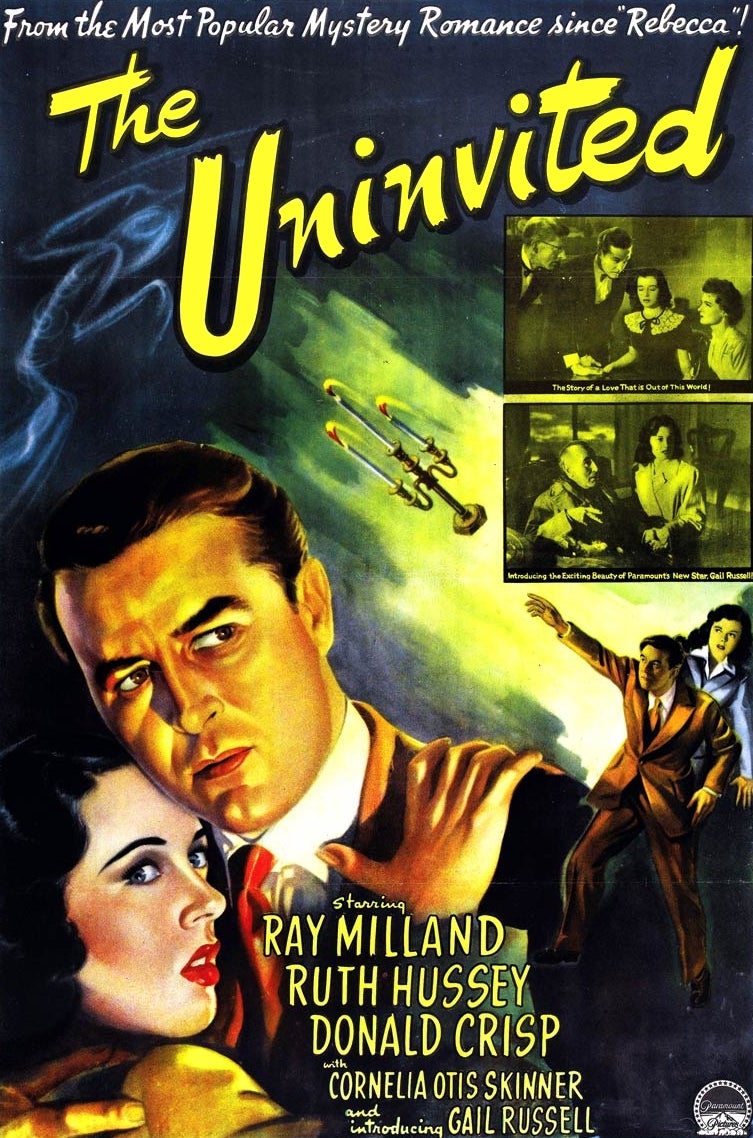
The Uninvited (1944)


The Uninvited (1944)
Dir. Lewis Allen
Written by Frank Partos, Dodie Smith
Starring Ray Milland, Gail Russell, Ruth Hussey, Donald Crisp, Cornelia Otis Skinner


An adult brother (Ray Milland, THE PYJAMA GIRL CASE, OUT OF THE PAST) and sister (Ruth Hussey, THE PHILADELPHIA STORY) decide to move into an old seaside mansion on the Cornish coast, only to find (immediately) that it’s haunted by the ghost of a former occupant, who may well be the mother of the brother’s wildly inappropriate naive teenage girlfriend (Gail Russell, OUR HEARTS WERE YOUNG AND GAY). Spooky stuff ensues, like the rooms get cold, there’s some disembodied crying, a seance. Sounds like pretty standard stuff, except that at the time it was something of a pioneer: it appears to be the first actual horror movie to center on a ghost.


Ghost were nothing new in fiction, of course. I mean, there are ghost stories in the Bible, in The Iliad, in Hamlet, in A Christmas Carol. You’d struggle to find a single folkloric tradition on earth that doesn’t offer at least some concept of the spirits of the dead returning to visit the living. These traditions were not explicitly tied to horror, but there are plenty of examples where they are; see, for example, Charles Dickens’ The Signalman from 1866, which clearly milks ghostly figures of the dead for creepy effect. But curiously, up to 1944, cinema had somewhat neglected this tradition. It’s not that it had never depicted ghost before -- Georges Méliès’ THE HAUNTED CASTLE from 1896, considered to be the first ever horror movie, depicts ghostly apparitions right in line with their cinematic depictions more than a century later. The tone, though, was anything but terrifying -- its intent is to provoke amazement and wonder more than horror. THE HAUNTED CASTLE would set the tone for the next half-century of films about the supernatural. The few early Hollywood films that concerned ghostly matters kept their tone light and comic. In fact, as near as I can tell, Hollywood largely avoided hauntings during the silent era. That changed in the late 30’s, but the films remained resolutely light comedies or fantasy-dramas. The earliest American* ghost film I could find was 1937’s comedy TOPPER (and its several sequels over the next few years), followed by the fantasy-drama BEYOND TOMORROW in 1940, and the Bob Hope comedy THE GHOST BREAKERS the same year. Plenty of ghosts, but no horror. Both Laurel & Hardy and Abbot & Costello would make ghost-themed comedies before THE UNINVITED finally came along in 1944.


Of course, the icons of ghostly mischief were all long established by the time director Lewis Allen (DESERT FURY, a movie experts have called “...the gayest movie ever produced in Hollywood's golden era,” which obviously I now desperately want to see) came along to this script by longtime studio worker bee Frank Partos (THE HOUSE ON TELEGRAPH HILL, THE SNAKE PIT) and novelist and playwright Dodie Smith (the original 101 Dalmatians novel [!?], and only one other film script).** But still, it seems to have been somewhat revolutionary to present them in this context, with a strong gothic atmosphere and a serious desire to unsettle. THE UNINVITED has moments of comedy --mostly the result of the witty dialogue-- but it’s clearly a horror movie at heart.


Not that this is exactly THE SHINING or anything. By modern standards, it’s a pretty conventional ghost story with some fairly mild stakes, which is notable more for its breezy charm than its bone-chilling terror. Milland and Hussey discover their house is haunted fairly quickly --mercifully sparing us the usual grind of time-wasting skepticism-- which mildly annoys them and slowly inspires them to pry into the house’s past. They’re surprisingly blasé about discovering that A) the afterlife exists and B) their new home is haunted by vengeful spirits, but gradually the irritation of being constantly awakened in the middle of the night, combined with the peculiar behavior of the adorable young neighbor who was born in the house, generate enough interest for them to casually make some inquiries.


It takes awhile for it to happen, but the film eventually structures itself as an amiable mystery, which moves along at the relaxed pace of its curious --but not especially obsessed-- main characters, pausing along the way for plenty of genial quips and even a little romance. In the final stretch, though, it manages to accrue some genuine momentum and tension, and builds to quite a respectable climax, heightened significantly by its elegantly evocative cinematography by Charles Lang (THE BIG HEAT, THE GHOST AND MRS. MUIR, THE MAGNIFICENT SEVEN). Lang had already won the Best Cinematography Oscar for A FAREWELL TO ARMS in 1932, was nominated again in 1940, 1941, and 1943, and was nominated for his work here as well. He would go on to be nominated thirteen more times before his retirement in the early 70s (his 18 total nominations put him in a dead heat with Leon Shamroy for the most ever nominations in his field). So it doesn’t just look gorgeous, it looks gorgeous in the kind of way which cements its basic iconography as part and parcel to the very notion of ghostly cinema. Some somewhat-dated but adequate special effects add a tangible edge to the haunting, but to the extent the movie is scary at all, it’s almost entirely a result of the quintessential ghost-story atmosphere conjured by Allen, Lang, and composer Victor Young (SHANE) who finds the right balance between wistful romanticism and creeping unease. Even by 1944, seeing the ghosts was a bit played out. They’re better off suggesting their presence with the gothic staples of dim rooms lit eerily by candles and accompanied by a soft, eerie moaning. Cliche? You bet, but seldom done with finer craftsmanship than we see here.


A smart, highly literate script guides our characters through the narrative with an assured confidence, gradually turning the tension up with the imperceptible patience of  a safecracker. But it does eventually come, particularly with the late introduction of Cornelia Otis Skinner’s (THE SWIMMER, 1968) psychotic mad house matron, who has a rather unhealthy attachment to the former occupant of the house (to the extent of adding a not-so-subtle lesbian subtext).*** The mystery itself isn’t exactly PRIMER or anything, but it’s subtly unique, eloquently constructed, and rather satisfying. And the ending isn’t anyone’s idea of action-packed, even in 1944 (the big finale finds Ray Milland giving the ghost a stern talking-to) but combined with the breezy charm of the cast, the rapturous cinematography, and the perfect air of spooky elegance, you can see how this has remained such a staple. In fact, if anything, the movie is guilty of too presciently anticipating the haunted house genre; although this concept would be revisited many, many times in the subsequent years, very few films indeed managed to add anything to the formula established here. A lot of tropes here have been imitated to the point of meaninglessness over these last seventy years, deluding its potency somewhat to modern eyes. Even if its then-pioneering tropes seem a little shopworn by today’s standards, though, there’s a mastery of craft on display here --and an earnest desire to entertain without pandering-- which remain as impressive and engrossing as they ever were. Not all boundary-pushing films can remain on the cutting edge, but the best among them have more important attributes anyway.


*There are a few scattered English and Swedish examples from earlier


**itself based --fairly closely from the look of it, both in narrative and in tone-- on the awkwardly-named novel Uneasy Freehold by Irish author Dorothy MacCardle.

*** Fun fact: young Gail Russell, who stars with Skinner here, would actually portray her in the film version of her memoirs OUR HEARTS WERE YOUNG AND GAY this same year.


CHAINSAWNUKAH 2015 CHECKLIST!
Play it Again, Samhain


  • TAGLINE: A Story of a Love Which is Out of this World! is my preferred tagline, but it looks like the more common one is: From the Most Popular Mystery Romance since "Rebecca"! That one is worth noting despite its lack of verbal poetry because it really suggests that the studio didn't know to sell this concept as a horror movie. Paramount didn't have the same success that Universal was still enjoying with its monster movies, and seemed to struggle to explain what the deal with this newfangled haunted house movie was, electing to present it as a mystery rather than a straight horror movie.
  • LITERARY ADAPTATION: Yes, of Dorothy MacCardle's Uneasy Freehold.
  • SEQUEL: Though not an official sequel, it was followed the following year by THE UNSEEN, also directed by Allen and starring Gail Russell. Unlike THE UNINVITED, the UNSEEN is a regular noir mystery and contains no supernatural element, and despite a screenplay by Raymond Chandler was not a success.
  • REMAKE: There's 2009 film called THE UNINVITED, but inexplicably it's a remake of the 2003 South Korean masterpiece A TALE OF TWO SISTERS, not this one. Though it's been ripped off by about a million other movies, there's no explicit remake. I do like that POLTERGEIST includes a reference to it via a line about the scent of Mimosa (which accompanies the ghost in UNINVITED).
  • DEADLY IMPORT FROM: USA
  • FOUND-FOOTAGE CLUSTERFUCK: No
  • SLUMMING A-LISTER: Milland for sure, probably Cornelia Otis Skinner as well. Donald Crisp, as the former owner of the house, had won the Oscar for Best Supporting Actor two years prior, so we'll count him too.
  • BELOVED HORROR ICON: None
  • BOOBIES: None
  • MULLETS: None
  • SEXUAL ASSAULT: No
  • DISMEMBERMENT PLAN: None
  • HAUNTED HOUSE: Yes!
  • MONSTER: No
  • THE UNDEAD: G...G....G....Ghost!
  • POSSESSION: Yes, this is one of those possession-y ghosts.
  • SLASHER/GIALLO: No.
  • PSYCHO KILLERS (Non-slasher variety): No
  • EVIL CULT: No.
  • (UNCANNY) VALLEY OF THE DOLLS: None
  • EGYPTO-CRYPTO: No
  • TRANSMOGRIFICATION: No
  • VOYEURISM: Nah
  • OBSCURITY LEVEL: Fairly low, major production and now a classic.
  • MORAL OF THE STORY: If the person selling you an apparently desirable property at an incredibly low price is acting shifty and evasive, maybe take note of that, because there's probably a ghost. Of course, you can just sleep with earplugs and a think blanket and that'll pretty much take care of the problem.
  • TITLE ACCURACY: I dunno, it's a little weird since there's not much inviting involved; I guess you could say that either the ghosts or the new living occupants are uninvited by each other, but it's kinda a stretch.
ALEX MADE IT THROUGH AWAKE: N/A.

Though Milland is the only male lead, this one only qualifies because of some late-film scenes between Gail Russell and Cornelia Otis Skinner

Wednesday, May 6, 2015

Burke and Hare-athon Part II: The Greed of William Hart


The Greed of William Hart a.k.a. Horror Maniacs (1948)
Dir. Oswald Mitchell
Written by John Gilling
Starring Tod Slaughter, Henry Oscar, Arnold Bell, Aubrey Woods


The first of our cinematic adaptations of the Burke and Hare saga comes to us from 1948, a mere three years after the end of World War II. Though it was the first version to hit cinemas, it was not the first dramatization of the events; in 1931, Scottish playwright James Bridie had written a play on the subject that had been adapted for TV in 1939. But I couldn’t find a copy of that, and in fact think it likely lost (as are most of the older BBC programs, which were frequently not archived even at the time), so this remains the oldest screen version I am aware of. It certainly was not necessary to re-introduce the story to the British public, who already knew it quite well, but the film introduced the story to the cinema, and, as such, what would come to be a cinematic love affair still going strong half a century later.


This is definitely the darkest version of the story. Not in a thematic sense, but in terms of actual lighting. The whole movie appears to have been shot with a single light source, possibly a flashlight, which is beaming straight out from directly above the camera. The result is that the film has a dim halo of light in the exact center of the screen, and everything outside that light is pitched at varying levels of total blackness. I’m not sure if this was an artistic decision or if the production was paying by foot-candle or what, but it makes everything a little hard to make out. That’s OK, though, because there’s not a whole lot to see; director Oswald Mitchell and cinematographer S.D. Onions (can that possibly be a real name?!) aren’t looking to make a film of great visual splendor (in fact, the cramped sets and blocky staging make the film look much older than it actually is). Instead, they’re interested in crafting a tight little crime story, featuring early British horror star Tod Slaughter in the Hare role.


Slaughter is an actor I wasn’t familiar with before this movie, but apparently he was a pretty big deal at the time. He’s a big guy with bright eyes, an easy charisma and a pleasing inclination to go broad with his performance as the more nefarious of the two killers. I can see why he was a great choice for playing maniacs (horror maniacs?) in early screen melodramas and thrillers; despite his hangdog mug and soft-spoken shiftiness, he totally dominates every scene he’s in with an effortless theatricality that recalls Vincent Price. I guess his career declined into obscurity in the years after this movie, but I’d say he’s the genuine article, well due for a rediscovery (hopefully I’ll get a chance to check out of a few more of his films next Chainsawnukah). Besides, his name is Tod Slaughter. That’s already the most metal name ever even before you consider that “Tod” is German for “Death.” So Slaughter is cool in my book, and he’s nicely complemented by Henry Oscar (later in Hammer’s BRIDES OF DRACULA) who looks like Colm Meaney dressed like a leprechaun and serves as a good sidekick in the Burke role.


I say “Burke role” because these two ghouls aren’t actually Burke and Hare. Oh, they act like them, all right, and they have the same story, and indeed, frequently you can see the actors mouthing the words “Burke” and “Hare.” But these are definitely not them, their names are Hart and Moore, they say them aloud several times. Or at least, they started to after the British Board of Film Censors insisted that all references to the real-life killers be removed, resulting in a last-minute re-titling and re-dubbing. Intriguingly, the victims’ names have not been changed; you still have the “big three,” Mary Paterson, Daft Jamie and (an unseen) Mary Docherty appearing with their real names. IMDB claims that the added expense of re-dubbing the film left no money for music; I don’t know if that’s true or not, but it is true that there’s no music throughout most of the runtime.


Despite its trailblazing status, the script, by future Hammer writer/director John Gilling (THE REPTILE, PLAGUE OF THE ZOMBIES), is pretty strong, and in fact a good deal more focused than most of the later attempts would be. Gilling frames the story as essentially a crime/suspense narrative; the killers are known to us from the start, and it’s simply a question of whether our (handsome? it’s hard to tell because it’s so dark) generic medical school student (hereafter HGMS) (Patrick Addison, no other film credits) will be able to prove their guilt before it’s too late. Subsequent cinematic tellings of this tale would get bogged down in multiple unrelated characters and subplots, but the pleasing straightforwardness of this scenario --two killers pursued by suspicious HGMS-- serves to draw drama and meaning out of the basic facts in a way which sadly has yet to be repeated. The trope of having a generic handsome med student character would plague subsequent adaptations, but Gilling clearly crafts the most tolerable version of this character; he’s introduced early on and set up as an antagonist for the two killers almost immediately, giving him way more reason to exist than any other version. Ironically, the one detail of this character nearly every other version includes -- that the student recognizes the body of Mary Paterson -- does not figure into this one (maybe it was too early to include a detail this tawdry).


Aside from its unusually focused screenplay, two other factors distinguish this story. First, it contains what is certainly the most negative portrayal of Dr. Knox (“Dr. Cox” here, thanks Censors, for protecting the kids). Nearly every other version presents him as a ambiguous, conflicted character, but this one shows him as a calculating and complicit co-conspirator, perfectly aware of what the two killers are up to and actively working to hinder any investigation into their misdeeds. He even gets an earful about it from our HGMS, though his ultimate fate is left unknown. The other odd wrinkle here is the film’s unusual focus on Daft Jamie. Here played by rising star Aubrey Woods (in only his second role, though he would go on to a long career on stage and screen, most notably as the candy shop owner who sings “The Candy Man” in WILLY WONKA & THE CHOCOLATE FACTORY), Jamie gets a ton of screen time and boy, does he just say the darndest things, like, all the time. He’s all over this thing and he has most of the best lines, so the prospect of his death is actually enough to introduce a little real suspense. Gilling obviously sees the dark humor in all this grim absurdity, and through Jamie's deceptively innocent quips, he pulls a thread of black comedy into the mix, a trend which found its way into a few subsequent adaptations as well. But Gilling was there first, and he did it more elegantly than those that followed.

THE GREED OF WILLIAM HART isn’t exactly a lost classic or anything -- much of the staging is ugly and awkward, and even with a slim runtime (the version I saw is only a hair over an hour, though supposedly a 79 minute version exists) it’s fatty and given to voluble excess, with way too much exposition for such a simple story. But in the ignoble history of Burke and Hare films its relatively streamlined narrative and handful of ingratiating performances make it easily among the better ones. This one at least seems to know what it was trying to do, even if it doesn’t necessarily do it all that well. Recommended for any filmgoer who likes stagey old films about murder that look like they were shot with the flashlight from Doom 3.

OUR STORY SO FAR:

2010: Burke and Hare


Burke and Hare-athon Checklist!


  • Title: THE GREED OF WILLIAM HART, aka HORROR MANIACS!
  • Genre: Crime/Black Comedy
  • Story regulars: Burke, Hare and Knox all go by thin pseudonyms, but they’re immidiately recognizable. Paterson, Daft Jamie, and Mary Docherty are all here as well, as is our beloved HGMS.
  • Attitude towards Dr. Knox: Negative. Movie clearly paints him as a unambiguous villain.
  • Wonky eye or no? Yes, although it’s subtle. Or maybe it’s not, maybe it’s just hard to see because everything’s so dark.
  • Scottish accents? Fairly strong, a number of people even use Scottish words like “kin” meaning “know”
  • Irish accents? Burke has a strong Irish accent and looks like a leprechaun. Hare, for some reason, does not, although he mentions being Irish.
  • Heaving cleavage? None. Or, again, maybe it's just too dark to see.
  • Rockin’ theme music? Almost no music.


Wednesday, November 12, 2014

The Devil Commands


The Devil Commands (1941)
Dir Edward Dmytryk
Written by Robert Hardy Andrews, Milton Gunzburg based on a story by William Sloane
Starring Boris Karloff, Richard Fiske, Anne Revere, Ralph Penny


What we got here is a simple, elegant mad scientists tale with Karloff as a guy whose hope that he can somehow bring his wife back from the dead gradually turns him into a madman. Unlike a lot of mad scientists from this era, Karloff’s Julian Blair is actually a real nice guy, not an egomaniacal monster or a cold, amoral egghead. He genuinely loved his wife and is really destroyed by losing her, and understandably instantly obsessed when he gets even a faint bit of evidence that he may still be able to communicate with her somehow. Alas, just like poor Frankenstein, his colleagues inexplicably don’t approve of his work or seem to care at all that he genuinely seems to have stumbled upon a possible method for communicating with the dead. Seems like that would be the kind of thing other scientists would be interested in, but I guess not. So he has to take his enterprise underground, where things turn a little shadier when a self-serving phony medium (Academy-award-winner Anne Revere, GENTLEMEN’S AGREEMENT) decides to become his partner.


The feel is maybe macabre more than outright horrifying, since Karloff remains fundamentally a nice guy who is just blinded by his desire to see his wife again. Revere is a much better antagonist in the Lady Macbeth role, egging him on and pushing him to darker places. But she’s kind of underdeveloped, and despite a great performance the character doesn’t really go anywhere. That kind of defines the problem with the movie: it’s technically quite well-made, and boasts a few strikingly designed images, but it isn’t structured very well. Karloff is off the deep end pretty quickly, and there aren’t really any other major characters so there isn’t much conflict or anything which could really be called an arc. The second half of the movie is mostly about Karloff trying to avoid detection from (rightfully) suspicious locals, which creates some tension I suppose, but not really enough of a story to hang the whole narrative on.

This is all very scientific, look, they got lightbulbs and everything.

That having been said, everything else about this movie is pretty nifty. It boasts a great classic horror look, with low, harsh lighting everywhere and Karloff giving a classic romantic madman performance, both sympathetic and dangerous. The film has a kind of unique hook, the idea that Karloff really legitimately is on the edge of being able to use science to speak to the dead, with all that implies (and, with the light but intriguing suggestion that he may actually be talking with someone very different than he assumes). His final machine, which incorporates five dead bodies sitting in spacesuits (because, science), is a genuinely creepy, surreal image, in fact it’s hard to believe it hasn’t been ripped off yet by Rob Zombie or somebody. Plus, the whole thing is admirably short and to the point -- a slim 65 minutes, barely enough time for a Michael Bay movie to get past the credits. It’s not exactly a lost classic; the vague structure holds it back from being entirely satisfying, but it still deserves to be better remembered than it is today. I don’t know if the devil commands it, but I certainly do!


CHAINSAWNUKAH 2014 CHECKLIST!

The Hunt For Dread October
  • LITERARY ADAPTATION: Yes, of William Sloane's The Edge of Running Water
  • SEQUEL: None
  • REMAKE: None, could be an interesting one, though.
  • FOREIGNER: Nope
  • FOUND-FOOTAGE CLUSTERFUCK: No
  • SLUMMING A-LISTER: None, exactly, though a strong cast
  • BELOVED HORROR ICON: Karloff
  • BOOBIES: Didn't exist in 1941
  • SEXUAL ASSAULT: No
  • DISMEMBERMENT PLAN: No.
  • HAUNTED HOUSE: None.
  • MONSTER: No
  • THE UNDEAD: Arguably talking with the dead, I guess that counts.
  • POSSESSION: No
  • SLASHER/GIALLO: No
  • PSYCHO KILLERS (Non-slasher variety): Nah
  • EVIL CULT: No
  • (UNCANNY) VALLEY OF THE DOLLS: No
  • TRANSMOGRIFICATION: None
  • OBSCURITY LEVEL: High, little seen Karloff effort
  • MORAL OF THE STORY: If you find evidence that you can connect to love ones from beyond the grave, don't try to pursue it using science, because no one gives a shit and you'll have to work in secret and gradually go insane.
  • TITLE ACCURACY: No devil, no commands. 0%
  • ALEX MADE IT THROUGH AWAKE: N/A