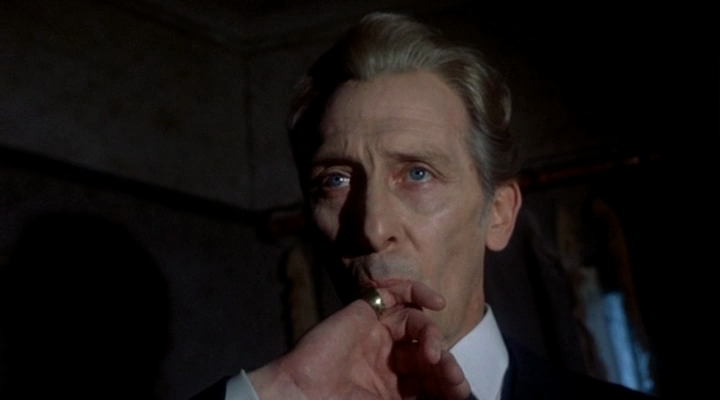
Torture Garden (1967)
Dir. Freddie Francis
Written by Robert Bloch
Starring Burgess Meredith, Jack Palance, Beverly Adams, Michael Bryant, Barbara Ewing, Peter Cushing

TORTURE GARDEN is not the first anthology horror film I’ve seen. It’s not the first Amicus Productions anthology horror film I’ve seen. It’s not the first Amicus Productions anthology horror film directed by Freddie Francis that I’ve seen. It’s not even the first Amicus Productions anthology horror film directed by Freddie Francis from the late 1960s and starring Peter Cushing that I’ve seen.
But you know what? It’s a damn fine one. I think it’s not only one of the studio’s best, but one of the best of the era’s many portmanteau films, period. And it’s not hurting for competition.
I mean, Amicus --scrappy competitor to the comparably more venerable British horror powerhouse Hammer Studios-- made a whole bunch of anthology horror films, it was kind of their thing. TORTURE GARDEN was an early one, but not the first (that would be 1965’s DR. TERROR’S HOUSE OF HORRORS); it was followed by THE HOUSE THAT DRIPPED BLOOD (1970), ASYLUM (1972), TALES FROM THE CRYPT (1972), VAULT OF HORROR (1973), and FROM BEYOND THE GRAVE (1974), and THE UNCANNY (1977). And that’s just Amicus’s output; if you want to take a broader look at the anthology landscape from this period, you’ve also got Mario Bava’s BLACK SABBATH (1963) from Italy, DEAD OF NIGHT (the 1977 one, not the 1945 classic), THE DEVIL’S MESSENGER (1961), JOURNEY INTO DARKNESS (1968), Masakai Kobiyashis’s KWAIDEN (1968) from Japan, THE MONSTER CLUB (1981), NIGHT GALLERY (1969), PARAPSYCHO - SPECTRUM OF FEAR (1975) from Austria, SPIRITS OF THE DEAD (1968), TALES OF TERROR (1962), TALES THAT WITNESS MADNESS (1973), TRILOGY OF TERROR (1975), TWICE TOLD TALES (1963). And that’s an almost-certainly incomplete list of horror anthology films only from the two decades between 1960 and 1980. So yeah, there’s a lot of these.
And yet, TORTURE GARDEN manages to stand out.

Part of that is director Freddie Francis; a veteran cinematographer by the time he became a director (a career to which he would later return --to great acclaim and a couple Academy Awards-- after his days as a horror schlockmeister were over), he had a pretty uneven career, but, especially in his early days, still seemed to have enough ambition to make his films look nice. No Brit ever dared go as purely psychedelic with their lighting as the Italians, but here and there he and cinematographer Norman Warwick (THE ABOMINABLE DR. PHIBES) manage to sneak some surreal green or feverish red into the lighting scheme, which nicely compliments the pushy, slightly heightened reality of the production design and the camerawork. It's not showy direction, but it has a careful attention to detail which subtly informs the tone and adds to its amiably creepy vibe.
Another part of TORTURE GARDEN's success is writer Robert Bloch; originally a short-story author in the Lovecraftian vein (he spent his early years corresponding with Lovecraft himself), Bloch had matured by the 1960s into a style distinctly his own, staking his claim to stories of prickly, abnormal psychology laced with a dark sense of irony (he wrote the novel which became Hitchcock’s PSYCHO in 1960). His stature as a titan of horror fiction is not in dispute, but his tenure as a film writer was as uneven as Francis’; I really dug the far-out weirdness of his work in ASYLUM, but his script for THE HOUSE THAT DRIPPED BLOOD isn’t nearly strong enough to survive the limp direction, and the movie is a total bore. And let's not forget, he wrote at least one draft of THE DEADLY BEES, a movie which -- I cannot stress enough -- technically qualifies as a war crime if shown to enemy combatants. The stories here, though, are some of his better, more fully realized work, and even if they probably worked better in their original form as short stories (especially the one with the murderous piano, which, as we will see, looks a little silly when visualized literally) they provide a solid foundation which Francis fleshes out admirably.
So the talent behind the camera is there, and that helps immensely. But the real ace in the hole this time around is the cast. Amicus supposedly originally wanted the old reliable duo of Christopher Lee and Peter Cushing as their anchor stars, but American distributor Columbia Pictures demanded they ditch the Brits and bring in some big American stars, so instead of Lee we get Burgess Meredith (ROCKY) and Jack Palance (SHANE) (Cushing got to stay on in a small guest role).

Even by 1967, Palance was long, long past the point in his career where he was interested in working very hard (as weird as it is that this stoic Western star would go on to win an Academy Award after doing z-movies movies like WELCOME TO BLOOD CITY and CRAZE [also for Freddie Francis!], it’s even weirder that the film that did it was fucking CITY SLICKERS. 1991 was a weird time), and he’s mostly a non-presence in this one. But Burgess Meredith --at the time, right in the middle of his tenure as The Penguin in the Adam West Batman TV series-- was always one of those actors who you could always count on to put in a little effort, whether he was working for Otto Preminger or voicing a character named “Golobulus” in G.I. JOE: THE MOVIE*. Meredith was also from an old school tradition of Hollywood vaudeville hams, and correctly identifies his appearing in a movie called TORTURE GARDEN as sufficient reason to play to the cheap seats. And he is absolutely correct: as much as I love Lee and Cushing, their brand of redoubtable British class can be a bit stuffy at time, and having Meredith in their place brings a huge influx of anarchic, broad energy to the proceedings and gives this particular horror anthology a very distinct feel.
Meredith, of course, plays “Dr. Diablo,” a gaudily-attired carnival barker at a macabre “torture garden” attraction, which I guess must have been a real thing at the time because nobody seems to be confused as to why there’s a tent filled with grotesquely mutilated wax dummies at this carnival, and seem to feel they’ve got their money’s worth. Once the show’s over, though, he appeals to five straggles to pay an extra £5 -- £83 in 2016 money, or a whopping $110 bucks US!-- and step into his back room for a very special show. This turns out to be a statue of Atropos, one of the three Greek Moiroi, and the Goddess who determines the ultimate death of mortals. Not really a good use of 100+ bucks (good thing everyone came to the county fair flush with a hundred bucks cash in their pocket), except that when you stare into her shears, you get to experience a neat little self-contained vignette which ends in your death. So, arguably a better value than it would first appear.
 |
| Even so, Palance looks a little bit more excited than I'm comfortable with, and he's definitely not wearing pants. I think Michael Ripper's expression on the left speaks for all of us here. |
The first taker is Max (Michael Bryant, who at the time had every reason to believe he would soon be a big star with the inevitable release of his showy role in Orson Welles’ THE DEEP**), who murders his wealthy uncle for his mysterious stash of gold, only to discover the source of the gold is decidedly, shall we say, unexpected: a demonic man-eating cat who demands he commit murder! And is not interested in taking 'nice kitty!' as an excuse. Obviously, a diabolical, man-eating cat is a difficult thing to film without looking silly, and this is certainly the sort of thing which would work better as a short story. But somehow Francis actually pulls it off here; rather than using a lot of lame cat puppets (or just hurling unwilling cats at actors, as Dario Argento did in INFERNO), he tells the story through implication and meaningful close-ups of a tragically uncredited cat actor who has charisma like you wouldn’t believe. Though the gore leaves a little to be desired, the segment proves a surprisingly effective opener.
 |
| This cat should have been a huge star |
Next up, we get aspiring Hollywood actress (Beverly Adams, mostly a TV actor who struck it big when she married hairstyle tycoon Vidal Sassoon and later divorced him and launched her own line of pet care products***) who has her sights set on clawing her way to the top, no matter what the cost. And she’s well on her way (muscling past her naive roommate to a date with a producer, and dumping him for a big star [American B-movie stalwart Robert Hutton, TALES FROM THE CRYPT]) before she starts to get the sense that something is a little… off about Hollywood’s ultra-elite. Before long, she’s risking her career (and life!) to uncover the horrible truth. If that sounds a lot like SOCIETY, well, it is (though the truth doesn’t turn out to be quite as colorfully goopy), but Francis again does a fine job of cultivating an atmosphere of incipient menace, clearly perceptible but never quite visible, and Bloch’s nasty, misanthropic take on these Hollywood clinger-ons --who aren’t even phonies, but wannabe phonies-- gives it the bite it needs to differentiate itself from countless “ain’t Hollywood a drag” tales of woe.

Following that, in the second-to-last slot where they inevitably stick the weakest segment, we find Kiwi actress and later crime novelist Barbara Ewing (DRACULA HAS RISEN FROM THE GRAVE) as the girlfriend --and aspiring wife-- of a famous piano prodigy (John Standing, V FOR VENDETTA, BBC’s Tinker, Tailor, Soldier Spy, Game Of Thrones). She’s something of a controlling, demanding character, but not nearly as controlling or demanding as the other woman in the musician’s life -- his mother, who is currently residing as a ghost in a possessed piano which demands he constantly practice. The two women are immediately thrust into a competition for the musician’s time and affection, which Ewing seems to be winning, until the competition becomes a physical altercation and, well, it turns out a 98 pound blonde doesn’t have what it takes to go 10 rounds with a pissed-off, 'roided up aggressive grand piano (ROCKY hadn’t come out yet, so the piano doesn’t know it should play Eye of the Tiger while it dukes it out with its rival). Alas, this setup is just as funny to watch as it sounds on paper, which is a shame, because riiiiight up til the big piano vs woman throwdown, the segment does a perfectly respectable job as an escalating battle of wills. But there’s no getting around it, that ending, while appreciably eccentric, is just plain silly.
Fortunately, the film rallys for the last segment, which finds Jack Palance, as an obsessed Edgar Allan Poe fan, pumping rival Poe fanboy Peter Cushing (who recently returned to the big screen as a cartoon zombie made of money in ROGUE ONE) for the secret to his unparalleled collection of Poe memorabilia. The segment has one major hurdle to overcome: Palance is a bizarre choice for this character, who needs to come off as nerdy and manic and vulnerable in a way which Palance isn’t even close to achieving, though he makes a game effort. Really, this segment is obviously written for Cushing and Lee, but even without Lee to balance things out, it could not be more clear that the roles here should be reversed, with stone-face, intimidating Palance as the character holding all the power and tiny little Cushing as the obsessed, desperately curious interloper. The dialogue even makes it clear that Cushing has had at least three generations of his family living in America, so what the fuck is up with his posh accent? Argh!

Anyway, all that aside, Cushing is a delight to watch, as he inevitably is, and working with the old British pro seems to inspire Palace to at least make an effort. I don’t know how successful he is --or is even capable of being in this inexplicably miscast role-- but he’s definitely not phoning it in, and as one twist leads to an even crazier twist, the whole thing builds magnificently. While the first three segments are sturdy, well-constructed horror shorts, they’re pretty standard stuff, playing with timeless horror tropes which go back ages and ages. Here, though, the Robert Bloch who wrote the segment from ASYLUM where Herbert Lom obsessively builds tiny, anatomically accurate robot dolls with his own face on them makes himself known. This story is absolutely fucking nutty, and I love it, from the more staid opening --where Cushing and Palance trade nerdy, obsessive anecdotes about Poe-- to the screaming mad out-of-the-blue climax. My only complaint is that for a segment so fixated on Poe, his writings, and his legacy, it ought to have a touch more of Poe’s actual influence. Bloch and Poe shared a fixation on abnormal psychology as a gateway to a deep, subliminal horror, but Bloch’s instinct for dark irony and ambivalence to Poe’s baroque, brilliant use of language seems to put an insurmountable gap between the legacy of the two greats, and consequently the segment has the feeling of a affectionate reference more than a true soul-deep tribute. But no matter; it’s fun and crazy and I’m for it.
After this final segment, we return again to our five carnival attendees, and you recall that there’s actually a fifth person here -- Hammer Studios mascot Michael Ripper (more than half of all Hammer films 1956-1970)-- and you briefly wonder if he’s going to have his own segment, which would be highly unusual for the guy (who spent most of his career a bit player, and never a leading man). Alas, it’s not to be, but he does get one good showpiece moment right at the end, before Burgess Meredith swoops in to bid us adieu in his inimitable broad style. It’s an odd ending, and I must confess I’m not even exactly sure that I understand what’s going on here (obviously Meredith is the Devil, taunting wayward souls about their evil ways, but what exactly does he need these accomplices and all the hokey carnival fakery for?) but no matter, it’s a delightfully colorful end to a rock-solid anthology which makes exceptionally potent use of the talents of nearly everyone involved. Francis, Bloch, Cushing, Palance, Meredith, --and Amicus itself, for that matter-- all had the capacity for greatness in them, but rarely indeed did the stars align so perfectly to bring that capacity out. TORTURE GARDEN is, then, anything but.
(I mean the “torture” part, obviously. To watch, I mean. But it’s not really a garden of any kind either, so that interpretation would also be acceptable)
*Wait, was he cast in that because of his famous turn in the 1945 WWII veteran porn classic THE STORY OF G.I. JOE? If so, I hope they asked Robert Mitchum too. If that was an intentional referene, it definitely went over my head as a kid.
**The release of which did not turn out to be quite so inevitable as it surely appeared at the time
***The American Dream really can come true.

CHAINSAWNUKAH 2017 CHECKLIST!
The Discreet Charm of the Killing Spree
TAGLINE
|
Do You Dare See What Dr. Diabo Sees? Which is pretty much the same thing as Can You Smell What The Rock Is Cooking? When you get down to it.
|
TITLE ACCURACY
|
There is a “torture garden,” with a sign explicitly naming it as such. Still not sure that’s a real thing, but hey, the magic of cinema.
|
LITERARY ADAPTATION?
|
Robert Bloch adapts from four of his own short stories
|
SEQUEL?
|
Arguably part of Amicus’ loose series of anthologies, being preceded by Dr. TORTURE’S HOUSE OF HORRORS and followed by THE HOUSE THAT DRIPPED BLOOD
|
REMAKE?
|
None
|
COUNTRY OF ORIGIN
|
UK
|
HORROR SUB-GENRE
|
Anthology horror
|
SLUMMING A-LISTER?
|
I suppose neither Palance nor Meredith were exactly on the A-list at the time, but they were definitely Marquee names
|
BELOVED HORROR ICON?
|
Cushing, of course, and Michael Ripper. Also arguably director Freddie Francis, and certainly Robert Bloch.
|
NUDITY?
|
No, although there is a truly startling live bikini snow globe in one of the segments, which goes uncommented on.
|
SEXUAL ASSAULT?
|
None
|
WHEN ANIMALS ATTACK!
|
Killer Cat! But then again, there’s a killer grand piano too, so it’s not that special.
|
GHOST/ ZOMBIE / HAUNTED BUILDING?
|
Definitely a zombie, and a haunted piano, too.
|
POSSESSION?
|
Possessed piano
|
CREEPY DOLLS?
|
The wax dummies in the “torture garden”
|
EVIL CULT?
|
Arguably SPOILER some kind of crazy new age Hollywood bodysnatcher cult, though not exactly in a religious bent.
|
MADNESS?
|
Certainly!
|
TRANSMOGRIFICATION?
|
Yes!
|
VOYEURISM?
|
We get a killer grand piano POV, that’s unusual
|
MORAL OF THE STORY
|
If a shifty carny in a slapdash schlock murder-porn torture garden asks for a hundred bucks to go backstage and get a “real show,” definitely do it.
|