Showing posts with label BIG QUESTIONS. Show all posts

Thursday, October 25, 2012

Red Lights

Red Lights (2012)
Dir. Rodrigo Cortes
Written by: Rodrigo Cortes
Starring Cillian Murphy, Sigourney Weaver, Toby Jones, Robert “duh” Niro, Elizabeth Olson


    Man, they don’t make ‘em like this anymore. Or I guess they do, since it was released this year. But boy, they don’t make ‘em like this very often. What we got here is a gorgeously filmed, consummately well-acted, highly literate, tense, well-paced film which manages to be rich in subtext without becoming overbearing and didactic. It’s original, compelling, constantly surprising, and intellectually honest. What I’m saying basically is that this is one really good film.

    Of course, I may be predisposed to like it. For one thing, it features the first actual acting either Sigourney Weaver or Robert De Niro has done is about two decades of lazy thrillers and cameo riffs on their classic work, and they’re both really great. For another, it’s about two academics (Weaver and Cillian Murphy) who go about debunking fraudulent claims of supernatural ability. At the top of the list is is De Niro as Simon Silver, a flashy psychic who is making a hugely publicized return from retirement, whose arrogance borders on threatening and who may just be the real deal. Can Weaver and Murphy prove that this smug celebrity is a manipulative charlatan, or are they messing with something more dangerous? That’s a setup which plays to my particular prejudices, I admit. Although I’m always open to what Mulder calls “extreme possibilities,”* I’m deeply skeptical of all paranormal claims and deeply angered by the sort of pseudo-religious sleazeballs who prey on people’s emotions and vulnerabilities for a quick buck and a snake-oil cure-all. But how much would it take to convince me that I’m wrong? At what point does it stop being about science and rationality and start becoming a personal holy war to protect your own beliefs about reality? That’s the question at the heart of the film, and it’s a big one.


Oh yeah, acting! I remember doing that.

    To answer it, writer/ director Rodrigo Cortes (BURIED) apparently spent a year and a half researching and studying psychic phenomenon, including both the people who claim it and the people who doubt it. The film never feels like a pedantic synopsis of the topic, but it does manage to naturally include an interesting variety of perspectives, from the inflexible skeptics to the hardcore believers to those who believe in spite of their better instincts to those who simply don’t care if it’s real or not. Having these perspectives represented does more than just offer different paths to the audience -- it eloquently helps to explain exactly how the phenomenon of psychic powers came to find its peculiar and unique place within our society. And, it helps explain what the stakes are for our protagonists.

    I suspect many people will find this movie deeply scary, as Weaver and Murphy begin to encounter frightening and seemingly inexplicable phenomenon the closer they get to Silver. But to me, weird coincidences and dead birds are nothing compared to the fear that somehow they’re wrong, that the kooks and superstitious ninnies are right, that our faith in rational thinking and science has allowed us to miss the forest for the trees. If that’s true, it opens a deep existential dread about what life itself means that a rational atheist is ill-suited to address (what can I say, I went to Catholic school). So this one evoked a particular anxiety in me that has nothing to do with its sumptuously creepy photography and seductively menacing performance from De Niro. It Challenges a guy like me with the question,  “what if everything you think you understand is actually wong?” -- and that had me on the edge of my seat and barely noticing how well-executed the traditional scare scenes are. But lest you be tempted to give up and believe your eyes, Cortes also provides us with Toby Jones’s character: a scientists who makes his career on rationally assessing paranormal phenomenon, but who turns out to not be great at seeing the “red lights” of the title -- little giveaways that someone may be using misdirection and trickery to make sure your eyes are seeing only what they want. And, the film subtlety reminds us, he has a nagging practical reason to allow himself to be tricked. As long as there’s some doubt, he still has a lucrative gig investigating things which are ultimately unprovable. And of course, as filmgoers we suffer from the same slight prejudice of wanting to be shocked. Cortes sadistically refuses to let you forget either point of view, even as he carefully pushes you in one direction after another. 


Who ya gonna call?

    I guess a lot of people, even that old fussbudget Roger Ebert, were annoyed by the end. I suspect it’s because they, like me, genuinely did not see it coming. It seems like the movie sets you up for one of two possible big reveals, and then diabolically goes for a third possibility which I have to concede sort of blew my mind and caused me to reflect back on the rest of the movie to see if it was indeed playing fair (it was, mostly). Twist endings are a tricky thing, because if you twist enough you’ll end up cutting the end off from the themes and narrative momentum of the rest of it and ultimately leave yourself without much substance beyond a well-calculated surprise. But here, I think, Cortes does the impossible and makes a sudden turn which in retrospect causes the rest of the film to feel more meaningful. When you go back to check his logic, you’ll find a whole hidden layer of meaning and emotion to a story which was already plenty filled with both. I believe this is pretty indicative of a piece of art which at the very least flirts with genuine greatness. No, I don’t just believe. The film provides plenty of good evidence to back that up.

PS: And for more evidence, don't forget to check out Dan P's take as part of his Abbot and Costello Prove that Religion is a Lie series.

* By the way, one of the great set decorations is Murphy's office is a reprint of Mulder's famous "I want to believe" poster, retitled something along the lines of "I want to understand."

CHAINSAWNUKAH 2012 CHECKLIST!

LOVECRAFT ADAPTATION: No.
BOOBIES: I'm afraid I must dash your hopes for some late-career 'Gourney boobage. And even Elizabeth Olson keeps her top on.
> or = HERSCHELL GORDON LEWIS LEVEL GORE: No significant gore.
SEQUEL: No
OBSCURITY LEVEL: Got limited release this year, but seemed to attract little attention despite the excellent cast.
MONSTERS: Only the monster of superstition and irrationality.
SATANISTS: No, even though there's an obvious religious subtext here we stay mostly out of specific religious matters.
ZOMBIES: None.
VAMPIRES: None.
SLASHERS: Nope.
CURSES: Well, it definitely seems like De Niro puts the whammy on our heroes.
ALEX MADE IT THROUGH AWAKE: N/A. Sorry Alex, I didn't think it would be this good or I'd have waited.


Tuesday, June 19, 2012

Prometheus

Prometheus (2012)
Dir. Ridley Scott
Written: John Spaihts, Damon Lindelof
Starring Noomi Rapace, Michael Fassbender, Charlize Theron, Idris Elba, Sean Harris, and, briefly and inexplicably, Guy Pearce.


PROMETHEUS takes its name from the ship upon which our intrepid crew journeys towards an alien world from whence came the creators of the human race. But of course, it really takes its name from the Greek myth about the Titan of that name who both created the human race and gave them the power of the gods (in the form of fire). Which I think is what the movie would like to be about. They’re definitely pleased enough with that allegory that they shoehorn it into a conversation just to make sure you didn’t miss how clever they were being. But maybe Ridley Scott and co. should have been thinking about another recent spaceship ironically named after a Greek myth: Icarus. Because in trying to scale up their ALIEN mythology into a big philosophical hard sci-fi movie, these guys forget that if you make your narrative wings out of wax, you’d be wise not to fly too close to the sun. Which in this metaphor represents unearned pretensions of depth. Because that fucker is gonna melt through the bullshit real quick and you’re gonna make a big splash in the sea of overreaching.

It’s not that it’s not a cool movie. It is. It’s huge and ballsy and filled with the craziest crap you’ve ever seen. But at the end of the day, it’s a movie that is so obsessed with being huge and important and blowing your mind that it forgets to go through the actual steps that would be necessary to do that.

It’s a movie that has one big question, and that question is “what is the relationship between the creator and the created?” Which is a pretty ballsy question to hang a movie on.


Whenever you bring an ax to meet your creator, I think it's fair to say things are probably not going as well as you'd hoped.


It then sets out to ask that question in various ways and various configurations for the next two hours. Ingeniously, it connects the ALIEN mythology --and its multilayered creation and motherhood iconography-- with that concept, juxtaposing multiple levels of creators and their creations with each other. Humans with the Androids they created, Humans with the human children they created, Humans with their unwanted Alien spawn, and Aliens with their own unwanted Alien spawn in the form of humans (no clones this time, though). No one seems to get along all that well, but they all damn sure want something or another from each other. There’s a good amount of disappointment on all sides, it’s safe to say.

So I give them a lot of credit for taking that aspect of the ALIEN mythos and putting it front and center this time. Problem is, that paragraph above is the exact extent to which any of this is explored in the movie. It just keeps repeating the same question over and over in different forms. I’m OK with ambiguity, and I understand that the question is always going to be more intriguing than the answer, but if you’re not gonna go anywhere with this concept, you gotta at least go somewhere else. I don’t know that I’ve ever seen a movie work this hard to simply tread water. It’s like Scott thinks if they just ask the question harder and harder with bigger and bigger setpieces, it will somehow succeed in blowing your mind through sheer force. Sorry, man. You can get stoned with some dudes in a dorm room and ask “Woah man, what if we met God and he was an asshole?” or you could spend $130 million asking the same question. My mind’s gonna be blown about equally either way. Or actually you could also watch STAR TREK V: THE FINAL FRONTIER or FIGHT CLUB, where they also ask that question. While stoned.

None of this would be such a disappointment to me if the movie itself were better. But Scott is so fucking fixated on this big crazy mind-blowing question he has that he treats the story and characters as pretext and props, instead of, well, as story and characters. Despite a tremendously talented cast, the characters are embarrassingly ill-defined, and their conflicts are indifferently sketched out or neglected all together. Scott and writers Spaihts and Lindelof seem to make their one and only goal to take the characters and twist them, by whatever means necessary, into one iteration after another of the same damn question. So someone is definitely going to have father issues, someone is definitely going to be unable to conceive, someone is definitely going to turn against their own creation, and so forth. Exactly how that happens and what it means to the characters seems to be completely irrelevant to Scott, just so long as it happens and matches up with his main theme. It’s a classic example of laboriously building a story around a subtext, instead of just telling an interesting story which has a natural subtext to it. It’s trying to think of something big to say without actually having something interesting to say, like a nerd at a Bruce Campbell book signing.

If you can't think of something interesting to say, try exploding!


So you’ve just got a great cast floundering around doing things seemingly at random so that the story can progress. I’m no stranger to bad logic in horror movies, but these are seriously the absolute worst scientists I’ve ever seen, ever. They’re supposed to be here making the single greatest discovery mankind has ever achieved, and their reactions are either annoyance or boredom. Half of the people are angry that God is not there to answer their immediate questions right this second, the other half seem irritated that they’re being asked to walk around looking at stunning alien artifacts in the first place. They even take off the helmets -- who does that?! One of them, upon seeing a creepy cobra-worm-plant hybrid, takes off his helmet and attempts to cuddle with it. That this seems hard to accept is not a failure on my part to suspend disbelief, it’s a failure of the writers to write actions with are even borderline consistent with real human beings. I simply cannot accept that a human being would do that in the same way that I wouldn’t accept it if Noomi Rapace suddenly turned into a cartoon turtle with no explanation. No rational human being --let alone a scientist-- would ever do these things or talk this way -- ever. Maybe some people will be able to look past that fact and enjoy the action scenes, but for me it was so egregious that there seemed to be no ignoring it, and hence I was constantly dragged out of the experience. That kind of disconnect is just ultimately, um, alienating.

The acting is generally good, but can also be weirdly inconsistent. Rapace and Michael Fassbender lend quite a bit of dramatic weight to their roles, while Idris Elba, Sean Harris, and newcomer Logan Marshall-Green seem to think they’re in THE AVENGERS. Who the fuck knows what Charlize Theron and Guy Pearce think they’re doing, but it’s definitely not the same thing as anyone else. And the diction of the script seems to be constantly in flux, too -- sometimes we get some quippy faux-Whedon one-liners, sometimes we get naturalistic drama (like the original ALIEN), sometimes we get high-drama epic speeches with metaphors and monologues and whatnot. Sometimes, one character will do all three. None of the performances are bad, per se, but they are all bafflingly incongruous with each other. The characters, then, completely fail to impact on each other and the result is one big, listless dramatic shrug. And you’re just left with some pretty pictures to keep you interested for two hours.

The best reason to see this in IMAX 3D. Not the hologram stuff. Michael Fassbender's face.


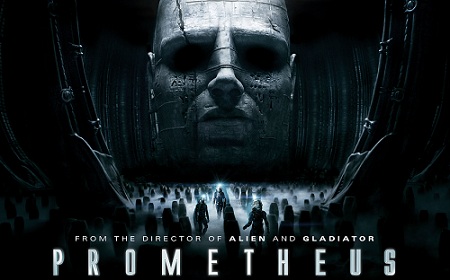
This being a Ridley Scott production, you can at least be assured that the production itself is gorgeous. They’ve created some pretty cool iconography to expand the universe --including that nifty giant head that’s on the posters-- and a couple rather striking additions to the basic elements therein. Unfortunately, the new stuff is side by side with the old stuff, which wasn’t just great but one of the most memorable and visually overwhelming production designs of all time. No offense to the new guys, but you’ll never in your sickest fever dreams be able to match the utterly nightmarish depravity of H.R. Gieger’s original visions of dessicated exoskeletons and perverse sexual suggestion. They’re self conscious about not wanting to rehash that stuff, so they come up with slightly different versions of essentially the same thing, which are cool but also indisputably nowhere near as cool as the original. And in an even more depressing twist, they actually demystify Geiger’s bizarre elephant-faced “space jockey” by showing us that it’s just a suit, there’s actually a big boring white guy under there. Let me ask you a question, are you really happier having seen that under that dapper mask/helmet combo, Darth Vader is actually a puffy old white guy? Of course you’re not. Same thing here. I understand that for narratives reasons, they have to look like humans and that this limits the potential for creative alien designs. But you know what, I would actually probably prefer they write a slightly different narrative and then actually show me something awesome. 

The cinematic equivalent of Miley Cyrus covering "Smells Like Teen Spirit."

Really, though, even when the film is trying to be awesome, it’s only intermittently successful. Only one scene in the whole thing even approaches the pure, visceral terror which made the original ALIEN one of the greatest horror films of all time. You’ve seen it already so you know the one I mean. That sequence, at least, belongs in the top tier of moments from this franchise. But even so, its impact is diminished slightly because it seems confoundingly shoehorned into at least two other plotlines which rush in and take over immediately before and after. After Rapace leaves her newborn squid and staggers away, everyone acts like they’ve forgotten the whole episode and no one seems at all surprised that suddenly there’s a bloody chick in her underwear wandering around. They’re like, “hey, we’re going back to the ship, wanna come along?” and she’s like “OK sure.” Same deal with the return of a minor character who seemed dead but then returns, (quipped fellow Vern-er “Jimblo”) as some kind of  yoga monster. Fucking scary, out-of-the-blue shocker, but then all he does is punch people and throw them into things, which is about as scary as any given scene from a Seagal film. It’s the Pumpkinhead curse all over again! And just like the squid baby scene, no one seems bothered by this or even mentions it again. I guess they see a lot more murderous yoga zombies than I do, and this shit is just routine for them?


That's the problem with threesomes, someone is always gonna feel left out.


So, the movie is just chock full of wasted potential and bungled execution. But I will say, there’s something uniquely strange about it. It’s mix of ambition, intermittently gorgeous design, occasional great performances (particularly Fassbender as ambiguously motivated, amoral android David) combined with completely arbitrary plotting and intentionally frustrating non-answers creates a weird cocktail which is not completely without its charms. As terrible as many aspects of it are, the film it evokes most for me is not some faux intellectual failed horror movie, but rather Spielberg’s most interesting disaster, 2001’s A.I. ARTIFICIAL INTELLIGENCE. Just like that one, it’s full of irresistibly compelling and completely unique touches, and yet falls apart in a disorganized mess of loosely defined relationships, unwieldy tonal shifts, and inexplicable oddness. The movie absolutely doesn’t work, but it’s sort of enthralling all the same. You’ve never seen anything quite like it. At its worst, it seems to be trying to pander to horror aficionados and fans of the series* with poorly-thought-out regurgitations of the same tired themes and tropes. But at its best, it’s almost deliberately antagonizing in its commitment to tantalize you with intriguing minutia which steadfastly refuses to resolve into any kind of clear picture. Hey. Sometimes an alien squid is going to mouth-rape a gigantic white bald dude while a Swedish lady with a belly full of staples and a talking severed head drive an alien spaceship to find God. You gotta admit, that’s something you ain’t seen before. Icarus might fly too close to the sun, but it’s a pretty wild view on the way down.


Barely, which is odd because there are at least three major women in the crew here. The only scene that saves it, though, is the scene where they do an autopsy on a alien head and discuss it. The head actually appears to be male, but we'll give them a pass on that one since the alien genders are ambiguous.


*The movie’s worst moment is the very end, which chickens out from the film’s frustrating but awesome ambiguous ending and finally delivers a familiar face that supposedly audiences are paying to see. But it irritatingly makes it seem as though the whole thing is about explaining where the titular alien came from, which, if it is indeed the point, is the lamest reason to make a movie since Lucas thought we’d enjoy seeing Darth Vader as a mop-headed 6-year-old who wuvs his mommy. Dude, the origin of the alien is the least possible interesting thing to explore, particularly when it turns out it originated the exact same way all the other aliens in every other movie did. It’s a completely anti-climatic moment which makes me question if I actually thought too hard about the rest of the thing.

Friday, August 5, 2011

Tree of Life

Tree of Life (2011)
Dir. Terrence Malick
Starring Brad Pitt, Jessica Chastain, Hunter McCracken, plus a few shots of Sean Penn looking out the window or walking barefoot on a metaphysical beach.


For his fifth total feature-length film in a career marked by the glacial pace of just over one film per decade, Terrence Malick apparently decided to just go for it and make his FEMME FATALE. If we are really lucky, every director with a distinct style will get at least one chance in their career to go whole-hog wild and indulge every one of their fetishes, quirks, themes, and tricks and create something really crazy that most people won’t like but is endlessly fascinating to cinemaphiles. For De Palma, this was FEMME FATALE. For Gilliam, IMAGINARIUM OF DR. PARNASSUS. For Seagal, ON DEADLY GROUND. “Normal” people don’t generally like these films very much because they’re so weird and crazy and hilariously tone-deaf. But they’re such pure distillations of a particular vision that I can’t help but be fascinated by them, and I’m always up for another swing for the fences.

With TREE OF LIFE, Malick has completed his long, slow drift away from narrative (or at least the pretense thereof) into a distinctively Malickian hazy dream of suggestion, atmosphere, and symbolism. Its ambition is practically dripping off the screen, and its sense of importance barely leaves room for an audience in the theater. Malick is not just asking the big questions, he’s shouting them like a Tourettes patient at a Tea Party rally. What is man’s place with God, the universe, and everything? Can we accept the authority of a God who allows suffering and misery? How bout pain and memory and family, what’s up with that stuff? OK, so those aren’t exactly new questions, but Malick asks them rather more overtly than most (sometimes just having creepy whispered voiced just outright ask them) which is where I got hooked. I mean, this thing begins at the dawn of time, takes us through the various geologic epochs (including my personal favorite Devonian period) and has fucking dinosaurs in it for God’s sake. How many pretentious art house films have not one but three sequences with different dinosaurs? Not enough, that’s how many. Terrance Malick is trying to address that ratio, but he’s only one man. Eric Rohmer, check yourself.

                                        Still better than JURASSIC PARK 3.

So I was excited about that. What I was less jazzed about is the family drama at the center of this thing. You know me, man, I’m always up to watch some trippy experimental jazz with stock footage of volcanoes and some gyrating light patterns, but you’re gonna have a tough time getting me in the theater with the promise of a tightly woven family drama about the complicated feelings between a boy and his father and zzzzzzzzzz. I was worried this was gonna be a bait and switch, where Malick lures me in with the promise of mid-grade CG dinosaurs but then spends most of the time droning on about people’s feelings.

Well, as the movie roles, I was relieved to see my initial fears were unfounded. There’s a little context-free nonlinear family stuff, and then it’s straight back to the beginning of time for you. You get to see God, (he’s actually a little unimpressive, looking like a meeker version of the screensaver drug trip from ENTER THE VOID) the creation of the universe, the formation of the planet, a plesiosaur (actually scientists now doubt that their necks would have been sufficiently muscled to hold their head up like this out of water, so that must be a metaphor or something) and I think some weird fish or something. No giant sloths, though, that apparently wasn’t important for the story.

So it’s all fun and trippy, and then we get to Sean Penn as an old version of Jack, the boy played as a youth by the awesomely named Hunter McCracken in the film’s primary narrative. Old Jack is a fancy pants architect, which gives Malick cause to luxuriate in the abstract grandeur or some big spacious modern buildings. Say what you will about Malick, (to yourself. In the meantime, listen to what I say about him) you can’t deny his ability to find amazing shots on everyday things, here turning the glass ceiling of a building into a stunning abstraction which probably symbolizes something like God or Death or Memory or something like that. Then we get Old Jack looking sadly out a window and flashing back on his childhood where his dad is Brad Pitt and his mom is Jessica Chastain.

This is the part I was worried about; I wasn’t sure how the mundanity of a childhood in Waco Texas in the 50s was really going to live up to all the big picture stuff. But a funny thing happens here. The longer you watch the family, the clearer it becomes that this is heart of the film, the classic work of genius. This is literally, with no hyperbole, the best depiction of youth I’ve ever seen put to film. McCracken is beyond fantastic as a normal kid entering the choppy waters of adolescence while his dad starts to gradually fall apart, taking the family with him. It’s a genuinely stunning document of a child’s focus, wisely depicting the child’s here-and-now reality where a caught frog has as much wondrous significance as a burning house but also noticing the budding sense of larger forces afoot as young Jack begins to question his dad and see the cracks in his larger-than-life authority.  

It’s not just a depiction of youth, though; it’s a depiction of memory. It’s entirely possible this is a highly subjective depiction of events, but it has a staggering emotional resonance and emotional truth to it. No film I’ve ever seen better captures the shards of intense memory which linger in our mind – a chance encounter with an old face, a stolen glimpse of a guy getting arrested, the image of a sunbeam playing over a mother’s hands. This isn’t metaphor or symbolism or a way to ask The Big Questions – it’s important because it informs our memory, our sense of self. Yes, we remember the big events, but the fragments of the everyday end up weighing just as heavily on our memory and our perception of who we are and where we’ve come from. Images, smells, words – tiny but potent icons which represent a past which is mostly elusive.

Pitt is excellent as the complex father, a sensitive and sometimes warm man who is gradually being crushed by his inability to meet the standards he thinks society is setting for him and slowly turning into a bitter bully. He wonderfully conveys the father’s deepening frustration and isolation but lets us see the good person he could have been, too, which makes his escalating brutality all the more frightening and painful. His disintegration turns the family abode into a bunker under siege from within, a chaotic nightmare of uncertain tension which might erupt at any point. Chastain brings a sense of gentle serenity to the mother, but her character is oddly underdeveloped considering the richness of her husband’s characterization. Old Jack seems to remember her as a saintly Madonna, offering perpetual comfort and forgiveness even as she is powerless to meaningfully stand up to her husband. We never see her get mad, or snap at a kid, or find herself tempted to be unfaithful, or do anything other than be selfless and stable. This might be interpreted as merely a son’s idealized memory of his mother, but it’s so markedly shallower and less interesting than Jack’s memories of his father that it stands out as disappointing and maybe even a tad stereotypical.

Even so, Malick’s camerawork (mostly hand-held in this section) marvelously captures the atmosphere and the deep, mysterious magic of childhood experience. McCracken feels so real and so vital, and his relationship with his father is so fraught with an almost painfully believable tension, that the whole thing feels as deeply moving and honest as anything I’ve ever watched. Even when Malick starts to get arty again and puts in needless shots of mom wandering through misty woods with cornball whispered voiceovers like “Father! Mother!—forever you wrestle inside me,” the whole thing simply feels too grounded to really derail.

Unfortunately, Malick doesn’t know when to stop. He had me sitting transfixed, through one of the most moving and sensitive portrayals of childhood and family dynamics ever created, and with only the barest wisp of narrative. It’s so good my filmgoing companion actually found it very hard to watch – too painfully honest, too close to the real thing. Too close to a lot of the real heartbreaks and cruelties which lurk below the surface in, I suspect, most of our memories. Malick sold me a ticket based on dinosaurs and managed to seduce me into loving –loving-- a nonlinear, free-floating family drama. But that wasn’t enough for him; it didn’t seem big enough, important enough to address all those Big Questions about God the Universe and Whatnot. So rather than ending it on a note of profound honesty and quiet, unassuming power… he had to do his version of the 2001 A SPACE ODYESSEY ending.

So suddenly we’re back with Sean Penn, and he has to cross through this wooden doorway on the beach and go up in a big glass elevator into memory or heaven and confront his parents and brothers and they walk barefoot on the beach and we go back to the universal scale and see God again. And you know what, after watching something as rich and legitimate as the family drama which anchors the film, it all seems very trite and needless. Somehow those Big Questions about man’s place in the universe and God’s right to rule us seem kind of pompous and silly compared to a kid watching his family fall apart. Without meaning to, I think Malick reminds us that for all our high-minded philosophy, our deepest experiences come from life itself, not from shouting questions into the cosmos and waiting for an answer. True, those questions are not entirely distinct from our daily lives either, but they may actually be better answered through the surprising gentleness of a father’s hand on his son’s shoulder than through walking barefoot on a metaphysical beach.

 No no, it's a metaphor! He's not really walking in the desert! It means something else so that means its automatically deep. If you don't think so it's because you don't "get" it.

I don’t fault Malick’s ambition, nor do I begrudge him his more esoteric examinations of the universe. He opens with a quotation from the book of Job, as God asks Job, "Where were you when I laid the earth’s foundation ... while the morning stars sang together and all the sons of God shouted for joy?" In the movie’s context, that becomes a question about Man’s place in the universe, and God’s place in the life of man. But maybe Malick ought to look a little closer at the original context of that quote. It’s what God says to Job after wrecking his life in a completely arbitrary and cruel fashion. Finally, after never losing faith while everything he loved was taken from him, Job’s composure cracks and he asks God what the fuck his deal is, and God answers with that line. It’s not a metaphysical question; it’s a rather stinging rebuke to anyone who might question God’s intent. It’s advice to not ask questions which you couldn’t possibly understand the answers to. If that’s the case, what’s left to us?

Maybe to find our meaning a little closer to home. To find those little shards of portent memory, and to build a lifetime with them. To live deeply in this haunted, strange, painful but beautiful world. Malick may be more interested in questioning it, but his camera and his actors remind us just how potent it is to live it.