Showing posts with label OUTRAGEOUSLY DEPRESSING. Show all posts

Monday, September 30, 2019

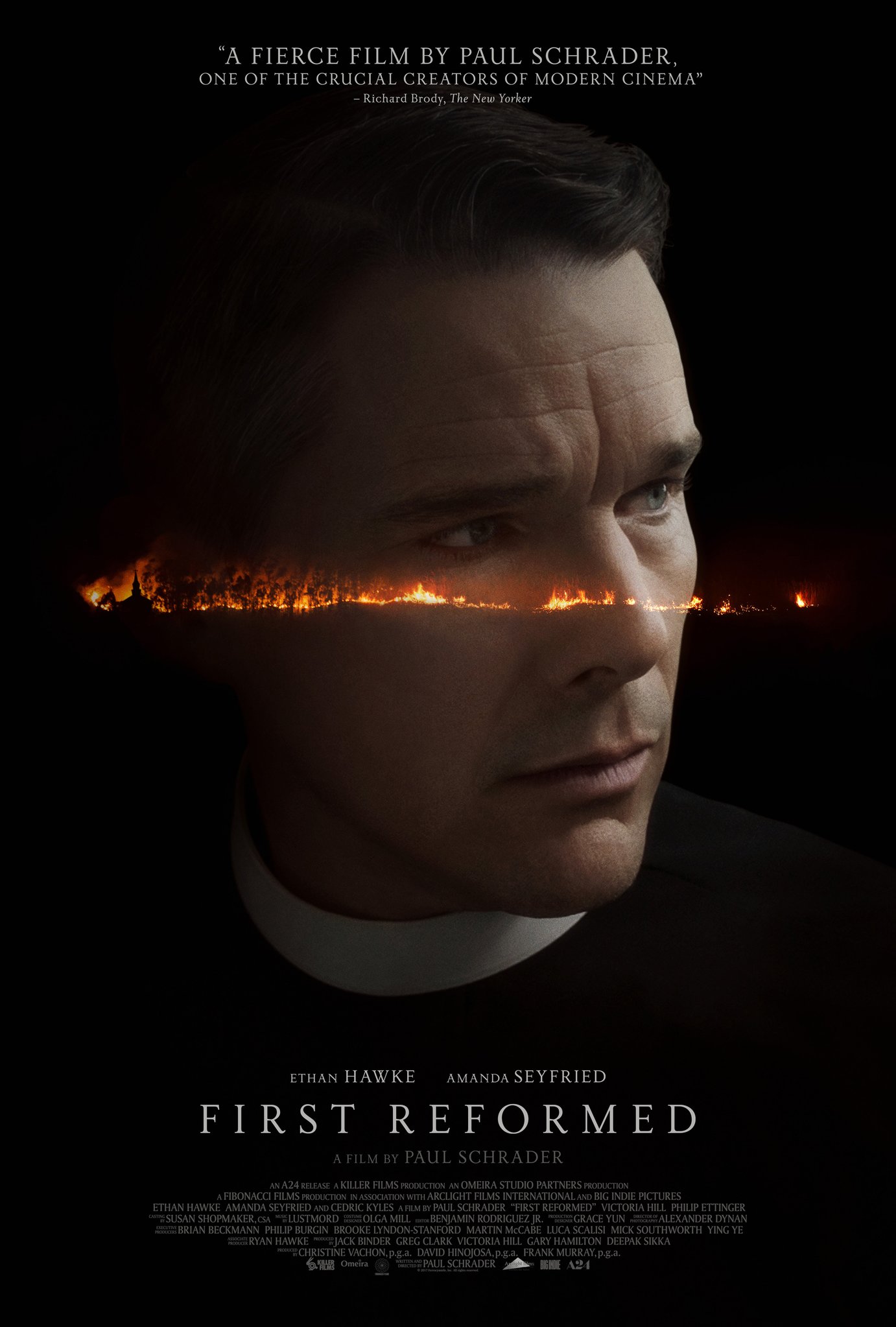
First Reformed

Image result for first reformed

First Reformed (2018)
Dir. and written by Paul Schrader
Starring Ethan Hawke, Amanda Seyfried, Phillip Ettinger, Cedric Kyles
          I honestly don’t know if this is a good movie or not. I think it is; I can definitely pick out things about it which are very finely crafted, aesthetically smart. But frankly I’m just too close to it to be able to objectively talk about it like a piece of art. More than any other movie I can think of in recent memory, maybe more than any other movie I’ve seen since I was a teenager, FIRST REFORMED feels like a movie about me, a movie which captures the world as I see it, which tries to wrestle with the particular horror of modern existence as I experience it. It is as close to seeing my own mind on-screen as I have ever experienced in a movie. If it has flaws, they are also to a large degree my flaws, and if it has strengths, they are to a large degree my own as well, at least intellectually (and the movie is almost exclusively interested in the intellectual). To give it any kind of objective evaluation would be to appraise my own mind, a task which, much as I wish it were otherwise, I am uniquely ill-suited to attempt. Suffice to say, then, that I found the experience of watching FIRST REFORMED absolutely shattering, and, perhaps selfishly, I think you might too. At the very least, if you watch it you might understand a little better who I am. That may not be much of a recommendation, but it is the one thing I can offer with any real certainty.
         I am not, like FIRST REFORMED protagonist Ernst Toller, a priest, nor, like writer/director Paul Schrader, a Calvinist. But I am very much Ethan Hawke. Not literally, of course, but I identify with the actor in a way which is very unusual for me. Despite being an American male of European ancestry, I’m an odd duck in a lot of ways, and don’t frequently see much of myself* in fictional characters. When I do, I tend to see the worst in myself rather than the best (the pathetic, self-sabotaging grifters of BUZZARD, the delusional, desperately needy Chuck Barris of CONFESSIONS OF A DANGEROUS MIND). But in many of Hawke’s characters over the years, I saw at least aspects of my better self that I encountered nowhere else. Being about ten years older than me, he was playing teenagers when I was a teenager, which is, I suspect, the period of life when we’re most apt to look to fiction for versions of ourselves, or at least ideals of what we could aspire to. Suffice to say, at a crucial moment of my development as both a cinephile and a person, Hawke embodied the kind of cool I wanted to be: intellectual, passionate, edgy, troubled. He combined the sort of rebellious, independent spirit that late-gen-Xers like me were drawn to, but tempered with an intellectual seriousness, a restless sense of curiosity about the world and an eagerness to experience it, that I found uniquely well-suited to own sensibility and aspirations. I was never going to be Sylvester Stallone, but cultured, thoughtful Jesse Walters from BEFORE SUNRISE? Maybe. Hopefully. Someday. At any rate, here was a character, and an actor, in whom I could see, if not myself, at least the self I wanted to have.
         And these years later, I still find a lot to admire in the actor. He’s had an interesting career, eschewing the easy mega-stardom that was probably within his reach in favor of more eclectic roles, from Richard Linklater experiments (BOYHOOD, WAKING LIFE) to gritty crime flicks (TRAINING DAY, BEFORE THE DEVIL KNOWS YOU’RE DEAD) to straight-up genre fare (DAYBREAKERS, SINISTER), and in all this time I’ve never once seen him phone it in. Highbrow, lowbrow, he is a rare actor you can always count on to give 100%, even in something as ridiculous and schlocky as 24 HOURS TO LIVE or the MAGNIFICENT SEVEN remake.

Image result for first reformed        
I bring all this up for two reasons: first, as far as I’m concerned, it’s always a good time to remind the world that Ethan Hawke is a God damn national treasure. Second, and more germane to the topic at hand, I feel it’s necessary to emphasize the degree to which he has remained stable my whole life as perhaps the only celebrity who represents a kind of person who I could meaningfully aspire to be. Because in FIRST REFORMED, we find him again playing a character with whom I identify to a striking degree. And that’s a real problem for me, because Schrader considers this film to be part of a loose trilogy, along with TAXI DRIVER and LIGHT SLEEPER. Those are great films, but not films featuring protagonists that anyone sane wants to personally identify with.
         Of the three, FIRST REFORMED’s Reverend Toller initially seems the odd man out. He’s got a stable (if somewhat austere and limited) life, working as a priest in a 250-year old New England church which is attended by a few parishioners, but mostly exists as historical landmark. Toller takes his liturgical duties seriously, but it’s clear his role as a priest is largely symbolic, and he’s really being retained as a caretaker and tour guide (his responsibilities include stocking the gift shop) for the old building, which is owned by a nearby megachurch and is itself primarily used for symbolic occasions, one of which is the building’s upcoming 250-year anniversary. Though Toller is outwardly functional, his obsessive journaling reveals that internally he’s a miserable husk, languishing in a self-imposed exile from the world as penance for pushing his son into the military, where he died during the Iraq war. Struggling with alcohol and hopelessness, Toller has been desperately, obsessively searching arcane religious writings for… something. Some reason to hope. Something to believe in. Some way forward. But he can’t make himself believe any of it.

Image result for first reformed        
His quietly imploding world of personal despair is interrupted by someone looking to him for the very thing he can’t seem to find for himself: hope. That would be Mary (Amanda Seyfried, JENNIFER’S BODY) the pregnant wife of environmental activist Michael (Phillip Ettinger, COMPLIANCE, BRAWL IN CELL BLOCK 99), a man so pessimistic about the future of the human race that he thinks bringing a child into a world of such dismal prospects is in itself an amoral act. Mary hopes Toller can talk him out of his bleak worldview, and though Toller doesn’t think he’s up to the task, and even suggests she might be better off seeking help elsewhere, he reluctantly accedes to talking with Michael. Unfortunately for him, Michael’s despair is very much rooted in hard fact. He’s spent his life trying to save the world, only to see it sink deeper and deeper into ruin in ways which are specific and quantifiable. He has graphs and charts, a mountain of data that supports his prognositations of doom. Toller is an intelligent guy with the usual stock of religious apologia, but as much as he enjoys this rare opportunity for a lively intellectual discussion, he privately knows that Michael is right, and there’s nothing, ultimately, that he can say to overcome the simple fact that all available evidence seems to point to despair as the most logical reaction.
         And this realization –or perhaps, this crystallization of what he already knew, on some level—inexorably pushes Toller to think about his own role in all this. And a problem of this dire scale is a dangerous notion for a man with nothing to lose to dwell on.
         This scenario, then, has, in some ways, a very similar shape to Schrader’s most famous and celebrated screenplay, 1976’s TAXI DRIVER: again, you have a guy with nothing to anchor him to society faced with an infuriating injustice that the world seems incapable of even noticing. But there’s a key difference between them, and it’s the heart of why this movie was so particularly shattering to me. It is, simply, that Michael, and subsequently Toller, are simply right. TAXI DRIVER’s Travis Bickle is a psychotic, a deranged obsessive outsider whose fixation is rooted in his own alienation, and spurred by the perverse extremities of human corruption which transform the world around him into a lurid grotesquerie. But Toller isn’t any of those things, and his world is a much more mundane, veristic one. He’s depressed and guilt-ridden, but there’s no question that he’s also a functional adult, a thoughtful, intelligent guy not in any way inclined towards cheap fanaticism or radical destructiveness. And the villains of his story are depressingly banal; they’re not exaggerated monsters, in fact their very evil flows from how reasonable they are, or at least believe themselves to be. Toller’s boss at the megachurch (Cedric “The Entertainer” Kyle[!], THE ORIGINAL KINGS OF COMEDY) is a well-meaning, friendly guy who seems to genuinely care about Toller’s well being. But he has a huge organization to run –an organization that likely does a lot of real good in the world!—and it needs funding and structure, and that means cooperating with, rather than challenging, the avatars of social and economic power. In fact, doing so looks like sanity to him, looks like what a reasonable, responsible figure of authority ought to do. And that means Toller’s stubborn, disruptive moral crisis looks like instability, if not outright derangement. And the truth of it is, it is instability; it’s exceedingly inconvenient for someone so invested in the system to have some kind of earnest idealist poking at its foundations. But Toller isn’t crazy; he’s unhappy, isolated, unstable… but he’s sane. It’s the world that’s insane. And in an insane world, a truthful, sane response looks like madness.
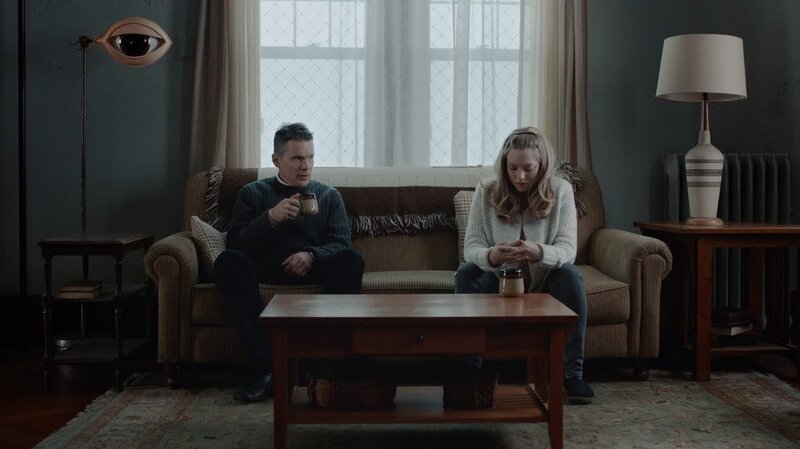
Image result for first reformed
I mean, let’s just talk it out, here, shall we? We have a moral imperative to future generations, to the continued existence of life, right? And if we encounter people actively and selfishly working to destroy that future, we have a moral obligation to oppose them, right? And if they use their ill-gotten bounty to seize power and prevent us from opposing them within the system they can set up and manipulate to their advantage, our moral obligation doesn’t simply end there, right? We still have a moral obligation to take action to affect real change, to do everything which is within our power, especially in the face of a scenario as grave as the current one, right? Even potentially at the cost of our own lives? If there’s a moral argument that lets us off the hook, I’ve never heard it. And yet, this logic has led us to some extremely troubling possibilities. If we follow the values we claim to believe in, it brings us inevitably to somewhere we don’t want to go. But if we shrug them off and tacitly admit that we never really believed in them to begin with, what does anything mean?
That’s the thing about FIRST REFORMED which, at least to me, feels so gutting. I can’t think of another work of art which feels so honest about how hopeless the world is. Which is to say, there are plenty of dismal, hopeless movies about the inevitability of suffering, but this one comes by that hopelessness is a uniquely intellectual way. There is no obvious weakness in Toller’s logic, there is never any point where you can argue he’s missed something or has other options. (vague SPOILERS follow) If he believes what he professes to, then the only two options are either the one he takes or the one Michael takes; the “best” option the film offers, and the one it ends on, is maybe he just gives up and tries to live a happy life and not think too much about the stuff he claims to believe in. (End vague, minor SPOILERS)
In short, any sort of intellectual honesty about our responsibilities to the world leads to a miserable selection of impossible solutions. It’s the perfect microcosm of the inescapable dismal logic of my life so far, and the reason I don’t know that I’ve ever seen a fictional character that I so profoundly saw myself in. I’ve struggled with this very dilemma myself, and my continued existence is less a testament to my successful moral reckoning than my cringing willingness to dodge these questions and retreat back to the simpler comfort of living my own small life. But that solution comes with its own sort of fatalist emptiness, a willed myopia in the face of total hopelessness that anything can be done to save humanity from itself. We’ve come too far, it’s too late now. This gets worse and worse from here, and all we can do is watch it all fall apart and try and cling to our tiny lives and try to put it out of our minds as much as we can.
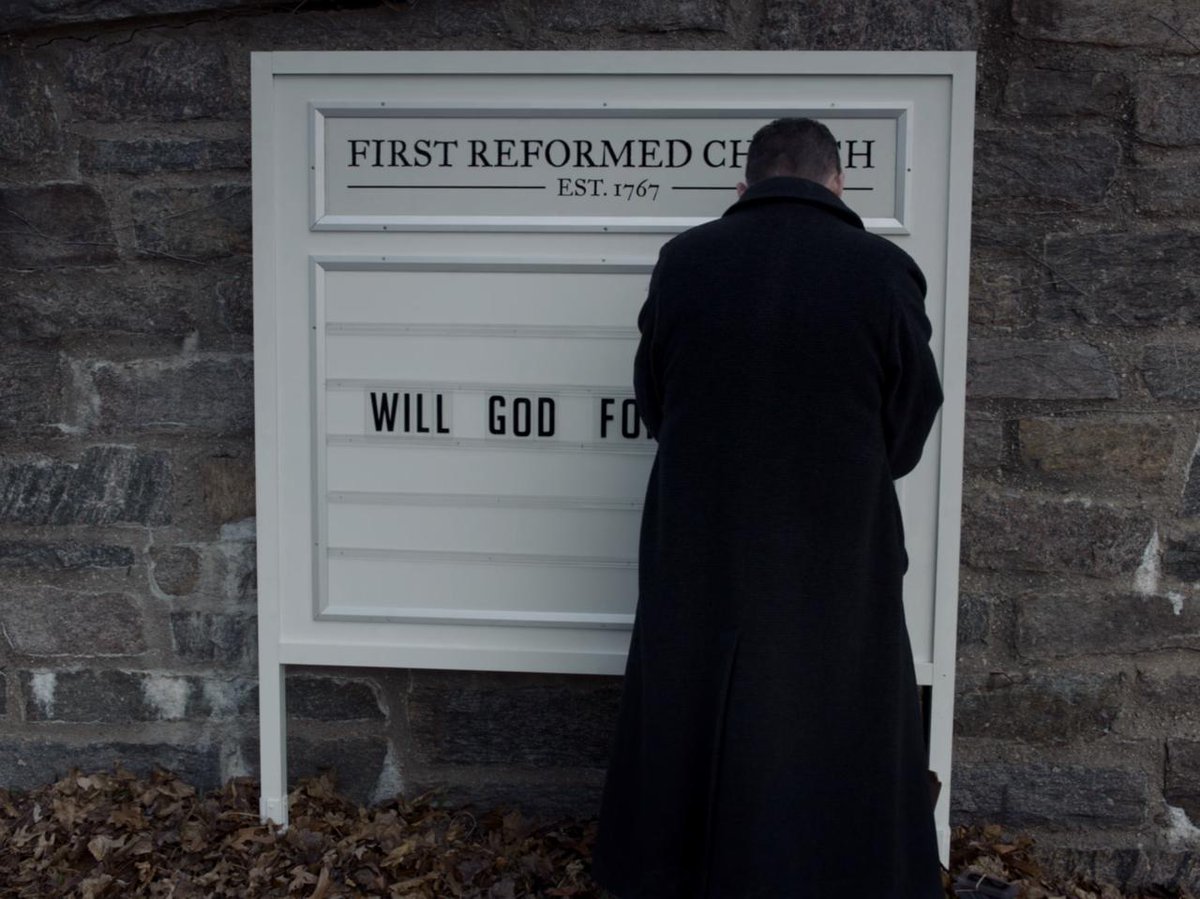
Image result for first reformed 
****************************
(END SPOILERS FOLLOW – read only once you’ve seen the movie) And indeed, it’s on that very note of dissatisfying uncertainty that the movie ends. And it’s an appropriately jarring ending which suddenly swerves away from the fatalist TAXI DRIVER climax it seems to be headed towards, instead settling into something much stranger and more mysterious. It builds to the perfect apocalyptic pitch of inevitable tragedy… and then, suddenly, a little glitch throws the whole thing off. Toller has gone too far now to turn back, and yet suddenly he can’t go forward. It’s a beautiful evocation of how life can disrupt our plans, even when we’re at our most certain.
(END SPOILERS CONTINUE – read only once you’ve seen the movie) I mean, as upsetting as Toller’s solution is, it’s also very much a relief to him; he’s miserable anyway, and this is a chance for an escape as much as it is a strike against the evil of the world. He’s finally at peace, he finally has purpose, finally has some hope that he can do some good. And then, just as he’s reached the point of no return, the situation shifts and he finds his certainty that he’s doing the right thing colliding head-first with his deep care for another person. It’s an absolutely irreconcilable situation; his conscience won’t let him do what he was planning, and yet it’s the only thing left that he can do. The only thing to survives that paradox has nothing to do with philosophy or conscience, it’s just his simple instinctual need for human connection. Something innate, immediate, physical, far removed from both thought and consequences, but no less inescapable, though it’s something he’s spent the whole movie trying to escape. It’s strange and awkward and confounding, and that’s just how life is. Certainty is easy, but life has a way of turning your most ardently held philosophy into hopeless chaos.
(END SPOILERS CONTINUE – read only once you’ve seen the movie) Which brings me back to my own life again – a selfish thing to do in a movie review, I know, but something I can’t bring myself to avoid in a movie which feels this personal. I’ve always used this blog as more of a journal than a catalogue of artistic merit, and with this particular film there’s no escaping it, my reactions are too intrinsically linked to my own struggles to separate them out and pretend this is in any way an objective discussion of a film. I relate so intensely to Toller’s philosophical free fall because I’ve lived it. I think I can say without false modesty that I’m a guy who desperately wants to do the right thing (regardless of how rarely I manage to do so), and that the only approach to that goal that I ever understood or related to comes through rigorous intellectual inquiry. Other people relate to things more empathically, and I think that’s good and necessary, but it’s not what I’m equipped for. Rational analysis is the only way I know to make sense of the world and how we’re supposed to live in it. I think Toller would probably describe himself the same way, and that’s why I see so much of myself in his complete disarray at the end. When a person like this follows what seems to be an irrefutable logical argument to a conclusion which gives you a rare sense of certainty and purpose, only to find that it brings you to an impossible, unworkable scenario… it’s destabilizing on a level that’s hard to even describe. I suspect it’s somewhat akin to suddenly losing your deeply held religious faith. You go through a period where everything feels like some kind of giddy, nonsensical dream. You feel panic, desperation; every action you take feels random and out of your control. You want to die, you want a sign, you want something to resolve it all, you crave that apocalyptic sense of self-destruction that was going to wrap everything up so neatly. 
But nothing ever comes, and then you just keep waking up every morning, and finally you have no choice but to do the hardest imaginable thing, which is to just keep living. The end of FIRST REFORMED is the best portrayal of that mental journey I’ve ever seen on screen; it captures the abruptness of it, the frustration, the uncertainty rushing back in all at once, and, most of all, it captures the infuriating open-endedness of a desperate question which doesn’t have an answer. When you find out that you’re actually going to have to live, even though you don’t want to and don’t have any clue what you’re supposed to do about that. It’s strange and disorienting and awkward and beautifully unfinished. 
***************************
Related image
Very few works of art can support a vision that bleak, and almost none ever try to reach that emotional point through intellectual rigor instead of emotional manipulation. I doubt it’s the best way to reach most people, but to me, watching this felt like having my guts ripped out. And yet, I’m not sorry that I did. It’s a relentlessly miserable, despairing film, and yet I emerged from it feeling oddly comforted. In a funny way, as hard as it was to watch, I felt a little less alone after seeing it. I’ve already been through this, lived through it, fought through it, maybe even self-indulgently wallowed in it. I know this terrain intimately and deeply. My demons are already all-too-aware of the litany of despair which FIRST REFORMED inventories, and they emerged from the experience without any fresh ammo, but perhaps somewhat cowed to be dragged out in the open with such vividness and empathy. Neither Paul Schrader, Reverend Toller, nor I have managed to wrestle an answer out of the hopeless paradox of existence, but having fought through it with them, I feel a certain spark of camaraderie. If I still don’t understand, there’s a certain succor to at least feeling understood.

*Which should by no means be taken as an argument against greater diversity in film; if anything, it should be read as an argument for more. Thousands of cis white male actors and I still find it astonishing when I see one who I actually feel some personal identification with. Imagine how a trans Indonesian plumber or someone must feel! We need more stories told!

THE BEST OF 2018, AS SEEN FROM 2019: THE SERIES


Thursday, March 31, 2016

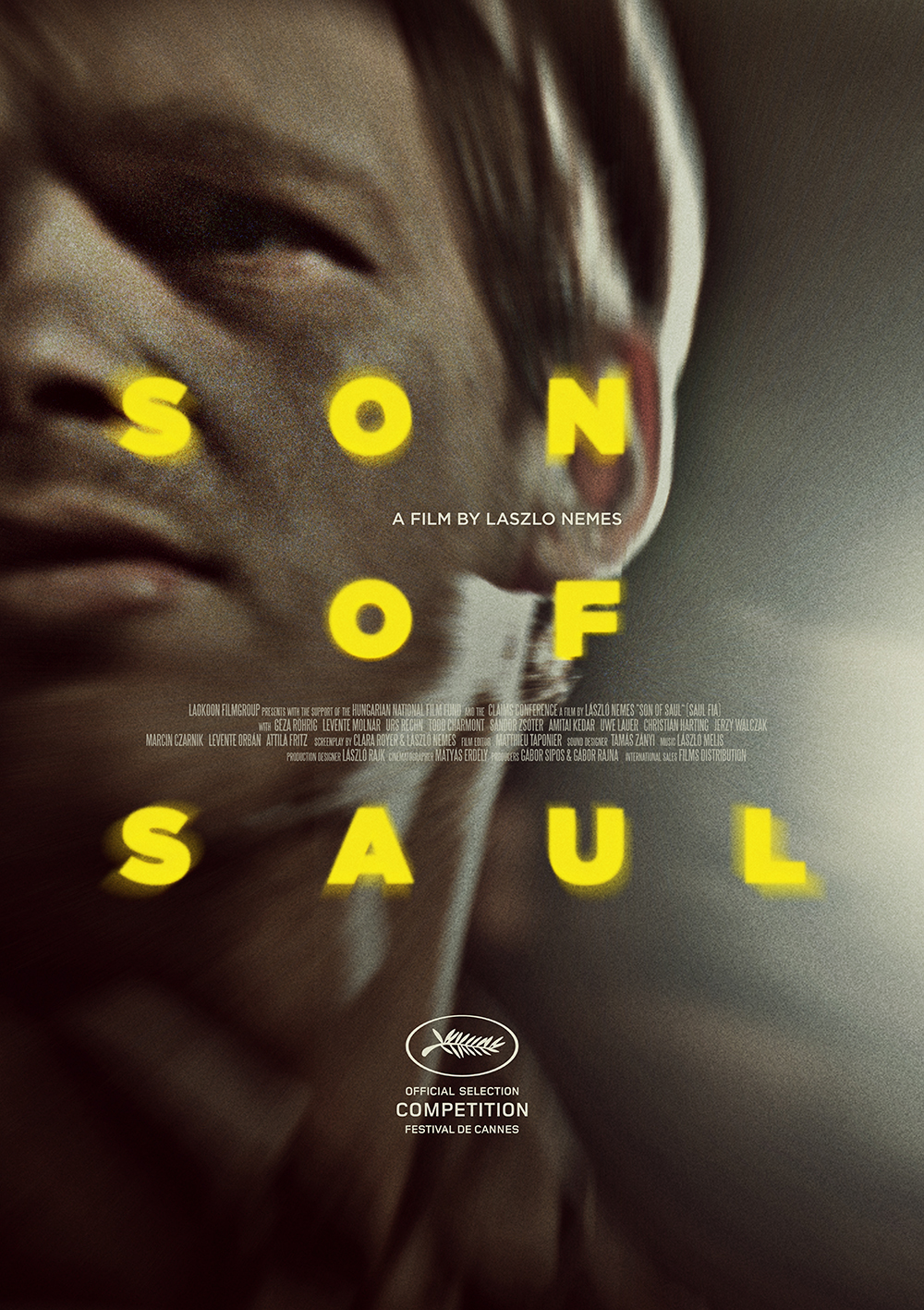
Son of Saul


Son Of Saul (2015)
Dir. László Nemes
Written by László Nemes, Clara Royer
Starring Géza Röhrig, Levente Molnár, Todd Charmont, Urs Rechn


“And I don't think we really need another film about the Holocaust, do we? It's like, how many have there been? You know, we get it - it was grim, move on. [But]... I've noticed that if you do a film about the Holocaust - guaranteed Oscar,” says Kate Winslet in her 2005 episode of Extras. She subsequently went on to win a Best Actress Oscar three years later… for a film about the Holocaust. Incidentally, this one also won. Ain’t life too funny? But yuks aside, she’s not wrong, Holocaust films are only slightly less ubiquitous than Dracula adaptations these days. And yes, we get it - it was grim, and --if movies are to be believed-- usually also it inspired heartwarming acts of compassion. Is there really a lot more to say about this? SON OF SAUL answers Kate directly: yes, there is. At least a little bit more, and especially if said with this degree of stylistic verve and audacity.


This --holy cow-- debut feature of Hungarian director László Nemes somehow finds an intriguing new angle on abject human suffering, depicting Saul, a Jewish-Hungarian prisoner in Auschwitz. Saul has been commandeered into a job as a Sonderkommando, a forced laborer whose job primarily consists of helping the Nazis recover valuables from, and dispose the bodies of, gas chamber victims. This work has clearly taken a significant toll on his mental health, and the brilliant 35mm camerawork by Mátyás Erdély (THE QUIET ONES, JAMES WHITE) emphasizes his self-protective myopia by maintaining a tight shallow focus on Saul and leaving everything outside a few feet from his head a hazy blur. I should say, maintaining a radical tight focus; virtually the entire movie follows Saul and his perspective --and frequently just the back of his head-- as he wanders through a mercifully blurry hellscape which had become horrifyingly routine to him. But Saul’s numb withdrawl is broken when he finds a corpse of a young boy who he insists (despite some evidence to the contrary) is is son, and he becomes singlemindedly fixated on finding a rabbi to give the boy a proper burial. This task --difficult enough in a death camp-- is further complicated by a burgeoning prisoner revolt which requires Saul’s increasingly unstable help, substantial language barriers, and the ever-present danger of getting shot or thrown into the gas chamber with everyone else. Against all odds, then, SON OF SAUL is actually more thriller than weepy-eyed melodrama, a harrowing race-against-the-clock by a man who literally has nothing to lose, and will risk his own life and anyone else’s in this final, clumsy, fanatical gesture towards not entirely losing his soul.  


As Saul, Hungarian-born Bronx-based poet Géza Röhrig (who had acted only twice before, in two late 80’s TV productions) brings a stubborn, stoic intensity to a complicated and not always entirely sympathetic role. Saul is so single-minded in his pursuit of dignity for the dead that he frequently abandons the living, giving us something maybe genuine new in a Holocaust film -- some deliberate moral ambiguity. He’s had to endure unimaginable horrors, but he’s also not a passive victim or a saintly martyr, he’s a flawed but fierce man dealing with being pushed to the outermost extremes of the human condition the only way he’s able. It ensures the film is about more than a simple revolt against the forces of inhumanity, and it makes Saul’s redemption arc all the more uncertain.


These nuances are good, because as upsetting as it is, Nemes crafts such kinetic, intense scenes with his showy, relentless handheld-camera takes that the movie actually threatens to be exciting. Fortunately it’s about stuff too, so we’re not put in the uncomfortable position of recommending an art film set in Auschwitz simply because it’s inarguably an edge-of-your-seat white-knuckled thrill ride. Please don’t credit me on the poster with that quote, thanks guys. But seriously, there are sequences in here so wildly immersive that you’ll forget you’re supposed to be all reverent about this and simply get lost in the wild abandon of the filmmaking. At its best, though, it does both -- a sequence where Saul accosts a group of new arrivals marching to their deaths in a corpse-strewn firepit is as nightmarish and gut-wrenching as anything which has ever been put to celluloid, but also packed with both powerful human moments and a terrifying, desperate urgency which can’t help but be thrilling even as it is utterly repulsive. Cinema doesn’t get much more powerful than that. It’s a sequence which I expect to remember very vividly many years from now.


But there are quieter moments, too, which are no less powerful. Saul can be a difficult character to entirely understand or identify with, but there’s no missing that there’s a lot going on behind his eyes. In fact, just before the scene I just described, there is another, almost equally intense scene, on a much more intimate scale. Saul is tasked with picking up a crucial item from a fellow conspirator named Ella, who he says he doesn’t know. But when he sees her, it becomes obvious they do know each other. Who she is, exactly, and how they know each other --let alone why he would lie about it-- we are never told. But they have a fraught, emotionally painful conversation with just their eyes, in total silence. Much of the movie evokes the searing, virtuosic depictions of chaos and horror in things like COME AND SEE and CHILDREN OF MEN.* But it’s impressive that Nemes can find such rich and mysterious feeling in smaller moments, too. It’s this sort of brilliant evocation of both the subtle and the grandiose that helps SON OF SAUL transcend pigeonhole labeling. We may not need any more film about the Holocaust, but this is simply a great film -- and we need all of those that we can get.

*And I don’t mean it’s derivative; comparing anything to COME AND SEE is among the highest compliments one can pay.


You loved the movie? Buy the merchandise! Collect all four limited-edition slurpee cups!

Thursday, January 7, 2016

The Final Terror


The Final Terror (1983) aka Carnivore
Dir. Andrew Davis
Written by Jon George, Neill D. Hicks, Ronald Shusett
Starring  John Friedrich, Rachel Ward, Daryl Hannah, Adrian Zmed, Lewis Smith, Ernest Harden Jr, Mark Metcalf, and Joe Pantoliano.


The first thing that jumps out at you about THE FINAL TERROR is its pedigree. Check it out, very early roles for Daryl Hannah, Rachel Ward, “and Joe Pantoliano as Eggar” (as the credits knew to introduce him, even though it was only his third credited role.) And it was the second movie for director Andrew Davis, future director of the Academy-Award-nominated THE FUGITIVE. Davis would later give Steven Seagal his start and his biggest hit by directing ABOVE THE LAW and UNDER SIEGE respectively, direct Tommy Lee Jones to his first and only Oscar, give early starring roles to Viggo Mortensen and Shia LeBeouf, and even directed Chuck Norris in his sole semi-respectable movie CODE OF SILENCE. His contributions to Seagalogy alone would make him an American hero even if he had never made a slasher with Joe Pantoliano... and he did that too, so having him at the helm is pretty cool. Plus, it was co-written by Ronald Shusett, who does not in all honesty have an unimpeachable track record of greatness, but when you number among your successes ALIEN, DEAD AND BURIED, and TOTAL RECALL, you’re forgiven a lot of FREEJACKS. That’s quite a lot of talent for a movie which didn’t even get released for two years after its production, and more than enough to make you extremely suspicious about why you’ve never heard of it before. This has BLEEDERS or EXORCIST II written all over it -- a can’t-fail proposition which obviously must have failed spectacularly, or you’d have already seen it.


But strangely, THE FINAL TERROR doesn’t exactly fail. It’s just not what anyone would expect, and it’s completely understandable that no one would expect it because there’s nothing else really like it. Shot in 1980  --just two years after HALLOWEEN made piles of money and inaugurated an army of imitators which would dominate the horror genre for the next decade-- this one, like HE KNOWS YOU’RE ALONE a year earlier, is one of those curious very early slashers which tried to replicate the success of HALLOWEEN before the slasher genre really solidified into the standard template it eventually became.


Today, everyone knows the formula for a slasher: A bunch of teens head out to some isolated location, fuck each other and prattle on about nothing and gradually get bumped off one by one in increasingly outrageous ways by a deranged killer of some kind, probably wearing some sort of mask. They’re supposed to be kind of goofy and sophomoric, and the emphasis is on the imaginative gore and establishing the killer’s iconic gimmickry. In fact, the emphasis is almost entirely on the killings, to the exclusion of other aspects of storytelling. This is just one of those The Way Things Are things; there’s some room for variation in the details, but the structure itself is pretty ironclad. So much so that today, if a movie with a killer strays even a small amount from the formula, it’s inevitably going to be notable mainly for its undermining of our expectations, and hence is going to be defined by traditional slasher expectations anyway. If your movie has a killer and a bodycount, you can be a traditional slasher or a commentary on slashers, and those are pretty much your only options.


But back in 1980 when this thing was made,* things were a little more fuzzy. We understood that there needed to be some kind of killer with a mythic backstory, and we understood that there needed to be a cadre of expendable generically pretty white people and maybe their one black friend who get killed. But as to the specific structure and the tone, things were still pretty undefined. In fact, the whole genre was somewhat undefined; the very term “slasher film” had not yet come to prominence; the earliest use of the term that I can confirm online appears to be in Cinefantastique Magazine, Volume 11, Fall 1981, a year after THE FINAL TERROR wrapped (though its use in that article makes it clear it must have been at least somewhat recognizable in the parlance of the time; I can find some evidence of other possible earlier examples, but for which I can't lock down a definitive date). I very much doubt anyone on the set considered what they were making to be a “slasher film,” or part of any particular distinct subgenre. That would come fairly soon; in the next few years, other movies would figure out how and what to mimic in HALLOWEEN and --especially-- FRIDAY THE 13th, the genre-defining series which premiered the same year THE FINAL TERROR was filmed. But remember, even FRIDAY THE 13th didn’t quite get the formula fine-tuned until 1982’s third sequel, the first where Jason picks up his iconic hockey mask. At the franchise’s humble beginning, the films still had the rough shape of a slasher movie, but with some decidedly unusual quirks.


Likewise, THE FINAL TERROR is unmistakably and unambiguously a slasher movie in some ways, but in others it’s totally unlike any other genre movie I’ve ever seen. It’s an incredibly bizarre misery-porn survivalist slasher-meets-DELIVERANCE hybrid. The setup is classic slasher -- a bunch of, I guess, camp counselors (it’s a little unclear) wander through the forest and have shenanigans, only to be attacked by a murderous backwoods psycho with a tragic backstory and a signature weapon. That sentence describes roughly 658,000 identical z-grade movies from the 80s, but THE FINAL TERROR doesn’t play out as you expect at all.


It starts the way you expect, though: with an inexplicable mostly mumbled semi-explanation as to what’s going on with at least some of our characters. I think it’s clear that they’re at least in some way kind of involved with some sort of woodland youth camp, though I can’t tell if they’re all counselors or if some are counselors and some are campers and they’re just the same age. They talk about it being a “work detail” and some of them are wearing uniforms, but then they also pick up a bunch of women to go into the woods and have sex with? Their bus has “Redwood County Youth Corps” crudely stenciled on the side, and the back says “Wild River Fire Base,” whatever that means. Googling “Youth Corps” produces a ton of hits, but they seem to be disparate organizations with the same generic name, and mostly for kids in early high school (is that how old these 20-somethings are supposed to be?). There is a Redwood County, Minnesota -- is that where they’re supposed to be? Googling “Redwood County Youth Corps” doesn’t produce any hits, but Redwood National State Park (in California, and not in Redwood County) does employ something they call a “Youth Conservation Corps” which their website claims pays $8 an hour to youths age 15-18 for “a chance to participate in conservation work throughout Redwood National and State Parks...Specific work projects include trail building and maintenance, painting, landscape projects and general park cleanup. Participants may also assist in backcountry road maintenance and removal of exotic plant species within the park boundary. Natural and cultural resource education is incorporated into the eight-week program, as well as a backcountry camping trip and year-end picnic.” (source) These characters wear badges which look similar to the National Park Service badge, so I think this is the most likely explanation, but man, $8 per hour of taxpayer money is going to these hooligans so they can tromp through the woods and get high and fuck each other? Oh my god, Grover Norquist was right! Maybe I’m getting old, but these kids are so rambunctious my first assumption was that this was some sort of forced labor camp for juvenile delinquents.


Anyway, it took me three viewings and quite a bit of googling and meticulous pausing to unravel the mystery of what the basic setup is, which means this probably approaches Amando Ossorio levels of unnecessarily convoluting a basic premise. But even from the start, we have a pretty good idea that these kids (?) aren’t going to have time for a lot of backcountry road maintenance or removal of exotic plant species. The first thing we see on-screen is a young couple who who end up the victim of deadly traps set by an unseen killer, before the title even comes up. Even the characters in the movie seem to understand that this isolated event will later impact them:  “What about that missing couple?” one concerned parent of one of the girls asks. “They’ll be OK, there’s three adults” Mark Metcalf, who seems to be the leader, explains. I guess he’s about 10 years older than the rest, but I don’t know who else he’s talking about, and all the actors including him are between 20 and 35.

Anyway, off we go to the woods, with a full complement of young people to kill off. The one person not along for the ride is the only other guy besides Mark Metcalf who seems to be a paid employee of anything, and that would be the shifty, suspicious Southern bus driver Eggar [sic] (Joe Pantoliano, THE MATRIX, THE FUGITIVE), who does not cotton to the idea of bringing nubile teens into nature for the purposes of having sex (remember, this was before the invention of having sex somewhere with a bed and shower, so heading off into the woods under the vague auspices of working for the National Park Service was the only option available to any of these kids if they wanted to get laid). Though he’s hard to understand with his hillbilly drawl, Eggar seems to be warning them away from this particular wilderness trail, and really takes it suspiciously personally when one of the kids tells a spooky tale about a murderous backwoods psycho who is said to haunt these very woods. The next morning, Eggar and another camper have mysteriously vanished. Hmmm….


Right where the backstory of the killer gets pre-explained, though, we suddenly see we’re not dealing with a normal slasher. Because this is absolutely the most depressing backstory of any killer in history. Here is the entire tale, transcribed verbatim (punctuated as its inflections dictate), as related by one of the kids around a campfire, as if this were in any way an acceptable story to relate in this medium:


“OK, so once upon a time, not too long ago, this used to be a logging camp, right here. And there was this little sweet, 14 year old girl who lived here with a big family, and her father died so her uncle came to take care of the place. He was a lumberjack. He was a mean son of a bitch. Mean boy. And one night [his? this? unintelligible] uncle said, “hey Susie Q, you want to go for a little walk in the woods?” So he took her on one of these trails here, way far out, you know, like we are? And he raped her. She screamed but nobody could hear her. She had to keep all this inside after the rape, she couldn’t tell anybody because, you know, he was supporting the family. She was afraid to. So she started going crazy. So what they done is, they put her in a mental institution. You know, that one we passed on the way down here? And while she’s in the hospital, they find out that she’s pregnant. So she has this little baby boy. But, the Doctor says ‘well, she’s too messed up to take care of the kid.’ So they take the baby away from her. OK, so 19 years later, this young kid, just about my age, shows up down there at the hospital. And he wants to see this lady. So they let him in, and he goes crazy. He just freaks out. Says “you can’t treat my momma like this, you can’t keep her in this garbage can!” It was her son! He just stole her right out of the place, just took her. But she was so crazy, you know? That he didn’t know what to do with her, so he put her out here in these woods, so she could live in peace, you know? So the story goes, that whenever anybody camps out around here, she sneaks into your camp, she whispers to you. She bends down over you --and I mean, you can just smell her breathing on you [you feel? unintelligible] -- she says “wwhoooo stole myy laaaamp [?]? Whoo stole my… YYEEAAAAARRRRGHHH!!!” [here he suddenly screams at the listeners, startling them into forgetting that nothing in his story would explain why the murderous old rape victim would be asking questions about a lamp].


I shit you not, that is the actual backstory for the killer here. How the fuck are we supposed to hate and fear this lady now that we know she was raped at 14 and locked up in a mental institution and had her son taken from her? Can’t we just get her a sponsor and a support network, throw some empowerment platitudes at her, maybe show her I SPIT ON YOUR GRAVE for some spiritual healing, and try to help her build a new life for herself? Whatever slashing she may perpetuate, she’s spent more of her life as a victim than a villain. The movie seems to have no idea whatsoever that this is a complete buzzkill, and seems to totally expect us to come down on the side of boy, I hope these horny teens get their revenge on this crazy bitch. But as weird and inappropriate a narrative as this is for a slasher movie, it’s vastly more so in its context as a spooky campfire story. Eggar gets suspiciously angry at the guy telling the story (“What the hell you tellin’ stories like that for, huh boy?!” he fumes) and you get three guess as to why, but I can't help notice that he’s absolutely right. This is the absolute worst Are You Afraid Of The Dark episode ever. Everyone else seems to think it’s a real hoot, though.


Anyway, from there, things get back to the expected slasher routine for awhile. Everyone separates to look for the missing camper, the two 30-year-olds decide to bone in the woods instead (ironic, since the explicitly stated reason they’re out in the woods is so these young’uns can get freaky, but the only two people who end up boning are the two self-described adults who presumably do have an indoor location they can fuck at their convenience instead of a damp, fetid forest floor) and one of them gets killed mid-coitus. They find a scary old decrepit cabin which clearly has THE HILLS HAVE EYES in mind, they get attacked on a bus (in a pretty great sequence where the killer slashes at them from the roof) and have to escape in a panic.


But here’s where things get really weird. The characters here are your typical stock cannon fodder (the only actor other than Pantoliano who stands out being John Friedrich, who had already retired from acting to become a financial consultant by the time the movie came out; Hannah and Ward don’t make much of an impression other than being pretty) but the production hews toward gritty realism rather than slasher schlock. Even when they’re not being attacked by a diabolical victim of child rape, these kids are facing a real hard time; they’re out in the woods, miles away from civilization, with barely any supplies, it’s cold, it’s rainy, it’s wet, there’s nowhere to go, they’re dirty and exhausted. It’s certainly the first ostensible slasher movie I’ve seen that really labors to make you realize just how much it would suck to have to survive in these conditions. Hell, one guy even starts philosophically musing about Vietnam and how we “lost the war.” There’s a lot of talk about survival tactics, a lot of discussion as to what to do, and the people are surprisingly practical about it. They stick together, they don’t do much in-fighting. They really seem like they would like to survive, but man, this shit looks like a real drag.


But then again, it ain’t easy to be a killer, either. Slasher movies traditionally have a scene where our heroes are trying to escape, and then improbably stumble upon the body of a friend. Sometimes, the killer will even play mind games by, say, suddenly dropping the body into a group of unsuspecting victims just when they think they’re safe. That’s exactly what happens here, except for one minor detail: it’s not played as a cheap shock. In fact, we actually get to see from her own point of view how the killer accomplishes this seemingly miraculous feat of villainy: while everyone is escaping, she kidnaps the soon-to be corpse and stalks the escaping kids silently through the woods for miles, forcing the friend along at knifepoint only to slash her throat right before dumping the body in front of the panicked campers. Man, this slashing business is hard work if you wanna do it right. But I guess she doesn’t really have much else to do with her time.


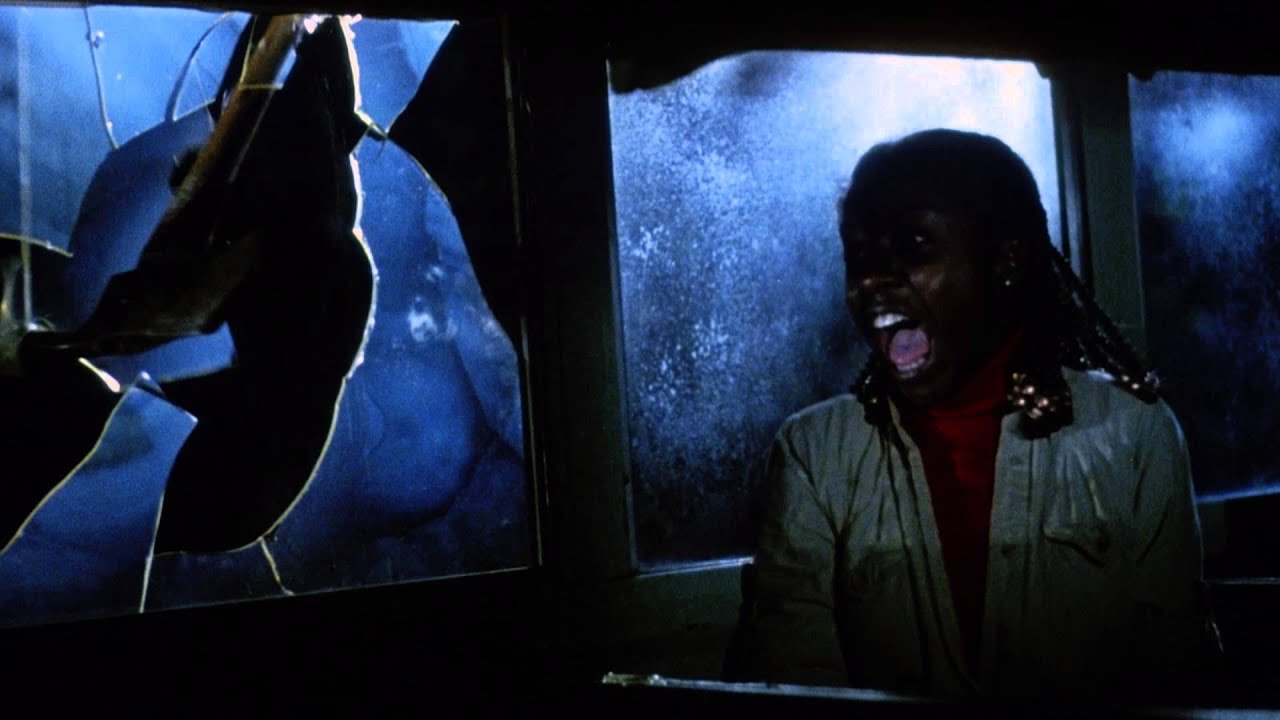
Davis has a way of shooting the forest that makes it looks alternately stunning and grotesque, half fairy-tale, half gritty, decaying reality (which, now that I think about it, more or less describes the film, too). Kinda evokes Werner Herzog’s classic rant about his perspective on the rainforest in THE BURDEN OF DREAMS; there’s nothing romanticized about nature here, it’s primordial, austere. Heck, despite the backstory, the killer herself seems to rise up out of nature, dirty and feral and unknowable. In one case literally:


Still, considering the movie’s title, there isn’t a ton of terror here. But it IS final. No sequel for this one, and I’ll tell you why. But to do so I’m going to have to SPOILER the movie’s ending. And it’s a doozy, and you don’t want that. So don’t read this unless you’ve seen the movie. Here goes:


SPOILERS SPOILERS SPOILERS SPOILERS SPOILERS SPOILERS SPOILERS


So, the kids decide they need to make a stand against Eggar, who they still incorrectly assume is the one who’s stalking them. One of them takes mushrooms and starts quietly rambling to himself about Vietnam (not that he was there, he’s like 23 and this is 1980. But still, I’m sure it was on everyone’s mind still), but the rest decide they have to hatch a plan. We catch up to them early the next morning, as someone is scaling a giant redwood for reasons we don’t understand yet. Next, they lure Eggar out of the woods and beat the tar out of him (which seems kinda sad, since we know he isn’t actually trying to kill them, but instead trying to protect his mentally ill mother). That rouses momma bear, who comes running out of the woods with murder in her eyes. But they’re not the ones who should be worried. Out of the fucking blue, the lady springs a trap which brings a giant, spiked log hurtling out of the sky, ewok-style. All she can do is blink in surprise before she’s impaled on this giant wooden stake and whisked off into the air, to swing limply back and forth as the funky theme song comes back up. Roll credits. Holy shit. That’s gotta be one of the most abrupt and definitive endings in all of slasherdom. No denouement, no epilogue, nothing to tell us that Terry “The Toad” was killed in Vietnam, just a sudden, violent comeuppance for our killer and we’re fuckin’ outta there. The suddenness of such a brutal conclusion and its brazen disregard for the cardinal rule of a slasher -- leave it open-ended enough for a sequel -- make it kinda jaw-dropping even in a movie which never quite goes where you think it will.
END SPOILERS END SPOILERS END SPOILERS END SPOILERS END SPOILERS


Anyway, despite the assembled talent here there’s probably not quite enough juice to coast to “unfairly-ignored gem” status. It’s real slow-moving, the survivalist stuff is OK but not such a great match for the slasher parts, and the whole thing is a little too serious-minded to be as much fun as the schlocky premise requires. But it’s definitely worth a true slasher connoisseur's time for it’s agreeable uniqueness, and especially that crazy ending. It’s more an interesting evolutionary curiosity than an independently great work of art, but hey, at least it’s interesting, there’s dignity in that, and it’s really more than I dared hope for. An interesting window into a parallel evolutionary world where the slasher genre took a radically different direction. I’m glad we don’t live in that world, but it’s an interesting place to explore for an hour and some change. Plus, Joey Pants has a ridiculous over-the-top redneck accent, how are you supposed to live your life not having seen that? Fuck it, I’m convinced, you should definitely see this thing.

* Again, note that it was shelved til 1983, and only premiered thanks to the burgeoning popularity of its at-the-time unknown stars Daryl Hannah and Rachel Ward


CHAINSAWNUKAH 2015 CHECKLIST!
Play it Again, Samhain

  • TAGLINE: Without knowing, they have awakened an unknown force... can anyone survive?
  • LITERARY ADAPTATION: No
  • SEQUEL: No
  • REMAKE: No
  • DEADLY IMPORT FROM: USA
  • FOUND-FOOTAGE CLUSTERFUCK: No
  • SLUMMING A-LISTER: Daryl Hannah and Rachel Ward had become famous in the two intervening years between the film's production and its release. And Joey Pants is as goddam A-list as they come.
  • BELOVED HORROR ICON: Writer Roland Shusset
  • BOOBIES: None
  • MULLETS: Oh yeah.
  • SEXUAL ASSAULT: No
  • DISMEMBERMENT PLAN: None, this is a mostly throat-slashing affair.
  • HAUNTED HOUSE: No
  • MONSTER: No
  • THE UNDEAD: No
  • POSSESSION: No.
  • SLASHER/GIALLO: Yes, though an early and weird one.
  • PSYCHO KILLERS (Non-slasher variety): No
  • EVIL CULT: Nah.
  • (UNCANNY) VALLEY OF THE DOLLS: None
  • EGYPTO-CRYPTO: No
  • TRANSMOGRIFICATION: None
  • VOYEURISM: Nah
  • OBSCURITY LEVEL: Extremely high.
  • MORAL OF THE STORY: Victims of childhood rape are murderous psychopaths, and should be isolated from everyone.
  • TITLE ACCURACY: Not a lot of terror, but definitely plenty of finality.
  • ALEX MADE IT THROUGH AWAKE: No, slept.


Add caption