
The Black Room (sometime between 1982 and 1984)
Dir. Elly Kenner & and “co-directed by” Norman Thaddeus Vane
Written by Norman Thaddeus Vane
Starring Stephen Knight, Cassandra Gava (as Cassandra Gaviola), Jimmy Stathis, Clara Perryman

You probably haven’t seen THE BLACK ROOM. That’s a shame, but it’s understandable, since most people haven’t seen THE BLACK ROOM. It’s a fairly difficult movie to see. Shot in 1981, it struggled to get a US theatrical released until 1984, and frankly I’m not sure what kind of release it got even then. I can find no record outside of IMDB that it was ever released in theaters in the US at all -- no box office numbers, no firm release date, no theatrical posters, no ads. The shady gray market website from which I bought the VHS-ripped DVD originally claimed it was made for cable; I can’t find any evidence to support that claim either. But then again, I don’t know what it was made for -- or who, for that matter. THE BLACK ROOM is a very weird movie. But I think it may be kind of great.
You know it’s not gonna be a normal movie right from the credits. We open in a bizarre, stylized room -- a literal black room, completely dark except for a couple candles and a boxy, coffin-like table which glows brightly from within. It looks like the perfect place for some kind of occult tomfoolery, but the current occupants are using it for another purpose, which is hot naked fuckin.’ It’s not exactly porn but it’s at least late-night-cinemax level (is that still a thing?), and we get to it before a full minute of screen-time has elapsed. And we’re not done yet. Because while we’re so enjoying watching these unknown characters have some very sensual lots-of-kissing-and-hugging-and-holding-each-other sex, someone else is doing the same thing we are -- there’s a secret peephole through which an unknown voyeur is watching. Only, he’s not just there for the show; while the two lovers are occupied, this unknown watcher sneaks into the room with a syringe in one hand and a chloroformed rag in the other. Quick shot of some kind of medical machine running. Quick shot of blood draining into a medical beaker. Cut to the bodies of the two lovers crudely buried in the backyard by a mysterious man and woman.

Having just witnessed a sex act which did not turn out so great, we quickly move on to another: our protagonists Larry (Jimmy Stathis, X-RAY aka HOSPITAL MASSACRE) and Robin (Clara Perryman, an episode of Remington Steele) are a happily married couple in the middle of getting busy, when they’re interrupted by their kid whining from another room. Fortunately the kid doesn’t walk in on them, as we know from all the giallos we’ve seen that this is a surefire ticket to becoming some kind of sex pervert homicidal maniac. So, crisis averted there. Unfortunately, the crisis of Larry’s libido is not so easily averted, and the very next day we see him circling ads in the “rooms for rent” section of the local paper. He’s not just casually flicking through either, he picks up the paper and turns right to that section. He’s been thinking about this for a long time. Now, you’re probably thinking “aww, he’s renting a room so he can finally boink his wife in peace without the risk of turning his kid into a gimmick killer.” But try not to look too shocked when I tell you that his plans for the room do not actually involve his wife.
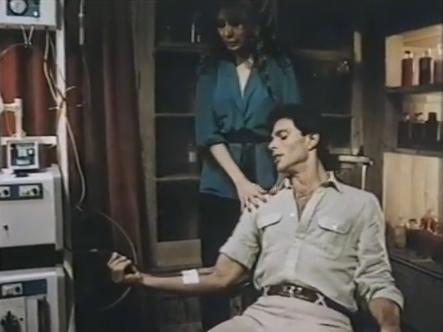
Wouldn’t you know it, the room Larry has bookmarked for a clandestine love nest is actually the very same room we just saw in the opening credits. It seems that the room is located in the Bates-motel-esque Hollywood Hills luxury home of Jason (Stephen Knight, “1983 Re-Issue of NECROMANCY aka THE WITCHING”) and his sister Bridget (Cassandra Gava, CONAN THE BARBARIAN), who are very, very accommodating of Larry’s desires to an almost uncomfortable degree. Particularly considering that Jason has a rare and fatal blood disorder which requires frequent transfusions. I mean, it’s truly heartwarming to find that there are still people in the world who, regardless of their own health, are not only OK with renting out a room in their home so horny guys can cheat on their wives, but go the extra mile and proactively stock it with lit candles, fine wine, and (one would hope) fresh couch pillows, so that everything is ready to go when the pre-seduced young lady of the hour arrives. “This place is really something else. So many candles!” Larry gushes, ignoring how openly creepy the room and its owners are. (One weird thing about this room, while we’re on the subject: everyone who sees it takes it for granted that it’s strictly a sex room. But there is no bed here at all. Aspiring sex partners have to choose between a slim couch and the oriental rug* on the floor. Admittedly --as is made indisputably clear during the course of the movie-- love will find a way, but it might be kind of an uncomfortable way which doesn’t provide for a lot of positions, is all I’m saying. But maybe that’s why it’s so affordable).
Anyhoo, you can see where this is going. Larry brings sexually liberated young co-eds back to the room, bangs ‘em, and meanwhile Jason and Bridget hide behind the peephole and take pictures (which I can’t imagine come out too well in such low light and through glass, but whatever). To blackmail him, you ask? Nah, they’re just into that. Actually their plan is to wait til Larry has a girl with him and suddenly has to leave her alone and run off, and then to lock her up and slowly drain her blood to keep Jason alive. Foolproof.

While on paper this seems like a lazy setup for some kind of aimless skin flick a la Jean Rollins, there’s a surprising amount of effort being made here by the filmmakers, which makes this seem like anything but the sleazy exploitation flick it probably is, or at least was intended to be. Cinematographer Robert Harmon --in only his second and last film in that capacity, before graduating to director with THE HITCHER and NOWHERE TO RUN -- shoots with some genuine ambition, letting the “black room” turn into an abstraction of hard light and indulging (with camera operator Jeff Mart, PUMPKINHEAD) in some lengthy steadicam shots, most notably during a genuinely intense aborted escape attempt by one of the captive girls. Combined with a droning, atonal score from James Ackley (primarily a composer for horror video games like Condemned and F.E.A.R.) and Art Podell (HOLLYWOOD ZAP!**), the movie captures an uneasy atmosphere which lingers despite (and maybe even because of?) the generally wooden line readings. It’s a disconcerting ambiance, which insists that underneath the most mundane situations, something is rotten. That the nightmare world is closer to the surface than anyone dares acknowledge, that perhaps we can even slip in through the cracks without realizing it. How else to explain that no one seems to find this bizarre “black room” an odd place to bring a date? There’s always the faint intimation that something is going on here even more sordid than marital infidelity and involuntary blood donations, which never quite materializes until the very, very end (if at all) but colors the whole experience nonetheless.
And it’s not just the atmosphere which is a little more interesting than you might expect. It also finds unexpected nuance in its pervasive sexual elements. I’m not saying that it’s not a pervy exploitation picture trying to grift some easy money by peddling deviant sex to undiscriminating genre fans, because it definitely is that. But it also has a somewhat more adult and unorthodox outlook on sex than you would typically get in a movie like this. For one thing, it’s surprisingly non-judgemental about Larry and his extramarital side projects, presenting him as a genuinely loving husband and father, who just also happens to fuck a bunch of co-eds and prostitutes on the side. It doesn’t exactly condone his behavior, but it doesn’t exactly condemn it either -- and it would be so easy to do so that refraining from condemnation imparts a startling sense of intent on the part of the filmmakers. Part of this is probably purely self-serving; writer and co-director Norman Thaddeus Vane (writer of FRIGHTMARE) calls the story a somewhat autobiographical account of his own history of infidelity to his 16-year-old wife Sara (which is also the basis for the eyebrow-raising Charles Bronson vehicle LOLA). To get some perspective on his life at the time, consider this excerpt from an interview he did with Hidden Film in 2012:
“When Penthouse launched in England [1965], I submitted a story to Bob Guccione about an English orgy. We used to have them in those days. They happened on Friday and Saturday. There’d be about 15 to 20 people there and they were all very elite. There was a famous barrister who used to throw one. You’d have a very luxurious dinner and little by little, the orgy would start. Bob called me up and said “We’re not ready to do a story about an English orgy yet, even if it’s true. But would you like to be the editor of Penthouse?” He paid me a hundred pounds a week, and he also let me do theater, movie and book reviews. I did that for a year. It was fun, because we were all getting laid by the beautiful girls that wanted to be in Penthouse. I always had sex with them before Guccione did. It pissed him off. I said, “OK, you interview them, Bob.” ...If you interviewed a girl and she wanted to do the center spread of Penthouse, and she went to bed with you, she knew and you knew that that was gonna help, not hurt. It wasn’t all the girls, it wasn’t half the girls, but it was quite a few of the girls. They were not exactly churchgoing debutantes.”

So, that’s the kinda guy we’re dealing with here, and also the time we’re dealing with. The film, though completed in 1981, feels very much like a holdover from the hedonistic 70’s, in both its frank sexual adventurism and its sedate artiness. But that’s not necessarily a bad thing, at least in terms of art. While it’s easy to see Vane’s kid-gloves treatment of Larry as merely a self-serving fantasy cover for his own caddish behavior, I’m not convinced it is entirely that. And even if it is, there’s still something intriguing about seeing film characters portrayed this way, particularly in a horror context. Don’t get me wrong, these are not especially interesting or well-developed characters. Still, it’s startling, and perhaps even a little elucidating, to witness a character arc that seems an almost comically easy setup for a pat morality tale which instead evolves in a less didactic way. Larry doesn’t exactly lie to Robin about the black room, and he doesn’t neglect her either -- instead, he describes his activities there in vivid detail to her, but in a way which leads her to believe that they’re merely erotic fantasies to spice up their sex life. And it actually works -- she’s into it, too. In fact, the movie comes perilously close to intimating that perhaps this is actually good for their marriage.
If it sounds obsequiously self-serving for a male writer with a long and open history of marital infidelity to make the case that cheating is a near-altruistic act, though, the latter half of the movie smartly challenges that impulse. When Robin discovers that his stories have been anything but fiction, she’s initially hurt and betrayed. But it’s not long before she arrives at the conclusion that maybe Larry is onto something here, and finds her own horny co-ed (in this case, a pre-fame Christopher McDonald of HAPPY GILMORE!) to bring to the black room. And to the movie’s credit, this isn’t presented as a petty, vengeful act, but rather an honest expression of her own repressed sexuality. Seems these two kids really have a lot more in common than they realize.
Well, sort of. When Larry discovers that his wife is pulling the same scam that he is, he’s the one who gets angry and jealous. This is, of course, blatant and unmissable hypocrisy, and the movie makes no excuses for him. Infidelity isn’t much of a sin in the eyes of THE BLACK ROOM, but inequality definitely is. If the movie is really about anything tangible, it’s about Larry’s hangups about female sexuality, and his inability to take into account that it’s not just men who can be sexually unfulfilled, even in a happy relationship. The problem is with him, and if he’s not secure enough to deal with the consequences of his “solution,” the movie has no sympathy for him at all. It doesn’t judge anyone for violating the sanctity of marriage, but it definitely finds fault with Larry’s revealed need to control his wife’s own sexual autonomy. Which is, when you come right down to it, a sort of a third-wave feminist message a whole decade ahead of its time. While it may not exactly deserve to win any Feminist Activism Awards --the solution to this problem is that Larry is unable to deal, and he agrees to stop using the black room in exchange for his wife doing the same, which probably lets him off a little easy-- it’s at least commendable to foreground female sexual desire in a way which is, if not explicitly positive, at least presented on equal footing with male sexual desire, with a distinct nod towards male hypocrisy and misunderstanding regarding the fairer sex.
That’s surprisingly complex stuff for what is basically a tarted-up boarding-house slasher setup. There’s no shortage of sex in the horror genre, of course, but the vast majority of it is both of the horny teenage variety and the horny teenage mindset. Sex tends to be a matter of pure libido and titillation, or a convenient means of creating physical vulnerability for the victims. Exploring sex in the context of adult, long-term relationships with more subtle emotional consequences is so rare in the genre that I’m honestly struggling to think of another example. While the scenario here is inarguably on-the-nose and perhaps a bit labored, you gotta give the movie credit for taking it seriously enough to finally have the two partners actually talk it out like mature adults with a genuine stake in working out their differences.
On the surface, it’s easy to see THE BLACK ROOM as a textbook archetype of 1980’s reactionary moralizing, wherein -- as John K. Muir wrote of the movie in Horror Films of the 1980’s, Vol 1:-- ”married people step out of accepted social mores [usually involving sex] only to see their families threatened by their irresponsible actions." But if that is indeed the intent, the movie does a real thorough job of confusing and obscuring that point. While the black room does represent an unexpected source of danger, it’s hard to find any evidence in the way the movie plays out that this is meant to represent any sort of punishment for our heroes. Both partners end up experimenting with sex outside their marriage, but in the end they reconcile and it seems that their experiences have actually improved their lives and their relationship, helping them open up to each other and face some unexpressed truths about themselves.

In fact, since Larry never realizes that his landlords are exsanguinating his sexual conquests, and he and his wife works things out on their own with a little under 20 minutes of runtime left, the movie has to pull a bit of a cheat in order to wring an adequate horror climax out of things. Turns out Bridget and Jason have designs on the blood of couple’s children, and while the two are hashing out their relationship, they snatch the kids and their babysitter (a young Linnea Quigley, RETURN OF THE LIVING DEAD, unrecognizable with her clothes on***) and the parents have to rescue them, leading to a climactic violent confrontation in the hilltop mansion.
What’s that, you forgot all about the vampiric homeowners? Sorry, I got off on a bit of a tangent there. That’s not representative of the movie though --while it does genuinely seem to care about exploring the prickly sexual scenarios it raises, it’s still a horror movie through and through, though admittedly one with a bent towards arty psychological horror more than whammy. Even so, it’s not completely lacking in earthier thrills -- the aforementioned aborted escape attempt by one of the victims is a brauvara, viscerally intense bit of filmmaking which evokes memories of ANGST in its grimy, frenzied panic and confident, kinetic filmmaking. And the climax, where Larry and Robin have to face off against their asshole landlords, boasts some intensely brutal, white-knuckle stalking action, amped up by the pervasively droning synth score that lays a thick layer of dread over top of the action. It’s not exactly HALLOWEEN, but just like most of the movie, it’s a bit more offbeat and effective than you would expect, making good use of its odd dichotomy between gritty, quiet realism and bizarre dream logic.
Even in its very last minutes, THE BLACK ROOM still manages to go somewhere surprising, finally wholeheartedly giving in to the temptation to let the nightmare take over in defiance of the grounded, deliberately naturalistic tone of most of the preceding movie. It’s an odd grace note, arguably even a twist, which seems to have pissed off every one of the three or four people I can find online who managed to watch the movie, and I guess I can understand that -- it’s certainly a strange turn which doesn’t necessarily arise out of anything that came before it. Still, I dig it. The end, like the movie itself, is clunky and ungainly in some pretty obvious ways, but also distinct and ballsy enough to forgive its shortcomings. It’s not conventionally successful enough that it’s some kind of great injustice that it lapsed into complete obscurity, but for those who are willing to seek something pretty far off the beaten path, it’s an experience with some decidedly unique strengths.
*By the way, how come those rugs are still “Oriental”? This is surely the last holdout for the word, no? You call anything else “oriental” and you’re gonna get a stern lecture, but say “oriental rug” and suddenly everyone thinks you’re cultured. Looking at wikipedia, it seems that so-called “Oriental Rugs” originate in a wide variety of countries loosely known (yes, this is real) as the “Rug Belt” which ranges from Morocco to the Caucus states in central Asia to Northern China to Pakistan and East India. Given that there is nothing “Oriental” by any stretch of the word, I move we make up a new name to describe the style of carpet weaving we associate with this particular floor covering. This has been a public service announcement brought to you by the We Are Cursed To Live fund.
** “The Story of two friends, one searching for his father, the other searching for the ultimate sexual video game competition.”
***An especially bizarre turn in this of all movies.

CHAINSAWNUKAH 2016 CHECKLIST!
Good Kill Hunting
TAGLINE
|
There’s a Room For Rent In The Hollywood Hills, And The Tenants Are Paying In Blood
|
TITLE ACCURACY
|
There is a black room. Or at least a dark room. Since there’s also a 1982 movie called THE DARK ROOM, I guess BLACK ROOM will do
|
LITERARY ADAPTATION?
|
No
|
SEQUEL?
|
No
|
REMAKE?
|
No
|
COUNTRY OF ORIGIN
|
USA
|
HORROR SUB-GENRE
|
Boarding-House Killer, Almost-vampire, Erotic Thriller
|
SLUMMING A-LISTER?
|
None.
|
BELOVED HORROR ICON?
|
Linnea Quigey
|
NUDITY?
|
Yes, though it’s usually pretty tame and fleeting, considering what we’re talking about here.
|
SEXUAL ASSAULT?
|
One early couple is attacked while they’re having sex, but otherwise nothing of the sort. This is the sort of world where most people are just down to fuck pretty much whenever on a moment’s notice and no coercion is ever necessary.
|
WHEN ANIMALS ATTACK!
|
None
|
GHOST/ ZOMBIE / HAUNTED BUILDING?
|
(spoiler) …Zombie? Vampire? Undead? Depends on how you interpret the inexplicable resurrection of our villains at the end.
|
POSSESSION?
|
No
|
CREEPY DOLLS?
|
None, although they have some demonic looking statues.
|
EVIL CULT?
|
Nah, nothing apparently religious going on here.
|
MADNESS?
|
I don’t know about full-on madness but the whole movie is about people going a little nuts
|
TRANSMOGRIFICATION?
|
None
|
VOYEURISM?
|
Tons, obviously, most notably pretty much the entire main cast watching each other fuck at one time or another.
|
MORAL OF THE STORY
|
Monogamy in the context of marriage is a complicated institution which requires compromise and honesty from those who want a long term stab… OMIGOD WEIRDOS ARE TRYING TO STEAL OUR BLOOD!!
|


