Showing posts with label OVER-ADAPTED SUBJECTS. Show all posts

Tuesday, January 29, 2019

The Raven (1963)


The Raven (1963)
Dir. Roger Corman
Written by Richard Matheson
Starring Vincent Price, Peter Lorre, Boris Karloff, Hazel Court, Olive Sturgess, Jack Nicholson

How in the world do you make a movie based on The Raven? Never mind that it’s just a hair over a thousand words long; it’s also one of the least narrative, least cinematic scenarios you could possibly imagine as the basis for a motion picture. Here is everything that happens in the entire poem (spoilers for The Raven): A sad guy sits in a chair, hears knocking, walks over to the door, finds no one there, walks over to the window, a bird flies in and sits on a statue above his door, and he yells at it a bit, while the bird responds by saying “nevermore” six times. The end. That’s it, that’s all that happens. Even trying to fill it out by, I dunno, flashing back to the backstory with Lenore --which would be just the worst-- you got maybe 15 minutes of screen time in there, and that’s if you reaaally drag it out. So it’s actually kind of ballsy that the movie starts burning through the poem from frame one. And not just by having some guy sitting around once upon a midnight dreary, but with an actual recitation. As Vincent Price (MASQUE OF THE RED DEATH) samples each syllable of Poe’s verse like a fine brandy, while some kind of psychedelic slideshow plays in the background, it’s almost bold enough to make you wonder, wow, are they really gonna go for it?
  
They make it all of three verses into the poem before abandoning it.

But to its credit, the film at least assumes we know the poem well enough that it’s a big laugh moment when a ‘stately Raven of the saintly days of yore’ does indeed interrupt Price’s melancholy musings to answer him... but doesn’t say what you expect it to. Instead, it’s a sassy talking animal sidekick. What the fuck is this, Dr. Dolittle?*


Fortunately, the talking bird is quickly transformed into a man -- of sorts, anyway. By which I mean both that the transformation is not complete (leaving him with bird wings and a tail) and that the object of its transformation --one Peter Lorre (THE COMEDY OF TERRORS)-- was by this point looking less like a human and more like a gloomy half-reassembled humpty-dumpty. Lennon may have been the Walrus,** I don’t know, but I can damn well tell you that Lorre is the Eggman.

            The “Raven,” it seems, is actually Dr. Bedlo, a surly alcoholic wizard who has been transformed into an animal by his powerful and sinister colleague Dr. Scarabus (Boris Karloff, THE RAVEN [1935]), with whom Price’s mild-mannered conjurer also has some bad blood due to Scarabus’s usurping of his proper place in a wizards’ society formerly headed by his fath… wait just a damned minute, what the fuck? Wizards society? **ejects disc, inspects label** It says THE RAVEN. Did they send me the wrong disc or something? Is this like that time my buddy watched THE GODFATHER on VHS and mistakenly put the second tape*** on first, and watched it all the way to the end before realizing that no, that opening scene without any titles where James Cann gets machine-gunned to death out of the blue was not some kind of arty, intentionally confusing way to throw the audience off-balance?

            But no, there is nothing wrong with your television set. Do not attempt to adjust the picture. This adaptation of Edgar Allan Poe’s timeless rumination on madness and loss is a silly, slapstick comedy about feuding wizards, set specifically in the 16th century for absolutely no discernible reason. Granted, adapting The Raven into a movie was always an impossible task, but equal amounts of shame and respect to screenwriter Richard Matheson (THE COMEDY OF TERRORS,**** which also featured Price, Lorre, and Karloff) for just giving up and writing something totally unrelated and then having the balls to type “The Raven, based on the poem by Edgar Allan Poe” at the top. Of course, he and Roger Corman had been up to this sort of chicanery for some time already, having churned out four Poe adaptations in the three years since 1960’s THE HOUSE OF USHER,***** none of them likely to exactly overwhelm a viewer with their strict fidelity to the source material. But reciting the first three stanzas of a poem and then throwing the whole thing out the window and making up some malarky about wizards is pretty bold, even for the kind of director who would finish a film and then notice the sets hadn’t been torn down and Boris Karloff’s bus hadn’t arrived yet, and take that as inspiration to squeeze an entire second movie out of them (which Corman would do following this very film, resulting in THE TERROR just a few months later).


            Anyway, my point is you either laugh that off and enjoy THE RAVEN for what it is, or you start to notice what it isn’t and gradually descend into violent madness, culminating in you becoming a deranged gimmick slasher who uses a trained raven to peck out the eyes of your hapless victims while you babble at them about magic in Vincent Price’s voice. I obviously chose the former route, but if you settle on the latter, more power to you. In fact, I’d kind of like to see that movie.

            Say, remember how in TWIXT Val Kilmer plays a hack horror writer named Hall Baltimore who solves a vampiric mystery in his dreams with the help of Edgar Allan Poe? Well, I’m thinking sequel, baby.

            So! Yes. Right. Where was I? Oh yes, THE RAVEN. So, THE RAVEN is about as much of a horror movie as it is a David Lean epic, but as a comedy, it's pretty endearing. There’s not a tremendous amount of plot; basically, Dr. Beldo enlists Price’s Dr. Craven (anticipating the trend of naming horror characters after Wes Craven an impressive nine years before anyone would know who that was) to challenge his adversary Dr. Scarabus, an errand which Craven is reluctant to become engaged in until Bedlo reveals that while he was at Scarabus's castle, he noticed someone who looks an awful lot like Craven’s lost wife Lenore (Hazel Court, THE CURSE OF FRANKENSTEIN, MASQUE OF THE RED DEATH, looking amused, but mostly content to let her cleavage do the acting, which it manages admirably). Craven is skeptical, but agrees to go along, and they’re accompanied by Craven’s daughter (Olive Sturgess, The Bob Cummings Show) and Bedlo’s son (Jack Nicholson, MARS ATTACKS!) so that there are occasionally at least a few people under the age of 60 on-screen. Once they arrive at Scarabus’s garishly-decorated abode (the quartet of life-sized dragon statues which periodically belch fire is admittedly attention-grabbing, but a little gauche), it’s a simple matter of watching three old hams indulge their silliest inclinations as actors while we wait for a magic-wielding special effects show for a finale.


            It’s pretty fluffy stuff, of course, a scenario which barely remembers to coagulate into anything resembling a story, let alone insist on any serious stakes. But it matters very little when you have Price, Lorre, and Karloff, none of them with so much as a fleeting thought towards subtlety, working to entertain as diligently as they ever have in a trio of careers which were devoted nearly exclusively to that goal (Nicholson, of course, would become a ham at least as shameless as any of them, but he was still to young here to really cut loose******). It helps that they don’t step on each other’s toes; the three leads could all have been interchangeably cast in any of these roles, but each part is broadly archetypal enough to allow its respective performer plenty of room to make it distinct. Karloff embodies the nefarious matinee villain with impish glee, while Price, playing the good guy for once, brings a kind of bemused, unassuming sweetness which nicely complements Karloff’s primary-colored cartoon villainy. Lorre, depressed and struggling with weight and morphine and disappointment over his diminishing career prospects, adds just a shade of nuance to his belligerent, craven bum of a wizard, if only by virtue of looking tired and defeated even through his most bellicose scenes. Every syllable seems to demand an impossible effort that he’s just barely able to summon at the last minute. Which may be uncomfortably close to the truth; he was dead just a little over a year later. But he must have been having at least a little fun -- multiple sources claim he improvised a handful of the film’s funniest lines.

            The script offers some urbanely funny lines on its own, but Corman’s direction cultivates a languid hang-out vibe that leaves it awfully slack and leisurely for a comedy, despite some able slapstick. There are some legitimate chuckles in there, but it’s more ingratiating than hilarious. Probably not a great trade, but certainly an acceptable consolation prize, because with Karloff, Price, and Lorre nearly always on-screen, it’s never less than watchable. The impeccable cast is aided in that regard by an unusually opulent-looking production, featuring colorful, gaudy costumes, the impressively expansive sets which Corman would repurpose (albeit in far more spartan form) in THE TERROR, and an unexpectedly nifty special effects bonanza at the climax, showcasing a range of charmingly hand-crafted magic tricks which, while never remotely convincing, are so finely-tuned to play to the film and the actors’ sense of humor that they pack more punch than most 200 million dollar productions do today.


            The end result is a film which is very much not Poe, but very much is Roger Corman: chintzy and campy and a little lumpy, but also far too scrappy and imaginative and committed to entertaining to resist. Corman would later claim, “Overall I would say we had as good a spirit on THE RAVEN as any film I've ever worked on,” and although you always have to take Corman with a grain of salt (he’s always one hustle ahead of himself), here I’m inclined to not only believe him, but to feel confident that spirit is visible on-screen. Between Price, Karloff, Lorre, Corman and Matheson, this is about as pristine example as the medium has ever provided of a group of consummate pros working squarely in the center of their comfort zone and just fucking around having fun. Would this team ever rise to such heights again? Quoth the Raven “Neverm-- nah, I’m just fucking with you, even I’ve got too much dignity to end on that note. Which is, not coincidentally, the exact note the movie ends on. THE RAVEN is a movie made by people utterly without shame --you know, the kind of people who would adapt The Raven into an 86-minute comedy about wizards-- but if you’re willing to find that charming rather than mortifying, the film has quite a lot of charm indeed.


PS: I recently visited the Edgar Allan Poe Museum in Richmond, Virginia, and noticed that they had an original poster for this movie prominently displayed in their reading room. It was, however, a poster for the film’s German release, under the title DER RABE, leaving one to the daunting task of trying to surmise how this confusing montage of magic spells and flying wizards would be interpreted by any visitor to the museum not familiar with the poem’s German title. 


* Please note my demure use of italics rather than caps for that title, to subtly suggest to you that I, as a gentleman of class and erudition, am referring to the series of 1920s children's novels by British author Hugh Lofting, and not the shrill and exhausting comedies of the same name starring Rex Harrison (1967) and Eddie Murphy (1998). 

** Just kidding, I think we all know who the walrus was #WalrusYes.


*** Only 90’s kids will remember!

**** Matheson, of course, accumulated a solid portfolio of screenplays over the years, but was best known for his horror novels and short stories, most notably the immortal I Am Legend.

***** Matheson wrote only three of those four; 1962’s THE PREMATURE BURIAL was a Ray Russell / Charles Beaumont script. Corman and Beaumont would get arguably even more lackadaisical about the source material the next year, when they put out an adaptation of Lovecraft’s The Case of Charles Dexter Ward under the name THE HAUNTED PALACE and called it a Poe adaptation! Now that’s just confusing!

****** Although a sequence which finds him possessed and furiously driving a carriage does give a hint at what’s to come, what with his unhinged shouting and all. But mostly he seems a little self-conscious here, which is understandable given how miserable he is at the old-fashioned dialogue which plays to exactly none of his strengths.


CHAINSAWNUKAH 2018 CHECKLIST!
Searching For Bloody Pictures

TAGLINE
The Macabre Masterpiece of Terror!

There are lies, damned lies, and Roger Corman taglines.
TITLE ACCURACY
Spectacularly inaccurate, almost stunningly so
LITERARY ADAPTATION?
In only the meanest theoretical way.
SEQUEL?
None, though part of Corman’s “Poe cycle” which ran from 1960-1965 and included eight adaptations.
REMAKE?
No, although there is both a 1935 film of the same name and a dire 2012 version. 
COUNTRY OF ORIGIN
USA
HORROR SUB-GENRE
Wizards? Poe Adaptations, I guess.
SLUMMING A-LISTER?
None. Well, Jack Nicholson would go on to be kind a big deal eventually I guess.
BELOVED HORROR ICON?
All.
NUDITY?
None
SEXUAL ASSAULT?
None
WHEN ANIMALS ATTACK!
Some Raven biting, and later a bat
GHOST/ ZOMBIE / HAUNTED BUILDING?
Zombie, actually, in a weird scene that is never referenced again
POSSESSION?
Breifly, yes
CREEPY DOLLS?
None
EVIL CULT?
None
MADNESS?
No
TRANSMOGRIFICATION?
Bird into Peter Lorre! And back again!
VOYEURISM?
None
MORAL OF THE STORY
If you’re going to lie about adapting one of literature’s greatest triumphs into a schlock b-movie, at least lie big.


Monday, March 14, 2016

Island of Lost Souls


Island of Lost Souls (1932)
Dir. Erle C.Kenton
Written by Philip Wylie, Waldemar Young, from the novel by H. G. Wells
Starring Charles Laughton, Richard Arlen, Leila Hyams, Bela Lugosi


As far as sci-fi authors who’ve had their works adapted into movies go, H.G. Wells has been served shockingly well. While the CIA spends their time ruining any movie Philip Dick was remotely involved with, C’thulu destroys the minds of anyone who attempts Lovecraft, and, honest to God, William Gibson has only ever been adapted to the big screen twice (and one of those was JOHNNY MNEMONIC), Wells, by contrast, enjoys a handsome surplus of well-regarded adaptations spanning basically the entire history of film, including the Méliès classic A TRIP TO THE MOON (1902), INVISIBLE MAN (1933), the now-partially-lost THINGS TO COME (1936), KIPPS (1941), one part of the anthology DEAD OF NIGHT, THE WAR OF THE WORLDS (1953), THE TIME MACHINE (1960), FIRST MEN IN THE MOON (1964), and even recent big-budget bouts like Spilberg’s 2005 WAR OF THE WORLDS.


By classic sci-fi author film adaptations standards, that’s a record which is something close to miraculous. But even Babe Ruth didn’t bat 1000. For every WAR OF THE WORLDS, there have been a couple EMPIRE OF THE ANTS. For every THINGS TO COME (1936) there’s been a THINGS TO COME (1979). But his most tragically mishandled story surely must be the one with which we concern ourselves here, the 1896 anti-vivisectionist novel The Island of Dr. Moreau. For such an indelible and well-known genre classic, it’s had a rotten run of adaptations, from the 1977 Burt Lancaster misfire to a series of no-budget Filipino knockoffs to the legendarily disastrous 1996 production with Marlon Brando in the title role. For fuck’s sake, Charles Band did a version. In fact, for years I’d said that the final segment of The Simpson’s Treehouse of Horror XIII was the only good adaptation of the tale. But I was wrong.


In 1932, a hack director (Erle C. Kenton, GHOST OF FRANKENSTEIN, making only his second-ever sound film) working from a script by pulp writer Philip Wylie (When World Collide, later adapted into a 1951 film) and Brigham Young’s grandson (Waldemar Young, scenarist for the famously lost LONDON AFTER MIDNIGHT), somehow managed to craft Wells’ notoriously adaptation-resistant novel into something of a masterpiece. How this happened, I have no idea. Not a one of them seems to have another notable work (though Wylie is a somewhat celebrated pulp writer, and his 1930 novel Gladiator is thought be be a major inspiration for the 1938 creation of Superman), but somehow they seemed to have pooled together their entire creative and artistic lifetime funds and poured them all into this one film.* Associate producer E. Lloyd Sheldon had a few brushes with success, having produced Josef Von Sternberg’s silent crime classic UNDERWORLD and 1931’s early noir CITY STREETS (he would later produce 1934’s romantic classic DEATH TAKES A HOLIDAY), but boy, there’s nothing in any of their filmographies which would suggest they would be capable of something this good, especially in this genre.


And yet, here it is, in all its nightmarish, pre-code glory. The story has been disassembled somewhat, but all the major players are here: shipwreck survivor Edward Prendrick (called Edward Parker here, for some reason, and played by Richard Arlen from WINGS and about a million Westerns) ends up rescued by a boat carrying a Mr. Montgomery (Arthur Hohl, long-suffering character actor in everything from SHOW BOAT to MONSIEUR VERDOUX) and a mysterious, beastial manservent (long-suffering Japanese stereotype actor Tetsu Komai, who at least isn’t playing Chinese here). As in the book, the captain of the ship turns out to be a total dickhole who maroons “Parker” with the the odd couple, leaving them no choice but to bring him to their home, a tropical island owned by disgraced British vivisectionist Dr. Moreau (Charles Laughton, MUTINY ON THE BOUNTY, WITNESS FOR THE PROSECUTION). He’s barely on the island for five minutes before it becomes obvious that Moreau is conducting weird, painful experiments to create animal-human hybrids, over whom he rules with a combination of fear and religious devotion to his “laws” regarding proper conduct, enforced by the shaman-esque “Sayer of the Law” (Bela Lugosi, hidden behind a full bigfoot’s compliment of facial hair, see below).


All this is more or less exactly as described in the novel. But you know how Hollywood is, wanting to commit genocide against white males etc, so they gotta force some women in there. Feminazis and all that. So ruining Wells’ all-male animal sausage fest are Leila Hyams (FREAKS) and Kathleen Burke, a former dental assistant who won a talent contest to appear in the film and would go on to make 20 more films in her brief 6-year career, before retiring at 25. Hyams has a thankless and utterly unnecessary role as Parker’s fiance, who has to try and drum up support on the mainland to look for him. Except for providing us with some cheerful assurance that the asshole captain who marooned Parker got what was coming to him, I can only assume that the part was written specifically so we don’t think Parker is some kind of swishy fairy when he doesn’t immediately and without question bang the hell out of Kathleen Burke when stranded alone on an otherwise all-male island with her.


About that: Burke plays Lota, a gentle soul inexplicably living amidst Moreau’s house of horrors. She’s immediately smitten with Parker, and Moreau encourages her, which is reason enough to immediately be suspicious. See, unbeknownst to Parker, Lota is one of Moreau’s creations, too -- a panther, transformed through "plastic surgery, blood transfusions, gland extracts, and ray baths" into a human -- or nearly so. She represents Moreau’s greatest achievement, but also his most frustrating failure: despite the lengths he’s gone to create a perfect replica of a human, the animal nature gradually re-asserts itself. But he has an ingenious plan: if Parker can be tricked into fuckin’ the cat lady, perhaps their offspring will be… something different? You know, for science.


OK, so that’s a pretty major departure from Wells (and probably one reason why he himself reported loathed the movie, but whatever dude, send your jars of tears to Philip Dick and see if he sends you a nice bunch of roses) and just screams about a studio note that the script needed sex appeal. But you know what, it works great here, for the same reason that the movie itself works: Charles Laughton.The guy is just fucking phenomenal; he’s hammy and a little mincing, but with a imperial demeanor and God complex which are legitimately overpowering. Despite his portly build and small stature, he totally and effortlessly dominates everyone in the movie, even when he’s not on-screen. You really believe he is absolutely smarter than everyone else, and sadistic, and insane. And a little perverse. That last bit adds some spice to a mad scientist trope which was already a bit old hat even by 1932, distinguishing Laughlin from the million other actors --even good ones-- to try their hand at mad science. Take Cushing’s turn as the mad baron in Hammer’s Frankenstein movies: yes, he’s a cold, amoral megalomaniac, but he’s still fundamentally just a maverick scientist, driven to evil by his singular obsession with knowledge more than any fiendish ulterior motive. Similarly, Karloff in THE DEVIL COMMANDS only a decade seperated from ISLAND OF LOST SOULS. Laughon is different. He’s a genius, but you get the sense that there’s something more perverse driving him. Why does he want to see interspecies sex so badly? Yeah, yeah, its for science, but look at the gleam in his eye, man. There’s a manic, fevered ecstasy to his performance which makes the now-standard line "Do you know what it means to feel like God?" feel like it’s drenched in Freudian psycho-sexual overtones. It’s a magnificent performance and a completely unique character, unlike any other screen villain I can think of.

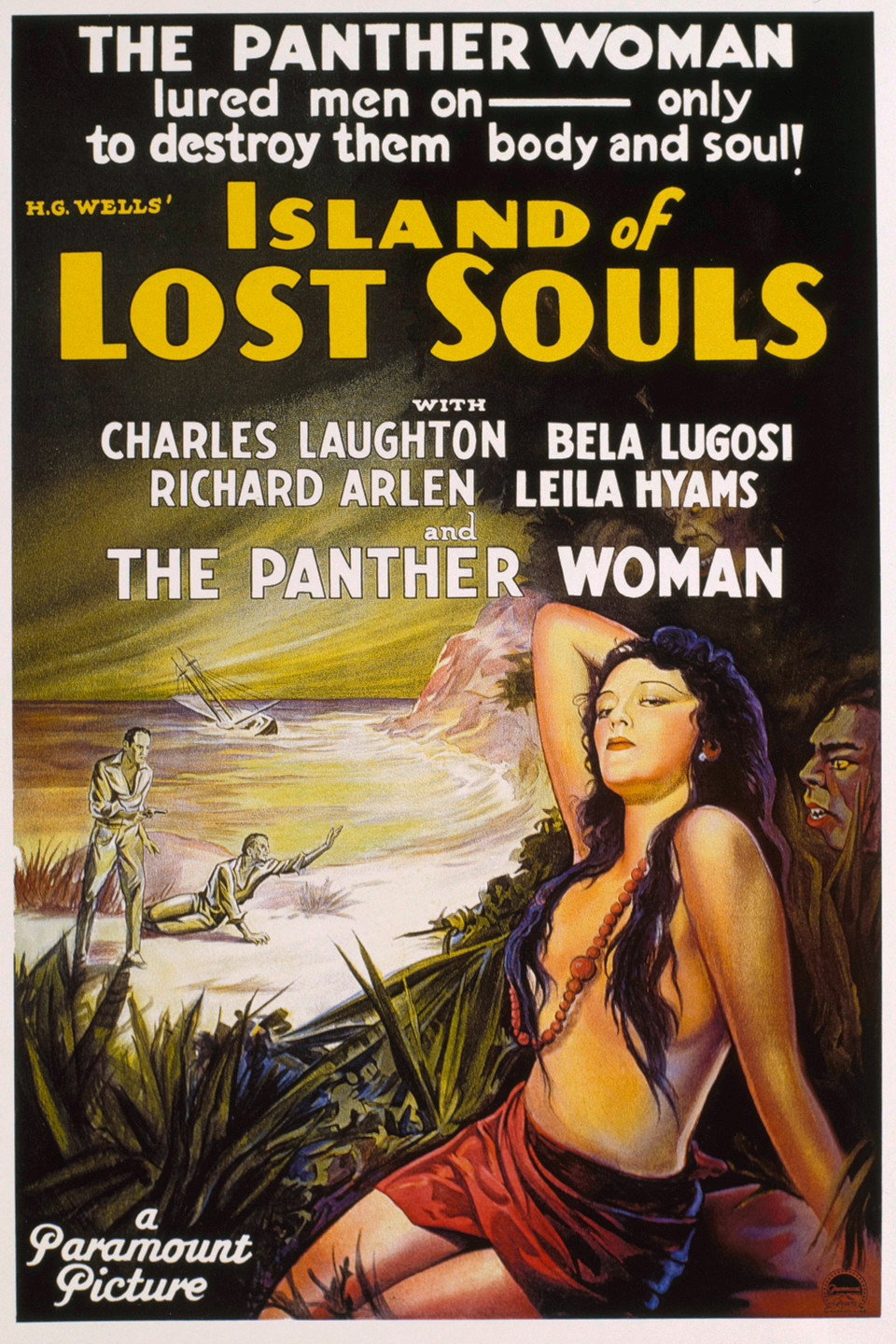
I think this poster art kinda says it all.

Laughton is far and away the best thing here, but the rest of the movie has plenty to offer. Arlen is pretty forgettable in his generic white hero role, but the supporting cast is also quite strong, especially Hohl’s Montgomery --who has a look of defeated self-loathing almost equal to Moreau’s pompous imperiousness-- and Lugosi, whose tendency to play to the cheap seats actually makes great sense for his character (full disclosure: he’s not in it much, and so unrecognizable under all his fur that I honestly forgot he was in there at all until the final credits rolled. Looks like he got over his aversion to makeup that cost him Karloff’s role in FRANKENSTEIN in a real hurry after that one.) Lugosi’s not the only unrecognizable character, either; there’s lots of impressive makeup effects, complemented by their wearers (who were chosen for their interesting or unusual faces since foam rubber hadn't been invented yet, meaning most of the animal effects are achieved through hair and actual facial makeup, not prosthetics). Most impressive, the movie look GREAT; cool sets filled with evocative shadows and strong geometric compositions. Its great art and great schlock.


But the moment that sticks with me most isn’t about the monsters, or the impressive sets, or the freaky psycho-sexual undertones. It’s the amazing scene where Laughlin’s face is lost in the dark as he murmurs --to himself, more than anyone listening-- about what he’s trying to accomplish. His plan is grandiose, megalomaniacal, insane, but Laughlin coos the words, softly, with a mix of hungry compulsion and tentative sheepishness, as if he’s trying them out for the first time, trying to see how these thoughts which have been driving him relentlessly for years taste upon his tongue, finally dragged out into the light of the world. His face is hidden in shadows, but some light somewhere is reflecting in his sharp, complicated eyes, turning them into flashing beacons full of glittering, naked madness. I don’t know if it was Laughlin or the director or simple chance that accounts for this, but it’s a remarkable moment.


Things like this, and the nightmarish, genuinely shocking pre-code finale transcend some of the superficially dated elements and achieve something unique, terrifying and timeless. Maybe someday someone other than Richard Stanley will make a more faithful adaptation of Wells’ original novel. But I bet this will still be better. Some movies are born great, but others have greatness thrust upon them. There’s little about ISLAND OF LOST SOULS that should work, but as Moreau discovers, there’s something a little more complicated to recreating things than simply grafting on the necessary parts. Sometimes things which superficially seem like they have all the right pieces never work right, and sometimes things which seem completely wrong somehow end up perfect. We couldn’t reverse-engineer something like this with the best minds in the world, but there’s no denying its greatness. Best just to enjoy it for what it is: not a perfect adaptation, not an especially articulate philosophical argument, but a strange and savage work of cinema which renders a sublime and completely unique nightmare.

* OK, Young had also done some at-the-time-huge, now-mostly-forgotten dramas with Cecil B. Demille, including THE SIGN OF THE CROSS and CLEOPATRA. But still.


CHAINSAWNUKAH 2015 CHECKLIST!
Play it Again, Samhain

  • TAGLINE: The poster highlights the “Panther woman” (spoiler) and offers us the come-on THE PANTHER WOMAN lured men on -- only to destroy them body and soul. None of that is right, but it makes great copy, donchthink?
  • LITERARY ADAPTATION: Yes, a somewhat loose adaptation of H.G. Wells’ 1896 novel The Island of Dr. Moreau.
  • SEQUEL: No
  • REMAKE: The book has been adapted numerous times, but none appear to be a direct remake of this one.
  • DEADLY IMPORT FROM: USA
  • FOUND-FOOTAGE CLUSTERFUCK: No
  • SLUMMING A-LISTER: Laughton had only started appearing in films four year prior in 1928, but he’d already racked up a dozen roles. He was not yet at the height of his fame, but certainly A-list, I would think.
  • BELOVED HORROR ICON: Though Laughton didn’t appear in a lot of horror films, he directed a horror classic --his only film as director-- one of the best films ever made, 1955’s NIGHT OF THE HUNTER.
  • BOOBIES: None
  • MULLETS: None
  • SEXUAL ASSAULT: Yes, another one of those “animalistic native sexually menaces virtuous white woman” situations, which if I had to guess is the reason Hyams is in the movie at all. At least in this case, the “animalistic savage” is an actual animal, so it’s a little easier to stomach.
  • DISMEMBERMENT PLAN: We don’t quite see it, but there’s a total fuckin’ dismemberment at the end here, holy shit.
  • HAUNTED HOUSE: No
  • MONSTER: Many
  • THE UNDEAD: No
  • POSSESSION: No
  • SLASHER/GIALLO: No.
  • PSYCHO KILLERS (Non-slasher variety): Yeah, I think this is fair to say.
  • EVIL CULT: There’s definitely a cultish quality to the Manimals’ devotion to Moreau’s laws, especially with Lugosi dramatically reading them.
  • (UNCANNY) VALLEY OF THE DOLLS: None
  • EGYPTO-CRYPTO: No
  • TRANSMOGRIFICATION: Oh yeah
  • VOYEURISM: Yeah, the scary monkey guy peeps our pretty white lady/
  • OBSCURITY LEVEL: Mid, not a huge hit at the time, but now a well-regarded classic. I got it from Criterion!
  • MORAL OF THE STORY: Before there was the internet, if you wanted weird interspecies porn you had to buy your own island and conduct horrifying experiments to breed a race of manimals.
  • TITLE ACCURACY: There’s an island, I don’t know about the “lost souls” part, though.
  • ALEX MADE IT THROUGH AWAKE: N/A.