
Frogs (1972)
Dir. George McCowan
Written by Robert Hutchinson, Robert Blees
Starring Ray Milland, Sam Elliott, Joan Van Ark, Judy Pace, Adam Roarke,

FROGS opens with minutes on end of a hunky gentleman in a canoe (Sam Elliott, who you will not recognize without his trademark mustache for a good half-hour or so) floating around a Southern waterway and doing some leisurely nature photography. This is an entirely appropriate beginning, because it’s also more or less the movie’s plan for the next 90 minutes of your life. FROGS, you see, is comprised of two things, in an approximately 50-50 split: footage of a bunch of annoying people sitting around a Florida panhandle manor house, and footage of frogs just kind of sitting there, looking pretty happy to finally graduate from extra to featured player. Why someone thought this would make for a good horror movie --or a horror movie at all-- is never even remotely clear. But if you like footage of frogs, this is the movie you’ve been waiting for your whole life.
Sam Elliott (THE LEGACY, THANK YOU FOR SMOKING) plays Detective John Frogs, a freelance photographer doing some hard-nosed digging into the seedy underbelly of amphibian life in sleepy Southern waterways. It must be pretty important work because the first thing he does when he gets back to civilization is run to call his editor, presumably to tell him to hold the presses. Unfortunately, this journalistic juggernaut is thwarted when a speedboat driven by Clint (Adam Roarke, DIRTY MARY CRAZY LARRY) swamps the canoe. Clint is a drunken rich-kid fuckup, but his sister Karen (Joan Van Ark, The Young and the Restless) --also on board-- is pretty nice and decides pretty quickly she’d like to bone the rugged young photojournalist, so she insists they fish him out of the water and bring him back to their family’s palatial manor house to dry off and then for some reason to stay for a few days.
Once there, Elliott quickly meets the family patriarch, wheelchair-bound Jason Crockett (Academy-Award-Winner Ray Milland, THE PYJAMA GIRL GASE, THE LOST WEEKEND), a grouchy old tyrant who is very fucking insistent that nothing ruin his birthday party tomorrow, not even a bunch of Frogs. For the next forty or so minutes Elliott just walks around the grounds of the house meeting every single relative and individually re-explaining why he’s there, while sometimes the camera cuts to footage of frogs. Pretty gripping stuff.
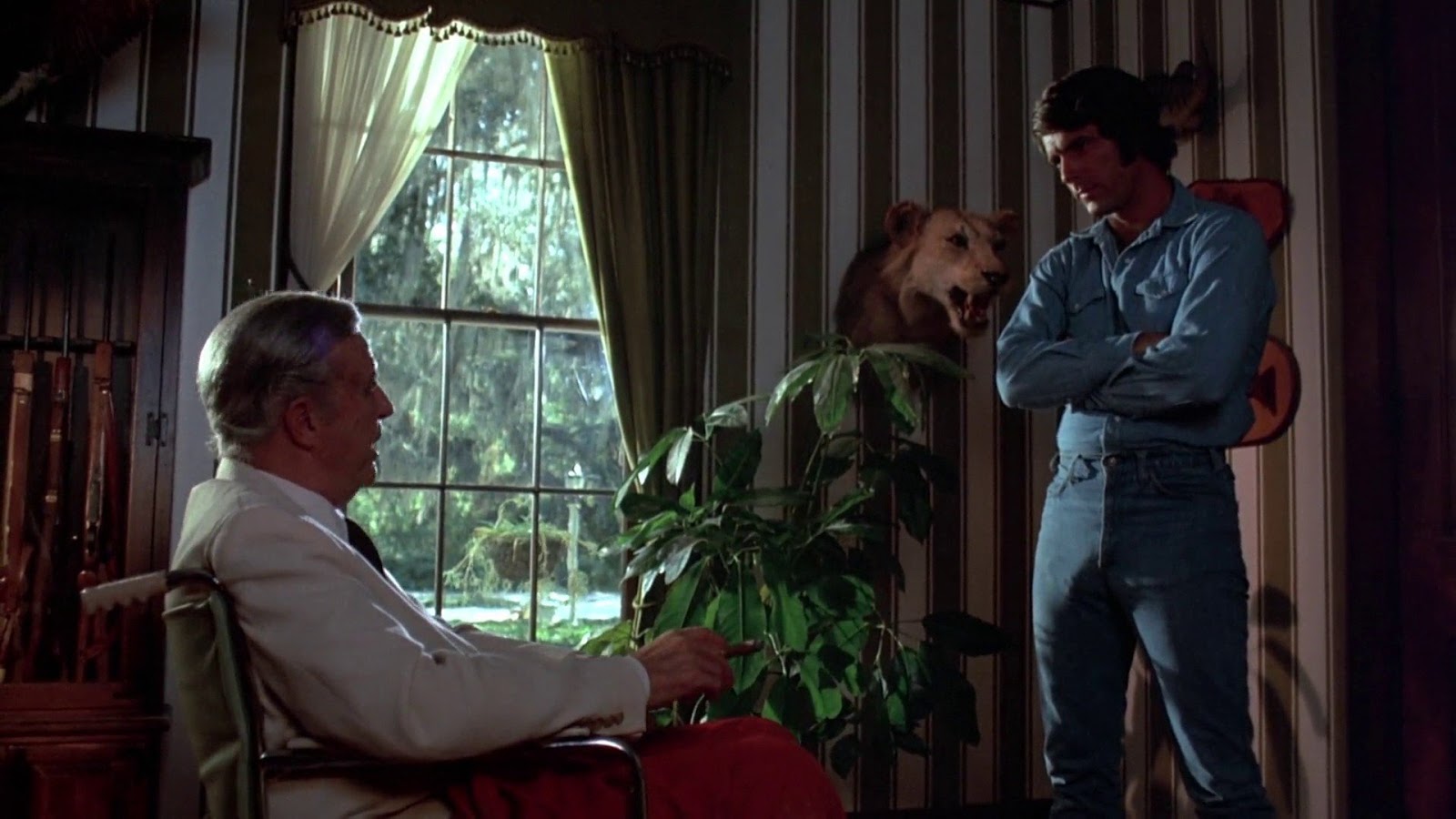
At about 45 minutes, we’ve had a lot of talking and a lot of footage of frogs, plus a good bit of footage of snakes, a sprinkling of geckos, a couple monitor lizards, and a little bit of alligator. But no actual scary parts. Elliott does find the deceased body of one of Crockett’s workers out in the woods, but he died off-screen before the events of the movie and nobody seems too surprised since, yeah, there’s snakes and stuff out there. Fair to say, then, that there’s not a lot of drama and absolutely no horror during the film’s first half, although in fairness the movie’s title promised FROGS, and frogs it delivers, dammit, and none too stingily. Finally, at 45 minutes, one of the hundreds of indistinguishable obnoxious people squatting at the house wanders out into the woods, where you know he’s gonna get what’s coming to him (and all humans). But even so, he as to accidentally shoot himself in the leg before nature can finish the job. Eventually, some other people die in some prolonged but fairly uneventful death sequences mixed with nature footage. But because FROGS doesn’t have a lot of animatronics or anything, the victims really have to do most of the legwork themselves. Another guy is standing in a greenhouse when lizards knock poisonous chemicals off the shelves and he asphyxiates instead of walking the four steps to the greenhouse door. Man, nature must really be kicking itself for not trying this sooner, who knew these guys went down so easy?

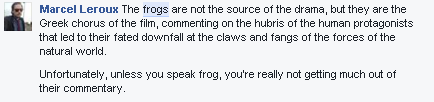
One thing you’ll notice, though, is that even once people start dying, the cutaways to frogs continue. Which is odd, because while people are killed by monitor lizards, snakes, alligators, snapping turtles, and mostly their own stupidity, I note that the frogs never actually do anything. I don’t know if they’re the masterminds behind all of this, or if they’re just nature’s cowards and they’re not gonna take action til they can see which side is winning, or what. But it strikes me as strange that in a movie called FROGS, which features almost wall-to-wall footage of frogs, and boasts a poster with a human hand dangling from a frog’s mouth, the frogs just kind of sit there. Although Mr. Majestyk offers an interesting interpretation:
Anyway, regardless of whether anyone does or not get devoured by frogs (they don’t), FROGS may accidentally be the perfect movie for our times. For one thing, it’s terrible, just like our times. But for another, I think it may be --maybe even intentionally!-- a metaphor for the inexorable changing cultural landscape and the bitter resistance some people put up against that change. The frogs never actually DO anything, but they’re the harbingers of what’s to come: they’re getting louder and louder, more numerous and brazen, harder to ignore, until the smart people finally acknowledge that a course correction is necessary. Those who refuse to take heed of their inability to control the world are gonna wind up in trouble. Seen in that light, there’s a lot of interesting subtext going on here with the various stock characters.

I mean, think about it -- you got Milland as the cranky, bullying family patriarch holed up in the gargantuan home he insists his family has lived in for generations. The only thing he cares about is ensuring things never change, that whatever happens, his birthday party does not deviate from the same routine he’s demanded his entire life. Oh, and when is that birthday? Why, on the Fourth of July! And lest you forget it, they have footage of frogs defiling his large American-Flag birthday cake, while he broods in his wheelchair, listening to patriotic music on a turntable. His single-minded insistence that they not budge a single inch from the routine that they’ve undertaken every year, without fail, is really the only conflict in the movie, which seems completely laughable unless you start to consider its potential for allegory.
I mean, is it too much to wonder if he represents the Old South (which was a little less old in 1972)? He’s a dithering, hectoring old bully, crippled and bitter, fixated on ensuring that everyone respects his unquestioned authority and dutifully goes through the same comfortingly familiar motions they’ve always gone through. But times are changing. One of his grandkids has a glamorous black girlfriend (Judy Pace, BRIAN’S SONG), and the awkwardness of her being a guest at this aristocratic Southern plantation hangs so heavy in the air that it doesn’t even have to be spoken. In fact, everyone fastidiously avoids speaking it; listing the reasons she’d be objectionable to grandpa, her fiance carefully avoids mentioning race at all, instead landing (lamely) on her being a “fashion model.” You can almost see him consider stating the obvious and then chickening out. She chickens out herself, albeit in a somewhat sweeter way, in a surprisingly nuanced scene between her and Crockett’s older, black maid (blues singer Mae Mercer, DIRTY HARRY, THE BEGUILED). Neither one of them needs to state the strangeness of their shared racial past and their radically different present, but the maid notices they have the same name -- Maybelle -- though her younger namesake goes by “Bella.” They share an odd moment of fractured, awkward kinship which feels unusually honest for a film (ostensibly) about killer frogs.

Are their different versions of the same name a sign that Bella is fooling herself in thinking she’ll ever be accepted in this world which almost certainly consigned Maybelle and her ancestors to humiliating servitude? Or is it a hopeful symbol that Bella could rebrand herself and sit as an equal with these backwards old crackers, who are surely deeply put off by her very presence, but are too scared to say something to a social equal (or better)? I don’t know, exactly, but it’s nice that the movie finds time for that ambiguity in-between shots of frogs. Towards the end, when Crockett’s black maid and butler (Lance Taylor, Sr, BLACULA) meekly ask if they can leave before they get killed by frogs or what have you, Bella finally makes the racial tension explicit: “Maybe you haven’t heard about it stuck out here in vacation land,” she snaps --and it’s hard to say if she’s addressing Crockett or his employees -- “but five score and seven years ago, they just started letting people make up their own minds.” When they do go, Crockett isn’t just angry, he seems genuinely hurt, even though they’re almost absurdly accommodating of the old bastard, and even seem touchingly concerned about his welfare. But concern isn’t what Crockett wants. Loyalty, he says, is -- but to him that just means unquestioned obedience.

He demands that obedience from both his hired staff and from his family. “He knows he’s not popular. With the public or his family. And he revels in it,” says one of his grandkids. But they play along, bored and annoyed, because they’re afraid that if they rock the boat they’ll lose their share of his wealth. If Crockett is indeed a metaphor for the Strom Thurmonds of the world, it’s an interesting perspective to cast his “kids” (the younger generation) as uninterested in his antics and priorities, but dutifully following them for their own selfish reasons. And of course, money is a big part of this; even though he’s just a single, crippled old man, Crockett can make everyone dance to his tune because he controls the money. It may not be earned, but that doesn’t mean his descendants fancy the idea of losing any of it. “You make us sound like the worst of the ugly rich,” one of his kids admonishes. “We ARE the ugly rich!” he replies, to which she explains, “We’re entitled to be ugly... God knows we pay enough in taxes.” Man, some things never change, huh? Which is particularly galling because FROGS is very much a movie which believes things have changed; which sees the grouchy old Crocketts of the world as the thing holding us back. Unfortunately it’s now 2017, and we just have new Crocketts to replace the old ones, and a lot of them are probably the same kids who just mechanically went through the motions to appease their bossy old grandpa, but who now cling to the same old bullshit as if they made it up. I guess with the benefit of hindsight it’s not so simple. But still, I appreciate the optimism of FROGS’s view that the Old Ways will get swept away whether they’re willing to acknowledge it or not, that the changing world is inevitable, overwhelming, a force of nature.

Of course, it’s also literally a force of nature here, which makes for a somewhat confused metaphor. On the surface, FROGS is very much a quintessential “Nature strikes back” movie, right down to the required scene where a character comes right out and speculates aloud about nature taking revenge. Hell, it opens with a potential motive for nature: Elliott photographs a bunch of garbage along with a bunch of frogs during the credits (in a perfect summation of what the filmmakers intend to do). But I think this is tied to the filmmakers' point, too; nature is one of those things -- like shifting racial, social and sexual mores-- which isn’t just going to politely sit there waiting for Ray Milland to come around. It’s gonna change, and you can either change with it or get trampled by it. You can try to ignore the growing chorus of frogs making a racket in the background, you can even try to kill them off. But in the end, who’s lying dead on the floor next to his overturned wheelchair, and who’s smugly hopping around on his corpse? I won’t say because I don’t want to spoil anything but after you watch the movie I think you will understand what I mean.
All this is kinda getting away from the fact that this is a ridiculous and terrible movie, which is pretty hard to deny. The acting isn’t a disaster, though; Elliott has a confident, reserved cool which makes his non-character seem compelling, and Milland is making at least a small amount of effort, or anyway more than one would expect from one of these late-career roles from former A-listers where they play a character in a wheelchair so they don’t have to stand up while shooting. But aside from some pretty nature photography (rendered in glorious blu-ray in the most recent Scream Factory! release) there’s not really much entertainment value to be had here. It’s not even really outrageous enough to be enjoyably campy, it’s just pretty dull (unless you suffer from a particular phobia of the fauna of Northern Florida wetlands, in which case this is probably far too horrifying for you to enjoy anyway).

Still, its little allegorical touches are interesting enough that it’s not a total wash, especially given the film’s ambiguous apocalyptic implication -- is this happening everywhere? “I still believe man is master of this world” Milland says. “Does that mean he can’t live in harmony with the rest of it?” Elliott returns. A pretty bold subtext for a schlocky killer frog lizard movie. Maybe someday, someone will make a good one. Until then, the best I can offer is the suggestion that you stick to the end of the credits to finally see an (inexplicably animated) frog actually eat someone. It’s not easy being green.

CHAINSAWNUKAH 2016 CHECKLIST!
Good Kill Hunting
ALIAS
|
Released mostly just as “FROGS” in various languages, though the West German title helpfully explains, “Frogs - Killer aus dem Sumpf” ie, “FROGS: KILLERS FROM THE SWAMP.” You know, in case you didn’t know where frogs come from.
|
TAGLINE
|
Today The Pond… Tomorrow The World! Which is inaccurate in two ways, first of all since the movie implies that they are probably taking over the world today, and also because it makes the movie seem much more funny and self-aware than it actually is.
|
TITLE ACCURACY
|
One of the most accurate titles in history.
|
LITERARY ADAPTATION?
|
No
|
SEQUEL?
|
No
|
REMAKE?
|
None, alas
|
COUNTRY OF ORIGIN
|
USA
|
HORROR SUB-GENRE
|
When Animals Attack!
|
SLUMMING A-LISTER?
|
Ray Milland; Elliott was not yet famous (and only 28 at the time) but in retrospect he definitely counts. Incidentally, his shirtless scenes here earned him his subsequent role in LIFEGUARD, so at least you got that waiting for you.
|
BELOVED HORROR ICON?
|
Milland probably did enough horror films to count, although I’m sure he’d prefer to be remembered for his actual good films.
|
NUDITY?
|
Just the frogs, though Elliott does have a couple beefcake topless scenes
|
SEXUAL ASSAULT?
|
None
|
WHEN ANIMALS ATTACK!
|
Oh mercy yes
|
GHOST/ ZOMBIE / HAUNTED BUILDING?
|
No
|
POSSESSION?
|
No
|
CREEPY DOLLS?
|
None
|
EVIL CULT?
|
No
|
MADNESS?
|
No
|
TRANSMOGRIFICATION?
|
None
|
VOYEURISM?
|
I think all that frog footage is definitely supposed to make us think the frogs are always watching us.
|
MORAL OF THE STORY
|
That swamp that Kermit was in at the beginning of THE MUPPET MOVIE was way more hardcore than "The Rainbow Connection" lets on.
|


