Showing posts with label EURO-HORROR. Show all posts

Thursday, January 23, 2020

Scream and Scream Again


Scream and Scream Again (1970)
Dir. Gordon Hessler
Written by Christopher Wicking, based on The Disoriented Man by Peter Saxon
Starring Alfred Marks, Michael Gothard, Vincent Price, Christopher Matthews, Christopher Lee, Peter Cushing (cameo)


SCREAM AND SCREAM AGAIN would be more accurately called SCREAM AND SCREAM AGAIN AND THEN SCREAM A THIRD TIME, because it’s all about threes. First, its three producers: Max Rosenberg and Milton Subotsky of the venerable also-ran British horror house Amicus studios being joined in this case by the equally venerable Louis Heyward of American exploitation house AIP. Second, its three “stars” – Amicus regulars Christopher Lee and Peter Cushing, along with AIP go-to Vincent Price, probably the three biggest marquee names in horror at the time, together for the first time, no less! And finally, its three plots, because it begins by introducing us to three seemingly unrelated storylines. In the first, a jogger who runs with an unimpressively floppy form (prolific British bit player Nigel Lambert) has a heart attack, only to wake up in a mysterious, sinister hospital where they slowly amputate his limbs. In a second, a sadistic military officer (Marshall Jones, CRY OF THE BANSHEE, MURDERS IN THE RUE MORGUE) steadily rises through the ranks in an unnamed European dictatorship. And in the third, a no-nonsense police superintendent (Alfred Marks, THE FRIGHTENED CITY, VALENTINO) and, I guess, an assistant coroner (Christopher Matthews, SCARS OF DRACULA), who sort of gradually turns into the protagonist through a process of attrition and the need for this sort of movie to have some blandly handsome British youngsters, seek a mystery killer in a series of apparently vampiric rape-murders. How on Earth could this all fit together?

Indeed, how could three sets of such unusual triplets fit together? Well, the answer is that they don’t entirely, because the movie’s a weird mess. But I confess to rather enjoying the messy, confounding, winding journey it takes. I’ll be damned if I know what to do with it, but give SCREAM AND SCREAM AGAIN credit for this, at least: it’s probably not what you’re expecting. First of all, it’s really more of a science-fiction thriller than a horror movie, despite the presence of Price, Lee, and Cushing (and they’re not much of a presence at that; Price eventually gets a bit to do, but Lee is a minor character and Cushing has just one throwaway scene). But second and most importantly, it’s a pretty wild --practically deranged!— ride, but for all the insane convolutions it takes, it turns out there really was a discrete destination in mind the whole time. It’s going somewhere. I’m not saying it makes sense, exactly, but somehow the movie does sort of tie everything together at the very end. But I do mean the very end; for the vast majority of its none-too-hurried 95 minutes, it seems like we’re watching a bunch of utterly unrelated lunacy, three paranoid, surreal plotlines playing out completely parallel to each other with no obvious connection of any kind.  


Like many movies of the period, it feels a bit dawdling when it would probably benefit from a breakneck pace, and also like many movies of the period, it gets painfully bogged down in groovy pandering to the swinging youth (two lengthy club scenes prominently featuring a trendy British-invasion rock group --in this case Welsh soul outfit Amen Corner). But unlike many movies of the period, it also features the credit “police chase arranged and executed by Joe Wadham,” and for a 1970 British B-movie, this thing’s a real doozy. It involves a diabolical vampire date-rapist (Michael Gothard, THE DEVILS, LIFEFORCE[!!], FOR YOUR EYES ONLY) in a red convertible sportscar (apparently a 1955 Austin-Healey 100/4) tearing around London and the surrounding Surrey countryside with dozens of expendable police cruisers in hot pursuit, and ends up blossoming into a lengthy --in fact, almost comically extended-- foot chase capped with several bouts of superpowered fisticuffs. It isn’t exactly jam-packed with jaw-dropping stunts or eye-popping spectacle, but clocking in at close to 15 minutes of screentime (pointedly beating BULLITT’s 10 minutes, a point of reference clearly on its mind), it ends up building momentum out of sheer moxie. Normally this sort of action spectacle is death for a horror movie, which thrives on tension rather than excitement. But a few touches of grotesque weirdness --the killer rips off his hand to escape a handcuff, and can crack a human skull with his punches— help resolve the disconnect here. It’s classic action cinema, but with a touch of the genuinely weird, both exciting and a little disconcerting. It honestly makes me wonder if these two genres aren’t as mutually incompatible as I’d always assumed.


As a fifteen-minute chase scene tangent might suggest, the three plotlines are all a little shaggy, which makes a little more sense when you learn that the credited author of the novel which became the basis for SCREAM AND SCREAM AGAIN (originally titled, appropriately, The Disoriented Man), one “Peter Saxon,” is actually a pen named most frequently used by Irish journalist, pulp author, and editor W. Howard Baker, but, the novel itself was apparently written primarily by fellow pulp author Stephen Frances, with additional possible input from Martin Thomas. All three men were veterans of the Sexton Blake detective stories which are said to number over 4,000[!] entries, and it’s unclear which of the three, if any, was the dominant creative force here. Several websites –all unattributed, I’m afraid—suggest the novel was the result of a “round robin” type writing exercise, which would obviously do much to explain its otherwise befuddlingly unconnected trio of storylines. But whatever the explanation, each tangent affords at least a few oddball pleasures. There’s not exactly a surplus of whammy (the gore is infrequent, though impressively gnarly and clearly shot when it does happen), so with Price, Lee, and Cushing only rarely on-screen, the movie must primarily rely on its pervasive strangeness to keep engaging. Fortunately, it is indeed very, very strange, so that works out.

How strange, you ask? Strange enough to feel completely comfortable removing the novel’s explanation –BOOK SPOILERS it turns out the villains are aliens! END BOOK SPOILERS —and replacing it with… nothing. No explanation at all. It’d be pretty weird to just throw extraterrestrial conspiracies into the mix of a movie which already contains a vampiric car chase, but it’s even weirder to just leave it unexplained, and that’s the kinda shit we’re rolling with here. SCREAM AND SCREAM AGAIN doesn’t give a fuck about your pathetic need for explanation. It’s just gonna let its freak flag fly, and you’re gonna have to deal with it. Some may find this intolerable; me, I was kinda disappointed to hear there ever was an explanation. I prefer the film’s satisfaction with the vague, uneasy ambiguity of it. So the movie is definitely weird, but obviously I’m on its wavelength.


Well, mostly, anyway. One weird thing which is less effective is the jazzy, sunny score by David Whitaker (VAMPIRE CIRCUS) which is, one can’t help but notice, monstrously inappropriate for such a bizarre, unsettling thriller, and does a great deal to undermine whatever tension director Gordon Hessler (MURDERS IN THE RUE MORGUE) might be building up. Not that the movie strikes one as being impeccably planned by a master craftsman or anything, but there’s weird which is productive, and weird which is counterproductive, and the groovy Bond music knockoff soundtrack is probably the latter. I might be more inclined to tolerate this kind of tomfoolery in an Italian flick, but it’s an ungainly and awkward look for the British. Italian genre films are the cinema of pure sensation, content to luxuriate in any sufficiently evocative artistic element; British films, especially from the 70’s, have a stiffer and more calculated feel, making an inappropriately funky soundtrack feel less like an indulgence in extravagant overstimulation and more like a misjudged attempt to feel hip. But no matter, few 70’s horror flicks, and especially British ones, feel as wildly out-of-control and unpredictable as SCREAM AND SCREAM AGAIN manages, and if that blurs its focus, it rarely blunts its impact. And that’s enough to recommend it all by itself.


CHAINSAWNUKAH 2019 CHECKLIST!
For Richer or Horror

TAGLINE
TRIPLE DISTILLED HORROR... as powerful as a vat of boiling ACID! I should probably mention that yes, there is a vat of acid in the movie.
TITLE ACCURACY
Completely meaningless, but that just add to its weirdo vibe.
LITERARY ADAPTATION?
Yes, from the pulp novel The Disoriented Man by “Peter Saxon” (actually some combination of W. Howard Baker, Stephen Frances, and Martin Thomas).
SEQUEL?
None
REMAKE?
None.
COUNTRY OF ORIGIN
UK/USA
HORROR SUB-GENRE
Boy, um, gosh. Vampire, I guess? Sci-Fi Horror?
SLUMMING A-LISTER?
None
BELOVED HORROR ICON?
Vincent Price, Christopher Lee, Peter Cushing, though none are especially prominent and Cushing in particular only has one throwaway scene.
NUDITY? 
My teenage self would never have believed it, but I swear I don’t even notice anymore. Those creeps on IMDB do include “Frontal female nudity” in their keywords, so I’ll bow to their superior collective horniness.
SEXUAL ASSAULT?
Yes
WHEN ANIMALS ATTACK!
None
GHOST/ ZOMBIE / HAUNTED BUILDING?
None
POSSESSION?
No
CREEPY DOLLS?
None.
EVIL CULT?
No
MADNESS?
No
TRANSMOGRIFICATION?
None
VOYEURISM?
None
MORAL OF THE STORY
Gosh, um. I dunno, man, “don’t go jogging because you’ll look like a dork and then have your limbs cut off” is about the best I can do for you. Otherwise…


Tuesday, October 29, 2019

As Above So Below


As Above So Below (2014)
Dir John Erick Dowdle
Written by John Erick Dowdle, Drew Dowdle
Starring Perdita Weeks, Ben Feldman, Edwin Hodge, François Civil, Marion Lambert, Ali Marhyar


            Well, it’s Chainsawnukah, so tradition dictates that you gotta get some found-footage shit in there. For years this was merely a matter of statistical probability; if two out of every three new horror movies was found footage, you just had to accept that you'd end up with at least one by sheer chance, even if you were actively trying to avoid it. This year, though, I notice that they’re not nearly as pervasive; a new trend of mopey, uneventful indie “horror” movies about sad people seems to have emerged as the fashionable way for lazy hucksters to crank out content with minimal effort. But a tradition is a tradition, so a-hunting for found-footage clusterfucks of yesteryear I went. This fit the bill nicely in that it was A) found footage and B) that’s it. I did not have high hopes for AS ABOVE, SO BELOW, even going in with the interesting trivia that it was actually shot in the real Catacombs of Paris. Great, what better way to experience a jaw-dropping real-world marvel than through an indecipherable visual jumble of shaky cam with ad-libbed shouting over top? But I watched it anyway, because that’s the kind of guy I am.

            And it turned out that was a good idea, because right off the bat, it's way nuttier than I anticipated. We begin with the introduction of our hero, the excellently-named Scarlett Marlowe (Perdita Weeks, minor roles in both HAMLET and SPICE WORLD! Now that’s a resume!) who we encounter in medias res, already on an adventure considerably more epic than you would usually find in some found-footage debacle: she’s tomb-raiding a forgotten, sinister underground shrine in Iran as part of her quest to discover the secret of famed 14th-century alchemist Nicolas Flamel. And what she discovers in Iran (after effecting an exciting escape while the cavern collapses behind her!) sends her to Paris, to uncover a secret message transcribed on the back of Flamel’s tombstone! Woah, was not expecting this crazy ass Da Vinci Code shit.


In Paris, she meets up with her dishwater-dull ex-boyfriend, George (Ben Feldman, one of the guys who gets killed in opening 15-minute mini-movie in the FRIDAY THE 13th REMAKE) and cameraman Benji (Edwin Hodge, two PURGEs), and then get right down to the business of finding the treasure map hidden on the back of Nicolas Flamel’s tombstone or whatever. You might think this in itself would require, like, a heist or something, but nope; the tombstone is just hanging there in a museum, not guarded or even behind glass or anything. I thought this whole thing was delightfully silly until I looked it up and discovered that no, this is actually a real place (the Musée de Cluny, a Paris museum devoted to the Middle Ages), and that’s probably Flamel’s real tombstone being used as a prop. Take this movie out of the “horror” section, folks, it’s a documentary! Needless to say, they waste no time in translating the Aramaic writing of a 14th-century Frenchman’s tombstone poem, and holy shit, it rhymes in English! That’s thinkin’ ahead, Nicolas Flamel, you old dog! He also apparently calculated his conspiracy numbers in feet, which seems surprising. But I guess I can't argue with them, since they're looking at the real tombstone of a legendary magical weirdo. 

This turns out to be the movie’s secret weapon. Something about the mix of fantastical bullshit with actual reality that’s even crazier really does it for me. I guess it’s why I’m so embarrassingly helpless to resist the appeal of Ancient Aliens or a good conspiracy theory or whatever. Reality is nearly always going to be weirder and more interesting than whatever bullshit some goofball found-footage director is going to be able to imagine, and so the smartest thing a fiction writer can do, sometimes, is find some little nugget of real-world insanity and piggyback on top of that, drawing tenuous but irresistible links between the stranger corners of actual reality rather than inventing new, and almost certainly less outlandish, fiction from whole cloth. The good create; the best steal. I’m sorry, but it’s fucking awesome that Nicolas Flamel really did design his own mysterious, cryptic tombstone, and that you can actually go to some museum in Paris and see it! Throw some circuitous plot and outlandish theory over top of that, and I’m a happy man.


Here’s the problem, though: I’m way into this dumbass story, but the found footage makes it 1,000 times harder to buy, because all I can think is how unnatural and phony all the acting and photography and everything about this is. I can and will happily accept that there’s a 600-year old alchemical conspiracy to solve, but I cannot accept that human beings talk or act like this, and the found-footage conceit forces me to compare this behavior to mundane reality in a way that traditional cinematic staging doesn’t. If you’re going to start throwing around the name “Nicolas Flamel” why on Earth would you ever intentionally do anything to remind the audience of what normal reality is like?

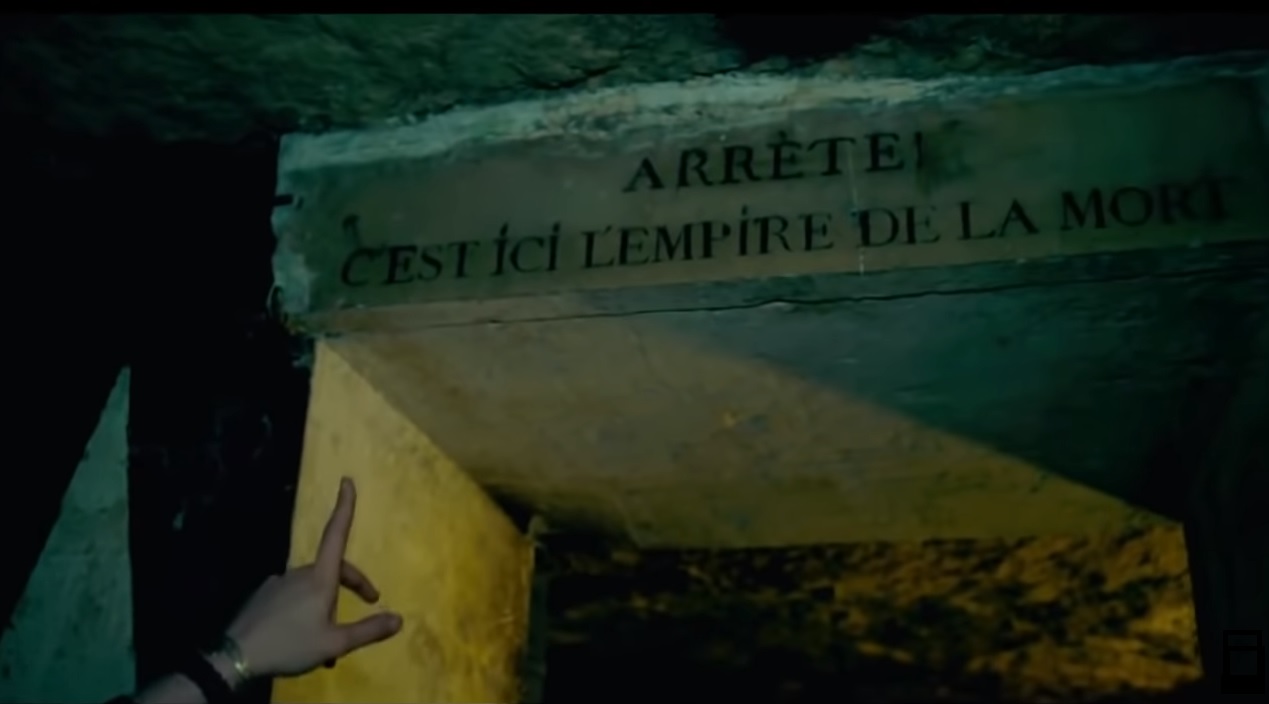
Still, as luck would have it, the tombstone sends our Da Vinci Treasure-hunters down into the endless, ancient catacombs below Paris, and of course, they actually shot there for real! Apparently this is the first film production ever to do so! And once there, the obvious objective reality of the catacombs themselves takes you a long way. Plus, our party is joined by irreverent, punk rock Parisians Papillion (François Civil, FRANK), Souxie (Marion Lambert, MONGEVILLE) and Zed (Ali Marhyar, ZERO DARK THIRTY), who agree to guide them through the dangerous maze, and have an easy, practical naturalism to them that the Americans do not. In fact, I wondered if they too were “real” – actual catacomb guides essentially playing themselves on screen. Doesn’t seem like it, but at least they inhabit their roles much more naturally than the Americans do, and contribute a real lived-in feel which grounds the film immensely. Papillion’s straightforward, pragmatic guide to how to crawl across ancient human bones without hurting your arms smacks of lived experience, and the actor delivers it with the right mix of very sensible advice and very slight smugness about his greater experience. He seems confident and reasonable and in control, in a very grounded way.


That makes it all the more potent when he suddenly doesn’t seem to be in control any more, when the skills he’s mastered betray him. Because wouldn’t you know it, before long our heroes end up hopelessly lost, and begin to suspect that something supernatural and sinister may be going down. Here, again, I appreciate François Civil's convincing mix of bafflement and panic. He should be in complete control down here –this is what he’s spent his life mastering—and yet reality refuses to cooperate. This is so fundamentally unbalancing that he doesn’t even think to conceal his shock and panic, which consequently makes it so internal that it doesn’t read to his companions as quite as devastating and potentially dangerous as it is. That kind of upending of reality is a much richer source of horror than simple fear of the unknown, and helps build an escalating unease which is surprisingly effective. Sadly, the French cast gradually gets lost in the shuffle, supplanted by Feldman and Weeks, neither of whom has even the vaguest echo of human authenticity to them. Feldman, in particular, is a total non-entity, which is especially disappointing since apparently the actor suffered from claustrophobia and must have been disturbed beyond words by the work he was doing. It doesn’t end up on the screen, though. There's a time and place for method acting, but the only important thing is what the audience actually sees. Sometimes it's better to just follow Peter Lorre's advice and 'just makes faces.' Whatever Feldman is feeling, he’s not making the appropriate face.

The found-footage approach is never believable, and almost always ugly and unnecessary, but it does get at the essential point here: this is an experiential movie. Found-footage is a miserable medium, generally speaking, for telling a story, because of its constricting focus on specific visual perspectives. But it’s a much better medium for documenting an experience, one long incident which doesn’t call for narrative finesse so much as focused intensity. At its best, the conceit traps the viewer within some kind of ordeal, refusing to grant them the omniscient safety of unmotivated editing and forcing a grueling, intimate sense of being in the thick of it. The camerawork here doesn’t do that more than thoughtful standard photography could, and in many ways it highlights the phoniness of the whole scenario and potentially lessens the impact. But it does generally get the job done sufficiently, if not optimally. It’s at least the sort of found-footage movie which understands that it’s shooting for immediacy, not realism. It doesn’t capture the strange, alien feeling of being underground better than the immensely shitty TEMPLE, though, and that ain't a high bar to clear. But it does have better ideas: it establishes a baseline of reality strong enough that small disruptions in that reality, be they phony acting or deliberate continuity breaks, have real impact. And of all the real things, there is nothing more real than the stomach-churning power of those catacombs.


The catacombs themselves are, of course, the real star –as well they should be. The feeling of all those years and all that weight above as we descend lower and lower into a claustrophobic netherworld has some genuine, undeniable power, at least to someone with my particular constellation of weaknesses (claustrophobia, antiquarianism, and Catholicism). And the idea of being trapped, forced down, down, beyond the point of no return, beyond the point where anything makes sense, perhaps into Hell itself, evokes something one encounters only very rare in a horror movie: actual horror. Philosophical horror, horror that troubles the very waters of the soul. If the movie had trusted this instinct, it might have strayed dangerously close to genuinely great territory, and damn the ugly and unnecessary shaky-cam.

Unfortunately, the movie’s actual idea of horror pales in comparison to the basic factual horror of its premise, and so much of the end is concerned with scary silent people sitting in chairs facing away from you, monsters that suddenly pop out from behind walls, and various assorted haunted house detritus. Even if the movie’s very end is suitable mind-bending, the 20 minutes of wasted goodwill leading up to it drain much of its impact.

Still, it lingered in my mind. There's something visceral and potent here, and no amount of phony acting or tired jump scares can quite dissipate the oppressive, amorphous feel of gut-deep horror that comes with the endless, maddening descent into that alien subterranean hell where the living hold no power. They can weaken that feeling, but a few days later any irritation has passed, and the troubled dreams remain. It's a feeling bigger and more powerful than AS ABOVE SO BELOW is capable of handling or channeling effectively, but at least for a little while, it at least manages to unambiguously conjure it. I wish it were great, and I think greatness was, at least at some point in the conceptual stage, within its reach. But I’ll settle for good, and it is intermittently pretty good.

Also want to point out that it introduced me to the French punk/psychaedellic band La Femme, and I think this is love.


CHAINSAWNUKAH 2019 CHECKLIST!
For Richer or Horror

TAGLINE
The Only Way Out Is Down.
TITLE ACCURACY
Pretty good, since it’s a phrase which literally suggests that our crew is going underground, and also has both religious and mystic connotations.
LITERARY ADAPTATION?
No
SEQUEL?
None
REMAKE?
None.
COUNTRY OF ORIGIN
USA, though shot on-location in Paris, France
HORROR SUB-GENRE
Found-footage, haunted house, Religious horror,
SLUMMING A-LISTER?
None
BELOVED HORROR ICON?
None
NUDITY? 
No
SEXUAL ASSAULT?
No
WHEN ANIMALS ATTACK!
None
GHOST/ ZOMBIE / HAUNTED BUILDING?
Yes, ghosts
POSSESSION?
Yes
CREEPY DOLLS?
No. But there is a creepy piano!
EVIL CULT?
Yes, though we never learn much about it
MADNESS?
Certainly
TRANSMOGRIFICATION?
No
VOYEURISM?
None beyond the basic found-footage conceit.
MORAL OF THE STORY
Da Vinci Coding is more common than you might think, yet another possible career option I unwisely never considered.

Admittedly a weak 4-thumb effort, but it definitely managed to get to me at times, just enough to push it into distinctly positive territory.


Friday, February 22, 2019

Rings Of Fear


RINGS OF FEAR aka TRAUMA aka Enigma Rosso (1978)
Dir. Alberto Negrin
Written by (seriously!) Marcello Coscia & Massimo Dallamano & Franco Ferrini & Stefano Ubezio & Alberto Negrin & Peter Berling. All named in the opening credits. IMDB goes on to name Thomas Danneberg (dialogue: German version) and Miguel de Echarri (screenplay). Maybe they didn’t have room on-screen to include them?
Starring Fabio Testi, Christine Kaufmann, Ivan Desny, Jack Taylor, Fausta Avelli

(WARNING: in case the following pullquote doesn’t ring your alarm bells, this is probably one of those reviews you shouldn’t read if you would be the type to get upset about things which it would be completely reasonable to get upset about. Italy, man, what can I say?)


“The pace is brisk and the school shower scene is truly gratuitous.” -- IMDB reviewer HumanoidOfFlesh, Nov 19, 2010.
  
            RINGS OF FEAR starts out by ogling the nude breasts of an underaged corpse. But before you get too judgmental, I have some reassuring news: except for one scene where it blatantly ogles a bunch of 16-year-olds playing together in the showers (the camera reluctantly follows the action of our leading girl as she leaves the showers, and then zips back in for one more peek before it cuts) and one scene where a girl is murdered at an orgy via penetration by a giant dildo… well, other than those scenes and a few others it gets a little classier as it goes on, at least as far these things go! I wasn’t aware of this going in, but apparently RINGS OF FEAR is considered the third film in the loose “schoolgirls in peril!” trilogy which began with WHAT HAVE YOU DONE TO SOLANGE? and continued with WHAT HAVE THEY DONE WITH YOUR DAUGHTERS?, and would have continued seamlessly here if not for the death of director Massimo Dallamano* (still one of the six credited co-writers). But the dream was too beautiful to die with its author, and so, just as it looked like we might have to live in a dark world with only two sleazy "schoolgirls in peril!" Italian movies from the 70's, in stepped TV director Alberto Negrin (the Secret of the Sahara miniseries starring Michael York, Andie MacDowell, and Ben Kingsley[!]) to offer us one last wild ride with those schoolgirls who, darn it, just can’t seem to stay out of peril.

            The peril these particular schoolgirls have found themselves in began prior to the events of the movie, as our protagonist, Inspector Gianni Di Salvo (Fabio Testi, THE GARDEN OF THE FINZI-CONTINIS, but most known for having a name which literally translates as “Fabulous Testicles”**) discovers when he steps in on a case which concerns a 16-year old schoolgirl. This particular schoolgirl is now thankfully out of peril, as she is currently deceased, having been killed by a giant dong (hey, I warned you!). Her classmates seem to know more than they’re saying, which becomes a real problem for them when they start to get targeted by a mystery avenger operating under the nom de guerre “Nemesis,” who may be a vigilante trying to avenge the dead girl, or the real killer trying to intimidate these co-conspirators into silence. Either way, Di Salvo is on the job, and he knows just what to do: kick his way into the school in the dead of night, rouse everyone from their beds, and shout at everyone incoherently that a girl was murdered and raped with a huge penis. When that somehow fails to produce the desired results, he’s gotta get creative.


            Despite the three “M”s prominently on display,*** this is probably more poliziotteschi than giallo, with a tough-guy cop as the main character, and most of the movie devoted to his hard-nosed attempts at shaking down the local underworld characters for information on this mysterious fiend with the killer johnson. Its style is more gritty than surreal, with a handful of action-packed chase scenes and fights, nearly always shot on-location during the daytime. But it has a few appreciably nutty stalking/suspense sequences too, probably just barely enough to justify describing it as a horror-thriller, if you were inclined to be generous about such things for some reason, such as if you were a person who blogs mostly about horror movies and saw this during October and was consequently honor-bound to write about it, for example.

It is a whodunnit, anyway, and, in fact, one with a batty enough solution to please even the most discerning connoisseurs of psychotic Italian exploitation cinema. (SPOILERS FOLLOW!) It turns out, in fact, to be a double mystery -- “Nemesis” and the dildo murderers are actually unrelated, and Di Salvo has been unknowingly chasing two perps, not one. The whole thing with the dead schoolgirl actually ends up mostly only being a sex conspiracy, not a murder conspiracy; it seems the young woman in question was just an participant in a totally normal and consensual school-wide orgy between underaged classmates and creepy old men, and one of the participants simply miscalculated what size of dildo he could use on her without fatal results. You know how that goes. What a faux pas! Anyway, just a completely understandable misunderstanding; in fact, I’m not even sure the movie ever bothers to actually identify the person responsible for the original death, it’s much more interested on the subsequent coverup. “Nemesis,” though, turns out to be a little more interesting: it is, in fact, the adorable little sister of the dead girl, resorting to some straight up fucking SAW shit to punish her sisters’ complicit classmates. The movie seems pretty comfortable with her assessment that these terrified 16-year-olds are equally culpable (if not more!) than the adult males who presumably put together this sordid little soiree; so much so that when Di Salvo finally figures it out, he doesn’t even punish this little fucking psycho, and in fact the movie implies that they may team up from here on! Seriously, it ends with an unmistakable "I think this is the beginning of a beautiful friendship" scene! Jesus, this has to be the most depraved, Machiavellian little kid since… well, I DRINK YOUR BLOOD only eight years earlier. What the fuck was up with the 70’s and thinking murderous little tykes were cute? (END SPOILERS)


Anyway, that’s a pretty nutty solution to a pretty nutty mystery, but still, it does basically kind of make sense. Not, like, in the way real things in real life make sense, of course, but in the sense that most of the basic questions posed get answered, and the solutions roughly conform to the basic tenets of the plot up to that point. Frankly six screenwriters (and possibly as many as eight!) adding up to a whodunnit which even vaguely coheres is kind of a miracle in itself, and when you throw 1978 Italy into the mix, we’re basically talking about quantum probability here. Nice work, RINGS OF FEAR. Not that the solution really matters, of course; the real enjoyment of this sort of thing --if you are, like me, the sort of person who has it in them to enjoy this sort of thing, and if you’re not, I sincerely commend you on being a better person than I am-- is in the journey, not the destination. A lot of it is disappointingly down-to-earth, considering the ludicrous premise, but it’s peppered all the way through with colorful details. You got a red herring character with a mysterious fake hand, a death by spilled marbles, an interrogation on a real roller coaster which absolutely looks none-too-safe (featuring the venerable Jack Taylor, THE GHOST GALLEON,  something of a Euro-sleaze staple), and one of the most hilariously abrupt suicides of all time. So it’s a pretty good time, especially when it’s rockin’ the jazzy, uptempo title track by Riz Ortolani (DON'T TORTURE A DUCKLING, CANNIBAL HOLOCAUST), which is as funky and catchy as it is wildly inappropriate. RINGS OF FEAR is by no means essential cinema, even by Italian trash standards, but it is both idiosyncratic and sleazy enough to satisfy the only people on Earth who would ever come across it.  

Which is all, now that I think about it, just a unnecessary longwinded way of saying exactly what we began with: “The pace is brisk and the school shower scene is truly gratuitous.” Next time I’ll let it go at that.

* Dallamano, by the way, directed a handful of giallo and poliziotteschi flicks, but is most known as the cinematographer for A FISTFUL OF DOLLARS and FOR A FEW DOLLARS MORE. Seriously!

** Warning: translation may not be accurate.

*** Murder, Mystery, and Misogyny

CHAINSAWNUKAH 2018 CHECKLIST!
Searching For Bloody Pictures


TAGLINE
No Girl Can Ever Feel Safe, warns the poster.
TITLE ACCURACY
Yeah, no idea what that means. I think the Italian title is just “Red Mystery,” which also is inaccurate, in fact I’m not sure there’s even any blood in here.
LITERARY ADAPTATION?
Nope
SEQUEL?
None.
REMAKE?
No
COUNTRY OF ORIGIN
Italy
HORROR SUB-GENRE
Giallo (sort of), Whodunnit
SLUMMING A-LISTER?
None, although Fabio Testi worked with Vittorio di Sica, which is pretty baller.
BELOVED HORROR ICON?
None
NUDITY?
Yes, but you’re obligated by law not to enjoy it, so don’t get too excited you creep.
SEXUAL ASSAULT?
Yes.
WHEN ANIMALS ATTACK!
No.
THE UNDEAD?
None
POSSESSION?
No
CREEPY DOLLS?
None
EVIL CULT?
No.
MADNESS?
Nah
TRANSMOGRIFICATION?
None
VOYEURISM?
Just by the camera.
MORAL OF THE STORY
It is entirely possible to have a productive conversation with a murder suspect while also riding a roller coaster, and you should do it.