Showing posts with label TORSOS. Show all posts

Tuesday, December 25, 2012

Hellraiser VII: Deader

Hellraiser VII: Deader (2005)
Dir. Rick Bota
Written by Neal Marshall Stevens, Tim Day
Starring Kari Wuher, Paul Rhys, Doug Bradley


    Following the massive, collective shrug that was HELLRAISER VI: HELLSEEKER, Rick Bota again returned to the franchise, surely with the intent of making a memorable, horrifying entry into the series which would restore it’s legacy and make Pinhead fans happy. Or possibly to crank out another generic cash grab with the minimum possible amount of effort, how should I know. The end result does seem to support the second possibility more than the first: again, we’ve got a generic horror script loosely adapted as a HELLRAISER film at the last minute; again, we’ve got a dismal surreal DTV feel where reality is constantly shifting, again Pinhead only appears for like five minutes at the very end. Honestly most of it is virtually indistinguishable from the last two entries, except --if anything-- it seems cheaper, more convoluted, and less ambitious. It does star a lady who has the same last name as the bartender from the Mos Eisley Cantina, though, so that’s a plus.

    Although it’s convoluted and uninvolving, this one does have a slightly more interesting premise than the last two. Kari Wuher plays plucky reporter Amy Klein, a reporter so plucky that we first meet her shooting smack in a grimy junkie’s den, just to get a story. That’s commitment to the profession, and I believe it qualifies as some grade A pluck, at least from a technical standpoint. Pluck, she has, but luck, not so much. So when her boss (Simon Kunz, the guy who gives Ourumov and Xenia Onatopp the Goldeneye in GOLDENEYE, here under the mistaken impression that he’s a scenery-chewing DeNiro-esque character actor) shows her a video which appears to show a weird cult murdering and then reviving one of their own, you can bet she’s on the case. Conveniently, the cult is located in Romania, which means that unlike most of these DTV films that shoot cheap in Romania, this one is actually set there and doesn’t have to half-heartedly try to impersonate New York City. 


Enjoy the familiar face, you won't be seeing much of it.

    The leader of the cult is Paul Rhys, honestly a classier actor than you would think they could get at this point, having worked with Robert Altman (portraying Theo, Vincent Van Gogh’s brother in VINCENT AND THEO) and Richard Attenborough (playing Syndey Chaplin in CHAPLIN. What is it with the guy and playing brothers of great artists?) Judging from his performance here, though, he’s probably aware that a DTV HELLRAISER sequel is a significant step down even from being 10th-billed in FROM HELL (that’s four lower than Jason Flemyng, who plays “coachman”). He looks like he’s devoting 30% of his energy to the scene and 70% to imagining how he’s going to fire his agent. Plus he looks sort of like Ted Raimi, so it’s a little hard to take seriously the idea that a bunch of suspiciously-attractive women and men think this guy’s the shit, even if he does bring people back from the dead*. All this has something to do with the puzzlebox, and Pinhead seems royally cheesed off by the whole thing, although it’s never exactly clear what the deal is or why Pinhead cares if some jerk in Romania is continuing the work of the late Dr. Herbert West. First he’s teaching people lessons about morality, now he’s playing grim reaper, what the fuck, is he the only denizen of Hell who does any work around this joint? I hope this guy’s got a nice Christmas bonus this year.

Anyway, getting to the Paul Rhys cult involves some mystery-solving, which is the most interesting thing here because the mystery is so convoluted and nonsensical that they have some fun coming up with random steps in the process of getting to the cult. The best, and by far the most memorable part of the whole movie, involves Amy pluckily climbing aboard some sort of metaphysical hedonism train to talk to this guy Joey who seems like kind of a big deal, I dunno. It looks like they spent most of their budget on this crazy ass hedonism train, which is just packed with naked chicks, needle drugs, vague graffiti, strobe lights, and sadomasochistic hijinks. In fact, there are more titties in this one scene than in the entire series up to this point, and given that this is a feature to both of Rick Bota’s entries into the series so far I’m going to have to assume it’s a major aspect of his auteurial vision. Anyway, the scene is over-the-top enough to at least seem perverse, which is closer to an actual feeling than anything else this series has evoked for some time now. Later she comes back and everyone on the train has been slaughtered and there are just a bunch of limbless torsos hanging in sex harnesses and so on, it’s pretty rad. I guess they died doing what they loved, though, so don’t feel too bad.
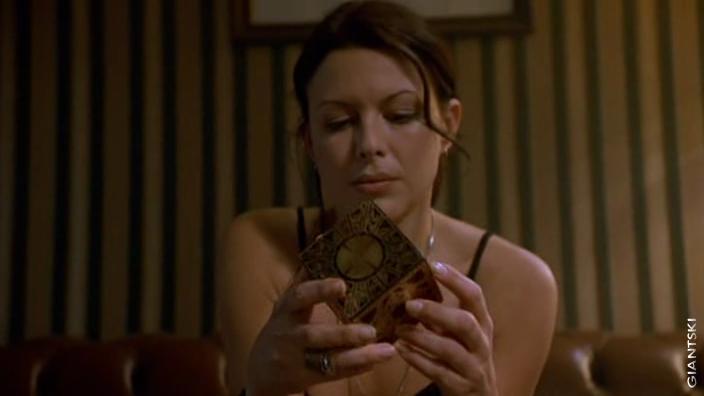
I can't see any harm in opening this ornate evil cube I pulled out of the hands of a corpse.

I should also say something nice about Kari Wuher, the actress who plays our plucky heroine. She’s not exactly the world’s best actress, but she commits to the part pretty respectably. When she screams “NOOOOOO!!!!!” you can see her suck in her breath and really belt it out, heroically overdoing it in a series which has been marked by listless, mopey nonperformances for the last couple installments. She’s also ballsy enough to do a pretty crazy scene where she wakes up topless and in her panties to discover there’s a huge kitchen knife sticking out of her back. It’s one of those what-the-fuck scenes like when Virginia Madsen wakes up covered in blood in CANDYMAN where it seems like it has to be a dream and then it just keeps going. You gotta give the gal credit for doing a scene where she’s basically nude but instead of looking sexy she’s screaming and whimpering and covered in blood on the bathroom floor, helplessly trying to pull out a foot-long kitchen knife jammed into her spine (when she can’t get it out, she wraps duct  tape around it and puts on a coat to conceal the fact that she’s gonna be spending her day with a knife handle sticking out of her clothes. That may actually go a little beyond simple pluck.)

    So, Wuher is clearly hustling, but in general the movie is not. For evidence, look no further than the tag-line on the cover of the box, which attempts to pique the interest of the casual viewer with perhaps the tamest come-on ever, “the latest, most terrifying evil.” Seems kind of unfair to call Pinhead evil after all the good work he’s been doing lately to teach people to be nicer, although he’s admittedly kind of villainous here. But “The latest”? Why not just say, “It’s a new one, what the fuck, you’ve got nothing better to do.” I guess since they got shy about putting numbers on these after part 5, they want to make sure people know that yes, this is the new one. It probably also doesn’t help that the covers of HELLRAISER I, 2, 3, 5, 6, 7, and 9 are all essentially identical, so it doesn't hurt to have a little reminder that even though this looks exactly the same** it’s actually “the latest” one. I can only assume the marketing guys thought the series would end here, because, of course, the existence of part 8 definitively establishes that part 7 is no longer the latest (and a long way from the most terrifying, but that’s a little harder to prove in court) but now it’s doomed to claim it’s the most current forever, just like poor FREDDY’S DEAD: THE FINAL* NIGHTMARE (*The use of the word “final” does not actually denote that this is the final one).  


It's pretty bright on this debauchery train, so the sunglasses make sense.

    What does this mean for our beloved series? Well, it simply means the series is still treading water, pulling the exact same bullshit that shamed them and sullied Pinhead’s good name for the last three movies. In fact, HELLRAISER V-VII are so similar you could almost look at them as a kind of trilogy -- they’re all about driven, amoral loners who are forced to face the truth about themselves through a hallucinogenic journey brought on by Pinhead and vaguely related to opening the puzzlebox. They’re all developed from other scripts, they’re mostly about muddled, unimaginative surrealism rather than the grotesque mythology originally developed by Clive Barker for the original (and to a lesser extent parts II-IV), and none of them have much Pinhead or seem to make sense with his character even when he does show up. The difference in number VII is that now this shit has been going on long enough that we can’t really pretend it’s a fluke anymore; this is the new definition of the series. And to celebrate the new, lowered standards hardcore fans now held for the franchise, Rick Bota decided that after part VII came out he’d call up Lance Henriksen, stop trying, and really just run the whole thing into the ground once and for all. Prepare yourself, dear reader, for HELLRAISER VIII: HELLWORLD.  

THE WHOLE SORRY HELLRAISER SAGA:
1: HELLRAISER (1987)
2: HELLRAISER 2: HELLBOUND (1988)
10: HELLRAISER X: JUDGEMENT (2018)  


Who wants a hug?

   
*They say this douchebag is the descendant of the original L’Merchant, but that seems questionable because he’s not played by Bruce Ramsay and as we know from HELLRAISER IV: BLOODLINES all descendents of L’Merchant looked exactly like him for at least 300 years. Why couldn’t they just have gotten him back? It would have been nice for the continuity, and Rhys could have gone back to playing the brother of famous artists way sooner.

**Part 8 looks a little different because Pinhead’s face is made of a collage of MATRIX-y 1’s and 0’s to artistically communicate the fact that it’s about video games.


Yep, there's a few solid back-and-forths between our protagonist and some female cultys.

Thursday, November 15, 2012

Hellraiser V: Inferno

Hellraiser V: Inferno (2000)
Dir. Scott Derrickson
Written by Paul Harris Boardman, Scott Derrickson
Starring Craig Sheffer, Nicholas Turturro, James Remar, Doug Bradley


    The advent of HELLRAISER V: INFERNO brings with it a number of new features to the series. For one, it’s the first time some shady producer came up with the genius idea of sticking a few Pinhead scenes into an unrelated horror script and calling it a sequel (PUMPKINHEAD 2 obviously set a dangerous precedent). It’s also the first HELLRAISER to bypass theatres entirely, admitting that the last two entries had left this franchise a cheapened, burnt-out husk of its classy original. Realizing this, the producers consulted with top Bush administration education experts, who agreed that the thing to do was to make sure we punish the failing institution by cutting its funding and diverting valuable talent away from it, letting it die a slow and humiliating death until it could be replaced with a private institution (in this metaphor, the inevitable remake/reboot).

But no one puts Pinhead in a box. Well, metaphorically anyway. Even though this humbling DTV cash grab isn’t great, it’s actually better than I was expecting. Basically, it’s the same low-imagination atmospheric mindfuck movie that every wannabe horror director has to make when they’re young and poor and before they can afford more interesting scripts. It’s a bit dull, and contains literally nothing you haven’t seen a million times before, but other than that it’s actually reasonably well made, and even reasonably well acted. If you can get over the fact that Pinhead probably has under 5 minutes of screen time and even those are completely unnecessary, it’s watchable enough.

Yes, the title comes with ripple effects to drive home the point that its an INFFEEEERRRNNNOOOO.


The story here is that Joseph Thorne (Craig Sheffer, no stranger to the Barkerverse, having already played Boone in NIGHTBREED) is a brilliant but somewhat corrupt detective. He seems like an OK guy, but he also takes cash from the evidence room and cheats on his whiny wife with a suspiciously attractive hooker. In terms of corrupt cops, I’d say he’s way less corrupt than Harvey Keitel in BAD LIEUTENANT, less than Harvey Keitel in THE BORDER, maybe on par with Harvey Keitel in CORRUPT (at least before he chains Johnny Rotten up in his bathtub), slightly more corrupt than Harvey Keitel in CLOCKERS, and much more corrupt than Harvey Keitel in THELMA AND LOUISE. But still, he seems like flawed dude who’s fundamentally decent. So when he finds a suspicious puzzlebox at the scene of a gristly hook-related fatality, you’re kinda hoping that he won’t try to solve it, even though he explicitly says earlier that he loves puzzles and that’s why he became a detective.

So what happens when he opens the box? Hooks, right? And maybe a Chatterer dog? Well, remember that this wasn’t originally written as a HELLRAISER script. So Pinhead’s MO this time is to briefly appear in a weird dream along with two female cenobites with long tongues and a walking torso with Chatterer’s head (both, to the movie’s credit, look pretty creepy, and are probably the best cenobites since the first one). I miss the hooks too, but I guess he got bored with them during the long ordeal of hook-murdering the guy Thorne took the box from and decided to try something new. Or maybe he finally got tenure and just doesn’t give a shit anymore. At any rate, that’s the last we’ll see of Pinhead for awhile. But Det. Thorne (there’s no Inferno anywhere in the movie, so maybe that’s his nickname) still has other problems. Some psychopath called “The Engineer” has kidnapped a child and is murdering people that Thorne knows and leaving the kid’s severed fingers behind, one at a time. You know, to fuck with him. And if that wasn’t bad enough, Thorne keeps having weird hallucinations and freaky encounters with a guy in a leather jacket and hood who also has Chatterer’s face (what, no love for Butterball?). And to top it all off, he’s being forced to talk to a bearded new-agey psychologist (James Remar) about his issues, because his fellow cops (including partner Nicholas Turturro) think he’s cracking up.

Still preferable to the two-guys-one-girl variation.

All this is reasonably well executed, with decent atmosphere (although like all DTVs, it overuses those lame green filters) and a good feel of surreal menace waxing and waning. Problem is, there’s just nothing very imaginative in here to make it memorable or unique. I doubt there’s a single thing in this movie that you haven’t already seen somewhere else in a better --or at least more interesting-- movie. To it’s credit, there is an occasional decent idea or jump to the truly bizarre here and there. The cenobites look pretty good, there’s a pretty rough early “found footage” type deal where Thorne gets a tape of an informant being whipped to death with a cat-o-nine-tails made of fishhooks. And there’s one amazing scene where he goes to this poolhall in search of “The Engineer,” only to find that everyone there is inexplicably dressed like a cowboy. Later he goes out into the woods, and two Asian women dressed like cowboys (one in all black, the other in all white) come out of nowhere and kick the shit out of him with kung fu. That’s almost some David Lynch shit right there, so I gotta give ‘em credit for that. It escalates pretty nicely and even though the climax is nothing you ain’t seen before, it works in its own derivative way. Oh, his memory of his mother gets possessed and he has to kick her ass, I guess that’s one other thing I haven’t seen before.

One of the funniest moments of the movie comes during the big revelation about what’s actually going on, which I hope you can infer from the previous sentence I’m going to SPOIL. It’s customary in these type of movies that the person secretly planning, “engineering” all this, if you will, is gonna be a character you already know, and it’s usually pretty easy to spot because there’s one character in the cast who’s played by a well-known character actor but doesn’t have much to do with the plot. It’s a tough spot to be in for a movie, because you know you’re telegraphing your villain this way, but you also want to have a good antagonist for the hero to face off against at the end, not some hammy low-watt extra. Here, you’ve got Craig Sheffer, his partner, and hmmm... James Remar as the psychiatrist who’s always going on about metaphysics and morality and so forth. OK, it doesn’t take a genius to see what’s going on here, Remar is actually the engineer, and feeding Sheffer clues while fucking up his life based on the things he reveals in their sessions. But get this: you’re right, he is, but there’s another twist: James Remar is actually the Engineer, and the Engineer... is actually Pinhead! It’s all a weird dream that Thorne is having after having open the box, to teach him a lesson about his wicked ways what with the stealing evidence and banging hookers in motel rooms and whatnot. So even though you’ve got James Remar revealed to be the bad guy all along, as soon as you find out he just morphs into Doug Bradley and Remar never even gets to have an evil speech or anything! Why the hell would you cast him in this role, it makes no sense, it just alerts us that he’s gonna be the villain and then you don’t even get to use him to give us some good villainy. Setting aside the odd change of character for Pinhead (what, he teaches us lessons about morality now? Guess he watched SAW and had a change of heart?) I think we can all agree that this was a silly thing to do. Shit, they should have just cast Doug Bradley as the psychiatrist. They could have saved some cash, and Remar could have had more time to prepare himself emotionally for being on Sex and the City. END SPOILERS.

Not to fear, Captain exposition has arrived. I only have five minutes so I'll make this quick.

The whole thing is surprisingly watchable, and probably on a whole works better than HELLRAISER IV: BLOODLINES, but it’s pretty low on reasons why you should watch it. BLOODLINES, despite it’s disastrous incompetence, is way more fun and more unique. This one coasts on a constant low level of decent competence, but only has maybe three or four memorable sequences in the entire runtime, and most of those get almost no mileage out of any of the familiar HELLRAISER tropes. They throw a few hooks in there, and even got some decent cenobites, but it’s hard not to notice how superfluous it all is to the actual plot, which is acceptably well-executed but unremarkable in almost every way. Amazingly, director Scott Derrickson would move out of his own DTV hell to helm the well-regarded THE EXORCISM OF EMILY ROSE, that abysmal remake of THE DAY THE EARTH STOOD STILL and, holy shit, last month’s SINISTER, a movie I generally enjoyed (and which also incorporates a well-utilized found footage angle). Hell, he’s even co-writing that movie DEVIL’S KNOT about the West Memphis Three that’s gonna be directed by Atom Egoyan (he also wrote URBAN LEGENDS: THE FINAL CUT, so don’t get too excited, Egoyan fans). Wow. In the movies, Pinhead punishes you for your sins, but I guess in Hollywood, you get rewarded. No wonder Pinhead stays in that box all the time, things make more sense there.

THE WHOLE SORRY HELLRAISER SAGA:
1: HELLRAISER (1987)
2: HELLRAISER 2: HELLBOUND (1988)

10: HELLRAISER X: JUDGEMENT (2018)

CHAINSAWNUKAH 2012 CHECKLIST!

LOVECRAFT ADAPTATION: No, but adapted from an unrelated script.
BOOBIES: No, not too many chicks interested in going topless for DTV. Even the hooker he fucks at the beginning is one of those leave-the-bra-on hookers.
> or = HERSCHELL GORDON LEWIS LEVEL GORE: Some good hookey stuff.
SEQUEL: First DTV sequel out of a total of 9 total HELLRAISERs so far.
OBSCURITY LEVEL: DTV, so I'll call it high.
MONSTERS: That torso thing.
SATANISTS: Nah.
ZOMBIES: No.
VAMPIRES: No.
SLASHERS: Well, "The Engineer" is a serial killer, and a couple stabbings. I'll say yeah.
CURSES: No.
ALEX MADE IT THROUGH AWAKE: N/A.

Monday, June 13, 2011

13 Assassins

13 Assassins (2010)
Dir. Takashi Miike
Starring Koji Yakusho, Takayuki Yamada, Goro Inagaki, Masachika Ichimura 


Takashi Miike is one of the most daring and controversial modern directors to come out of Japan in a long time, and has produced some crazy films which are already acknowledged as genre classics (from ICHI THE KILLER to GOZU to SUKIYAKI WESTERN: DJANGO). He's made shocking horror films and family films, and in the period between 2001 and 2002 alone, Miike is credited for directing 15 films (so says Wikipedia). Problem is I, ah, haven't seen any of them. I've seen enough of AUDITION to get the picture, but somehow managed to completely absorb the hype without ever actually watching one of his films all the way through. So whatever his latest --13 ASSASSINS-- has to do with his work as a whole I honestly couldn't say. So to paraphrase Mitch Hedberg, 'when you meet a legend but you don't know his body of work, you have to divert from that fact. Hey Takashi Miike, do you like SEVEN SAMURAI too?"

I'm guessing he does, since 13 ASSASSINS is basically a remake of Kurosawa's seminal 1954 action drama (actually, Wikipedia says it’s a direct remake of a 1963 Japanese film of the same name, but I'm guessing that one borrows pretty heavily from SAMURAI too, even though its supposedly based on real history). But that's OK, if you're gonna remake SEVEN SAMURAI with an extra six characters, you might as well have somewhere interesting to go with the concept, and Miike does nicely giving this thing a reason to exist.

It's a surprisingly straightforward, classic Samurai picture, which surprised me a little given Miike's reputation for shocking and boundary-pushing horror. There are a few little hints of the kind of craziness that seems to have endeared him to my more cinematically educated peers, but mostly they're just flavor in what is otherwise a classy, superficially normal period action piece. Sure, Kurosawa would probably not have showed us the naked quadruple-amputee lady bleeding from her eyes, but a few little touches like that just make the rest of the film seem more conventional. Not that that's a bad thing, but it’s not exactly what I was expecting given Miike's reputation. Seriously, you could show this alongside any number of Samurai films from the last 40 years and only find a few clues that it's a modern film made by this crazy auteur.

The action is quite good, and some of the set pieces are awesome and respectably crazy. There’s a couple oddball touches like these giant walls of heavy tree trunks (never explained) which leap out of nowhere to block escape, or a bunch of flaming bulls released to run down the enemy Spaniard-style. But mostly, the battle sequence is just watching our guys fight against approximately 200+ attackers by any means necessary. They get creative a couple times but I’d say a good 170 die by being slashed by swords. Since all our 13 Assassins wear the same color of dark purple and sport identical haircuts and no facial hair, it can be hard to tell them apart, especially since the camera tends to shake around a little. Not so much as to become incomprehensible, but enough that it’s hard to tell if that’s Hioki, Horii, Higuchi, Balin, Dwalin, Sleepy, Grumpy, or whoever fighting that particular group of faceless opponents with a sword (everyone except one guy uses a sword, so that’s not much help).

Miike compensates for this by having someone yell out the guy’s name every time something major happens to him, which makes it easier to figure out but also gets funny after the seventh time or so. Every once in awhile they’d show this guy with a little heavier build and I’d get excited because he’s easy to recognize, but then I’d see he was using a spear instead of a sword and I’d remember that no wait, there was another heavyset guy and I guess this is the other one.

Pretty much any given frame from the second half of the film looks like this.

What I’m saying is that with 13 instead of 7, you don’t get a whole lot of characterization of anyone except the Yul Brenner of these assassins. Most of the 13 get at most a line or two of personality exposition before they’re off to meet their deaths. Kurosawa probably got it right by paring the number down to a more memorable seven, although to be fair each one has enough flavor that you can pretty much keep them straight (‘right’, you’ll says, ‘it’s that guy who was supposed to train on explosives’, or ‘oh yeah, it’s that guy who was sitting to the left in that one scene and he seemed like he was in charge, I think his name begins with an M’). It still hurts when they start to go down, but it might hurt more if we knew a little more about them and had a few more human moments here and there.

So there’s just more people, more attackers. The geography is generally pretty clear but in the chaos of battle it’s hard to tell where everyone is or how close to their goal they are. Miike gets the most out of having so many attackers by filling up frame after frame to bursting with bodies in motion. It gets a little funny because every time one of our guys catches a moment to breath and it seems like Jesus Fucking Christ, look at those piles of corpses, surely that must be all of them… suddenly in rush what seems like 100 more opponents. I do not exaggerate when I say this happens six or seven times. It’s kind of funny but also helps you see what an exhausting slog it is to mindlessly chop your way through hundreds of opponents to find that one guy you actually want to kill. On the other hand, I’d almost have to say that SEVEN SAMURAI’S final battles feels even more like an exhausting ordeal, and there’s way less cannon fodder. It hardly needs to be said, but the SEVEN SAMURAI comparisons are inevitable and are obviously going to favor Kurosawa.

So what's the different here? Not much. The structure is virtually identical to SEVEN SAMURAI, with an hour of setup and recruiting the 13, and then the entire second half consisting of the final battle. Half setup, half payoff. Although these folks are assassins out to kill the Shogun's brother instead of protect a village, they set up their ambush in an abandoned village so it still has a kind of siege element in a single location. They’re trying to keep people from leaving rather than keep them from entering, so that’s a nice twist, but the similarities are really too overwhelming to ignore. If there's a difference here which I haven't seen in a samurai picture before, it's in the subtext.

This is a film about suicide. It starts with a man committing hara-kiri in lieu of making a direct complaint, and he’s not gonna be the last. All 13 assassins are working with the explicit knowledge that they’re going to their deaths, and they’re just going to have to find a way to be OK with that. Hell, it beats dying peacefully after a long and uneventful retirement.

Allow me to explain: The stage is set in the waning days of feudal Japan, and life is pretty peaceful in its rigidly ordered way. That seems great unless you’re a samurai, whose only purpose in life is to fight to defend the Shogunate. These peaceful times are killing the trade, and most of the Samurai haven’t seen any real combat in a long time, making their lives kind of pointless and empty. We meet our protagonist, Shinzaemon (frequent Kiyoshi Kurosawa player Koji Yakusho, CURE, SEANCE), sitting alone fishing and –with no wife, children, or work—pretty much just waiting out the clock. He’s thrilled when he hears that he’s going to get to die in the service of his profession. He’s been called out of semi-retirement because of the one person who does still seem to be enjoying his job, the Shogun’s half-brother Naritsugu (played to the hilt with bored malevolence by Goro Inagaki). Naritsugu is the one who de-limbed that poor gal I mentioned above, and he’s a hateful sociopath of breathtaking proportions, raping and murdering with impunity due to his high social status. Everyone but everyone knows this guy has to go, but due to their rigid social hierarchy, not only can no one do anything about it, no one can even bring themselves to say it. When he finally makes the mistake of killing people with connections, Shinzaemon is called in and told using a series of artful euphemisms that Naritsugu needs to no longer be in his position of power. They leave it at that, and so does everyone else. The very concept of conspiring against their hierarchy is virtually unthinkable, and the Samurai are just happy that someone gave them something to die for that they can secretly know is actually the right thing to do.

And that’s the genius of this film. It’s about this awful open secret that everyone is party to, and yet no one can acknowledge aloud. Everyone --probably even Naritsugu-- knows that he’d be better off dead, but instead of just killing him and calling it a day, everyone’s going to have to die so that they can claim the system is working. That’s where the film’s most interesting conflict comes in, in the form of Hanbei (Masachika Ichimura), Naritsugu’s head Samurai. He knows better than anyone what a stunning piece of shit Naritsugu is, and it’s written on his face the whole film. He has the trapped horror of a man being gradually eaten alive from the inside. But this system has given him only one purpose in life, which is to defend his lord. If he does his job, he has to spend his life and others’ lives to protect someone actively engaged in making the word an exponentially worse place… but if he casts aside that system, his life has been completely meaningless. The horror of that conflict is constantly dancing in his eyes, but the most he can ever do to admit it is to halfheartedly say that his circumstance is unfortunate for reasons which he doesn’t elaborate on.

This is what makes the film more than merely a slightly bloodier SEVEN SAMURAI. It becomes a commentary on living in a system which so inflexibly assigns value to lives and jobs. Shinrouko, Shinzaemon’s nephew and one of the 13, is first encountered in a brothel/gambling house type of situation where he’s spending cash, getting hammered, and presumably fucking absolutely everyone in sight, wasting his talents as a samurai on booze and games of chance. Shinzaemon’s quest convinces him to stop his fun and take up the sword again. That’s where most films would stop the character arc, but by the end of this one is becomes pretty clear that he had it right the first time. Everything here is a terrible waste of life and effort, and it’s all because the feudal system which gives them no options except to walk happily into suicide and thank the guy who sent them there.

Without needing to say anything explicit about it, Miike demonstrates how horribly trapped everyone is by this system which survives entirely on the strength of people refusing to acknowledge how flawed it is. No one complains, everyone acts honorably, everyone does exactly what good samurai are supposed to do, and most films like this would leave us to be impressed by their discipline and commitment. But Miike ends the film by focusing on the piles of bodies and silently daring us to argue that this was a good use of their lives. Without comment, he informs us that the system of feudalism fell about 20 years later (he doesn’t mention that their feudalism would eventually twist itself into fascism, which brought along most of the same problems to the same culture). It’s not an anti-war picture, it just wants you to think a little bit about what kinds of things are really worth dying for, and if you should trust a society where dying for a cause is more important than living for one.

On the other hand, this poster makes a pretty compelling argument for violence.