Friday, December 11, 2015

Asylum (1972)


Asylum (1972)
Dir. Roy Ward Baker
Written by Robert Bloch
Starring Peter Cushing, Britt Ekland, Robert Powell, Herbert Lom, Barry Morse, Patrick Magee


The years between the 1971 release of THE HOUSE THAT DRIPPED BLOOD and the 1974 release of FROM BEYOND THE GRAVE were something of a golden age for horror anthologies, especially those released by the longtime also-ran English horror factory Amicus productions. While rival Hammer Studios was suffering a painful artistic and popular decline with their characteristic brand of gothic bloodletting, Amicus was managing to stay relevant by cranking out contemporary-set anthologies corralling the still-popular British horror stars of the time into a few days’ work on different segments. It was cheap and hit-or-miss, but overall boasts a surprisingly high success rate, as we saw with the excellent VAULT OF HORROR and TALES FROM THE CRYPT.


Both of those films were based on the EC horror comics of the same name, but ASYLUM (premiering in 1972, the same year as TALES) took a different approach: four different adaptations of Robert Bloch short stories, adapted by the author. Bloch was already the subject of some renown for having written the novel upon which Hitchcock and screenwriter Joseph Stefano based PSYCHO (apparently quite faithfully), but his writing was quite a bit more versatile than that much-copied story would indicate. Actually, Bloch was a writer somewhat more in the Lovecraft vein than the fairly grounded world of Psycho would suggest; in fact, he corresponded with Lovecraft himself and his circle of writers quite a bit as a youth. Lovecraft even includes a very thinly-disguised Bloch (“Robert Blake”) in his final fictional work, The Haunter of the Dark, itself a sequel to an earlier Bloch story in which a thinly-disguised version of Lovecraft gets killed. And then Bloch wrote a sequel to Lovecraft’s story to bring himself back from the dead! That immediately suggests something about Bloch which was never evident in Lovecraft: a sly sense of humor, and a sure hand at a cheeky twist.


These traits would serve him well in the medium of short fiction, but would transfer successfully to the silver screen only sporadically. By 1972, he’d written a total of nine screenplays --five of those for Amicus-- and had a fairly spotty track record from what I’ve seen. I hear TORTURE GARDEN is pretty good, and I liked THE SKULL (though more for its stylish direction than its somewhat languid screenplay), but on the other hand THE HOUSE THAT DRIPPED BLOOD is the very definition of tepid mediocrity, and THE DEADLY BEES (apparently significantly re-written without his consent, but still…) is a solid candidate for actual factual most direly worthless artistic endeavor ever mounted by humans. That’s not hyperbole, that’s just stating a simple scientific fact. Give me a pen and paper and I can prove it to you mathematically.


Turns out ASYLUM is one of the good ones, though. Directed by Roy Ward Baker (the earlier Amicus anthology VAULT OF HORROR, the English parts of the Hammer/Shaw Bros oddity LEGEND OF THE 7 GOLDEN VAMPIRES), this turns out to be one of the sleeker and more enjoyable horror anthologies from this period, even if it somewhat lacks a truly classic sequence. Eschewing both the pulpy meta comedy of HOUSE THAT DRIPPED BLOOD and the more visceral sadism of TALES FROM THE CRYPT, ASYLUM, true to its name, defines itself with some of the strangest and most esoteric stories ever to grace an anthology. Somewhat different in tone from the twist-heavy EC comics that supplied the giddy essence of VAULT OF HORROR and TALES FROM THE CRYPT, these tales wind their way into stranger and often nearly surreal corners of horror.  


It starts with a real solid wraparound story -- not always a strong suit of these movies, so it’s worth noting. It’s not as eloquently dreamlike as VAULT OF HORRORS’ 5-people-in-a-locked room premise, but certainly more cinematic. It involves a young doctor (Robert Powell, the title role in JESUS OF NAZARETH) arriving at an asylum seeking a job. The asylum administrator (Patrick Magee, CLOCKWORK ORANGE, BARRY LYNDON, as well as THE SKULL and TALES FROM THE CRYPT) gives him a test to prove his merit: it seems that the previous head psychiatrist has recently gone mad, and has been committed to his own institution along with the other nutjobs. If the neophyte psychiatrist can identify which of the deluded inmates is the doctor, the job is his. The stage is set, then, for four interviews with different inmates, each with a strange tale to tell. This nifty setup invites the viewer to play a little game with how much they want to believe of the twisted stories, all told by madmen, at least one of whom is so deluded we know it would take special talent to even establish his true identity. It provides an air of slippery ambiguity to the whole proceedings, nicely heightening the special strangeness to be found here.


The first story is a pretty perfect encapsulation of the general weird vibe here, though it’s the most literal, and the most traditionally horror-driven. It’s a simple setup, almost to a fault: A cheating husband kills his voodoo-aficionado wife, chops up her body, and neatly wraps the pieces up in a freezer for later disposal. But, wouldn’t you know it, wifey took the precaution of pre-voodooing herself, presumably with the expectation of exactly this scenario, because the severed body parts have no intention of letting their death and dismemberment keep them from some well-deserved revenge. That’s it, there’s nothing else to the story itself, but the design of the vengeful body parts is top-notch -- having them wrapped in butcher paper (aside from making them more feasible as props) somehow makes the whole thing way more morbid than it would be if they were simply exposed. And besides, take a look at this:


I mean, who could ask for anything more?


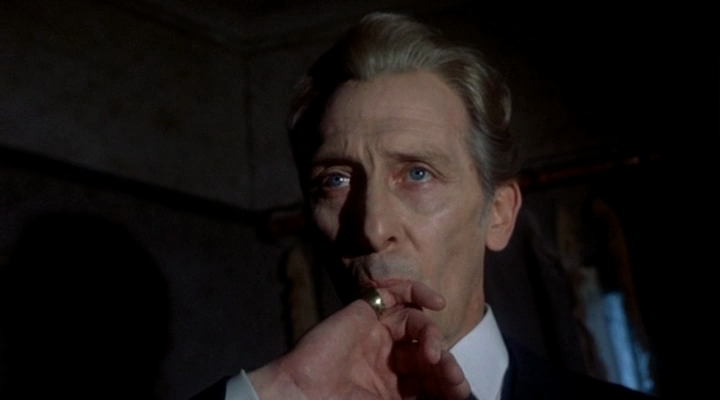
The next segment is a strange one, possibly more of a fantasy-drama than out-and-out horror; it has a gothic whimsy that recalls some of the gentler Twilight Zone episodes (at least one of which is almost certainly an inspiration). Not necessarily what you’d expect from the writer of Psycho, but there you go. A put-upon tailor facing financial ruin (Barry Morse, THE CHANGELING [the 1982 one with George C. Scott, which I consider to be something of an unacknowledged horror masterpiece]) accepts a job from the mysterious Mr. Smith (Peter Cushing) to make a suit out of a glowing, inexplicable fabric. You at first assume he’s planning on mounting a production of Joseph and the Amazing Technicolor Dreamcoat, but alas, the story takes an arguably more tragic turn. I’ll say no more, except that Cushing’s part is extremely small but he’s absolutely terrific here, even by his usual high standards. Like his role in TALES FROM THE CRYPT, this casts him in a somewhat atypically sympathetic role for such an iconic horror actor, and one can’t help but remember that the actor was still dealing with his crippling grief over the death of his beloved wife Helen in 1971. With only a handful of scenes, he gives a performance of painfully raw emotion so potent that it actually kind of derails the segment; nothing else it can offer is going to be as affecting, and it kind of peters out with its somewhat rote and egregiously telegraphed twist. Ever seen an actor ruin a movie by giving too good a performance? Enjoy.


Anyway, the next segment is a serviceable but somewhat disposable psychological thriller revolving the mentally unstable Baraba (Charlotte Rampling, ZARDOZ, BABYLON A.D., TIS PITY SHE’S A WHORE, ORCA, and probably some classy shit as well, but what would I know about that?) returning home after a stay in the nuthouse. She’s closely monitored at home, and her frustration is given worrisome focus by the arrival of her troublesome friend Lucy (Britt Ekland, GET CARTER, THE MAN WITH THE GOLDEN GUN, THE WICKER MAN) who seems to have had something to do with her previous unwilling incarceration. Well, if you’ve seen a movie before, you can probably guess what’s going on here. But no matter, Rampling and Ekland are both compulsively watchable, and share an easy, electric chemistry which makes the inevitable escalations feel more energetic and arresting than the languid pace warrants.


The final tale is the shortest and by far the strangest, almost transcending the horror genre into pure art movie in its unprecipitated weirdness. It’s the only story which doesn’t involve a flashback of any kind  --or a story at all, per se. The final interviewee is Herbert Lom (The PINK PANTHER series, Jess Franco’s DRACULA), an obsessive doctor who, while incarcerated, has a hobby of building miniature robotic automatons visaged with his own scowling countenance. Inside these boxy metal contraptions, he’s meticulously reproduced the entire organ system of a human in miniature (it’s not clear with what). He’s done all this, he explains, because he hopes to transfer his consciousness into one of them. Initially it’s hard to see what he hopes to gain from this plan, but quickly it becomes clear -- after our young protagonist leaves him and returns to the interviewer, we see that Lom has, in fact, created a tiny assassin with the intent of murdering the man keeping him locked up! But then it stops making sense again, because making a tiny, clumsy mind-controlled robot seems like the least efficient possible way to go about this task. I guess he was crazy after all.


Both Cushing and Lom have tiny roles,* and there's something of a lack of showy setpieces (aside from the first segment) so it’s good that the general weirdness of the thing is strong enough to carry it. And it's certainly not guilty of overstaying its welcome; at a slim 88 minutes, it feels like it’s over a little fast, actually (especially since Lom’s tale is very short, almost a vignette). But Bloch’s inimitable weirdness pervades everything; there’s simply a dreamy, murky creepiness which grows stronger the longer you stay in this world of mentally unstable rambling. Roy Ward Baker is not a director I would list among the greats, but he sure gets a lot more out of Bloch’s creepy ideas than Peter Duffel did in THE HOUSE THAT DRIPPED BLOOD. And more than that, he seems better suited to craft the right vibe for the endeavor, which is crucial, because more than anything this is a vibe movie. It doesn’t traffic in big shocks or gruesome violence, it just wants to drag you into its macabre world and let you kick around for awhile -- and at that, it succeeds admirably. While it may not be quite a pinnacle of the form in the way TALES FROM THE CRYPT is, it’s a perfect little slice of moderately surreal 70’s psycho-horror and an excellent example of why these portmanteau films are so enduringly popular.


*IMDB claims they spent two days and half a day on set, respectively.


CHAINSAWNUKAH 2015 CHECKLIST!

Play it Again, Samhain

  • TAGLINE: Some posters read You Have Nothing To Lose But Your Mind, which is a pretty good tagline. The others feature the blunter alternate tagline, Come To The Asylum… to GET KILLED!
  • LITERARY ADAPTATION: Yes, Bloch adapts his own stories.
  • SEQUEL: No, but part of Amicus’ loose series of anthology horror films
  • REMAKE: I wouldn’t swear that none of these Bloch stories have been adapted for other mediums, but I can find no direct evidence that they have.
  • DEADLY IMPORT FROM: England
  • FOUND-FOOTAGE CLUSTERFUCK: No
  • SLUMMING A-LISTER: Today, I’d have to say award-winning actress Charlotte Rampling, though at the time she was nearer the start of her career.
  • BELOVED HORROR ICON: Cushing, Herbert Lom
  • BOOBIES: None
  • MULLETS: None
  • SEXUAL ASSAULT: No
  • DISMEMBERMENT PLAN: Total dismemberment in the first segment.
  • HAUNTED HOUSE: No
  • MONSTER: No
  • THE UNDEAD: Killer limbs!
  • POSSESSION: Does possession of tiny evil robot dolls count?
  • SLASHER/GIALLO: No.
  • PSYCHO KILLERS (Non-slasher variety): Yes
  • EVIL CULT: While the first segment centers on Voodoo, that’s really more of an “emerging religion,” though in this case it was definitely practiced for evil purposes, or at least morally ambiguous post-death revenge.  
  • (UNCANNY) VALLEY OF THE DOLLS: Finally! Creepy Herbert Lom dolls! Plus a creepy mannequin! I was beginning to think the dolls had totally failed us this year, but then along comes a two'fur.
  • EGYPTO-CRYPTO: No
  • TRANSMOGRIFICATION: No
  • VOYEURISM: Nah
  • OBSCURITY LEVEL: Mid, a successful Amicus release in 1972.
  • MORAL OF THE STORY: If the first task your new employer gives you is to locate the guy who went insane doing your job before you… perhaps seek employment elsewhere.
  • TITLE ACCURACY: There is definitely an Asylum, 100%.
  • ALEX MADE IT THROUGH AWAKE: N/A.
Thanks to the Rampling/Ekland teamup.

Wednesday, December 9, 2015

Noroi: The Curse


Noroi: The Curse (2005)
Dir Kôji Shiraishi
Written by Kôji Shiraishi, Naoyuki Yokota
Starring Jin Muraki, Rio Kanno, Tomono Kuga


Here’s a pretty strange one. NOROI: THE CURSE combines a series of words which really have no business being anywhere near each other: it’s a surprisingly effective Japanese found-footage 2-hour epic. Arriving in 2005, it preceded PARANORMAL ACTIVITY’s 2007 inauguration of the current blight on cinematic culture, and undoubtedly has more in common with the few predecessors in the years since CANNIBAL HOLOCAUST introduced the form (BLAIR WITCH most prominently, of course, though wikipedia lists a dozen or so others, mostly very low-profile). Like the latter two movies, NOROI follows a group of people who are intentionally making a documentary, saving us the indignity of wondering why in god’s name some jackass with a camera phone is running towards obvious peril for an hour and a half. They’re supposed to be professionals making a documentary, so it makes sense that they keep rolling, and also it’s a good excuse to have it shot by professionals who know how to make hand-held footage look pretty comprehensible if not, you know, pretty.


The documentary in question is being made by paranormal expert/film director Masafumi Kobayashi (Jin Muraki, RETRIBUTION) --something of a Japanese Art Bell-- who thinks he’s just making a normal hacky TV mystery program. The more he investigates, though, the stranger things become, and soon it’s clear that they’ve stumbled onto something far bigger than they could have possibly imagined. The structure, then, is essentially that of a mystery documentary -- a stark difference from most modern “found footage” debacles, which typically purport to be raw, unedited footage. Like DIARY OF THE DEAD or THE BAY, the edited-documentary framework gives the film license to actually tell a fairly complete story, and not just depict a single stream-of-consciousness incident as has become increasingly common in the subgenere (lookin’ at you, VHS series). NOROI unfurls over the course of several months, and follows something like a standard (if somewhat surreal) mystery plot, pretty much the exact same movie it would have been had it not utilized the found-footage conceit. It’s got characters, a central mystery for us to unravel, conflict, and resolution. As I think Shakespeare originally put it, “the whole she’boigle.”


Ordinarily, then, this is the part where I’d sarcastically ask, “so why bother with found footage if it just makes everything uglier and less artful, and you’re planning on telling a normal story anyway?” But this is a rare case where I’m prepared to say it legitimately works, and actually brings something decidedly unusual to a tale which would otherwise be a bit more exotic than usual, but still replete with all the expected elements of J-horror. In editing, performance and cinematography, there’s something surprisingly convincing and grounded about the workaday ugliness of the production. This is actually the way real hand-held news footage shot with real cameras in the real world looks, and this is clearly the real world we’re seeing, in all its scruffy, unadorned glory. The banality and the casual familiarity of the medium combine with the creepy, otherworldly demonic plot in a way which creates a surprising and upsetting tension.


In a more traditionally shot genre movie, you get the comforting predictability of genre; we know when the music gets ominous and the angles get canted that something spooky is coming up. With this particular found-footage approach, our reassuring assumptions about the language and structure of cinema are shaken away. The surreal can unexpectedly superimpose itself onto the mundane; something as simple as a convincingly frivolous Japanese TV talk show can erupt into chaos and violence at a moment’s notice. Everything feels natural and ordinary, but weird tendrils of something deeply bizarre keep disrupting the calm waters of normalcy. It helps that the film’s imagery eschews a lot of the traditional horror beats in favor of something more surreal, and in doing so neatly avoids a lot of expectations about how found footage manipulates us, allowing a queasy sense of genuine strangeness to seep through. And the fact that the film’s premise requires our ostensible protagonists actively pursue a mystery --rather than just film things which passively happen to them-- confers the galvanizing impression of peering into a hidden world which lurks, unseen, just underneath the everyday trappings of modernity.


It’s altogether an engrossing and unique use of the medium, certainly among the best and most worthy uses of the found-footage conceit I’ve seen, and markedly different in both its intent and its execution from most of its found-footage descendants. In the few genuinely good found footage films out there --[REC], THE SACRAMENT, the Evans/Tjahjanto segment of VHS 2 -- the idea of found footage has mostly been used to effectively insert the audience into an immersive, unrelenting experience. As I talked about in my reviews of VHS and THE BAY, if found footage has any logical use, it’s to craft something like a subjective, first-person perspective, a way of trapping an audience in with the participants in a story and denying them the comforting omniscience and detachment of traditional editing. It seems tailor-made, then, to document grueling, stream-of-consciousness situations and indulge in uncomfortably long sequences where the audience is stuck with the protagonist in the thick of the action; think CHILDREN OF MEN from a subjective POV. Though NOROI does indeed include a few harrowing sequences --particularly the climax-- which utilize the form in exactly this way, the meat of the film uses it quite differently. Rather than creating unrelenting intensity, it’s used to generate intimacy, inserting the audience naturally into the minutiae of a burgeoning and open-ended investigation -- a story which contains several very successful immersive incidents, but also works as a complete narrative.


The plot itself is surprisingly intricate, gradually drawing together numerous characters and strange incidents into a gossamer web of weird conspiracy. It centers around a reclusive mother and her strange son, who seem to spell disaster for anyone who pokes around in their business (eventually including, we learn from the prologue, Kobayashi himself). Strange behavior and mysterious occurrences seem to point to some sort of demonic boondoggle from antiquity, but to figure out what in god’s name is going on, they need to employ the assistance of not one, not two, but three colorful psychics, at least one of whom wears a tinfoil hat and coat at all times.


The performances are uniformly quite solid; in keeping with the rest of the production, the whole cast seems entirely believable as normal people with normal lives, suddenly swept up into this Cronenbergian weirdness. I’m not a native Japanese speaker, so maybe the line deliveries would feel phony to someone who was,* but at least with subtitles it comes across as very close to completely naturalistic. From the requisite psychic child (Rio Kanno, DARK WATER) to the bemused TV actress who gets embroiled in the investigation (Marika Matsumoto, voice actress in Final Fantasy X and Pokemon, playing herself in a weird bit of apparently unironic postmodernism) to the raving, mentally disturbed medium (Satoru Jitsunashi, JU-ON 2), they’re an unusually colorful lot for a Japanese film, but with a strong sense of earthy reality, which makes the bizarre mystery they encounter exponentially more jarring and unsettling. Combined with the stripped-down filmmaking, the characters come across as unusually vulnerable and relatable in the context of this strange situation. Realism isn’t something I typically look for in the exaggerated, illogical world of horror movies, but in this case it works rather beautifully, casting the divide between the prosaic and the phantasmagoric into stark relief but insidiously weaving them together. There are sequences ostensibly taken from different Japanese TV shows which I would have no trouble at all believing were real TV footage inserted into a horror plot; they’re so utterly believable in their humdrum normalcy in every respect (from acting to format), and yet they mesh so disconcertingly seamlessly with the intruding nightmares. It imparts the extremely disquieting sense of not knowing where reality begins and ends, throwing us firmly off-balance and expertly undermining our reassuring assumptions about the form.


At just five minutes shy of two hours, it seems that the big complaint about this one is that it’s overlong. It’s certainly shaggy, full of strange, ominous sidetracks which can be mildly disorienting and disruptive before they gradually dovetail into the story proper. I’d guess a full 30 minutes and a half-dozen minor characters could be excised with only minor changes to the basic narrative, which would unquestionably streamline the experience somewhat. On the other hand, I found it completely absorbing all the way through; its tangential ramblings add to its surprising sense of an epic journey into the unknown, creating a winding trail through a bizarre mystery that probably relies more on dream logic than good detective work. It could be condensed, sure, but since the whole point is to soak in the off-kilter weirdness of this enigmatic mystery, why rush things? I like the attention paid to the details here, and if the movie lingers to smell the demonic roses, so much the better.

Besides, the details are full of creepy iconography and esoteric characters. I particularly love Jitsunashi as the raving psychic with a penchant for tinfoil, who’s possibly the only one with the tools to grasp just how fucked up things are going to get, but who’s too erratic and incoherent to adequately communicate what he knows. I’m a sucker for intense depictions of fear so wrenching it renders the sufferer a incomprehensible, gibbering mess, and this is something of a tour de force, an actor bravely going mega (even for a Japanese movie) to convey to you, on a emotional, nonverbal level, just how worried you ought to be. But there’s plenty more to like; ominous pigeons, creepy masks, bizarre rituals from ageless antiquity, and even (SPOILERS) a swarm of harvested ghost fetuses crawling over a child (END SPOILERS). Now that’s something you don’t see everyday. It’s little touches like that, and the rather ingenious juxtaposition of morbid imagination with intentionally stark realism, that puts this one a cut above the rest.

*I once drunkenly managed to watch Roland Emmerich's 10,000 BC dubbed in German with English subtitles; I thought it was fucking awesome. Inherently silly, of course, but in a agreeably bombastic way. When I later tried to show it to some friends in the original English, I died a little inside every time someone opened their mouth; with the original English line readings, it was less earnest bombast than it was shameless camp. Ever since then, I’ve been leery of over-praising any actor speaking in a language I am not fluent in.


CHAINSAWNUKAH 2015 CHECKLIST!
Play it Again, Samhain

  • TAGLINE: Everybody DIES! gushes the American poster.
  • LITERARY ADAPTATION: Nope
  • SEQUEL: None, though director Shiraishi went on to several other found-footage horror movies.
  • REMAKE: No, but you know that fuckin' Hollywood version is coming.
  • DEADLY IMPORT FROM: Japan
  • FOUND-FOOTAGE CLUSTERFUCK: Yes, though a good one.
  • SLUMMING A-LISTER: None
  • BELOVED HORROR ICON: None
  • BOOBIES: None
  • MULLETS: None
  • SEXUAL ASSAULT: No
  • DISMEMBERMENT PLAN: None
  • HAUNTED HOUSE: Not as such. The haunting, as it were, is more generalized
  • MONSTER: Demon, though we don't get to see it.
  • THE UNDEAD: Ghosts
  • POSSESSION: Yes.
  • SLASHER/GIALLO: No.
  • PSYCHO KILLERS (Non-slasher variety): No
  • EVIL CULT: Turns out this is all the fault of some small-town demon cult in rural Japan who have a whole ritual for it.
  • (UNCANNY) VALLEY OF THE DOLLS: None, though the mask looks sort of doll-like
  • EGYPTO-CRYPTO: No
  • TRANSMOGRIFICATION: Nah
  • VOYEURISM: While there's a certain level of voyeurism to any found-footage approach, this one doesn't focus on it or get pervy or anything.
  • OBSCURITY LEVEL: Pretty high; no official American release as far as I can determine.
  • MORAL OF THE STORY: Sometimes, ancient supernatural powers give you some pretty clear and consistent signs that you should fuck off, and when they do, consider following that advice.
  • TITLE ACCURACY: There's definitely some sort of curse. They probably added the "Noroi" to distinguish this from the 1987 Wil Wheaton-starring THE CURSE. "Noroi" (呪い) is "curse" in Japanese.
  • .ALEX MADE IT THROUGH AWAKE: N/A.