Showing posts with label PHILOSOPHY. Show all posts

Monday, September 30, 2019

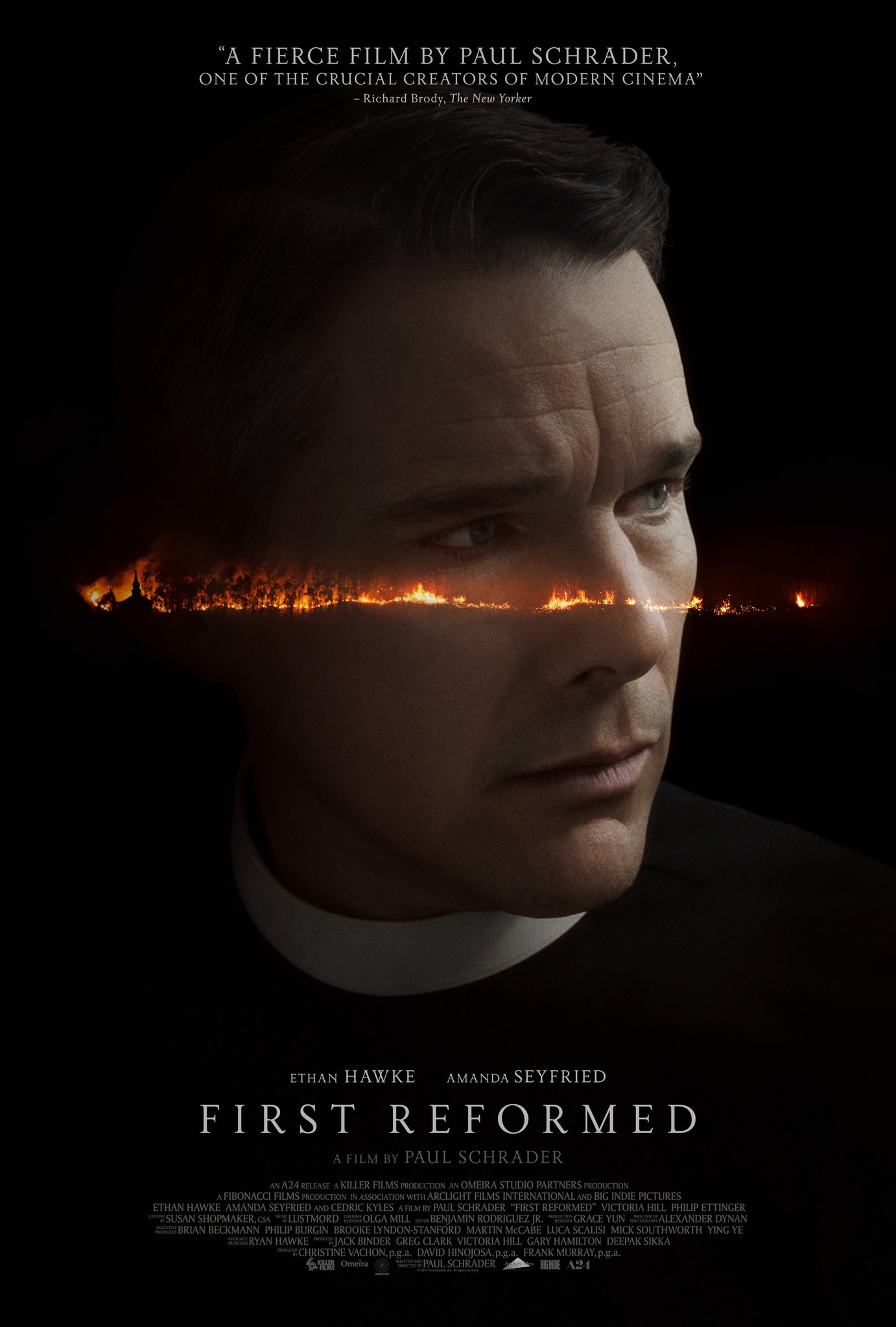
First Reformed

Image result for first reformed

First Reformed (2018)
Dir. and written by Paul Schrader
Starring Ethan Hawke, Amanda Seyfried, Phillip Ettinger, Cedric Kyles
          I honestly don’t know if this is a good movie or not. I think it is; I can definitely pick out things about it which are very finely crafted, aesthetically smart. But frankly I’m just too close to it to be able to objectively talk about it like a piece of art. More than any other movie I can think of in recent memory, maybe more than any other movie I’ve seen since I was a teenager, FIRST REFORMED feels like a movie about me, a movie which captures the world as I see it, which tries to wrestle with the particular horror of modern existence as I experience it. It is as close to seeing my own mind on-screen as I have ever experienced in a movie. If it has flaws, they are also to a large degree my flaws, and if it has strengths, they are to a large degree my own as well, at least intellectually (and the movie is almost exclusively interested in the intellectual). To give it any kind of objective evaluation would be to appraise my own mind, a task which, much as I wish it were otherwise, I am uniquely ill-suited to attempt. Suffice to say, then, that I found the experience of watching FIRST REFORMED absolutely shattering, and, perhaps selfishly, I think you might too. At the very least, if you watch it you might understand a little better who I am. That may not be much of a recommendation, but it is the one thing I can offer with any real certainty.
         I am not, like FIRST REFORMED protagonist Ernst Toller, a priest, nor, like writer/director Paul Schrader, a Calvinist. But I am very much Ethan Hawke. Not literally, of course, but I identify with the actor in a way which is very unusual for me. Despite being an American male of European ancestry, I’m an odd duck in a lot of ways, and don’t frequently see much of myself* in fictional characters. When I do, I tend to see the worst in myself rather than the best (the pathetic, self-sabotaging grifters of BUZZARD, the delusional, desperately needy Chuck Barris of CONFESSIONS OF A DANGEROUS MIND). But in many of Hawke’s characters over the years, I saw at least aspects of my better self that I encountered nowhere else. Being about ten years older than me, he was playing teenagers when I was a teenager, which is, I suspect, the period of life when we’re most apt to look to fiction for versions of ourselves, or at least ideals of what we could aspire to. Suffice to say, at a crucial moment of my development as both a cinephile and a person, Hawke embodied the kind of cool I wanted to be: intellectual, passionate, edgy, troubled. He combined the sort of rebellious, independent spirit that late-gen-Xers like me were drawn to, but tempered with an intellectual seriousness, a restless sense of curiosity about the world and an eagerness to experience it, that I found uniquely well-suited to own sensibility and aspirations. I was never going to be Sylvester Stallone, but cultured, thoughtful Jesse Walters from BEFORE SUNRISE? Maybe. Hopefully. Someday. At any rate, here was a character, and an actor, in whom I could see, if not myself, at least the self I wanted to have.
         And these years later, I still find a lot to admire in the actor. He’s had an interesting career, eschewing the easy mega-stardom that was probably within his reach in favor of more eclectic roles, from Richard Linklater experiments (BOYHOOD, WAKING LIFE) to gritty crime flicks (TRAINING DAY, BEFORE THE DEVIL KNOWS YOU’RE DEAD) to straight-up genre fare (DAYBREAKERS, SINISTER), and in all this time I’ve never once seen him phone it in. Highbrow, lowbrow, he is a rare actor you can always count on to give 100%, even in something as ridiculous and schlocky as 24 HOURS TO LIVE or the MAGNIFICENT SEVEN remake.

Image result for first reformed        
I bring all this up for two reasons: first, as far as I’m concerned, it’s always a good time to remind the world that Ethan Hawke is a God damn national treasure. Second, and more germane to the topic at hand, I feel it’s necessary to emphasize the degree to which he has remained stable my whole life as perhaps the only celebrity who represents a kind of person who I could meaningfully aspire to be. Because in FIRST REFORMED, we find him again playing a character with whom I identify to a striking degree. And that’s a real problem for me, because Schrader considers this film to be part of a loose trilogy, along with TAXI DRIVER and LIGHT SLEEPER. Those are great films, but not films featuring protagonists that anyone sane wants to personally identify with.
         Of the three, FIRST REFORMED’s Reverend Toller initially seems the odd man out. He’s got a stable (if somewhat austere and limited) life, working as a priest in a 250-year old New England church which is attended by a few parishioners, but mostly exists as historical landmark. Toller takes his liturgical duties seriously, but it’s clear his role as a priest is largely symbolic, and he’s really being retained as a caretaker and tour guide (his responsibilities include stocking the gift shop) for the old building, which is owned by a nearby megachurch and is itself primarily used for symbolic occasions, one of which is the building’s upcoming 250-year anniversary. Though Toller is outwardly functional, his obsessive journaling reveals that internally he’s a miserable husk, languishing in a self-imposed exile from the world as penance for pushing his son into the military, where he died during the Iraq war. Struggling with alcohol and hopelessness, Toller has been desperately, obsessively searching arcane religious writings for… something. Some reason to hope. Something to believe in. Some way forward. But he can’t make himself believe any of it.

Image result for first reformed        
His quietly imploding world of personal despair is interrupted by someone looking to him for the very thing he can’t seem to find for himself: hope. That would be Mary (Amanda Seyfried, JENNIFER’S BODY) the pregnant wife of environmental activist Michael (Phillip Ettinger, COMPLIANCE, BRAWL IN CELL BLOCK 99), a man so pessimistic about the future of the human race that he thinks bringing a child into a world of such dismal prospects is in itself an amoral act. Mary hopes Toller can talk him out of his bleak worldview, and though Toller doesn’t think he’s up to the task, and even suggests she might be better off seeking help elsewhere, he reluctantly accedes to talking with Michael. Unfortunately for him, Michael’s despair is very much rooted in hard fact. He’s spent his life trying to save the world, only to see it sink deeper and deeper into ruin in ways which are specific and quantifiable. He has graphs and charts, a mountain of data that supports his prognositations of doom. Toller is an intelligent guy with the usual stock of religious apologia, but as much as he enjoys this rare opportunity for a lively intellectual discussion, he privately knows that Michael is right, and there’s nothing, ultimately, that he can say to overcome the simple fact that all available evidence seems to point to despair as the most logical reaction.
         And this realization –or perhaps, this crystallization of what he already knew, on some level—inexorably pushes Toller to think about his own role in all this. And a problem of this dire scale is a dangerous notion for a man with nothing to lose to dwell on.
         This scenario, then, has, in some ways, a very similar shape to Schrader’s most famous and celebrated screenplay, 1976’s TAXI DRIVER: again, you have a guy with nothing to anchor him to society faced with an infuriating injustice that the world seems incapable of even noticing. But there’s a key difference between them, and it’s the heart of why this movie was so particularly shattering to me. It is, simply, that Michael, and subsequently Toller, are simply right. TAXI DRIVER’s Travis Bickle is a psychotic, a deranged obsessive outsider whose fixation is rooted in his own alienation, and spurred by the perverse extremities of human corruption which transform the world around him into a lurid grotesquerie. But Toller isn’t any of those things, and his world is a much more mundane, veristic one. He’s depressed and guilt-ridden, but there’s no question that he’s also a functional adult, a thoughtful, intelligent guy not in any way inclined towards cheap fanaticism or radical destructiveness. And the villains of his story are depressingly banal; they’re not exaggerated monsters, in fact their very evil flows from how reasonable they are, or at least believe themselves to be. Toller’s boss at the megachurch (Cedric “The Entertainer” Kyle[!], THE ORIGINAL KINGS OF COMEDY) is a well-meaning, friendly guy who seems to genuinely care about Toller’s well being. But he has a huge organization to run –an organization that likely does a lot of real good in the world!—and it needs funding and structure, and that means cooperating with, rather than challenging, the avatars of social and economic power. In fact, doing so looks like sanity to him, looks like what a reasonable, responsible figure of authority ought to do. And that means Toller’s stubborn, disruptive moral crisis looks like instability, if not outright derangement. And the truth of it is, it is instability; it’s exceedingly inconvenient for someone so invested in the system to have some kind of earnest idealist poking at its foundations. But Toller isn’t crazy; he’s unhappy, isolated, unstable… but he’s sane. It’s the world that’s insane. And in an insane world, a truthful, sane response looks like madness.
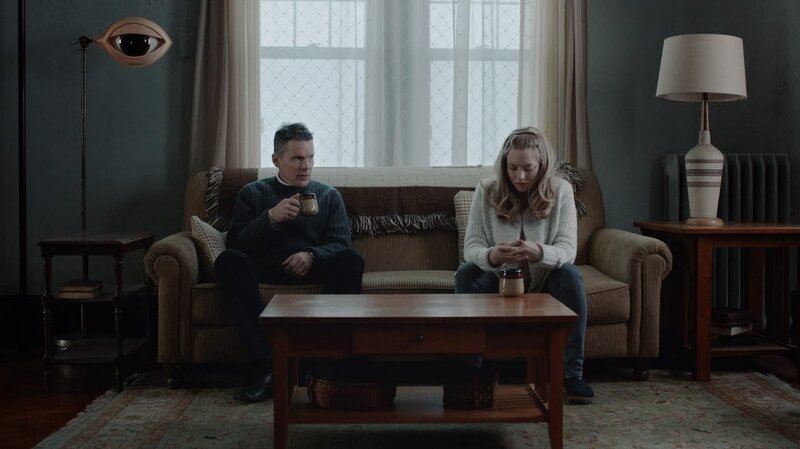
Image result for first reformed
I mean, let’s just talk it out, here, shall we? We have a moral imperative to future generations, to the continued existence of life, right? And if we encounter people actively and selfishly working to destroy that future, we have a moral obligation to oppose them, right? And if they use their ill-gotten bounty to seize power and prevent us from opposing them within the system they can set up and manipulate to their advantage, our moral obligation doesn’t simply end there, right? We still have a moral obligation to take action to affect real change, to do everything which is within our power, especially in the face of a scenario as grave as the current one, right? Even potentially at the cost of our own lives? If there’s a moral argument that lets us off the hook, I’ve never heard it. And yet, this logic has led us to some extremely troubling possibilities. If we follow the values we claim to believe in, it brings us inevitably to somewhere we don’t want to go. But if we shrug them off and tacitly admit that we never really believed in them to begin with, what does anything mean?
That’s the thing about FIRST REFORMED which, at least to me, feels so gutting. I can’t think of another work of art which feels so honest about how hopeless the world is. Which is to say, there are plenty of dismal, hopeless movies about the inevitability of suffering, but this one comes by that hopelessness is a uniquely intellectual way. There is no obvious weakness in Toller’s logic, there is never any point where you can argue he’s missed something or has other options. (vague SPOILERS follow) If he believes what he professes to, then the only two options are either the one he takes or the one Michael takes; the “best” option the film offers, and the one it ends on, is maybe he just gives up and tries to live a happy life and not think too much about the stuff he claims to believe in. (End vague, minor SPOILERS)
In short, any sort of intellectual honesty about our responsibilities to the world leads to a miserable selection of impossible solutions. It’s the perfect microcosm of the inescapable dismal logic of my life so far, and the reason I don’t know that I’ve ever seen a fictional character that I so profoundly saw myself in. I’ve struggled with this very dilemma myself, and my continued existence is less a testament to my successful moral reckoning than my cringing willingness to dodge these questions and retreat back to the simpler comfort of living my own small life. But that solution comes with its own sort of fatalist emptiness, a willed myopia in the face of total hopelessness that anything can be done to save humanity from itself. We’ve come too far, it’s too late now. This gets worse and worse from here, and all we can do is watch it all fall apart and try and cling to our tiny lives and try to put it out of our minds as much as we can.
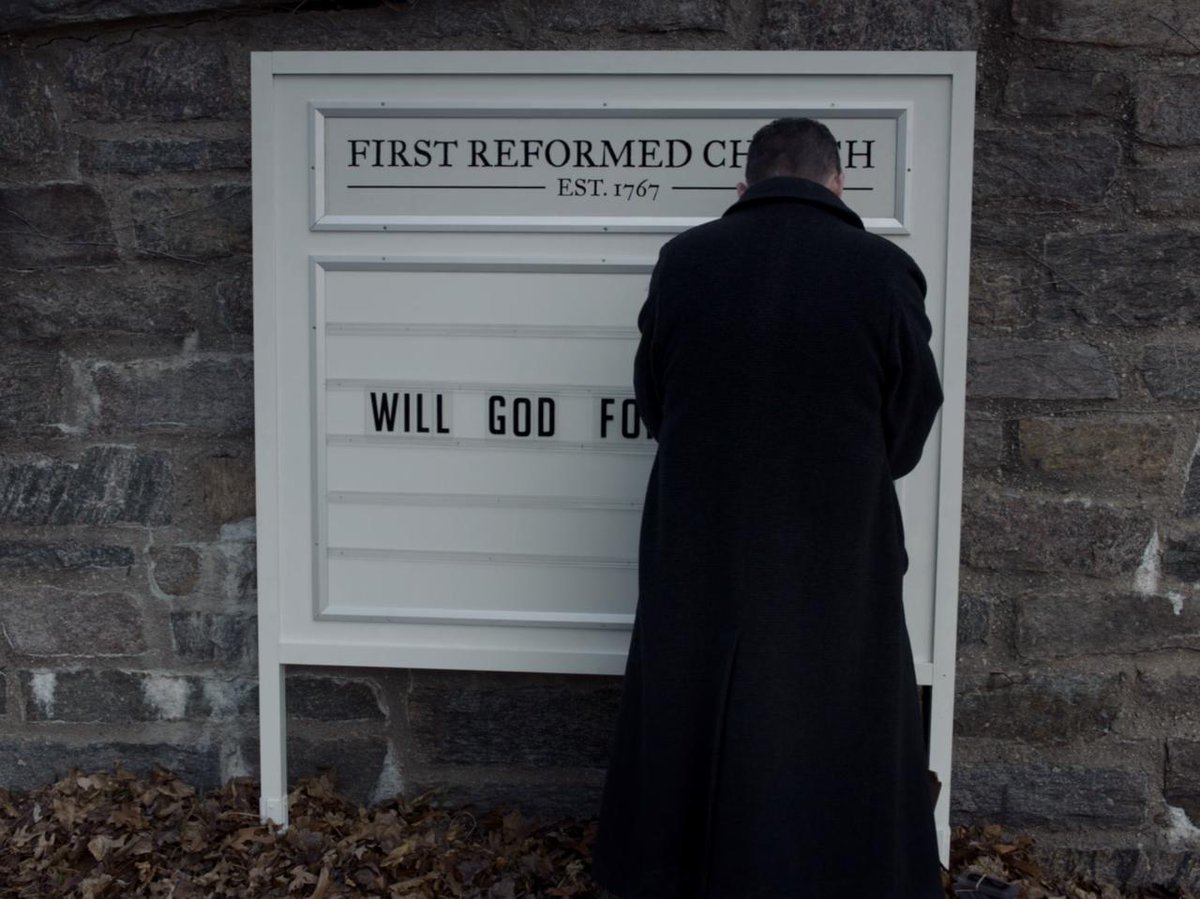
Image result for first reformed 
****************************
(END SPOILERS FOLLOW – read only once you’ve seen the movie) And indeed, it’s on that very note of dissatisfying uncertainty that the movie ends. And it’s an appropriately jarring ending which suddenly swerves away from the fatalist TAXI DRIVER climax it seems to be headed towards, instead settling into something much stranger and more mysterious. It builds to the perfect apocalyptic pitch of inevitable tragedy… and then, suddenly, a little glitch throws the whole thing off. Toller has gone too far now to turn back, and yet suddenly he can’t go forward. It’s a beautiful evocation of how life can disrupt our plans, even when we’re at our most certain.
(END SPOILERS CONTINUE – read only once you’ve seen the movie) I mean, as upsetting as Toller’s solution is, it’s also very much a relief to him; he’s miserable anyway, and this is a chance for an escape as much as it is a strike against the evil of the world. He’s finally at peace, he finally has purpose, finally has some hope that he can do some good. And then, just as he’s reached the point of no return, the situation shifts and he finds his certainty that he’s doing the right thing colliding head-first with his deep care for another person. It’s an absolutely irreconcilable situation; his conscience won’t let him do what he was planning, and yet it’s the only thing left that he can do. The only thing to survives that paradox has nothing to do with philosophy or conscience, it’s just his simple instinctual need for human connection. Something innate, immediate, physical, far removed from both thought and consequences, but no less inescapable, though it’s something he’s spent the whole movie trying to escape. It’s strange and awkward and confounding, and that’s just how life is. Certainty is easy, but life has a way of turning your most ardently held philosophy into hopeless chaos.
(END SPOILERS CONTINUE – read only once you’ve seen the movie) Which brings me back to my own life again – a selfish thing to do in a movie review, I know, but something I can’t bring myself to avoid in a movie which feels this personal. I’ve always used this blog as more of a journal than a catalogue of artistic merit, and with this particular film there’s no escaping it, my reactions are too intrinsically linked to my own struggles to separate them out and pretend this is in any way an objective discussion of a film. I relate so intensely to Toller’s philosophical free fall because I’ve lived it. I think I can say without false modesty that I’m a guy who desperately wants to do the right thing (regardless of how rarely I manage to do so), and that the only approach to that goal that I ever understood or related to comes through rigorous intellectual inquiry. Other people relate to things more empathically, and I think that’s good and necessary, but it’s not what I’m equipped for. Rational analysis is the only way I know to make sense of the world and how we’re supposed to live in it. I think Toller would probably describe himself the same way, and that’s why I see so much of myself in his complete disarray at the end. When a person like this follows what seems to be an irrefutable logical argument to a conclusion which gives you a rare sense of certainty and purpose, only to find that it brings you to an impossible, unworkable scenario… it’s destabilizing on a level that’s hard to even describe. I suspect it’s somewhat akin to suddenly losing your deeply held religious faith. You go through a period where everything feels like some kind of giddy, nonsensical dream. You feel panic, desperation; every action you take feels random and out of your control. You want to die, you want a sign, you want something to resolve it all, you crave that apocalyptic sense of self-destruction that was going to wrap everything up so neatly. 
But nothing ever comes, and then you just keep waking up every morning, and finally you have no choice but to do the hardest imaginable thing, which is to just keep living. The end of FIRST REFORMED is the best portrayal of that mental journey I’ve ever seen on screen; it captures the abruptness of it, the frustration, the uncertainty rushing back in all at once, and, most of all, it captures the infuriating open-endedness of a desperate question which doesn’t have an answer. When you find out that you’re actually going to have to live, even though you don’t want to and don’t have any clue what you’re supposed to do about that. It’s strange and disorienting and awkward and beautifully unfinished. 
***************************
Related image
Very few works of art can support a vision that bleak, and almost none ever try to reach that emotional point through intellectual rigor instead of emotional manipulation. I doubt it’s the best way to reach most people, but to me, watching this felt like having my guts ripped out. And yet, I’m not sorry that I did. It’s a relentlessly miserable, despairing film, and yet I emerged from it feeling oddly comforted. In a funny way, as hard as it was to watch, I felt a little less alone after seeing it. I’ve already been through this, lived through it, fought through it, maybe even self-indulgently wallowed in it. I know this terrain intimately and deeply. My demons are already all-too-aware of the litany of despair which FIRST REFORMED inventories, and they emerged from the experience without any fresh ammo, but perhaps somewhat cowed to be dragged out in the open with such vividness and empathy. Neither Paul Schrader, Reverend Toller, nor I have managed to wrestle an answer out of the hopeless paradox of existence, but having fought through it with them, I feel a certain spark of camaraderie. If I still don’t understand, there’s a certain succor to at least feeling understood.

*Which should by no means be taken as an argument against greater diversity in film; if anything, it should be read as an argument for more. Thousands of cis white male actors and I still find it astonishing when I see one who I actually feel some personal identification with. Imagine how a trans Indonesian plumber or someone must feel! We need more stories told!

THE BEST OF 2018, AS SEEN FROM 2019: THE SERIES


Wednesday, July 31, 2019

The Sisters Brothers


The Sisters Brothers (2018)
Dir. Jacques Audiard
Written by Jacques Audiard, Thomas Bidegain, based on the novel by Patrick deWitt
Starring John C. Reilly, Joaquin Phoenix, Jake Gyllenhaal, Riz Ahmed

All Westerns are fairy tales, and they all say more about us than they ever did about some brief historical period in the Western United States which was mostly defined, as far as the culture is concerned, by the East-coast pulp writers who spun a unique sort of fantasy out of scraps of overheard, imagined and embellished stories that drifted back to them over the years, secondhand. The first Westerns rode by on a quintessentially American fairy tale of rugged masculinity, of potent individualism made flesh in the larger-than-life heroes of that era: John Wayne forcefully ensuring neither Indian nor bandit nor bureaucrat would tell him what to do, Shane confidently riding into town to supplant father and lover alike. Eventually, this took on a mournful tone, casting that fetishization of manly power as a nostalgic reminder of a bygone era; consequently, all subsequent Westerns were not only fairy tales, but requiems. Eventually, when the hollowness of this particular fairy tale began to show through the increasingly threadbare seams, the revisionist Western was born, a new sort of fairy tale for an era where the shortcomings of the old one had become too obvious to ignore; now, Westerns were about demystifying the icons of our fathers' generations, about telling ourselves that the "true story" is a lot more complicated and morally ambiguous than the white hats and black hats of yesteryear would have it seem.

THE SISTERS BROTHERS, along with SLOW WEST and a few other Westerns from the last decade (THE BALLAD OF BUSTER SCRUGGS, THE ASSASSINATION OF JESSES JAMES BY THE COWARD ROBERT FORD, THE REVENANT) have sometimes been called "revisionist Westerns," but I'd argue they're actually something else entirely, maybe even something more honest. While the Revisionist movement tried to ground the familiar genre tropes in gritty, self-consciously unromanticized realism, these movies more openly embrace the mythic nature of the Western, returning to the deeper truth of fairy tales, which have much more to tell us about reality than the gritty reimaginings of old cowboy pulp tales from the late 19th century ever could. Of all of them, though, the SISTERS BROTHERS tells the most complex fairy tale; if the revisionist Westerns tried to sully the clear lines between the black hats and white hats, director Jacques Audiard (A PROPHET, which remains his masterpiece) reimagines the conflict completely, into something whimsical, tragic, and baffling; there is some kind of moral here about the loss of Eden, but it's a slippery, nebulous thing. Characters who seem set up to give us clear moral parables shift subtly as the situation changes, find themselves stranded in unknown territory, and wander onward blindly, eventually emerging blinking into the light, unsure how they came here. 


The setup seems simple enough; we have two titular Brothers (Joaquin Phoenix and John C. Reilly, looking only vaguely like the same species, let alone brothers) veteran bounty hunters a little down on their luck, sent by a nameless Commodore (Rutger Hauer, RIP, in a wordless cameo) to work with a spy (Jake Gyllenhaal) to execute a penniless (but erudite!) prospector, one Herman Warm (Riz Ahmed) for crimes that are at first not specified. That the movie intends to undermine the seeming simplicity of its premise seems obvious; exactly how it does so is what makes the movie so unique and interesting. 

At first, it seems like a fairly straightforward post-modern gag: Phoenix, the dominant brother, is the archetypal Western hero in the John Wayne mode, a man of masculine power and violence, benevolent but flawed, principled but fiercely independent, a protector, a hero and an outcast. I think it is not overstating the case to say this is the rough shape all true action heroes in American fiction, and Audiard wants us to be acutely aware of it. A character like this is the expectation in a Western, but here he's comically joined by his partner (and older brother) John C. Reilly, nobody's idea of an action hero, an invading force of soft modernity, contrasting our placid modern values against the righteous Old Testament virtues of the genre cinema of the past. Where Phoenix is blunt and confident, Reilly is neurotic and tentative; where Phoenix’s flaws are tragic and dignified, Reilly whines and suffers comic indignities. The joke, it seems, is that Reilly is something of a man out of time, skeptical and uncertain about the rough and tumble world around him that everyone else seems to easily take for granted.

But things are not quite what they appear; after a while, it seems like the movie is making the opposite point, a point I've maybe always wanted to see in a movie: Phoenix’s macho code of violence is basically psychopathy, and Reilly's humble dorkiness is actually a sanity which only looks goofy because men like Phoenix have ruined the world. And to compliment that interpretation, we have the parallel story (which for much of the first half threatens to become the main story) of Gyllenhaal and Ahmed, who stumble together onto a genuinely different way of being, something based in earnest love instead of violence (maybe it’s just seeing Gyllenhaal in a cowboy hat again, but I took their relationship to be more than simple business partners, though the movie is not explicit on this point). The movie, then, seems headed towards a gentle bit of optimism about the possibility of changing ourselves into kinder, more humane beings. But just when it seems like this is coalescing into a clear moral, things shift again, and everything turns topsy-turvy, and we're left with nothing to do but slink away scratching our heads, wondering what it all meant. 


It would be, I suppose, easy enough to accuse a movie which so carefully avoids the expected moral lesson of a kind of lazy nihilism, the sort of offhanded cynicism with which French movies (it’s actually a French-American co-production) so often get stereotyped. But I don’t think that’s the case here; there’s a warm affection for the characters which is evident from the start. I think Audiard would genuinely love to give them all a happy ending, but he also knows that life is random –not even cruel, per se, although that’s certainly always a possibility— and the story you think you’re living doesn’t always arrive at a clean catharsis, the lesson you think you’re supposed to learn isn’t always the one you come away with. Everything becomes complicated and messy and confusing, and who knows what it all means? We tend to think of the past as a simpler time, compared with the endlessly complex, unpredictable modern world, where all our actions ripple out and return in ways we can never wholly imagine or prepare for. THE SISTERS BROTHERS is a good reminder that nothing about the human condition has ever been simple (even their name is contradictory!).

Of course, the (intentional) anti-climax and chatty, journey-not-the-destination structure might be off-putting to some. I suppose it’s probably the result of the film’s novelistic origins; the written word can be a more direct medium to communicate an author’s intentions than cinema has historically been, meaning that a film like this, which doesn’t want to tip explicitly into the avant-garde, is probably more essentially narrative-driven than its written progenitor. It presents itself as being a normal narrative, and then deliberately undermines the expectations it sets up, and I could certainly understand why that would feel disappointing, or even like cheap shot. But at least in this case, with a glass or two of red wine in me, I was able to get on-board with the movie’s uniquely off-beat, shaggy vibe, and it really resonated with me. There’s a kind of fatalistic melancholy here which feels all the more acute for the movie’s generally unflinching, unsentimental tone and refusal to bend itself into the expected lessons. The world can be a hard, confusing place which offers no easy answers and resists our most carefully crafted plans to make sense of it. And yet, there’s no alternative but to just live in it anyway, to keep going forward. It’s impossible, and sometimes horrible, but also sometimes kind of beautiful, if you stop to pay attention to it.

On hand to remind us about that beauty part is cinematographer Benoît Debie (LOST RIVER). You don't need a talent like Debie's to make the West look gorgeous, but it sure doesn't hurt, especially in the nifty way he frames nighttime gunfights as eruptions of orange fire in the deep blue-black of the landscape (some people have complained about the garish digital color grading here, but I sort of like how it eschews the usual Western palette of drab earth tones by turning the landscape into a candy-colored wonderland). The incisive, almost minimalistic score (by Alexandre Desplat, Wes Anderson’s go-to guy, but obviously most notable as the composer for VALERIAN AND THE CITY OF A THOUSAND PLANETS) also packs a big punch, though in the movie’s typically unpushy way, and does much to lightly suggest its weary, vaguely mythic tone.


The craft on display here is certainly indisputable, but it doesn’t seem like most reviewers connected to the movie the same way I did. It’s certainly understandable; what’s an audience to do with a film that isn’t really a drama, or a comedy, or an art film, or an action film, but has little streaks of all four shaped into a narrative which just rises and then withers on the vine? To a lot of people, it seems to have added up to a whole lot of nothing. To me, though, it seems deeply, even painfully, evocative of my particular time and place in history. It’s not a wholly nihilistic film; in fact, it’s a film which very much wants the best for and sees the best in people. But it’s also a film acutely aware that this is a world full of good ideas that die random, ignoble deaths, good people trapped in a cycle of doing bad things, good intentions which are not the right intentions for this particular moment. Evil doesn’t usually prevail, but then neither does good; only chaos and entropy can be counted on consistently in a universe that cares neither for our souls nor our values. Obviously one need look no further than the front page of a newspaper to learn this lesson, but there’s something about the way that Audiard blends that sense of mournful hopelessness with the classic American iconography of a Western that feels poetic and poignant, both deeply admiring of American idealism and moral rectitude and simultaneously clear-eyed and despairing of how naive and brittle it all is.

We'd like to have a journey with a clear purpose, a moral arc that lets us tell a story to give it all some meaning. We’d all like to live by a code, to be the hero, to be upright and uncompromising, self-sacrificing, independent, ultra-competent, powerful but benevolent.  We’d all love to be John Wayne, we’d all love to be Shane. But of course, they never existed, they were just a fairy tale, a fantasy we told ourselves about what we wanted to be and maybe ended up believing a little too much. There's a sweetness to that aspirational fantasy, but also something stifling, even dangerous in its ignorance. We're not John Wayne; even John Wayne wasn't John Wayne, he was just some prima donna actor, another American huckster peddling a comforting lie. We are not mythic heroes; Instead, we’re all John C. Reilly; unfulfilled, undignified, uncertain, groping blindly towards doing, if not the right thing, at least hopefully not the wrong thing either, and maybe --maybe-- a few times in a lifetime, seeing some kind of profound truth, some kind of divine path, only to watch it slip out of our grasp before we can put ourselves upon it. And when that happens, what are we left with but to trudge home, older and more broken but barely any wiser than before, towards that dim hope of simple human comfort. And maybe just a little bit of beauty along the way.


Tuesday, March 3, 2015

Horns and Chainsawnukah Epilogue

Horns (2014)
Dir. Alejandra Aja
Written by Keith Bunin, based on the novel by Joe Hill
Starring Harry Potter, Max Minghella, Joe Anderson, Juno Temple, James Remar, Heather Graham, David Morse, Kathleen Quinlan


In what may be the single most accurate title of the year, HORNS is about a guy who grows horns. The horns are a major plot point and everything, so it totally makes sense that it’d be a good title. Take that, BANSHEE CHAPTER.

Well folks, here we are, at the very final chapter in the Chainsawnukah adventure which took a goddamn third of a year to wind down. I want to thank you all for sticking with me all these long, lonely months (at least, those of you who did -- readership is down about 70%, so never let it be said I don’t suffer for my art) but here it is, at last, the end. Actually, to be entirely honest I was planning on ending it with RETRIBUTION, but when I caught this movie in theaters two days after Halloween, I knew it was meant to be, this is the perfect one to close off the season, this is the one we’d been circling towards, unaware of the parallel lines of destiny quietly and precisely drawing nearer, those fine threads which pull us inexorably into a future unseen but impending.

This is the story of Ig Parrish (Harry Potter, THE WOMAN IN BLACK), a nice young man who everyone thinks is a murderous sociopath. See, Ig’s longtime girlfriend, Merrin (Juno Temple, 2012 Cursed-to-Live Winner KILLER JOE) was recently raped and murdered. Right after they had a big, public fight. And they found Ig nearby the next day, drunk and babbling about her. So it doesn’t look good. He insists he’s innocent, but even though his best friend and lawyer (Max Minghella, ART SCHOOL CONFIDENTIAL) has so far kept him out of prison, the whole town is certain that he’s a monster, and lets him know in no uncertain terms. And then he grows the horns, so that doesn’t help matters. Boy, when it rains, it pours. And it’s set in the Pacific Northwest, so it’s always raining.


The horns are obviously a cause of some concern for Ig, but, curiously, no one else seems especially rattled by them. Mostly other people don’t even mention them, which I’d chalk up to an excess of politeness except that there are already people spitting on Ig in the street. Instead, the horns seem to have a strange psychological effect on the people he encounters; they notice the horns, but can’t seem to concentrate on them, because they’re too concerned with their own problems. The horns seem to release inhibitions in anyone Ig encounters, turning people into violent street brawlers, arsonists, or sex fiends. Or, they start to spill their most intimate secrets. Which might just prove helpful in finding out just who exactly it was that murdered Ig’s girl.

There’s an obvious tension in that premise, between the extremely grim story about a brutal murder and the possible guilt of our protagonist, the surreal, grotesquely comic havoc he causes as he encounters people he knows (at first to pump them for information, and later, in increasingly nasty ways, to punish them) and the darkly fantastic magical realism of the imagery and iconography Aja employs. Those are tough impulses to balance. Though they’re rarely acknowledged as high art, successful comedy and horror in art are quietly difficult things to get right. Drama, the much-vaunted golden boy of genres, is actually deceptively simple in its mechanics: fundamentally, it’s about accurately communicating a narrative. As long as you can effectively tell the central story, it will succeed. But successful comedy and horror are mercurial things, a delicate alchemy of subtle manipulations of art buried beneath outwardly exaggerated scenarios. Getting either of them seriously right requires a deft touch on the expressive dials of cinema, and a few wrong notes can throw everything off. So getting both of them right at the same time is a rare enough feat that it’s nearly a fool’s errand. Oh, I’ve seen plenty of funny horror movies, but usually only because the horror is softened, its exaggerated nature played for parody instead of terror. It’s a rare film indeed where both horror and comedy can thrive without one or the other being neutered and denatured.  

Rare, but not unheard of. Director Alexandre Aja has shown himself to have a striking aptitude for the ephemeral nuances of cinematic tone from the start, succeeding in conjuring the right feel for movies as disparate as the grueling HILLS HAVE EYES remake and the amiably goofy PIRANHA 3D, even when his sometimes shaky grasp of plot mechanics fail him. PIRANHA, for example, is a complete narrative mess that never goes anywhere, and yet it’s impossible to completely write it off because moment-by-moment it so effortlessly captures the sense of straight-faced, cheerful preposterousness which is so much more essential to a movie called PIRANHA than any script could be. The fact that it successfully conjures the right mood, the perfect vibe for the endeavor in spite of its glaring narrative deficiencies is a testament to a carefully crafted cinematic style with a rare emphasis on getting the production details right -- editing, musical cues, particular performance styles, cinematography. PIRANHA falls clearly on the comedy side of the horror/comedy divide (its sequel, PIRANHA 3DD, pushes the genre into disappointing cheap comedy by the film’s end) but with HORNS, Aja proves himself capable of doing something a little more complicated.

There's no Aja-stice in this world.

HORNS isn’t exactly a comedy, but it’s also not exactly a horror movie, or a mystery, or some sort of weird fantasy allegory. It’s a little of all those things, but never entirely any of them. And that was a problem for a lot of reviewers, who complained that it never settles on a consistent tone or genre. But for me, that’s the whole point; what makes it impressive is its insistence that it’s simultaneously all those things. The various tones fluctuate in intensity, but none ever entirely dissipate, like musical themes deftly woven in and out of an overarching melody. It makes for a wild ride, and a few times Aja almost lets it get away from him (especially towards the somewhat deflated finale) but when it works, it’s absolutely an arresting, unique experience.

Part of that likely has to do with the source material, of course (a novel by Joe Hill [Billy in the framing story for CREEPSHOW**], unread by me). Aja has proven himself an unreliable structuralist over the years (see: the movie-killing twist in HAUTE TENSION, the structureless middle finger to act-based screenwriting that is PIRANHA) and it no doubt helps him to have the story mechanics basically laid out for him in advance. But that seems to free him up to focus on something he’s better at: crafting a strange, dark fantasy world which can unexpectedly erupt into farce or brutality at any given time. Cinematographer Frederick Elmes (frequent David Lynch collaborator, who shot ERASERHEAD, BLUE VELVET, and WILD AT HEART as well as bounty of other gorgeous films, from THE NAMESAKE to HULK (2003) to NIGHT ON EARTH to SYNECDOCHE, NEW YORK) captures the foggy Northwest location with a fairy-tale’s eye to deep mossy greens and warm earth tones, always saturated by the iron-grey sky that looms over everything with a predacious eye.  And underneath scramble our characters, your typically attractive and articulate thirtysomething movie actors, but all with an unsettling edge of darkness, looking quietly exhausted, disheveled, scared. People with something to hide.

Lookin' a little horny, buddy.

Boy, who would have guessed back in 2001 that little Daniel Radcliffe, cast primarily for his startling physical resemblance to a fictional wizard child, would go on to be such a daring and surprising adult actor? He’s tremendously good here, making his tortured character’s oscillations between bafflement, malevolence and despair look effortless and natural, and providing a rock-solid emotional anchor for the whole enterprise, all the while without resorting to showy actorly tics. It’s the very definition of a performance so graceful it looks easy, but potent enough to ground a wild tale with a million possible distractions.

The rest of the cast is rock-solid too. You got Joe Anderson (ACROSS THE UNIVERSE, THE RUINS, bass player Peter Hook in the Joy Division movie CONTROL) as Ig’s jazz-rock-fusion musician brother.* You got Max, son of Anthony, Minghella as Ig’s one loyal supporter and lawyer. You got Kelli Garner (LARS AND THE REAL GIRL, BULLY) as one of Ig’s childhood friends. Heather Graham as a waitress in a quirky Northwestern small town diner (hmmm.. what does that evoke?). And for the parents, you got an embarrassment of riches: James Remar and Kathleen Quinlan as Ig’s folks, and David Morse as the resentful father of the dead girl. And you gotta appreciate Juno Temple in the usually thankless role of the flashback victim. Normally when actresses do this, all they have to do is silently giggle and roll around in bed with our hero in sun-drenched flashbacks to more idyllic times. But a surprising amount of time here is spent on her, and she actually manages to craft something approximating a real character, not just a plot point (the movie has an unusual focus on the past, imbuing the relationships with a surprising amount of complexity and weight across the board). Along with Radcliffe, she manages to add genuine emotional heft to a story which could easily have been a pretty but hollow shell nestled around a generic MacGuffin of a core. Thanks to the strong character work here, that never becomes a problem. Also she gets naked and freaky in a tree, which I believe is one good reason to always hire Frenchmen to make these films.

Planning, people. 

With top production talent behind the camera and a wealth of excellent actors in front, Aja seems confident in his pacing and tone, sometimes indulging in stylish tricks (a spiraling camera to signal the disorientation of waking up drunk, a slippery and nightmarish drug trip taking on both symbolic and emotional abstraction) but mostly seeming content to simply lets the story unfold, as Ig’s new horny powers set him loose on the town. Some of it is goofy fun, but there’s also a layer of real bleakness here; this was really a horrible crime, and everyone’s lives are irrecoverably broken by it. That sense of darkness deepens as Ig increasingly starts plying people for their deepest secrets, and discovering that in most cases, there are things rotting under the surface that reveal the already depressing situation to be even worse than it seemed. And how much of that can you learn before you get tempted to go beyond prying into actual punishing? And how much of that can you do before you turn into a monster yourself? I mean, even beyond the horns thing, which is admittedly pretty monster-y but come on, you think those guys in NIGHTBREED would be impressed by a couple horns? Please.


Which brings us full circle back to our theme from this year: transformation. We talked back at the very beginning --when we were so young and naive and thought this would be well over by December-- about the horror genre as the cinema of transformation. And here is a movie which really hits at the heart of the horror that comes with transformation, both physical and psychological. In fact, that’s really the only sense in which it’s a horror film at all; the most dangerous person here is the protagonist, and he’s had to literally transform himself into a monster in order to do what he has to do here.

Yeah, but you should see the haystack.

Though HORNS, unlike THE ORDER, has the good taste not to mention it, there’s a lot of that famous Nietzsche quote here. No, not that one. The other one. The one which customarily appears as pre-credit text in movies. “He who fights with monsters should look to it that he himself does not become a monster. And when you gaze long into an abyss the abyss also gazes into you.”

Boy, there’s something to be said about that, isn’t there? For all of our denunciations of the evils of the world and the evil ones who do them, sometimes there’s a lot more of them in us than we’re comfortable admitting, let alone us in them. Those roles of monster and fighter are not as fixed and intragnizent as we like to say, we like to believe, we need to believe. Both dragon and slayer have death as their goal; only their targets differ. At the core, the more the conflict deepens the more the psyches converge -- if you’re capable of hating evil, you’re also capable of becoming the same force of destruction you so oppose, regardless of how you dress it up, the stories you tell to convince yourself it’s different. We can put a pretty face on almost anything, but what lies behind that facade is another story. So of course, here’s a movie about someone who gets a unique chance to crack open the protective outer shell of the people who surround him, and get an unfiltered look at the darkness inside. And there’s a lot of darkness. How many times can you look directly into the abyss of people’s minds before it starts to transform you, too?

The horns themselves are an interesting metaphor, with their obvious connotation to the devilish. ‘People see Ig as a devil, and so that’s what he becomes,’ is the obvious underlying logic of the metaphor. He is transformed by their accusing gaze, physically at first, but maybe also a little bit mentally. (Or, is it the other way around? Does the fact that everyone he encounters --maybe even his family-- believes him to be a mosnter change him first, sow the seeds of bitterness and anger and doubt in him, in ways he only notices when those changes start to manifest themselves physically?) The curious thing, though, is that becoming a literal devil seems to have more effect on the people around him than it does on him. Seeing the externalization of what is either Ig’s actual guilt or his bitterness at how unfair his life has been seems to liberate people to give in to their own worst instincts. If Ig’s horns are the result of his demonization by the town, what are we to make of the way it reflects back on them? And how the secrets they reveal seems to strengthen the cycle?

This is why you always use forehead condoms.

The angrier Ig becomes as he gets a painful, horrifyingly unfiltered look into the darkest corners of his friends and loved ones’ brains, the stronger his demonic powers become and the more pronounced his physical transformation seems. The movie is intriguing ambivalent about this fact, just as it interestingly withholds judgement about whether Ig may be crossing some kind of line with the punishment he decides to doll out. I can’t help but wonder if this is ultimately an explicitly religious musing on the nature of the devil, of evil. Is the devil --ruler of hell and hence the ultimate arbiter of punitive morality-- really the cause of evil, or is he more of a necessary reaction to it? Can we truly understand how deep evil runs in the world without being corrupted by our desire for violent retribution?

I’m not sure the movie ever quite coalesces into a coherent exploration of these questions, but it mostly doesn’t matter: this one can be ungainly, and it’s constantly threatening to go off the rails (and also coasts through its final resolution more on momentum than merit). But it’s an arresting, engrossing experience all the way through, full of fascinating nuances, strong performances, impeccable direction, and sharply realized ambition. And you don’t need a pair of magical horns to see it, so that’s a plus.

*By the way, the band he plays with, Canadian hard-ska outfit The Brass Action, is totally bitchin’.

**In the interest of journalistic integrity, I should also point out that he has a rather famous pedigree that he’d prefer you not to know about. You can look it up for yourself if you’re curious, but on the strength of the story here I’d say he’s earned the right to his own individual career. But if you look at a picture of him you’ll probably guess it immediately.


CHAINSAWNUKAH 2014 CHECKLIST!

The Hunt For Dread October


  • LITERARY ADAPTATION: Yes, from Joe Hill's 2010 novel of the same name.
  • SEQUEL: None
  • REMAKE: No
  • FOREIGNER: French director, but in English, shot in Canada.
  • FOUND-FOOTAGE CLUSTERFUCK: No
  • SLUMMING A-LISTER: I'd say Daniel Radcliffe probably counts.
  • BELOVED HORROR ICON: James Remar was in HELLRAISER V: INFERNO, but is more a reliable genre character actor than a horror staple. Probably the same could be said about most of the cast; Morse and Quinlan have been in their share of horror movies too, and heck, Daniel Radcliffe already has WOMAN IN BLACK under his belt, maybe he's gonna Elijah Wood himself into a long and prosperous career appearing in horror movies.
  • BOOBIES: Yup!
  • SEXUAL ASSAULT: Yes
  • DISMEMBERMENT PLAN: Head blown off
  • HAUNTED HOUSE: No
  • MONSTER: Horn man!
  • THE UNDEAD: No
  • POSSESSION: No
  • SLASHER/GIALLO: No
  • PSYCHO KILLERS (Non-slasher variety): Yes
  • EVIL CULT: No
  • (UNCANNY) VALLEY OF THE DOLLS: No
  • TRANSMOGRIFICATION: Horns away!
  • OBSCURITY LEVEL: Mid, very limited theatrical run, but now available.
  • MORAL OF THE STORY: If you stare into the abyss enough, you can write 90,000 words about obscure horror movies no one will ever see.
  • TITLE ACCURACY: certified 100%
  • ALEX MADE IT THROUGH AWAKE: N/A
Maybe a tad too undisciplined to be an unmitigated victory, but ambition counts for a lot. Call it A-


********************************

Of course, these questions about the abyss brings up a kind of uncomfortable question for us Chainsawnukah-goers, as well. Is that abyss that we should take care not to stare deep into… to be found in fiction, too? Is it possible, like Margaret Thatcher thought, that by watching XTRO or HORNS or FACES OF DEATH that we might really be turning ourselves into those very monsters we so enjoy watching?

I mean, nothing pisses me off more than genre fans defending their violent, exploitative filmatic fetishes by claiming that it’s just art, it doesn’t hurt anyone. Bullshit. All art affects you, that’s the whole point. It’s not just a bunch of colored pictures that moves around in front of your eyes and then go away, the whole point, the only reason to make art at all, is to connect with people, to share something new. And that change, that transformation, is inherent in any new experience you have, and the more powerful that dialogue, that experience, the more extreme the transformation may be. Today you are not the same as yesterday, you have a day’s worth of new memories, new facts, new ideas, new emotions, new experiences. And art strives to cultivarte a particular experience for you to wander in, to imagine something which may be altogether different than your ordinary life. All art is transformative, just as all experience is transformative. And inevitably, sometimes those experiences change people for the worse.

That’s not an argument for censorship, of course, far from it. But it’s something which needs to be acknowledged. We make art in the hopes of changing people, of putting a little of our own particular experience into their brains, shaping them, at least in the moment of the art itself. Sometimes that can have an unexpected effect, sometimes by sharing our own little imagined abyss, we might well be able to turn those who look into it into monsters. But it is not, and it must not be, the responsibility of the artist to try and anticipate every possible interpretation on the part of the viewer; just as art is the shaping and directing of a particular experience by its creator, the experiencer is him or herself bringing with them a lifetime of their own thoughts, biases, history, cultural, personality. It is the experiencer who will undertake the final transformation, try and incorporate this new bit of life into the ever-increasing complexity of the puzzle that makes up their own psyche. It’s up to them to take it and contextualize it, give it its own unique meaning and flavor.


As I talked about last year, discovering horror was just such a transformational experience for me, personally; facing horror, directly addressing my fears about life and death and the terrifying fluid nature of the human experience was indeed a crucible of destruction, but one from which I’ve been able to grow back, rebuild, stronger, better, hopefully to some degree wiser. Destruction is always an element of transformation, and as frightening as it is to experience that sensation of unfixed freefall, there’s something even more awful about stagnating, stunting, rotting from the inside to avoid changing on the outside. But not everyone will have the same experience. You can never truly grow without some level of destruction, and that destruction can sometimes be painful, can sometimes be so total that rebuilding completely may be impossible, or so daunting that working up the strength so do so seems an impossible task. Art can hurt people, I wonder if almost by definition all great art is powerful enough to damage. But if art can hurt people, it can do so only because of the transformational power of experience, and hence, so can life. And life is meant to be lived, not hidden from.

So I say, it’s not just the abyss you need to be afraid of. Those who pick daisies should also look to it that they do not become a monsters. There’s a lot of good in this world, and a lot of bad, and a lot of time and complexity for them to become inextricably tangled. The deeper you look, the more you see, the more of both you’ll encounter, and the stranger and --often-- darker the world may become. Those Horns that Ig acquires here don’t change the world, they merely reveal things about it that we’d often rather not know, and others would certainly rather not share. Is not the apple that the snake bids Eve eat, in fact, the knowledge of good and evil? Is the abyss we fretfully stare into, in fact, simply the truth? Simply a reality which can be so crushing we don’t know what to do but lash out, become the very monsters we fear? The devil is in the details, they say -- I suppose that makes the angels in the elusive and intangible abstractions. But the abstractions are for the angels only; in this real world, there are only devils, seekers or knowledge and truth even in the face of sometimes overwhelming pain.

But even with that, even seeing the world starkly, even knowing that we will forever be changed by what we encounter-- what choice do we have but to press on, aware of both the world and ourselves, and trying, desperately trying, to each day build our new self into something that reflects the best of us, rather than the worst. If HORNS has a moral, it must be that: Even when you are cursed to see the worst parts of life, even when you are helpless as to what others think of you, even as you are powerless to stop the world and its people from inflicting pain and cruelty and banality -- you are still you. You still have power over yourself and your own mind, and you still have a choice as to what you will be, moment-by-moment. There’s angel and devil in us all, and maybe neither one is wholly bad, they’re both a necessary reaction to such a strange life as this. Just as an unwieldy but engrossing horror/comedy/mystery/religious meditation is.

As for me? I choose to watch more horror movies next year, and think even harder, and write even better about them. But, ahem. Shorter. Sometimes the process of building up requires a change of strategy or two. Don’t need a pair of magical horns to see that one, either. May Chainsawnta Claus bless us, everyone!

Happy Chainsawnukah everyone, and see you soon for a much-delayed return to movies you might actually be interested in watching!