Showing posts with label HORROR. Show all posts

Wednesday, January 9, 2019

Hell Fest


Hell Fest (2018)
Dir. Gregory Plotkin
Written by Seth M. Sherwood, Blair Butler, Akela Cooper, “Story by” William Penick, Christopher Sey, Stephen Succo. Yes, you read all that right.
Starring Amy Forsyth, Reign Edwards, Bex Taylor-Klaus

            HELL FEST is an absolutely by-the-numbers, low-concept, meat-and-potatoes slasher flick, distinguished only by two minor details. The most immediately obvious of these details is that it’s set in a gigantic, spectacularly elaborate Halloween-themed amusement park from whence the film takes its name. But the more startling detail is that it is an absolutely by-the-numbers, low-concept, meat-and-potatoes slasher flick which hit theaters in 2018. There was a time (the 80’s) where you could just count on this stuff getting churned out like clockwork, but these days it’s almost a high concept in itself to have a film this simple. Just a normal old slasher, where there’s some young women in a place and a stabby guy kills them off one by one in colorful ways. By law must contain at least 50% fun. HELL FEST meets that modest goal efficiently, and seems pretty content with that. And why not?

            Little enough needs to be said about the setup: a straight-laced young woman named Natalie (Amy Forsyth, A CHRISTMAS HORROR STORY, BEAUTIFUL BOY) returns to her hometown to visit her slightly estranged best friend (Reign Edwards, The Bold and the Beautiful, Snowfall) and, to her obvious annoyance, an obnoxious old classmate (Bex Taylor-Klaus, THE LAST WITCH HUNTER, Scream: The Series) who she would clearly have preferred to leave safely in her past, but who is inconveniently her BFF’s roommate. In order to avoid talking to one another, the trio heads to Hell Fest, a sprawling horror-themed amusement park that we’re told travels across the country during Halloween season, which --given the immense scale and functional complexity of the park-- seems like a questionable business proposition at best. But that’s a thread best left unpulled, especially when we begin to consider how remarkably blaise they appear to be about the possible legal ramifications of their extreme caveat emptor philosophy of park attendee safety. At any rate, the girls also drag along some body count boys including one for Natalie to shyly flirt with.


Alas, any burgeoning relationship is going to have to remain unconsummated, for you see --and sit down, because this is going to come as a real shock-- there is a masked killer on the loose. And this is a particularly appealing hunting ground for a masked killer, because, of course, in Hell Fest, everyone is wearing a mask, and everyone is acting creepy and vaguely threatening. So even though our heroine is starting to suspect that some creep is stalking her and her friends, of course no one is going to believer her. This is the basic gimmick of this almost gimmick-free movie, and it allows for a light dusting of (spoilers for the 1944 movie GASLIGHT) gaslighting plot on top of our normal stalk-and-slash mechanic. It’s not strictly necessary, and HELL FEST is content to pursue this line of thinking only in the most casual sort of way, but it really doesn’t matter, because the movie’s real gimmick is the park itself, a genuinely magnificent creation (A+ work, production designer Michael Perry [THE WILLIES, IT FOLLOWS] and art director Mark Dillon [BLOOD MONEY]) absolutely stuffed with loving detail and grand scope, and rapturously photographed by José David Montero (THE HOLLOW POINT) with an altogether pornographic eye for gaudy monochromatic lighting. Ripping off SUSPIRIA’s signature look has gotten to be a bit of a cliché in recent years for low-budget horror films hoping to see artsier than they actually are (to the extent that the actual SUSPIRIA remake avoided it altogether) but hey, repetition has not made it any less pretty, or any less apt to evoke a surreal, slightly dreamlike vibe which makes a slasher’s sudden outbursts of visceral violence more potent.

Which is good, because HELL FEST does not exactly have an overwhelming abundance of violence to fall back on. It’s rated R, and it’s not exactly averse to bloodshed, but it seems like between the six (yes, six) credited screen and story writers, not everybody was on the same page about what the point of a gimmick slasher is. Because we get two agreeably over-the-top gorey kills (including a bravura “how have I never seen this before?” kill where a guy gets his head smashed in on one of those “test your strength” hammer games) and then after that, the kills completely fall off the radar. The only remaining characters to die get obliquely stabbed in one confusingly shot rampage, and after that’s it’s on to the final girl chase. Which is fine, I suppose; lots of those slasher movies I loved from the 80s were a lot of fun, but abandoned the sublime cat-and-mouse adrenaline rush of HALLOWEEN in favor of silly splatter. HELL FEST is no HALLOWEEN, but it is just barely competent and imaginative enough to make a suitable meal of a final chase sequence through an intricately curated haunted house (that plays like a walking tour through virtually every distinct horror cliché the genre has accrued in its century of life, from cannibal butcher shops to creepy doll rooms), and eventually settles on that goal. We get a handful of beats that play off the colorful setting, a handful of neat-looking images, a few effective stalk-and-shock moments. It’s as by-the-book as these things come, but I like the book it’s by, and this is a perfectly adequate rendition. Tony Todd has a cameo, anyway, so that’s good. 


Of course, six credited writers does not exactly speak to an overwhelming abundance of laser-focused artistic vision, and while the movie overall is generally competent (and let’s face it, technical competence has gotten so easy in the decades between 1980 and 2018 that this is not the pleasant surprise it once was), there are a few real obvious blunders that remind you that in 2018, even a movie this unambitious and conventional can’t quite escape being overthought and re-written into an inelegant kludge of half-scrapped ideas and malformed detrietus from various early drafts that fit into the final product so awkwardly and uncomfortably as to stand out. The most obvious to me is the (SPOILERS) final fate of Bex Taylor-Klaus’ obnoxious, attention-craving character, who is clearly set up to die in the big, elaborate set piece which would have been the movie’s third big gimmick kill. But then, obviously, some later screenwriter came along and decided she should actually be around for the final act, maybe even get a shot at redemption, and so inexplicably she ends up surviving this laboriously set-up death machine, and realizing that Natalie was right all along about the crazed killer. But then, apparently, some other screenwriter came alone and decided, no, the last act should really just focus on the core two friends, and so Taylor-Klaus needs to die after all. But instead of going back and re-writing the script so she just dies where she obviously should, he kept both previous revisions and just wrote a new scene where she gets randomly stabbed in a crowd two minutes later along with all the other remaining characters that the finale has no use for but the script has not yet disposed of.

An effective slasher has no real need for good writing in most of the traditional senses of that phrase (which suits HELL FEST just fine), but good structure is another matter, and the way the movie sets up and pays off this character is bad structure, a failure to properly capitalize on the things that it invests in. It’s not the kind of problem people usually have in mind when they use the phrase “bad writing”; they're thinking of clichéd characters, unrealistic situations, tin-eared dialogue. All of which HELL FEST has in abundance, of course, but that's not the problem. It’s just bad economy of storytelling. What’s the point of so carefully cultivating us to hate this character and setting her up for a spectacular death scene if she’s just going to get knifed off screen and never mentioned again? You can insult my intelligence all you want, but don’t waste my time.


Likewise, the movie has a curious little coda that I kind of like, but also demonstrates that they didn’t really think this through very carefully. (SPOILERS FOR THE VERY END) Natalie defeats the killer, of course, but he, equally of course, manages to sneak off into the sequel night before the cops can bring him in. Completely standard-issue, taken directly from the HALLOWEEN playbook. But the movie doesn't end right there; instead, it cuts to an unassuming, upper-class house in the suburbs that we've never seen before. We see the killer casually enter, and we realize this is his house as he walks into what is clearly his serial-killer hidey-hole, where he takes off his mask and places it in a cupboard with a dozen others, like Mr. Rogers changing into his friendly lounging sweater after a hard day at the office. Honey, we got any beer in the ‘fridge? You won’t believe the day I had at work. But then, he walks into a nicely-appointed living room, where a cute little girl is sleeping on the couch, and he stands menacing over her for a moment until she awakes, and greets him with a hug and a 'daddy, you’re home!' Cut to credits.

(Spoilers continue) Now, this is, in a way, a kind of provocative ending to a nasty little slasher, no? The movie has steadfastly told us nothing whatsoever about this killer (we never even see his face) but this puts to bed the idea he’s some kind of mythical boogeyman, and instead tells us something arguably even more disconcerting: this is just a normal, everyday citizen, someone no one would suspect, someone even his own family doesn’t suspect. It makes the killer retroactively more grounded in reality, but also even more frighteningly unknowable. It's an interesting and suggestive detail... but it’s also a damn strange note upon which to end this studiously unambitious gimmick slasher flick. It’d be like ending Skid Row’s 1989 debut album with a tender rendition of Judy Sill’s Enchanted Sky Machines. Nice, but, uh, what does this have to do with anything? It seems like you can’t end a movie this way without trying to say something, but I’ll be damned if I could imagine what. And in fact, all evidence points to this ending being just one more dumb little detail that somebody thought up in some earlier draft and it just kinda got stuck in there wherever it would fit because it never got entirely written out.


 I’m not asking for the film to make some kind of sweeping thematic statement of course, but I am asking it to stick to its established central conflict. The way it plays, the last beat of the film suddenly introduces a completely different conflict totally absent anywhere else in the film. It wouldn’t be such a big deal if it weren’t the very last shot, but ending it that way makes it the thing we leave the film thinking about. Again, bad structure.

(Incidentally, even something as simple as reversing those two beats in the coda would go a long way towards making it land more gracefully; since we see him go to his murder closet first, we understand immediately that this is his house, and therefore this is likely his daughter. Since he’s obviously been doing this for awhile and living a successful double life, it makes the idea that he’s any threat to this girl sleeping in his own living room seem unlikely, so the final shot is robbed of both tension and purpose. Better, I think, to introduce the killer standing in this unknown living room. Oh shit, he’s escaped, and now he’s gonna take out his revenge on this poor girl! Oh wait, no, this is his daughter, holy shit, he’s been living a double life! Maybe he’s rethinking his evil ways now that we see him in a tender domestic situation? Nope, look at his closet of murder, not only has he done this before, he’s done it far more than we ever suspected and is surely going to do it again, setting up a sequel! THEN you smash cut to title, back on message.)  


Not that any of this is movie-killing, it just kind of irks me when a movie which obviously has plenty of resources fumbles such easy material. I often reference Vern’s “Blues Theory Of Slashers” which holds that "slasher movies are a classic American artform not equal to but similar to the blues. There are simple, familiar tunes that you follow, and you put your own spin on it, but you don’t have to get too fancy, you still want it to be recognizable." But to that, I like to add George Carlin’s line about the blues: “it’s not enough to know which notes to play, you gotta know why they need to be played.” Imitation will get you most of the way there, but sooner or later you’re gonna have to improvise at least a little, and if you haven’t really considered why you’re playing these notes in the first place, it’s probably gonna come off a little bit muddled. Not enough to ruin something with such a solid and familiar structure, but enough that you notice a few errant notes that jar you out of it for a second.


            Anyway, not really that big a deal, and certainly not worth devoting half a review to these small bumps in a mostly enjoyable road, but what’s done is done. Mostly HELL FEST is a perfectly serviceable genre movie with an ingratiating cast, some stellar production design, and the bare minimum amount of effort and imagination necessary to pull off its modest goals. There’s about 40,000 slashers which are easily superior, but at least twice as many which are substantially worse, and frankly in this crazy world of found footage anti-cinema and “post-horror” po-faced gloomfests, just being a normal, mildly entertaining genre outing with a few good parts and a run time of less than 90 minutes is something worth applauding. Or at least enjoying. I’d be up for a sequel, anyway.

CHAINSAWNUKAH 2018 CHECKLIST!
Searching For Bloody Pictures

TAGLINE
Fun Going In. Hell Coming Out.
TITLE ACCURACY
Sure, it’s the name of the theme park, which is without a doubt the most important thing in the movie.
LITERARY ADAPTATION?
No
SEQUEL?
None as of yet. Not a huge box-office money-maker, but surely made enough of a profit to justify a DTV sequel, no?
REMAKE?
None
COUNTRY OF ORIGIN
USA
HORROR SUB-GENRE
Slasher
SLUMMING A-LISTER?
None
BELOVED HORROR ICON?
Tony Todd
NUDITY?
None
SEXUAL ASSAULT?
No
WHEN ANIMALS ATTACK!
No
GHOST/ ZOMBIE / HAUNTED BUILDING?
No
POSSESSION?
No
CREEPY DOLLS?
Totally.
EVIL CULT?
None
MADNESS?
No
TRANSMOGRIFICATION?
No
VOYEURISM?
Standard stalker stuff, but no POV shit.
MORAL OF THE STORY
Someone needs to take this same premise and set it in Disney World with a killer Mickey.


Friday, March 23, 2018

It Part 1 (2017)


It (Part 1) (2017)
Dir. Andy Muschietti
Written by Chase Palmer, Cary Fukunaga, Gary Dauberman
Starring Jaeden Lieberher, Bill Skarsgård, Jeremy Ray Taylor, Sophia Lillis, The Incorrigible Finn Wolfhard, Wyatt Oleff, Chosen Jacobs, Dylan Jacob Grazer


            I have never read Stephen King’s novel It. I have also never seen the landmark 1990 ABC miniseries IT starring Tim Curry. Shocking, I know, but there it is. Seems like the sort of thing a person would watch before resorting to, say, THE AMERICAN SCREAM (1988) or SATAN’S BLADE or TIME WALKER or FROGS, but such is the path I walk. Somehow it just managed to slip through the cracks. And yet, I still sort of know what the deal with IT is, just like you do, just like everyone does. IT’s become an inescapable seasoning of the cultural stew in which we all swim, and over time everyone just sort of absorbs it through osmosis until we seem, almost instinctively, to know the basics. Pennywise the clown, “we all float down here,” it jumps between 1957 and 1984, and it ends with (spoilers for the book) an insane unpublishable-yet-somehow-published prepubescent sewer gangbang.* And also it’s really long.

            The 2017 movie which bears the name IT incorporates two of those five elements (mostly because it adapts only the 1957 part of the book [pushing the date for ‘childhood nostalgia’ up to 1988 instead of ‘57], while leaving the adult years for the inevitable sequel) and obviously they picked the two right ones, because the damned thing made some 700 million dollars worldwide at the box office, to comfortably become the highest-grossing horror movie of all time and the 3rd-highest grossing R-rated movie of all time (!) as of this writing. That’s like, crazy money, like HARRY POTTER money (in fact, it actually outperformed at least two POTTERs domestically). How on Earth did this happen? I honestly have no idea. I mean, it’s a solid enough little movie, but so are lots of movies that don’t make goddam 700 million bucks. It boggles the mind. Of course, the last time we discussed such an inexplicable financial juggernaught of a horror movie, we were talking about CONJURING 2, a film which I vaguely recall being well over two hours in length, and yet the only thing I can specifically remember from it is that there’s this huge improbable spike that Patrick Wilson has to avoid falling on. So maybe I’m just out of touch with what people are into these days.

            IT 2017 and CONJURING 2 do have one thing in common, though: they’re both fairly extravagantly budgeted (for the horror genre) and invest most of that budget in two things: elaborate (but not entirely convincing) CGI effects and a generally slick, professional look with acting and production values closer to a real movie than you’d typically get in any movie about a killer clown, or even a Killer Klown. Those things have their value, but I’m bearish about how valuable they are to a horror movie, and IT 2017 doesn’t exactly force me to reevaluate that view. There’s plenty of expensive, elaborately rendered special effect work here that looks pretty cool, but very little that wouldn’t be at least as effective --and probably more so-- using cruder methods and hiding them in shadow or through editing.


That’s the problem with putting more resources into the hands of someone without a real distinct vision (and I think it’s fair to call director Andy Muschietti --whose only previous film was 2013’s equally solid but unimaginative MAMA-- such a person); it becomes tempting to just foist everything off on the computer nerds instead of really thinking through all your options. When you can easily just throw money at the effects crew and immediately depict anything, the danger is that you stop asking “how are we going to do this?” and just figure the one’s and zero’s will take care of it. In theory, that sounds good -- the director can realize his or her vision without any logistical compromises for puppets that don’t work quite right, or composite effects that aren’t quite there and have to get obscured by editing or lighting. But in practice, this can be a devil’s bargain, because it means a director no longer has to really ponder how to make a sequence work. Very often limitations, not resources, force artists to get creative, to think about the scene in a different way, to carefully focus on crafting the details so it works just right. I’m by no means some kind of anti-CGI zealot, but I do think that the idea that it’s simply interchangeable with practical effects overlooks some key distinctions which can end up having a subtle but significant impact on the final product.

The end result of both techniques looks superficially the same, of course -- a special effect on film. But the means by which that effect is achieved are radically different, and require entirely different skillsets. CGI effects are, essentially, animation; not really meaningfully different from a WHO FRAMED ROGER RABBIT mix of cartoons and real-world actors and objects. Practical effects have much more to do with the kind of in-camera, real-world photography that exemplifies most film directing. Some filmmakers are equally skilled at both; see, for example, how Robert Zemeckis’s career has merrily criss-crossed the border between the two words.*** Often, however, directors with great strength in one medium will struggle in the other. Guillermo Del Toro is exhibit A: witness the enormous difference in impact between the excellent (mostly) man-in-suit subway fight in HELLBOY and it’s completely enervating CGI tentacle finale. Or the profound contrast between the eye-popping practical monsters in PAN’S LABYRINTH and the weightless afterthoughts of PACIFIC RIM. Del Toro is something close to a genius when it comes to physical filmmaking, but something about that massive talent just doesn’t seem to translate intact to animation. (Conversely, anyone wanna argue that Brad Bird or Andrew Stanton’s live-action work has anywhere near the potency of their animated output? Anybody?)

That sure is a scary lot of 1's and 0's.

What accounts for this difference? In part, I suspect it’s a purely biological phenomenon: the physical process of being present around real-world objects (in practical effect work) gets the brain working in ways which looking at still images simply cannot, and consequently inspires lines of thinking that you otherwise wouldn’t get. There’s plenty of evidence for this in studies which measure the difference between stimuli similar as reading on-screen text vs paper text.  But more importantly, it is also an effect of different creative process. CGI is actually kind of a static creative process, because once the nerds get started doing the animation, you can’t really fuck with it very much, it’s way too expensive to go back and significantly alter or pare down. You can’t do a few takes and then see how it looks and try again, or have an actor experiment a little with how he moves his body, or decide that there’s not enough whammy and cut your sequence down to a single shot. Sure, you get to storyboard it and see some models and mock-ups and stuff, but once you’ve made it through the initial creative process, there’s not much flexibility. You’re stuck with just your first batch of ideas, and can’t let it naturally evolve while it’s being created. It’s a tightly controlled process, utterly removed from happy accidents. Practical effects done on-camera, on the other hand, are not just something that gets computered into existence far away and then they send you a link -- someone has to be sitting there in person, seeing how the lighting hits the effect, deciding how long each beat is going to take, noticing how a particular tendril of smoke curls in a nifty way, contemplating how to best capture the tangible artifacts on film. All this takes hours and hours, sometimes days, of walking through physical spaces and manipulating real objects. And that, I think, is where the difference is: forcing that kind of slow-down, and that kind of direct, feet-on-the-ground, hands-on interaction with real objects, forces a director to engage with the scene, and the way it will play out, in a way which he or she cannot meaningfully do with CGI.

Consequently, I nearly always find that expensive, computer-assisted horror feel implacabley anemic, like unknowingly drinking a diet soda or listening to Paul Ryan talk about an ethical issue. You can’t put your finger on exactly what’s missing, but your brain immediately registers an unmistakable and vital deficiency which makes the whole endeavor completely pointless. And that’s usually gonna be a detriment to a horror movie, which is gonna live or die on whether or not it can impact you at a gut level. Which brings us back to IT 2017, the movie I was supposedly writing about 50,000 words ago. Horror directors in particular -with their necessary technique rooted in tightly controlled image, editing, and mise-en-scene- are especially vulnerable to losing control of that kind of film craft when they cede so much power to animators, and that’s certainly in evidence here. There are maybe one or two sequences in IT 2017 that rise to the level of “scary” --one, a scene where a burnt torso pursues a kid through a dingy basement vault, was enough to get my heart racing a little-- but most falls somewhere closer to “cool,” in that it’s cool to watch a flagrantly unreal computerized clown body which is under no obligation to obey the laws of physics float around in front of some scared-looking kids. I definitely enjoy watching it, but it’s hard to argue it comes anywhere near actual horror.  


Still, while obviously you’d love to have pure, white-knuckled terror in your Stephen King killer clown demon movie... that failing, “cool” is a not-unwelcome substitute. There’s a moment where Pennywise the evil clown (in person played by an excellent Bill Skarsgård, THE DIVERGENT SERIES: ALLEGIANT****) starts crawling out of a slide show projection, RING-style. But here’s the thing, since he’s being projected on the wall, larger-than-life, when he emerges from the screen he’s a gigantic teeth-gnashing monster who can’t even fit his whole body into the tiny garage and has to awkwardly let his back half languish in 2-D. That is pretty cool, I have to acknowledge. You don’t get to see something like that in a horror movie very often, because who can afford it? It’s a highly enjoyable, and even exciting sequence.

            Not very scary, though.

            And I guess that’s kinda the thing with IT; It’s really a pretty good movie, all things considered. But it’s not all that great a horror movie, and I think it would really like to be. It definitely posits itself as a horror movie, and structures itself as a stately march from one fright set-piece to the next, so it’s a palpable disappointment that it so rarely lands an effective jolt, or even a sustained sense of dread.

Where it is surprisingly adept, oddly, is as an ensemble kids’ movie -- and that’s no small thing in itself. King is known as a horror writer, of course, but while his gift for scary ideas is usually at the forefront of people's’ conceptions of him as a writer, I’d be willing to argue that it’s his rock-solid gift for relatable characterization that really makes his stories work in a way that most other horror authors --Clive Barker, Lovecraft, Robert Bloch, etc-- either can’t manage or don’t see as important. Even a horror icon as untouchable as Poe was little interested in crafting relatable, likeable protagonists to menace with unholy nightmares; he was interested in intense, extreme psychological states, not characters we’d like to hang out with. But King is the polar opposite;***** he cares about his protagonists, on a personal level, and he does a surprisingly consistent job of ensuring his readers do, too. That strength in his writing has only sporadically made it to the big screen, and almost never to horror adaptations (STAND BY ME, THE GREEN MILE and THE SHAWSHANK REDEMPTION are probably the best examples, though you could probably add SILVER BULLET and maybe THE MIST to that list) but it is the secret foundation of IT 2017, and the thing that comfortably pushes the film from “decent enough killer clown flick” to “legitimately pretty good movie.”


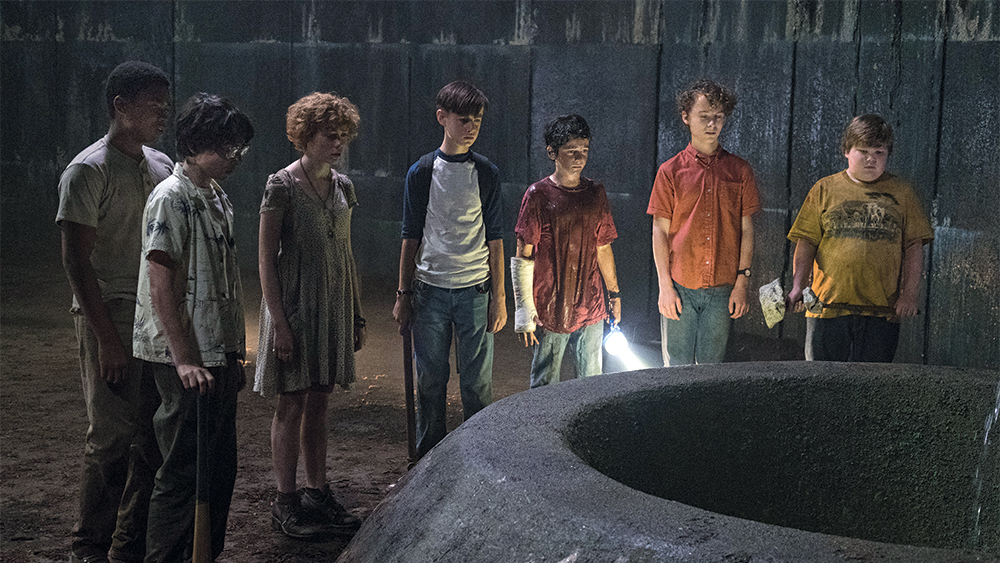
            At least as much as it is concerned with killer Clowns and/or Klowns (I don’t think they ever specify), the movie is interested in its seven protagonists, chiefly Bill (Jaeden Lieberher), Bev (Sophia Lillis), and Ben (Jeremy Ray Taylor), but also Ritchie (Finn Wolfhard), Stan (Wyatt Oleff), Eddie (Jack Dylan Grazer) and Mike (Chosen Jacobs), a group which makes up a loose gang known as the “Losers Club” (though the movie just barely touches on the last point). That is a lot of characters for any film to handle --even one with a comfortable 135 minutes to stretch out into-- and bear in mind, those are only the protagonists, and we’ll meet most of their parents, bullies, victimizers, classmates, and fellow citizens as well. So the fact that anyone leaves much of an impression is by itself somewhat miraculous, and amazingly, almost everyone manages to leave an impression. That’s partially an effect of the generous script, which is impressively nimble at giving each kid a rudimentary arc and at least one showpiece scene, but mostly a function of the director and the young actors’ confident proficiency at investing in the characters in more subtle, unspoken ways. With seven primary characters running around, that approach can only take you so far --the film is occasionally willing to substitute superficial characteristics as shorthand, which leaves Eddie as “The hypochondriac one” and poor Stan and Mike as “The Jewish one” and “the black one,” respectively--  but even in those cases, the film’s obvious broad affection for its characters and its clear eye towards the way they naturally organize and interact with each other, leave you with the unmistakable sense that you’re one of the gang. It’s a surprisingly rare thing in film, and IT can hold its own with the best of its competition, plus it has a killer clown.

            This being IT, of course, the clown is really the featured attraction, and if he must ultimately collapse into a dispiriting heap of shiny, weightless CGI nonsense, at least for awhile we have the immense pleasure of Bill Skarsgård’s magnificently inhuman portrayal. If King writes humans with surprising earthy care, his other strength runs more Lovecraftian: creating strange, unknowable intelligences for whom even adopting the physical form and human language seem an awkward fit. I’m immensely partial to the suffocating, nonsense-babbling entity in his short story 1408, for instance, which didn’t quite survive the transition to the big screen version. But Skarsgård nails it here, treating his Pennywise as a malignant intelligence which can only barely be bothered to offer a passing facsimile of a human. He --with the likely assist, I’m forced to admit, of some hated computers-- does this wonderful thing where while he’s talking to you, his eyes subtly of wander off, as though keeping up the illusion of a functional human face is a effort he can’t quite keep together unless he’s really focusing on it. As I said, I haven’t seen the original 1990 IT, but Skarsgård is so strong he I honestly can’t imagine how even Curry could top it (I am given to understand that the performances are quite different).


            A performance like that justifies the film’s existence all by itself, and paired with the excellent young cast, a splendid evocation of everytown 1980s America which mercifully eschews cheap nostalgia porn, and a brisk but unrushed pace that spools through a capacious tangle of exposition and plot with an ease that belies how much material it has to cover, the movie goes down real easy indeed. I don’t know if all that justifies more than a half-billion dollars in profit, but it does, I think, justify something a bit more honorable: the designation of “good movie.” I don’t think the horror works quite the way it should, but it turns out the movie writ large does -- which leads one to suspect it was really about something other than horror in the first place. Probably something about friendship and finding a community and growing up and stuff. And on that level, it’s a pretty unmitigated triumph. I guess coming from my perspective, a great killer clown movie with some decent coming-of-age drama in it would probably be more welcome than a great coming-of-age drama with some decent killer clown stuff, but I think I speak for everyone here when I decry the shameful paucity of both of them. This might not be the IT that I want, but it’s a damn sight better than anyone had any right to hope for. And that ain’t nothing.

            So let us all take a moment to really savor this feeling before they muck it up with a sequel that, by all accounts, is going to be composed of 100% the bad parts of the novel that they left out of this one.

Well, not the gangbang, I guess. You don’t make 700 million bucks without knowing what to leave out.


*Look it up.**

** Wait for the love of God stop! Look up “End of the novel IT,” not “prepubescent sewer gangbang,” come on dude what the hell you know better than this.

*** Other notable crossovers: Steven Spielberg, who’s animated TINTIN movie is one of his most Spierbergian efforts in modern times, and Zack Snyder, whose animated owl movie was, OK, bad, but basically indistinguishable in quality or style from his live-action works.

**** Huh?

***** If anything, he can sometimes be a little too sentimental about his characters, to the point of disliking THE SHINING because it makes Jack Torrence too unlikable.

CHAINSAWNUKAH 2017 CHECKLIST!

The Discreet Charm of the Killing Spree

TAGLINE
You’ll Float Too
TITLE ACCURACY
They sure do say “it” a lot.
LITERARY ADAPTATION?
Yep, of half of Stephen King’s 1986 novel
SEQUEL?
First of a two-parter.
REMAKE?
It was previously made in 1990, though this is billed as an adaptation of the book, not a remake of that film.
COUNTRY OF ORIGIN
USA
HORROR SUB-GENRE
Stephen King, Killer Clown, Demons
SLUMMING A-LISTER?
None, actually, a cast of young mostly-unknowns who really knock it out of the park
BELOVED HORROR ICON?
Stephen King, Pennywise the Clown
NUDITY?
None
SEXUAL ASSAULT?
There’s a strong suggestion that one of the characters is being molested, or at least is in danger of it, though it’s not explicit
WHEN ANIMALS ATTACK!
Nah. IT sometimes embodies what you fear (when it feels like it) but none of them are afraid of giant spiders or tapirs or something.
GHOST/ ZOMBIE / HAUNTED BUILDING?
Not really, although there is an evil house, as with so many King stories.
POSSESSION?
No, though Pennywise seems to be able to put people into something like a hypnotic trance
CREEPY DOLLS?
Just the clown
EVIL CULT?
Nah
MADNESS?
No
TRANSMOGRIFICATION?
Well, Pennywise does a good bit of transforming
VOYEURISM?
Nothing notable
MORAL OF THE STORY
Might as well adapt just the good parts of a book.