Showing posts with label CREEPY CASTLES. Show all posts

Thursday, October 17, 2019

Dinner With A Vampire


Dinner With A Vampire (1989)
Dir. Lamberto Bava
Written by Lamberto Bava and Dardano Sacchetti, story by Luciano Martino
Starring George Hilton, Riccardo Rossi, Patrizia Pellegrino

It's technically Dinner with A Vampire, but apparently German audiences demand definite articles.


            If there is one immutable and universal iron law of pop art, it is this: when something achieves a certain level of popular success --no matter what the thing originally was, no matter how idiosyncratic the product, or how obviously a fluke the success-- you can count on at least one rich guy to grab the artist responsible and say “make me more like that.” In this case, the inspiration was the financial success of DEMONS and DEMONS 2 in 1985-86 Italy, the rich guys were executive producers Massimo Manasse and Marco Grillo Spina of Italian TV production company Reiteitalia, and the lucky recipient of this enthusiastic artistic patronage was DEMONS and DEMONS 2 director Lamberto Bava. The result: from 1987-1989, Bava cranked out four (out of a planned five) made-for-TV horror movies that played on the channel Italia 1. Needless to say, none of them matched the feverish frenzied perfection of DEMONS, none is very well remembered today, and considering Bava The Younger does not exactly have an unimpeachable track record of quality, I was little inclined to doubt that assessment. Little inclined, that is, until I unknowingly watched UNTIL DEATH back in 2016. Obviously it’s no DEMONS, and nothing ever could be or will be again. But I found it a surprisingly solid, well-made little film noire horror riff that managed to entertain me even without any tits, gore, or swears. So I figured, what the heck, might as well tempt fate and see if lightning sometimes does strike twice.

Lightning did not strike twice. But if DINNER WITH A VAMPIRE is monumentally cheesier and crappier than UNTIL DEATH, it is not utterly without merit. In fact, it’s a rare Italian horror movie which seems to be at least marginally self-aware of how batshit it is, leaning into its silliness with a zeal that probably crosses the boarder into intentional parody. Or at least, everything about the script and performances scream campy, tongue-in-cheek fun, and the only thing that holds me back from wholeheartedly believing this was intentional is the simple fact that it would require the director of DEMONS to be self-aware enough to know when a film has gotten ridiculous, and I don’t see how I can square that with reality as I understand it.


            Anyway, DINNER WITH A VAMPIRE will deliver its titular meal eventually, but it starts with a film crew unintentionally resurrecting a vampire and enthusiastically filming the results until he predictably murders them all. This is the first, but not the last touch which could be seen as a bit of meta humor; you can easily imagine Bava himself (dubbed by an American accent, of course) shouting at his cameraman, “don’t miss a thing! This is incredible!” even as his crew gets slaughtered. Tedious backstory now out of the way, we then move on to the euphemistically titled “talent” portion of the movie, where we’re introduced to various young people and future vampiric victims of dubious ability, who are auditioning to be a singer (“well, I’m trying to be. I don’t have a great voice, but I have a good ear!” [??]), an actor (hot take: the romantic words of the immoral bard in Romeo and Juliet don’t sound so hot via the medium of a dubbed Italian woman mumbling the English phonetically), a “dancer” (skipping around vaguely to the rhythm of a pop beat) and… I dunno, some guy who’s really into finger puppets? What, specifically, they are auditioning for doesn’t seem to be an immediate concern for them, so they are dangerously unsuspicious when, after the audition, all four of them get “the call” to a mysterious castle which they all happily assume has need of dancing, singing, acting, and finger puppetry.

And what a castle it is! If ever there was a castle where one was obviously going to have an unexpected Dinner With A Vampire instead of a finger-puppet routine, this is obviously it. “Where’s the headless horseman?” asks one dude, apparently not as familiar with the setting of The Legend Of Sleepy Hallow as he believes himself to be. When the door is answered by a hunchback who appears to have taken Marty Feldman’s YOUNG FRANKENSTEIN role as a challenge to go broader (and I’m not the only one who thought so, since the young guy actually calls him "Marty Feldman" -- guess he’s more up on his Mel Brooks than his Washington Irving), they’re only slightly more surprised than they are when they’re told they can’t meet the promised “director” until… after midnight (this by an assistant with a rather pronounced Transylvanian accent). Soon a old-timey lady with very nicely crimped hair is warning them about an unspecified danger, which they take as an invitation to split up and wander around alone (“where are you going?” “To the bathroom!” “Alone?” “I always go to the bathroom alone!”).


Once the plot is introduced, much running around in a line through the most stunningly beautiful castle I’ve ever seen ensues, and it’s all very silly and could certainly be set to the Benny Hill theme song without losing much in terms of spine-chilling terror. The characters are notable for panicking when there’s no reason to panic (at the start, when they don’t even know there’s any danger, just watching a black and white movie causes one girl to faint!) and then being bizarrely nonchalant once they actually have to face rampaging ghouls. Faced with an obviously real vampire sitting two feet away and monologuing about the torments of immortality, one of his guests can only think to nonchalantly ask, “Well don’t you have a vampires’ union or something?” At an hour and seven minutes, this mental giant solemnly mansplains, “girls, I think we may have to accept the fact that he’s a real vampire,” as if that hadn’t been established forty minutes before.

            Still, it makes its silliness something of a charm, best embodied in the titular vampire who eventually makes an appearance at an elegant dinner where he informs the motley assembled “talent” that they’re actually here for a very unexpected reason (and indeed, one which might be unexpected even to the audience, who doubtless assume our collected protagonists were summoned to be Dinner For A Vampire). The courtly vamp in question is played by Uruguayan actor turned Spaghetti Western star George Hilton (THEY CALL ME HALLELUJAH, ALL THE COLORS OF THE DARK), camping it up gamely as an ageless supernatural menace bound and determined to have a good time with his unsuspecting guests, and fond of teasing them with phony hints about how to kill him (when they suggest killing him with a cross, he points out that he’s wearing one [“I wear it for good luck!”], and I like the implication that vamps have overcome their old nemesis of garlic and crosses by investing in big corporations which come up with scientific cures).


Hilton cements the movie’s sense of silly, giddy fun, and that tone is sufficient to keep things lively and tolerable, even when technically speaking there’s not a whole lot of whammy going on. The movie, for example, spends a surprising amount of time with our protagonists just watching a black and white film-within-a-film starring a suspiciously familiar vampire. This movie looks quite handsome in black and white and does turn out to be relevant to the events at hand, but somewhat typifies the film’s comically ineffective protagonists, who find it challenging even to successfully watch all the way through a movie. Their complete uselessness is kind of funny, but also makes them somewhat inert narratively, meaning we spend a whole lot of time basically watching them run around screaming. There’s some monsters and chasing and creepy dungeons backlit by an eerie blue light and all that, but it’s a little short on showstopper moments, which gets to be a bit patience-testing even at 92 minutes. Still, if one must watch a bunch of nitwits run around screaming for an hour and a half, one could hardly imagine a more pleasant setting for it. Shot in the Tuscan Sammezzano Castle, which sports 365 rooms each featuring a unique Moorish design, the location itself is such an eye-popping marvel that it almost doesn’t matter what’s happening in the foreground. Even when the movie is corny and kinda uneventful -- which is almost always—it’s never entirely uninteresting because it’s in such a sumptuously imagined palace, lit as elegantly as you would hope from an Italian production.

The juxtaposition of this stunning work of architecture against a dorky Scooby Doo story about a campy vampire film director is, perhaps, a fitting symbol for Italian genre filmmaking as a whole, especially by the late 1980’s: impressive technical artistry backing up a bunch of muddled, schlocky nonsense. Where the best films of this era blended those two things indissolubly (as in the immortal DEMONS), though, this one stratifies them almost entirely, leaving the schlocky stuff a little stranded and too lacking in the goods to stand on its own. But it’s a friendly, goofy enough experience to squeak by on charm and good looks, if only barely. Self-awareness is not the best lens through which to experience Italian genre films, but it’s at least unusual enough that I’ll allow it in a single TV movie that no one could reasonably have much hope for in the first place. Lightning may not have struck twice, but perhaps I was foolish to think myself capable of finding any Italian horror film from the 80s completely worthless. Bring on GRAVEYARD DISTURBANCE and THE OGRE!      

But seriously dawg, look at this fuckin' place!

CHAINSAWNUKAH 2019 CHECKLIST!
For Richer or Horror

TAGLINE
None
TITLE ACCURACY
There is a literal dinner with a vampire in there, though it’s mostly just exposition. But I guess HALFHEARTEDLY RUNNING AWAY FROM A VAMPIRE wouldn’t be as good a title.
LITERARY ADAPTATION?
No
SEQUEL?
None
REMAKE?
No
COUNTRY OF ORIGIN
Italy
HORROR SUB-GENRE
Vampire, horror-comedy
SLUMMING A-LISTER?
None
BELOVED HORROR ICON?
Not specifically horror, but George Hilton is something of an Italian B-movie God, appearing in Westerns, actions movies, and gialli
NUDITY? 
One boob appears in the horror movie they watch
SEXUAL ASSAULT?
None
WHEN ANIMALS ATTACK!
The vamp turns into one of those adorable 1930s bat puppets, but the poor thing looks like it can barely stay aloft, let alone harm anyone
GHOST/ ZOMBIE / HAUNTED BUILDING?
Vampire, but the building doesn’t seem to be the problem.
POSSESSION?
Vampiric hypnotism
CREEPY DOLLS?
One girl stumbles onto a prop room with a bunch of weird mannequins, including one with a arm for a head with one eye in the middle. Man, I wanna see THAT movie
EVIL CULT?
No
MADNESS?
None
TRANSMOGRIFICATION?
Vamp into bat, Sexy George Hilton into scary vampire Hilton
VOYEURISM?
None, oddly; you’d think this would be a prime opportunity to have the antagonist peeping on his guests while they’re vulnerable, but he’s actually quite the gentleman.
MORAL OF THE STORY
Finger-puppetry as a career won’t get you as far as your High School Career Councilor told you it would.


Tuesday, October 16, 2018

The Terror (1963)


The Terror (1963)
Dir by (deep breath) Roger Corman (only credited director), Francis Ford Coppola (!), Jack Hale, Monte Hellman, Jack Hill, Dennis Jakob, Jack Nicholson
Written by Leo Gordon, Jack Hill
Starring Jack Nicholson, Boris Karloff, Sandra Knight, Dick Miller, Sandra Neumann


First off --and as near as I can tell I am the first living person with the particular cross-section of personality flaws that would allow for the discovery of this fact-- the establishing shots of the imposing castle punctuated by lightning that begin THE TERROR are clearly the inspiration for the animated establishing shot of a isolated castle which was first used in Johnny Quest (which began production the next year), but subsequently became better known as the Laboratory of Dr. Weird, South Jersey Shore, in Aqua Teen Hunger Force, the show so powerful it once shut down the city of Boston.

Behold!

That might seem like an odd detail to begin on, but it’s actually the most appropriate starting point imaginable, because THE TERROR is all about Reduce, Reuse, Recycle. In fact, that’s how it came to exist in the first place. Having just completed THE RAVEN, Roger Corman decided to take advantage of the fact that the sets had not yet been torn down and he still had Boris Karloff’s phone number, to shoot two days of Karloff basically just doing stuff in an impressive (but increasingly sparsely decorated) castle set, figuring they’d fill in the rest of the plot later. Karloff was understandably reluctant, but was somehow convinced it would be an easy payday when he was promised $15,000 once the film had grossed $150,000. Apparently more of an optimist than his long history in the industry would lead one to imagine, Karloff somehow thought this was possible (it didn’t even come close). When three years passed and it became clear Karloff was never going to see that money, Corman then dangled the offer of finally collecting on that elusive $15,000 bonus… if Karloff would star in one more movie for him (which turned out to be 1968’s Peter Bogdanovich-directed TARGETS). And that’s how Roger Corman turned one castle set into two no-budget horror thrillers and three Boris Karloff projects (or at least, three films with Boris Karloff’s name on the poster). Don’t feel bad, Boris, there’s no shame in losing to the best.


Amazingly, despite all that, the movie isn’t a total disaster. It’s pretty narratively unfocused, of course, but it does have a story that, while a bit haphazardly plotted, is at least vaguely identifiable. Like some of the Italian movies of its era, it gets by on a kind of hazy dream logic, where nothing exactly makes complete sense in any kind of concrete, rational way, but the broad strokes of the drama are clear enough. It even builds to a kind of legitimately crazy twist which I gotta admit, I never saw coming (because it comes out of fucking nowhere and they apparently made it up in editing when they realized that the movie they had shot made no sense, but still).

So what is the story? Uh, that’s a little hard to pin down, exactly. But basically, it involves a Napoleonic soldier (Jack Nicholson! LITTLE SHOP OF HORROR) who nearly drowns in the ocean like a damned idiot while pursuing the silent ghostly apparition of a woman named Helene (Sandra Knight, BLOOD BATH, and newly married to Nicholson [they would divorce in 1968, the same year Karloff finally got paid]). It’s immediately obvious to everyone except Nicholson that Helene is a ghost, but this fucking moron cannot get that fact through his skull no matter how many times she disappears impossibly right in front of him or people tell him no, Helene’s been dead for years. So he goes to a nearby castle occupied by Baron Von Leppe (Boris Karloff, THE RAVEN, THE TERROR, TARGETS) and demands that he be allowed to stay there until he can find this mystery girl, despite the fact that the Baron and everybody else tell him directly that there is no girl there, and this is a private residence and not a fucking boarding house for horny soldiers trying to bang the local ghostly co-eds. (Incidentally, this is exactly why we have a Third Amendment in the US Constitution, so Jack Nicholson can’t just show up at your house and say he’s gonna hang out there while he tries to seal the deal with the ghost of a dead queen or whatever). Of course, this inevitably leads to a convoluted mystery about who Helene is and why she is haunting the place, and I mean really convoluted, because it involves witchcraft, hypnotism, possession, spousal infidelity, Dick Miller, murder, mistaken identity, and dissociative identity disorder (all that was a spoiler, I guess, but good luck trying to figure out how it all fits together. Heck, I just saw the movie, and even I could barely offer a theory about how exactly it's all supposed to work).


Nicholson is a complete, unmitigated disaster with the stilted old-fashioned dialogue, which handily defuses every single one of his strengths as an actor (and has there ever been a more thoroughly modern actor, less suited to antiquarian affectations, than Jack Nicholson?) but Karloff, even on set for a scant few days, acting with only the vaguest hint of a script while the sets were being dismantled around him, still puts in the effort. He has this little thing he does, where he mischievously arches one eyebrow, which I am just incapable of not falling for. It exemplifies exactly why he works here and Nicholson doesn’t; Nicholson is trying to play a character here, and there’s just nothing for him to work with. Karloff, on the other hand, is just trying to entertain. “Me, act? I just make faces,” said his THE RAVEN co-star Peter Lorre,* a cheeky but somewhat revealing insight into the style of acting employed by much of the generation which preceded Nicholson. Karloff, for his part, makes great faces, big and broad and theatrical but (mostly) without irony. He’s not mugging or indulging in any kind of arch camp (like his other RAVEN co-star, Vincent Price), he just figures that hey, the kids paid good money** to see this turkey, might as well give them the maximum possible acting by volume. Hell, they even managed to drag the 76-year-old actor (he was born in 1887) into a fight scene in chest-deep water, which honestly seems like it would qualify as elder abuse. I guarantee he had no idea what the hell he was doing, but he always knows to be entertaining, which is every bit what a movie like this requires.  

The movie itself is a little less lively than Karloff; there’s a little bit of action, a couple minor setpiece sequences, but mostly it finds a nice groove of spooky, dreamy ghost story, and parts of it actually look quite nice. There’s a sequence with a rotating multi-colored lantern that casts different colors on Dick Miller’s face which would be recycled for Karloff’s CURSE OF THE CRIMSON ALTAR and probably looks even better here. It’s uneventful and the acting is sometimes a little dodgy, but it looks suitably stately, and certainly not like a movie which was thrown together haphazardly in a matter of days just to get some extra value out of a corny castle set. Hell, there are a dozen major-budget movies which came out this year which don’t look half as good. It’s twice as coherent and five times prettier than SUICIDE SQUAD, for example. Not that it’s a visual feast or anything, it just makes the most of some nice-looking sets and locations, in classic Corman style doing as much as possible with as few resources as possible. The huge entrance hall he purloined from THE RAVEN has been stripped to almost nothing compared with its imposing opulence in that movie (you really miss the fire-breathing statues, which really tied the place together in my opinion) but just to make sure the space doesn’t look entirely drab, Corman or one of his dozen uncredited directors*** sprinkle the background liberally with brightly colored candlesticks arranged in geometric formations. It couldn’t have cost more than ten bucks, but exactly the sort of thing that separates a lazy, monotonous cheap movie from a watchable one.


            I’m not saying it’s a classic or anything, but if you’re a fan of this era of Corman schlock (it is often grouped with his Poe movies, even though it’s an outlier which, unlike THE RAVEN or THE HAUNTED PALACE doesn’t even pretend to be based on Poe) it’s got the vibe you want. And hey, that set from THE RAVEN does look fly as hell. There are certainly worse reasons to make a movie.

            * See Stephen Youngkin’s biography of Lorre, The Lost One: A Life of Peter Lorre

            ** Although you don’t have to, as in their haste to crank THE TERROR out they neglected to add copyright information to the credits. I highly recommend that you avail yourself of this very nice-looking youtube version instead of the VHS-quality one that Amazon Prime, with their usual shamelessness, is trying to hustle as content for their paid service, the charlatans.

*** The minute budget precluded Corman himself from directing certain segments as per union rules, requiring a rotating cast of novices he was mentoring including a very young Francis Coppola, Monte Hellman, and Jack Hill.

CHAINSAWNUKAH 2017 CHECKLIST!
The Discreet Charm of the Killing Spree

TAGLINE
DRACULA…. FRANKENSTEIN… HOUSE OF WAX… PIT AND THE PENDULUM… and Now A New Classic Of Horror Comes To The Screen. If you’re gonna lie, lie big.
TITLE ACCURACY
Given its historical French setting, I genuinely thought this was going to be about either the Reign of Terror or the Great Fear. But it turns out to be about neither, and no one is ever terrified at any point (there is a ghost, but Nicholson is horny for her instead of terrified).
LITERARY ADAPTATION?
No, which is impressive given that they could have passed it off as Poe without really losing any more credibility than they had already lost when they made THE RAVEN about dueling wizards.
SEQUEL?
Arguably part of Corman’s loose “Poe Cycle” of 1960-1965, though also arguably not.
REMAKE?
None
COUNTRY OF ORIGIN
USA
HORROR SUB-GENRE
Ghost/ Haunting
SLUMMING A-LISTER?
Nicholson and Francis Coppola, very early in his career
BELOVED HORROR ICON?
Karloff, Corman, Dick Miller.
NUDITY?
No
SEXUAL ASSAULT?
None
WHEN ANIMALS ATTACK!
Hawk attack!
GHOST/ ZOMBIE / HAUNTED BUILDING?
Yes
POSSESSION?
Some old lady, like, hypnotizes the ghost, I think?
CREEPY DOLLS?
None
EVIL CULT?
None, though the implication of witchcraft.
MADNESS?
Certainly!
TRANSMOGRIFICATION?
No
VOYEURISM?
Dick Miller watches some villainous hypnotism through a window
MORAL OF THE STORY
It’s not necrophilia if she’s a ghost


Friday, April 28, 2017

Mr. Sardonicus


Mr. Sardonicus (1961)
Dir. William Castle
Written by Ray Russell
Starring Ronald Lewis, Guy Rolfe, Audrey Dalton, Oskcar Homolka


When London doctor Robert Cargrave (Ronald Lewis, A TASTE OF FEAR) visits the reclusive Baron Sardonicus (Guy Rolfe, DOLLS) at the request of the his old flame --and the current Mrs. Baron Sardonicus-- (Audrey Dalton, THE MONSTER THAT CHALLENGED THE WORLD), he finds a situation which could safely be called unexpected. Seems that the cruel Baron --who lives in an menacing gothic castle and casually tortures his servants-- is the victim of a bizarre medical condition: years ago, while digging up his father’s corpse to retrieve a winning lottery ticket (long story), he became so overcome by terror that his face froze in a horrific contorted mask. He demands Cargrave cure his condition, or else risk brutal punishment for Mrs. Sardonicus! That’s right, Fix my face or I’ll kill my own wife! This guy’s got some bold new villainous ideas.


What we have here, then, is a curious mix of classic horror and asynchronous 1960’s modernity. In the classic horror corner, we got a looming gothic castle, a dry-ice-drenched grave-robbing flashback, and a medieval torture room headed by a guy named “Krull” (Oskar Homolka, Oscar-nominated for 1948’s I REMEMBER MAMA and clearly fallen on hard times since then). But we also have some startling modern detritus; winning lottery tickets (the proceeds from which bought the “Baron” his castle and title, a weirdly comic detail that the movie doesn’t seem to find odd), medical specialization, and corny pop psychology. And of course, it’s Wiliam Castle (THE HOUSE ON HAUNTED HILL), so there’s gonna be a gimmick, oh my yes.

This movie is set in 1961, by the way.


It doesn’t feel haphazard or fragmented, though, it just feels transitional: a particular tendril in the evolutionary tree of modern horror which was still trying to recontextualize its classic tropes into a world increasingly alien to them. There is no particular reason for there to be a gothic castle or a Baron of any kind in here, except that in 1961 horror movies had either gothic castles or rubbery monsters, and this one doesn’t have any rubber monsters. It was a solidly old-fashioned movie even at the time (PSYCHO and PEEPING TOM had both come out the previous year, effectively inaugurating the modern period of horror cinema) but gothic horror was by no means dead yet, and, following on the heels of the “nuclear monster” films of the 1950s and The Twilight Zone (which had begun two years prior in 1959), allegorical horror was still very much in vogue. And MR. SARDONICUS has a little bit of all those elements in there. There’s a hint of the early psychoanalytic fetishization which would play into PYSCHO, some hoary gothic flourishes, and a lot of stagey morality play.


“Stagey morality play” sounds like death on celluloid, but the movie has enough fun to stay light on its feet. It’s a solid, old-fashioned fable with a small but potent surfeit of great details, mostly in “Sardonicus’s” fucking terrifying, incredibly painful-looking face and only slightly less terrifying mask. (The mask was necessary because, as you can plainly see from just looking at it, the prosthetic makeup actor Guy Rolfe had to wear was so painful he could not physically stand to wear it for more than an hour at a time.) It’s very simple but surprisingly effective, with solid performances (at least by B-move standards) and an elegantly unencumbered story structure which gradually doles out both conflict and explanation. It also looks quite nice (in its cheap, soundstagey sort of way) courtesy of two-time Academy Award winner Burnett Guffey (FROM HERE TO ETERNITY, BONNIE AND CLYDE). And of course, it sports the requisite darkly ironic ending which is absolutely crucial for this sort of affair.


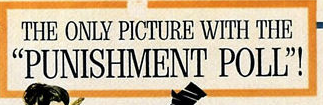
But ah, that’s where Castle’s trademark gimmick comes into play, and of course we simply must talk about that. His gimmicks ranged from “free toy!” giveaways (the glow-in-the-dark “magic” coins from ZOTZ!) to chintzy carnie hokum (the pop-up skeleton in HOUSE ON HAUNTED HILL) to the ambitiously elaborate and inventive (the vibrating audience seats in THE TINGLER, which must have been absolute hell to pull off). MR. SARDONICUS, though, has one of his more interesting parlor tricks, and it’s probably the thing which is most remembered about the film, other than Sardonicus’s disturbing visage. Castle himself appears at the beginning of the film and near the end in something of a Rod Serling capacity, acting as host and narrator. His second appearance, though, is unique in cinema history, because he pauses the action right after the climax of the film, and directly asks the audience to decide Sardonicus’s fate. Should he be punished for his cruelty, or has he suffered enough to deserve mercy? Audiences were given a glow-in-the-dark (of course) card with a hand on it, with which they could show “thumbs up” or thumbs down.”


Gee, I wonder what a horror audience is going to do with that? The “verdict” is such a foregone conclusion that apparently only one ending was ever filmed, and I’ll give you two guesses which one. Castle went to his grave swearing there was an alternate ending which was, in his words “rarely, if ever, used,” but given that not one scrap of physical evidence has ever come to light to support this claim, the consensus seems to be that he’s full of it. (And would you want him to be anything else?)

Supposedly, this is the actual voting card.


Being a total lie doesn’t make it less of a fun gimmick, but the movie is actually good enough that it doesn’t need it. Arguably, Castle ought to have trusted the premise and the excellent makeup design to get the audience where he wanted them. But I guess he wouldn’t be William Castle if he had. It’s actually a pretty dark ironic punishment (which implies, SPOILER, a slow and horrible death for Sardonicus that could be easily avoided if only he hadn’t been such a prick) but Castle’s intrusion kinda breaks up the film’s momentum and the “punishment” has only about 3 minutes of screen time to pick up steam again before the film ends. Despite the exotic strangeness of the “punishment poll” (even more pointless at home than it was in the theater), it can’t really recover its impetus after the interruption, and lurches unsteadily across the finish line. Part of the problem is that the “poll” occurs only after the real conflict in the film has already been decisively resolved, and only requires the audience to choose their preferred coda. The good guys have already won, the only question is what happens to the now-defeated villain. That’s interesting, but maybe not very satisfying; if you’re going to involve people in the plot, it would probably work better to have them make more impactful choices. It’s like if AMERICAN GRAFFITI ended and you got a choice of whether or not you wanted Terry “the Toad” to die in Vietnam in a text-only epilogue (for the record: I would vote against it). It might work if it were a more over-the-top, active revenge, but instead it’s intrinsically passive, about not saying something. It’s the ending of the original short story by Ray Russell (from which he adapted the screenplay) but although I’ve never read the story I suspect there’s no “choose your own adventure” option, and that probably works better. Amusing as Castle is, the film would be stronger without the gimmick, or at least with the ending changed to something corny enough to work with the added lowbrow fun of a “punishment poll.”


Even so, it’s not disruptive enough to kill the movie’s charm, and it’s not like the movie is otherwise some unimpeachable classic which got tarnished at the last minute by some hustling showman. It’s silly and stagey and dated, like most of Castle’s pictures, and even if the gimmick is a bit narratively disruptive, it adds a little exotic oddness to something which otherwise might feel a little too much like an unnecessarily extended Twilight Zone episode. Still, there’s something that fundamentally works about the story which needs no flashy trappings. If it’s stagey and silly, it is so in a way which feels appropriately mythic, and it has enough macabre instincts to maintain its gleefully morbid tone throughout an unhurried 89 minutes. I always got the sense that Castle, like his huckster successors monsieurs Golan and Globus, liked being a filmmaker more than he actually liked making films, but this one is a testament to his ability to make a film which is borderline worthy of his genius as a marketing impresario.


CHAINSAWNUKAH 2016 CHECKLIST!
Good Kill Hunting


TAGLINE

One of the most accurate taglines I've ever had the honor to read.
TITLE ACCURACY
Actually it’s Baron Sardonicus. He didn’t spend all that lotto money on a fancy title to be called Mister.
LITERARY ADAPTATION?
Yes, from writer Russell’s short story of the same name.
SEQUEL?
None
REMAKE?
None
COUNTRY OF ORIGIN
USA
HORROR SUB-GENRE
Uhhh… Ironic morality play? I guess Body Horror, to a certain extent? I dunno, there’s nothing else really like it.
SLUMMING A-LISTER?
Oskar Homolka had been nominated for Best Supporting actor in 1948, and is actually first billed here despite the fact that he’s playing a pretty small role as Sardonicus’s main henchman. But A-list? You don’t end up in a William Castle film if you’re A-list.
BELOVED HORROR ICON?
William Castle. Guy Rolfe?
NUDITY?
No
SEXUAL ASSAULT?
None
WHEN ANIMALS ATTACK!
No, although some dogs die
GHOST/ ZOMBIE / HAUNTED BUILDING?
No
POSSESSION?
None
CREEPY DOLLS?
Creepy mask, but no dolls
EVIL CULT?
no
MADNESS?
Sardonicus’ condition, we hear, is the result of shock, not medical trauma. So in that sense, sure, but by the time we meet him he seems pretty with it.
TRANSMOGRIFICATION?
Normal to Sardonicus
VOYEURISM?
None apparent
MORAL OF THE STORY
Never dig up your father’s corpse to retrieve a winning lottery ticket. Or, I guess, don’t be such a dick afterwards if you absolutely must.