Part III: The Best of the Rest: Documentary and Drama Category!
(see part one here! and part two here!!)
Confession time: there ended up being so damn many winners this year that I broke my usual year-in-review post into THREE parts: part one is here, with my top 14 of the year. You should check that out first, obviously, since it's the very cream of the crop. But I saw too many movies I loved to stop at 14, so what follows is everything else which I thought was undeniably great this year, in no particular order. Last week it was genre stuff with Action, Sci-Fi, Horror, Art, and Comedy! Today, In our last segment, we're covering Drama and Documentary.
Documentary
 |
This is a deeply affecting, expertly constructed, powerfully observed documentary which really disappointed me. It has the unfortunate handicap of being director Joshua Oppenheimer and Co-director Anonymous J. Pleasedontkillme’s follow-up to their 2012 masterpiece THE ACT OF KILLING. That film is perhaps the only movie of the new millennium which I would feel completely confident hailing as One Of The Greatest Films Ever Made (it lost Best Documentary to 50 FEET FROM STARDOM, a nice movie about singers who worked with famous people), and this is not just from the same directors, but also about the same subject. That subject, of course, is how modern Indonesians come to terms with the 1965-66 Indonesian genocides which killed well over a million people (by way of comparison, the disastrous Syrian civil war hasn’t yet reached half that number of dead in four years), and yet today remain largely a matter of public pride for the perpetrators and fearful silence for the victims. ACT OF KILLING brilliantly snuck past the defenses of several killers by encouraging their bragging, politely handing them the rope to hang themselves with. But LOOK OF SILENCE takes a somewhat more conventional approach: an ophthalmologist whose brother was killed during the purges now conducts eye tests for former killers, and while doing so indirectly challenges them about their responsibility by first bringing up the subject (eliciting nostalgia and pride) and then pointing out that his brother was one of their victims (which makes them uncomfortable and evasive). Give it this: our hero must have balls of brass to do this, and there’s a wrenching power to watching him sit silently, while the people who murdered his family sit smugly in front of him, whining that he’s being unfair to them. But unfortunately while ACT OF KILLING was startlingly elucidating in its examination of the killers, the confrontational nature of LOOK OF SILENCE results in exactly what you would imagine: the killers totally shut down, sometimes to the point of just walking away or sitting in stony silence. It’s more a companion piece to ACT OF KILLING in that it shows exactly how not to approach this topic if you want to get anything of substance from the actual perpetrators. Which may be the point; like last year’s Rumsfeldsploitation fiasco THE UNKNOWN KNOWN, this is essentially a study in frustration, a window into the impossibility of getting powerful people who committed grievous wrongs to own up to them, balanced against our overpowering need for them to do so in order to give us closure. If ACT OF KILLING was a window into the unchecked self-aggrandizing of villains, this is a window into the painful impotence of victims. The result makes for cinema as gripping and emotionally raw as documentaries come, but somewhat limited compared to its masterful predecessor. As a symbolic act of confrontation, it has plenty of power… but not a lot of insight. It feels like an aside to ACT OF KILLING, not the main show. Even so, this is unmistakably searing, deeply affecting stuff, and it will leave its mark.
Since he can’t safely go back to Indonesia anymore, I might humbly suggest that if Oppenheimer wants to make a third film in the trilogy, he might make it about the CIA programs here at home that encouraged the slaughter and provided material support to it. I appreciate that ACT and LOOK keep the focus on the Indonesians without needing to tie US history into the mix, but it might be time for an accounting about our role in this mess, too.
RED ARMY
From a depressing documentary to a crowd-pleasing one: this is the story of the Russian ice hockey team that dominated the sport during the Cold War, and were eventually seduced over to the NHL. But more than that, it’s the story of the politics of the time, and the price paid by the ambitious sporty types who got roped into the huge, propaganda-churning spirit-crushing political machine when all they wanted to do was be good at hockey. This is not just anti-communist misery-porn, though; these guys really were great, and remain very proud about what they accomplished, and even --perhaps somewhat surprisingly-- their motherland, which by all accounts treated them rather harshly. They’re also fuckin’ hilarious, in their deadpan Russian sort of way, and so is the movie. As a simple, exciting, and funny way to explore the insane cold-war mindset from a safe distance, you could hardly do better, and this is coming from someone who literally could not possibly care less about hockey as a sport, or for that matter sports in general (it was executive produced by Werner Herzog, who I doubt spends a lot of time at the… I dunno, skating rink? What’s the name for the place you play hockey? They probably mention it in this doc but it’s been a few months). Trigger warning, though: This is a American-Russian co-production, so it ends with some unusually positive, eyebrow-raising words about how Vladimir Putin is making Russia great again. I think these guys honestly believe it, but I doubt it was an entirely unmotivated gesture of goodwill on their part. Some things never change, but at least now these guys are rich.
AN HONEST LIAR
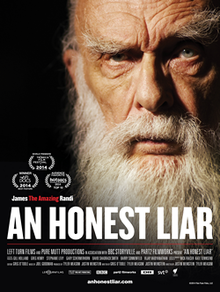 |
Almost certainly my favorite documentary of the year, this clever biopic details the remarkable life of James Randi, both as one of the US’s premier illusionists (a job he describes with the title -- he’s being paid to trick his audiences) and subsequently as one of its premier skeptics and debunkers. Randi (now 87) is a spirited, funny figure, and his life has been chock full of landmark feats in both his careers, though the movie leans towards his later years -- most notably, perhaps, in his epic takedowns of charlatan faith healer Peter Popoff and self-proclaimed psychic Uri Geller. But the movie (perhaps even unexpectedly to the filmmakers) picks up a more interesting thread as it goes along. It explores the contradictions inherent in a man who devoted the first half of his life to great trickery and the second half to exposing frauds, and finds that truth might be a slightly more slippery concept than Randi’s dogmatic skepticism easily allows. Using Randi’s own surprising and sometimes tragic life, they gently imply that maybe people want to be tricked, even need to be tricked, and explore a surprising ambivalence about whether or not this is a tragic flaw or a survival mechanism. How honest do we dare be, about anything other than the fact that we prefer a comforting lie a lot of the time (and that, only when we’re not busy lying ourselves)? Though the film (rightly) has a lot of admiration and love for the lively septuagenarian, it perhaps finds its most interesting insights in interrogating his worldview a little. Like 2012’s Ricky Jay doc DECEPTIVE PRACTICES, it is this lightly philosophical turn which subtly transmogrifies what was already a riotously entertaining journey through a colorful life into something a bit more substantial. AN HONEST LIAR is just as funny and delightful as its central character, but it’s also an unexpectedly moving, thoughtful film, especially for what is essentially a talking-heads clipshow until near the end. Worthwhile even for those who would not consider themselves fans of Randi, but especially essential for anyone who already loves him.
Drama
TIMBUKTU

In Timbuktu, Mali, Jihadist invaders take control and impose a strict, fundamentalist Islamic law on the locals.* That sounds about as grim a scenario as one could imagine, but Mali-born, Soviet-educated, and France-based director Abderrahmane Sissako (who, I would guess, is no stranger to cultural conflict) examines the scene with a more nuanced lens than one would expect. Rather than a misiberalist drama, it plays out as an darkly absurd parable, full of flawed but likeable characters and tragicomic slice-of-life sketches (boys play soccer with an imaginary ball after sports are banned, a young jihadist sneaks a cigarette when his boss is away). It has a few moments of gut-wrenching brutality (a couple deemed to be adulterous are buried up to their necks and stoned) but mostly avoids the obvious villainous jihadi cliches you are probably expecting to see, instead merely observing the dissonance between the complex, diverse local culture and the harsh new regime. Rich, closely-observed details provide much of the film’s power: sometimes, they’re mechanical (the newcomers don’t speak the local language, and translation can be a crucible of misperception) other times deeply human (a jihadi commander confesses to his translator how bad he feels about sentencing a man to death, but does it without changing his demeanor so the condemned man won’t realize it) and still others mysterious and surreal (a minor conflict between two characters inexplicably escalates into murder, silhouetted against a sunset-soaked river, in what might be the single most stunning image of the whole year). The film isn’t big on narrative or exposition, instead simply pointing a roving eye at the human side of the headlines. It’s not a film that feels like a righteous declamation, nor political rabble-rousing --it cares far too much about these people to ever use them as props-- but nonetheless it makes for completely absorbing cinema. Even at a brisk 96 minutes, it feels expansive, unhurried, and completely confident in its unique blend of beauty, humanism, and bleakness, and frankly now that I’m writing this, it was a terrible mistake not to include this in my top 14. Only the somewhat truncated climax holds this one back from being a masterpiece of the highest order; and even at that, it’s an absolutely unmissable experience and a desperately needed perspective on the world that probably only Sissako could have provided.
*This happened in 2012, but I never heard about it. Looks like it’s over now. I always like it when I find out about a problem and then immediately learn it’s already been resolved. Feels like progress.
MAPS TO THE STARS

I would never have figured David Cronenberg for a “burn, Hollywood, burn!” type, but MAPS TO THE STARS is about as savage a condemnation of callow tinseltown vanity as, uh, tinseltown has yet been able to produce. Working with a fine cast and a nearly 20-year-old script (?!), Cronenberg trots out the usual assortment of delusional Hollywood phonies and pathological egomaniacs --most notably a 13-year-old Bieber-esque fame monster played by Evan Bird (CHAINED), his TV-shrink father (John Cusack), a desperate fading starlet (Julianne Moore), and her mysterious new assistant with the burn scars hidden beneath long gloves (Mia Wasikowska)-- and, at least initially, this seems like the conventional sort of vicious Hollywood satire, the kind they’ve been making since at least SUNSET BOULEVARD. Well, except for the satire part. That may have been how it was written (and certain parts are broad enough that I suspect it was), but it doesn’t play out like that at all. Instead of black comedy, the tone is one of icy, mysterious dread, perpetually circling but never quite becoming out-and-out horror. There’s a mystery at the heart of the plot, and as it unspools the characters get somewhat more complex --if no less broad-- sometimes with genuinely surprising results. Excellent performances abound (particularly Moore, who plays her deluded has-been character with a withering abandon) and combined with the tone and the strange asides to the 1942 French poem Liberté, the net result is that in spite of all the familiar digs at LA phoniness, the movie is more a rumination on ego and identity than yet another masturbatory Hollywood in-joke. It suffers from some structural problems, but like all of Cronenberg’s work, there’s something too perverse and compelling lurking here for you to dare lose interest. A strange, off-kilter, and subtly unnerving story, even by Cronenberg’s usual standards.
ABOUT ELLY
This Iranian film from Asghar Farhadi (A SEPERATION, THE PAST) actually came out in 2009, but it didn’t make it to America til 2015 (thanks, Obama!). But it’s just as well, because in 2009 I wouldn’t have known to take a chance on it, but after the masterful THE PAST in 2014, Farhadi has a much-coveted free pass with me, where I’ll see anything he does. And that’s working out great so far, because ABOUT ELLY is another terrific work. Just like THE PAST, it’s fundamentally a tense drama about the personal dynamics of a small group in an isolated place, but with an unassuming gilding of mystery thriller. A bunch of pretty, wealthy young people sharing a beach house are thrown into chaos when the titular Elly -- who none of them know very well -- mysteriously vanishes. In her absence, the group tries to figure out what to do, and what happened, and, for that matter, who Elly really was. What follows is a sharp examination of group dynamics in a stress situation, coupled with an intriguing and subtle examination of how we imagine identities for others. Tense and existential without losing its sense of intimate realism.
CAROL
A Sumptuously filmed, vividly acted drama about a burgeoning lesbian affair in the spirit-crushing 1950’s. Just as weepy as you’d want it, but fortunately the movie offers characters a little more complex and interesting than your standard tearjerker melodrama, and Cate Blanchett and Rooney Mara are more than up for the challenge. Unfortunately Mara’s repressed, mousey character has the more interesting arc (Blanchett’s story gradually devolves into a standard custody battle with her frustrated, vindictive husband) but the movie never quite comes around to letting it play out. It seems to want to push a true-love fairy tale which doesn’t seem to really make sense in the complicated, messy world it depicts. But whatever, the story’s as lugubrious as it needs to be, and the experience of watching it is sensuous and captivating.
THEEB

This Jordanian film finds a young Bedouin boy unexpectedly plunged into the chaos of WWI when a British officer enlists the help of his family. What starts off a sweeping adventure tale (capturing the unassuming magnificence of the Jordanian desert with an unsentimental realism) quickly turns into violence and danger, but the movie resists easy genre classification. It has moments of blistering intensity, but mostly focuses on capturing the quiet moments in-between the action. It’s slow, contemplative, and doesn’t go at all where you expect, all while portraying both a time and place we almost never get to see on the big screen with precision and nuance. Maybe a little too shy about cheap thrills for its own good, but even so, it’s a fascinating, deeply engrossing little movie.
BRIDGE OF SPIES
Ho-hum, another perfectly tailored, effortlessly gripping, and meticulously crafted crowdpleaser from Steven Spielberg. I’m really getting sick of him making such consistently technically masterful, irresistibly engaging movies. And it’s getting easy to take them for granted, especially when he tends towards such middlebrow, mainsream-prestige subjects so much nowadays. But if anyone but Spielberg had made BRIDGE OF SPIES, I feel like people would have been blown away by how pitch-perfect it is; it’s absolutely wall-to-wall packed with wonderfully endearing performances, witty, literate conversations, and gripping suspense sequences. But even more than that, it’s a movie which is surprisingly unafraid --in its middlebrow, mainstream-prestige sort of way-- to genuinely tackle some big issues about the Cold War mindset in specific and the legitimacy of American exceptionalism in general, without getting overtly sanctimonious about it, or ever letting up, even for a second, on its relentless desire to keep you entertained. The one sour note is Thomas Newman’s pushy score, which lays it on way thicker than is needed when the acting and filmmaking are this strong. If Spielberg has any weakness at this point in his career, it’s probably that his mastery of the artform is so complete that it probably benefits from restraint more than excess, and he doesn’t always quite have it in him to dial it back when he can overwhelm with sheer force. Even so, BRIDGE OF SPIES represents the very best in respectable, mature mainstream filmmaking and we’d be fools to take it for granted.
LOVE AND MERCY

Ugh, Musician biopics. Here’s a good idea: let’s depict an artist who is recognized specifically for their unique voice and inimitable performance style, and then have someone else do it. I’m sure some actor can do just as good a job with that. And also, if we could get a side dish of one traumatic event from their childhood which totally explains everything else that happened in their life, that would be great, too. Oh, and if you could just string together a long series of recreations of times when they did stuff and dramatize every major event of their whole life, I also think that would really help us understand them so much better. So LOVE AND MERCY was a tough sell for me, but it turns out it avoids most of the usual biopic cliches by a) using the original music, not trying to recreate it, and b) focusing exclusively on two points in troubled Beach Boys singer/composer Brian Wilson’s life: first, the creatively rich but psychologically destructive experience of creating Pet Sounds in 1966, and second, his efforts to escape the control of tyrannical, exploitive “therapist” Eugene Landy in 1986. The two stories are loosely interwoven, but as much as I like John Cusack and Elizabeth Banks in the ‘86 segments, Paul Dano as the younger Wilson in his Pet Sounds days is absolutely marvelous, funny and frustrating and eccentric and loveable, making Wilson’s essential strangeness into a fully realized character, not just a symptom or suite of actorly tics. Director Bill Pohlad (mostly a producer up til now) instill the experience with just enough sun-soaked stylization to allow a little subjectivity to peek through, but really it’s Dano’s show here, everyone else is just along for the ride. What emerges is not so much a biopic as two snapshots of a tortured genius at two very distinct moments in his life, and they’re both so rich with Wilson’s strange, tragicomic charm that you could completely forget that all this is supposed to be some silly prestige picture at all.
BLACK MASS
Johnny Depp is every bit as good as you’ve heard here, playing the ice-cold gangster James “Whitey” Bulger with a truly devilish intensity unlike anything you’ve seen him do before. But you know Depp is good; he’s always gonna be good, it’s just that sometimes he’s good in the wrong way for a movie, or just in the wrong movie, period. What makes BLACK MASS work isn’t just that Depp is great, it’s that director Scott Cooper (CRAZY HEART) and writers Jez Butterworth (EDGE OF TOMORROW, GET ON UP) and Mark Mallouk (nothing) actually craft a movie around him which is good enough to deserve it. Depp gets the showiest role, but the filmmakers do a fine job of crafting a long and multi-year crime story into an actual workable narrative, putting the conflicted FBI agent John Connelly (Joel Edgerton) at its center as a means of examining the worrying overlapping worlds of law enforcement and organized crime. Edgerton is great too, though in a less flashy sort of way, and a strong cast of seasoned character actors make sure the somewhat tired crime epic procedural side has plenty of vitality. The script’s ability to hew a functional narrative film out of so much sprawling historical material is quite impressive, and with Depp’s menacing presence dominating the film even when he’s not on-screen (which is surprisingly often) it zips along through 122 minutes with a commendable urgency. The only thing which holds it back from true genre greatness is it’s somewhat disappointing lack of style; Cooper and cinematographer Masanobu Takayanagi cultivate a very naturalistic look for the film, which worked nicely for the other Takayanagi-shot, Boston-set multi-year crime ensemble this year (SPOTLIGHT) but feels a bit flat here, considering the somewhat more intense, exaggerated characters and the greek tragedy Connelly’s character arc eventually takes him through. Still, I fucking love gangster epics, and this is one of the best in years, maybe since the MEREINE films.
PHOENIX
In postwar Berlin, a Holocaust survivor with a new face must pretend to be a stranger in order to get close enough to her grifter ex-husband to find out if he was the one who betrayed her to the Nazis. That’s a classic noir plot if I ever heard one, but in the hands of German director Christian Petzold (2012’s BARBARA) it doesn’t quite play out that way -- it’s more repressed drama than white-knuckled thriller, perhaps not entirely to its benefit. But then again, I can’t argue that it doesn’t work; Petzold is comfortable enough with the inherent and inescapable tension of the premise that he doesn’t need to push the point and can just linger on the complex emotions at play here. And complex they are -- Nina Hoss (A MOST WANTED MAN) gets a role about as nuanced as any actor could ever hope for, playing many layers of hidden meaning with each subtle change of expression, and it is through her that we try to interpret her husband’s ambiguous motives and character. I’d probably have preferred a more stylized, classic noir take on this somewhat outrageous premise, but there’s not denying the power of the film as it is. And the ending, when it comes, is a thing of such absolute perfection that I cannot find it in my heart to offer any equivocating criticism of the film as a whole. Petzold obviously knew where he was going, and while I may have had my doubts here and there about his methods, I can’t argue with his results. That last scene is as spellbinding a bit of cinema as you could ever hope to see.
Also mildly worth watching, but not good enough to warrant a whole review, except for the ones I already reviewed:
The Hallow (actually this is pretty good, I don't know why I didn't put it in my Horror Best Of. But too late now. Just read the full review, I liked it).
Straight Outta Compton
I dunno, I guess Trainwreck? I like Basketball cameos. AND THAT'S IT! That's all she wrote, folks! Back to your regularly scheduled horror programming next, and thanks for playing The Subtlety Guide to Shit You Should Have Seen in the Year of Our Lord, 2015!