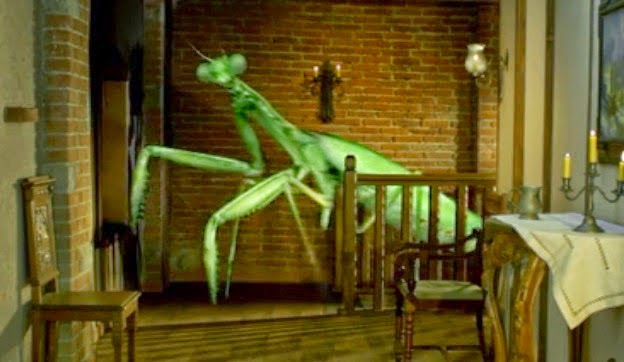
The Church (1989) aka La
chiesa aka Cathedral of Demons aka Demon Cathedral
Dir. Michele Soavi
Screenplay by (so says
IMDB): Michele Soavi, Dario Argento, Franco Ferrini, and, (uncredited), Dardano
Sacchetti, Lamberto Bava, Fabrizio Bava, Nick Alexander, and --why not?--
fucking M.R. James (they claim it’s a uncredited adaptation of The Treasure
of Abbot Thomas, I guess in the sense that there’s a guy who finds a hidden
evil thing in the vicinity of a church?)
Starring Hugh Quarshie,
Tomas Arana, Barbara Cupisti, Asia Argento

THE CHURCH began life as DEMONS 3, the third sequel in
the Dario-Argento-produced, Lamberto-Bava-directed loose series of films about
people who go to a place, and then there are demons there. In DEMONS, there is
a group of people who go to a movie theater, and then there are demons there,
and they kill everybody. In DEMONS 2, there are people in an apartment complex,
and then there are demons there, and they kill everybody. But unlike those two
classics of hallucinogenic Italian anarchy, the third film was to be directed
by Argento protege Michele Soavi (CEMETERY MAN, STAGEFRIGHT) who had far grander ideas. This wouldn’t simply be a film about a bunch of demons who kill everybody someplace. This would
be sophisticated, philosophical; a meditation on religion and violence that he
certainly didn’t want to be associated with those crass and uncouth DEMONS movies.
The artistic difference between Soavi and Argento was as unbridgeable, and they
never worked together again,* but Soavi got his way and was able to give the film a new name, to clearly demarcate it from those sophomoric, primitive DEMONS movies and ensure that anyone going to see it understood this was something bold, visionary, different.
Which is weird, because
I watched THE CHURCH, and here’s what happens: there is a group of people who
go to a Church, and then there are demons there, and they kill everybody.
In fact, in nearly every way imaginable, the premise and screenplay are as broadly in line with the two DEMONS movies as it would be possible for
another human besides Lamberto Bava to get. Like them, it is not so much a
narratively broken film as it is a film which appears to have originated in
some kind of bizarre alternate universe where narrative was never invented in
the first place. It has nothing even remotely resembling a protagonist;
top-billed Hugh Quarshie (STAR WARS EPISODE I: THE PHANTOM MENACE) has said
maybe five words by the 55 minute mark and eventually emerges as something like
a main character strictly through a process of attrition, and even then nobody
in sight has anything even vaguely identifiable as an arc. Slightly over
halfway through, roughly a dozen new characters who we’ve never seen before
appear and occupy most of the film’s remaining runtime; meanwhile, the only two
characters who have had any substantive dialogue in the first half vanish
completely. Several major characters persist throughout nearly the entire
runtime without ever actually doing anything (most notably cute little 12-year-old Asia Argento [DARIO ARGENTO'S DRACULA 3-D!] who the ending seems to suggest must be important in some way which is certainly never apparent during her time on-screen). Which is not to say any of this is a problem! On the contrary, it's actually one of those charming bits of eccentric character which makes the DEMONS series so special. It just seems odd that Soavi would make such a fuss about wanting to do something different, and then make a movie which exactly recreates the single most identifiable feature of the series he's trying to distance himself from.

Of course, perhaps there was only so much he could do with this screenplay, written (as were the DEMONS movies) by Argento, Franco Ferrini (ONCE UPON A TIME IN AMERICA[!]), and Dardano Sacchettii (Fulci's Gates of Hell trilogy, A BLADE IN THE DARK). But there is one major difference here noteworthy enough to suggest some kind of auteurial intent: While the DEMONS movies
offer virtually no explanation for the sudden uptick in demonic activity (and, indeed, barely seem aware that this would even be the sort of thing that would
rouse a natural curiosity in a viewer), THE CHURCH is much more invested in its
backstory than its main…. well, "story" seems like the wrong word. But to the extent
that there is any kind of identifiable linear series of events depicted in THE
CHURCH, it is very much more focused on the why than either of its
predecessors. In fact, it actually begins sometime in the vaguely defined
Middle Ages, as a group of mounted Christian knights identify a hidden
village which they deem to exceed the acceptable legal limit of witchiness, and then
proceed to massacre absolutely everyone and everything in sight, down to the
last whimpering child. They then toss them all in a hastily-dug corpse-pit, cover ‘em up
with dirt, lay a giant cross over the pile, and, at some point, build a church
over the whole damn thing.
As with most horror films that root their evil in the heretic purges of the past, this immediately
produces a pretty muddy conflict. Because, surely aren’t
expected to side with this group of masked warriors who mercilessly slaughter a
whole village of screaming, begging women and children who seem to pose
absolutely no threat whatsoever to anyone, and who, by every indication the
movie offers, merely want to continue their tranquil existence hiding
from the brutal oppression of these roving gangs of murderous zealots. Hell,
the last thing we see in this sequence is a POV shot through the cross-shaped
visor of a helmet, as its wearer happily skewers a cowing child. We’re
later told “they killed everyone, no one knew why,” which sure seems to
establish the villagers’ innocence. And yet, everything about the story which
follows seems to suggest that no, the fundamentalist maniacs were quite correct to butcher this
bucolic hamlet, and really the only problem is that the Church didn’t quite
erase their existence thoroughly enough. When we later watch as the Church
elders sadistically torture and murder the brilliant architect of the very Church they
compelled him to construct, he plaintively admonishes them that everything
you don’t understand, you think is demonic. But, uh, you know, all these
Demons around here sure seem to prove them right. As is often the case with Italian genre film, the more they try to explain, the more questions are raised. Obviously this incident has something to do with the Demonic infestation that follows many centuries later, but why, and exactly who's fault it is, remains completely obscure.

Anway, this sort-of-backstory
accomplished, we leap immediately into another backstory, this one
involving the present-day librarian of the massive, austere Gothic church which now rests on the former site of the massacred village (Tomas
Arana, who, holy crap, has a surprisingly lengthy career of bit parts in major
movies, including TOMBSTONE, THE HUNT FOR RED OCTOBER, THE BOURNE SUPREMACY,
and THE DARK KNIGHT RISES. But of course, around these parts we know him best
for BODY PUZZLE). He and a nice lady who is restoring an
obviously evil demonic fresco (Barbara Cupisti, NEW YORK RIPPER, OPERA,
CEMETERY MAN) decide that if they uncover the ancient Templar secrets hidden
underneath their place of employment, they might, like, I dunno, benefit in
some way (“it’s not like I want to spend the rest of my life around old books!” the librarian says, apparently regretting some of his life choices). He seems to immediately jump to the conclusion whatever’s buried down
there will make him a mystically enhanced super-man (an especially disconcerting word
choice after his worrisomely non-judgemental lecture about how much the Nazis
loved the Teutonic Knights) and she seems, I guess, generally on board with that, without being especially invested one way or another. We might think otherwise, though, especially after an agreeably shocking moment when the dishwater-dull fresco-restorer suddenly sees a gigantic goat-faced demon peeking through her window. That's a red flag, lady.
Hey, it just struck me
that this here is another horror movie about discovering an ancient evil by
restoring a creepy old fresco, just like THE HOUSE WITH LAUGHING WINDOWS or
Kiyoshi Kurosawa’s SWEET HOME. Three makes a pattern, so at this point I’m
happy to inaugurate a hitherto undiscovered horror subgenre: Frescosploitation. Oh yeah, and GHOSTBUSTERS 2, also!
Anyhow, the movie spends
nearly half its running time setting up the backstory of why there will
eventually be Demons in this church that kill everyone, and really only manages
to take something inexplicable and make it more convoluted and confounding.
That the movie is complete nonsense is no problem for a committed lover of Italian horror, but it’s a mildly
bigger problem that it treads water so long before getting to the good stuff.
Fortunately, Soavi’s grasp of the pure cinema of horror is strong -- on
average, probably stronger than Lamberto Bava -- and he imbues the whole thing
with a omnipresent sense of imminent doom, crafting a visual style very slightly
more natural than Bava’s two DEMONS movies without particularly bothering with
anything as tacky as realism.

Indeed, despite its strange need to over-elaborate and
under-explain the origins of its demonic infestation, the movie is fiercely,
unapologetically committed to the bizarro dream logic that made the two DEMONS
movies classics. At no time during the entire movie does Soavi seem interested
in doing the obvious or expected. For example: the demonic plague is sealed
beneath a giant cross, augmented with a rotating centerpiece -- engraved with the image of an elaborate goat’s head demon -- that seems to act as something of a lock. You'd assume this is a pretty straightforward scenario: you break the lock, and the Demons or whatever march up out of their centuries-old prison. But THE CHURCH would never even consider doing something so direct. Instead, when unsealed, the cross tumbles downwards, impossibly, into an empty infinity of
space so vast the falling object is lost to the eye. But then a second later, the guy who unsealed it reaches into the hole
and pulls out a bag, as though it is only a few feet deep. Then he opens the bag,
and hands come out and strangle him. Then, he’s laying on his back and the
thing’s still sealed up, as if none of it happened. In fact, for the Demons to really get going, some random guy has to get possessed, and then jackhammer himself to
death, the shaking from which releases some weird liquid vial hidden in the walls, which falls into a Mousetrap-style cup, which in turn releases sand,
which turns some hidden gears, which closes and locks the church doors, which flips a capstone to
read a long paragraph in Latin.** And even all that doesn’t seem to directly release
anything obvious, it just tells us that things are getting rolling. And this is
all well over an hour in.
The runup to our big
demon-palooza is atmospherically potent enough to never exactly drag, but
there’s no denying that the film seems intentionally slow to get going,
reaaaallly ramping up its sense of apocalyptic dread without ever quite
resolving into a specific turning point, let alone anything which could
feasibly be termed a narrative. It's a movie which is all about build, possibly to the detriment of any climax it might believe itself to be building towards. Even once things progress beyond ominous hints of danger to some full-scale carnage, the
movie stubbornly refuses to abandon its slow-burn structure and really cut loose.
Once the doors of the Church close, there are quickly giant demons and
possessed people running amok and gruesomely dying, and yet our soon-to-be-victims sitting
in the cathedral don’t seem to notice, or at most seem to feel a vague sense of unease. A crazy demon-possessed redhead rips
down part of the rail around the church’s altar and runs screaming across the
entire length of the building in front of dozens of witnesses to impale a lady
on the front door where everyone is gathered, and yet one second later everyone
is sitting in the pews, bored. What?

It’s certainly no more
inscrutable than DEMONS (which would be a high bar for any film to clear) but
it is a little more staid; DEMONS is full of cartoonish, exaggerated characters
and wild, free-form vignettes, while the CHURCH mostly keeps its characters
toned down and placid, making for an oddly low-energy journey considering how
many crazy things happen. Which is unfortunate, because the few times Soavi
does go broader, the results are pretty good: there’s a bickering old couple,
for example, who amount to a welcome bit of silly fun despite their schtick
being about as old as the written word. And the movie is certainly never too
highfalutin’ to resist some some splendidly outlandish gimmick kills, like a
lady who gets spattered like a bug on the windshield of a oncoming subway, a
lady who decapitates her paramour to use his head as a bell ringer or --my
personal favorite-- a killer baptismal pool that turns into a really pissed off
fish and tries to bite a guy’s face off.
Mostly, though, it’s more interested in being weird and
ominous than fun and gorey. This, I think, is what Soavi had in mind when he said he wanted to do something different than the DEMONS movies; not that he didn't want to have a bunch of silly-looking rubber monsters and outrageous gorey gimmicks, but that he wanted to treat them as unsettling phantasmagoria, as opposed to DEMONS' cheerful empty-headed zen splatter. Consequently, the cinematography (by Renato Tafuri, STAGEFRIGHT) draws its palette from religious artwork of the late Renaissance, the editing emphasizes a squirming sense of creeping unease, and even the score, by Keith Emerson and Goblin, is moodier and much less funky than their usual fare (and even apparently quotes liberally from Phillip Glass's KOYAANISQUATSI score. So you know they're not fuckin' around.)
For better or worse, this is the approach he commits to, and with surprising success: there’s a hair-raising potency to the voyeuristic wrongness of walking around the corner and suddenly seeing a gigantic demon fucking a motionless naked woman (this actually happens twice, with two different wild-looking demons), and a genuine nightmarish grandeur to the film’s final surprise, an enormous writhing tower of demonic bodies which groans upwards out of the earth to tower above the impotent Christian iconography of the building it’s defiling. Images like these are weird in the original sense of the word, so uncanny and outside any imaginable stripe of relatable human experience that they frustrate our usual defenses to the familiar tropes of horror movies and manage to create a mild, but very real, sense of true unease. If the movie is ultimately too tacky and ridiculous to ever make a real play for being scary, it is indisputably nightmarish. It’s the kind of nightmare that’s hard to describe, and when you try it just sounds silly and inconsequential, but there’s no denying what you felt.
For better or worse, this is the approach he commits to, and with surprising success: there’s a hair-raising potency to the voyeuristic wrongness of walking around the corner and suddenly seeing a gigantic demon fucking a motionless naked woman (this actually happens twice, with two different wild-looking demons), and a genuine nightmarish grandeur to the film’s final surprise, an enormous writhing tower of demonic bodies which groans upwards out of the earth to tower above the impotent Christian iconography of the building it’s defiling. Images like these are weird in the original sense of the word, so uncanny and outside any imaginable stripe of relatable human experience that they frustrate our usual defenses to the familiar tropes of horror movies and manage to create a mild, but very real, sense of true unease. If the movie is ultimately too tacky and ridiculous to ever make a real play for being scary, it is indisputably nightmarish. It’s the kind of nightmare that’s hard to describe, and when you try it just sounds silly and inconsequential, but there’s no denying what you felt.

Still, there’s equally
no denying that the movie has a frustrating lack of closure. It keeps teetering
on the brink of a climax, and delivers plenty of wild sequences on the way, but it
never quite builds to a proper fever pitch. It ends right as it it seems like the
final act is set to begin, with the fate of a bunch of characters never even
really resolved (did the biker guy die when his girl got smashed? What about
all those schoolkids? What about the bald priest, and the little girl’s mom,
and the photographer, etc, etc.) This is partially the inevitable result of a script which so rigorously ignores every basic element of narrative structure; after all, how can a movie which has no identifiable character arcs or conflicts even meaningfully propose a "climax" in the traditional sense? But it's also the result of the editing and tone: the DEMONS movies are essentially free-form collages of loosely-related vignettes, but THE CHURCH finds enough formal structure in its images and scene construction that it seems to promise a more coherent destination than it's able to deliver. Since it shares an editor with the other DEMONS movies (Franco Fraticelli, also editor of DEEP RED, OPERA, and SUSPIRIA), it presents an interesting case study in how a director can shape almost identical technical elements into something which reads very differently on-screen.
Different indeed, and probably technically better, but also somewhat less satisfying. It’s a shame,
because pound-by-pound THE CHURCH has vastly more whammy than most movies. But
filmmakers tell you how to experience the things they’re putting on-screen, and
the entire runtime of THE CHURCH finds Soavi urging his audience wait for
it, waiiiit for it, waaaaiiiiit for it.....
(In fact, I was going to end the review with that line, just to artistically demonstrate how infuriating it is to go out on such an unfinished note. But re-reading it before publishing, I actually found it so bothersome that I couldn't bring myself to pull the trigger. Instead, I added this useless final paragraph to explain the joke. Which I guess isn't much better, but at least it feels like a definitive stopping point. If a comparison of THE CHURCH and DEMONS has taught us anything, it's that if you're going to commit to unhinged aranchic chaos, you better really commit. Trying to apply even a little sanity is just gonna blunt the impact of something better left wild and feral. Maybe Soavi was onto something after all about making THE CHURCH entirely its own thing, but the final result suggests if that's what he was after, maybe he didn't go quite far enough.)
FIN
FIN
*Or so the legend goes,
anyway. I’ve seen this bit of trivia repeated in multiple articles on the film,
and even by Soavi in an interview, yet I can’t help but noticed they did, in
fact, work on another project together, in the same capacities, a
mere two years later (that would be 1992's THE SECT). So I don’t know.
** We’ll later learn
that not only is the demon trap a giant Rube Goldberg machine, but the building
was designed with a single spot that you can press which will bring the whole
building tumbling down. Whatever they paid that architect before torturing him
to death, it wasn’t enough.

CHAINSAWNUKAH
2018 CHECKLIST!
Searching For Bloody
Pictures
TAGLINE
|
You Haven’t Got A
Prayer. Now that’s how
you do the thing, tagline writers. Simple, succinct, to the point. A+
|
TITLE ACCURACY
|
There definitely is a
church, but in my opinion a more accurate title would have been DEMONS 3
|
LITERARY ADAPTATION?
|
IMDB does officially
claim it is an adaptation of M. R. James’s The Treasure Of Abbot Thomas,
though it shares not a single specific character, event, or setting with that
story, save for the basic premise of finding a nasty creature in a hole in
the vicinity of a Church. (Actually, now that I think about it, a grotesque
demon head which seals the the “treasure” in its hiding place does figure in
both stories. But that’s literally the sole direct similarity between the two
works)
|
SEQUEL?
|
Arguably a sequel to
DEMONS and DEMONS 2, and distributed that way in some territories.
|
REMAKE?
|
None
|
COUNTRY OF ORIGIN
|
Italy, and how.
|
HORROR SUB-GENRE
|
Demons, Catholic
Horror, Possession, Apocalyptic horror
|
SLUMMING A-LISTER?
|
None
|
BELOVED HORROR ICON?
|
Michele
Soavi, Dario Argento, Asia Argento
|
NUDITY?
|
Maybe like, a tiny
bit? That’s an obvious oversight for a movie like this.
|
SEXUAL ASSAULT?
|
Certainly some demonic
sex with pliant, but not necessary consenting women.
|
WHEN ANIMALS ATTACK!
|
No
|
GHOST/ ZOMBIE /
HAUNTED BUILDING?
|
No
|
POSSESSION?
|
Some Mind Whammy, yeah
|
CREEPY DOLLS?
|
No
|
EVIL CULT?
|
Well, Catholicism
seems like maybe the bigger problem, but there is a village of people who are
perceived to be heretics.
|
MADNESS?
|
Nah
|
TRANSMOGRIFICATION?
|
Baptismal Bath into
Fish Monster
|
VOYEURISM?
|
Yes
|
MORAL OF THE STORY
|
Either don’t kill a
village full of innocent victims, or, I guess, maybe do, but do a better job
of sealing their corpses in?
|