Showing posts with label DAVID CRONENBERG. Show all posts

Wednesday, June 29, 2022

Crimes Of The Future


Crimes of the Future (2022)

Dir. and written by David Cronenberg

Starring Viggo Mortensen, Léa Seydoux, Kristen Stewart


CRIMES OF THE FUTURE has been billed as a return to form for director David Cronenberg (JASON X), his first relapse to his "Baron of Blood" body-horror roots since  back before the turn of the millennium. And I mean, there’s definitely some truth in that; this is unmissably, unmistakably a return to the aesthetic of slimy, gnarled bio-mechanical mutation that he has been toying with, on and off, since at least 1970's um, CRIMES OF THE FUTURE (despite having identical titles, the films are apparently unrelated). And I mean, it’s got all the classic Cronenberg moves. It's almost a Greatest Hits album! There's goopy bodily transmogrification à la THE FLY, bio-mechanical synthesis evoking eXistenZ, the squirmy surgical invasion of VIDEODROME, the perverse, subterranean sexual fetishization of deformation from SHIVERS, RABID, DEAD RINGERS and CRASH, the lurking sense of subversive, clandestine conspiracy from SCANNERS and NAKED LUNCH. And to that list of influences, it adds… not a whole lot. Indeed, to a longtime Cronenberg fan this might actually seem a little quaint, more a Crime Of The Past than the future, pushing the boundaries of 30 years ago but more comfortingly familiar than disturbingly transgressive when viewed from the year 2022.

Which is why it matters a great deal that although the method is a familiar --even nostalgic-- one for Cronenberg, the motive is entirely different. What was once the province of grubby, perverse little mindfuck thrillers has itself mutated into something far stranger and less classifiable, retaining something vaguely recognizable as a thriller structure flitting around the margins somewhere, but letting itself drift into far less familiar waters tonally. It is at its core, I think, something like a romantic comedy --though such a ridiculously dry and bleak one that this could hardly be called obvious or indisputable-- which is more interested in examining (and sometimes satirizing) the transformative nature of art than it is in playing its central premise for anything remotely resembling thrills.


Still, there’s something like a genre structure knocking about. It’s unambiguously a Sci-Fi film, for starters, set in an unspecified shambolic, run-down future. The first image of the film shows us a child playing on the beach next to a giant overturned cargo ship, which tells us all we really need to know about what kind of world this is: one in which some major civilizational collapse has occurred, but either long enough ago or slowly enough that the humans grifting along in the aftermath have come to take it entirely for granted. The ubiquitous decay found everywhere in the movie’s design (and especially in the sets) evokes a familiar post-apocalyptic aesthetic… except that one doesn’t get the sense here that there has been a specific, identifiable apocalypse; more like people just gave up on maintaining their world, and it gradually rotted away around them while they retreated into a catatonic haze of amnesic detachment, the crashed cargo ship not the result of a sudden nuclear conflagration so much as its crew simply abandoning any attempt to steer it and wandering off. It is a portrait of a society not so much dying as already dead, grinding on only out of simple, mechanical inertia. The empty shell of civilization putters on --there are government bureaucracies, cops, corporations—but a sense of purposeless entropy pervades everything, casting these pursuits as meaningless rituals which persist only out of the complacency of those involved, too checked-out to bother resisting the accumulated momentum of the past, which is gradually winding down of its own accord in any case. A phrase from THE DARK CRYSTAL comes to mind, there referring to the marginalized race of Mystics, but just as applicable to the humans of CRIMES OF THE FUTUE: a dying race, numbly rehearsing the ancient ways in a blur of forgetfulness. The inhabitants of this future feel utterly alienated from the world, their futile play-acting lacking even an emotional connection to the bygone past they’re half-heartedly acting out. That latter fact feels particularly significant here – despite the evidence all around them of a catastrophic decline, no one in the film seems to harbor any belief that it would be possible to reverse. The hubristic glories of the past are as omnipresent but remote as the gods themselves, and the conflict here is entirely between the forces that seek to chart a path to an entirely new future, and those who will savagery fight to defend the miserable status quo.

Our protagonist, as it turns out, fits neatly into neither category, though he may embody both. He is Saul Tenser (Viggo Mortensen, PRISON), a “Performance Artist” who, along with his partner Caprice (Léa Seydoux, THE FRENCH DISPATCH) has a wildly popular act. To explain what that act is requires a little more backstory. One other thing about this strange future, you see, is that the human body itself is changing. Most humans no longer feel physical pain –Saul is a rare exception—and are no longer susceptible to disease, both facts which would seem ideal, utopian even, but here just serve to further alienate people from their lives and bodies. But humans are changing in other ways, too – many people are experiencing strange and seemingly random mutations. The government is extremely suspicious of those with “accelerated evolution syndrome,” and many reactionary citizens are zealously hostile; in the opening scene, we witness a disgusted mother murder her son when she catches him using a newly-evolved digestive system to consume plastic. But of course, anything that gets The Man this riled up is going to intrigue the counterculture crowd. And so we return to our “Performance Artists’” act: Saul is constantly growing new organs (if I understand correctly, these were originally duplicate organs, but have recently begun to manifest as unique and never-before-seen organic structures, and maybe even whole organ systems). His act is that Caprice carefully tattoos these organs as a means of categorization, and then removes them during live surgeries for awed crowds. The official line is that their act is a sober warning about the horror of genetic mutants. But of course, this being a David Cronenberg film, not-so-secretly everyone is super turned on by it, it’s the most exciting thing going on in this horrible, dead world. “Surgery is the new sex,” mousy bureaucrat/fangirl Timlin (César Award winner Kristin Stewart) whispers to Saul at an afterparty. But their countercultural success comes with a note of danger: they’ve attracted the attention of an underground group fronted by Lang Dotrice (Scott Speedman, “The discount Bradley Cooper”), father of the plastic-eating boy we saw murdered. He has a proposition for a new act, which might have explosive revolutionary potential.


This sounds like thriller territory, and there are a few other spoiler-y wrinkles I haven’t mentioned which might support that impression. But the movie doesn’t pursue any of this with the least bit of vigor. It’s always rattling around in the background, but the pace is so glacial and the mood so elegiac that it never even flirts with excitement. At most, there’s a tendril of that ol’ Cronenberg icy paranoia hanging in the air, but the things the movie seems most interested in are strange little meetings with the various inhabitants of this world, mostly in small groups, having quiet but often rather funny offbeat conversations about what exactly it means to be this kind of “performance artist,” much of which reads pretty easily as Cronenberg directly addressing his own career as a seemingly normal, dignified guy who grows weird, mutant things inside himself and then, with help, removes and displays them for our –what, enjoyment? Edification? Titillation? All of the above, none of it? Is it a courageous act, or perverse folly, or just a meaningless geek show? Is art itself a method of evolution, or is it a purging of our malignant growths so that we can be more fully human? Despite the outré nature of the visuals, this is where the movie wants to go, for better or worse. It’s more LA BELLE NOISEUSE than HELLRAISER (which is not to say there’s no HELLRAISER in there; it does still want to get a rise out of you). 

This is a choice which is not going to please everyone, obviously. Fans of the “Baron Of Blood” lured in by the promise of a return to perverted body horror may find themselves baffled to get exactly that, but in the context of a bunch of semi-comic vignettes and small, intimate emotions which the actors allow to just barely peek out of their meditative stoicism. And the movie is hardly lazer-focused even on that; it’s mainly interested in creating a peculiar sort of mood, letting the somnambulistic editing of Christopher Donaldson (Penny Dreadful, The Handmaid's tale, American Gods) combine with the moody, classical camerawork of Douglas Koch (THE SEXIEST ANIMAL [documentary], Perverts Anonymous: Episodes 1-3) and then drenching the whole thing in the austere, anxious score by MVP Howard Shore (a longtime Cronenberg collaborator going back to THE BROOD, and yet it's still kind of a shock to see him on a tiny-budget movie like this after having done the LORD OF THE RINGS movie and such*). Which is no small thing! Combined with the ragged, post-apocalyptic setting and, of course, the movie's pathological fetishization of grotesque physical disfigurement, and it adds up to a powerfully oppressive, disquieting atmosphere. But not a lot of action.  

And yet, for my money it may just be the most powerful thing Cronenberg's ever done. And it manages that in part by turning our (or at least my -- I don't want to speak for you!) expectations about a Cronenberg movie on its head. Because ultimately, I think this story of fetishistic underground surgery cults and escalating body dysmorphia is actually surprisingly sweet, even optimistic. In fact, it turns the logic of Cronenberg's other bio-horror films entirely around. Whereas SHIVERS, THE BROOD, or THE FLY invite us to view the disintegration and displacement of the human organism with horror, CRIMES OF THE FUTURE sees it as perhaps the only glimmer of hope in a world which has become so horrifically intolerable that the only way forward is to cease being human and become something else entirely. That something else might seem disturbing and shocking to those of us who are stuck in the past, but the past is unquestionably dead here; its decaying corpse is visible all around. Still, there is a future --or can be one-- if we are simply willing to change, to become something completely new. Not that there aren't still forces, even in a society rotted practically to the bone, that won't work hard to make sure that we die rather than change.


If one wants to find a straightforward metaphor in this –and there’s no particular need to do so, but the film certainly leaves itself open to it—it isn’t hard to come up with one. Or many, depending on what (or who) you think the new organs represent, and the degree to which you want to assume this scenario is or isn’t essentially autobiographical for Cronenberg. Like all movies with a vague revolutionary metaphor at their center, it’s easy to project whatever you want on it. If you see “accelerated evolution syndrome” as a metaphor for burgeoning gender fluidity, for example, it’s not hard to make the plot hew pretty snugly to that interpretation, making it a paean to a bold new world which might be scary and disturbing to those stuck in their old ways, but will ultimately allow for a more functional world where people can be true to themselves. Of course, if you want to imagine the movie’s underground revolutionaries as patriotic and persecuted Q Anon believers, it wouldn’t be hard to do that, either. In my formative years (perhaps not coincidentally, when this script was originally written) the social left felt so disenfranchised that we saw basically any revolutionary concept as intrinsically “our” story. Since then we’ve managed to stake out enough ground in the middle that it seems like the hub of revolutionary fervor has shifted to the reactionary right. I was well on my way to middle age before I ever even considered that neo-Nazis and anti-government Militia types and so on might see their own grievances in the anodyne revolutionary narratives of THEY LIVE, or THE MATRIX.

So does it all mean nothing? Not at all! Whatever you want to place as the central metaphor here, and even if you want to resist that urge entirely, there’s one thing beyond dispute: the movie is a soul-wrenching howl against a world that simply doesn’t work. And that resonates deeply – whatever your politics, don’t we all feel it? Don’t we all feel like Saul Tenser, contorted and uncomfortable, body constantly in revolt, trying vainly to scratch out some kind of feeble existence in a world which never seems the right fit for humans, even as we transmogrify it more and more until it’s hardly fit for anything? For all its offbeat humor and light meta commentary, there’s a crushing and deeply poignant sense here of the of generalized wrongness of every second spent in this fictional world, which feels so uncomfortably close to our own even if it doesn’t much resemble it.

And that, I think, is what makes it such a powerful experience. With the exception of FIRST REFORMED back in 2019, I don't know that I have seen another movie in the last decade that so exactly captured my own experience of this rapidly metastasizing culture  -- so perfectly captures the disquieting brokenness of the world right now, the feeling of utter, irreversible entropy all around on ever side, and both the resigned near-catatonia it triggers, and also the curious feeling of seeing a glimmer of hope in the strange things the young people are into, the things I will never entirely understand or be capable of wholly becoming part of, except that somehow there's something in me that begs to change and grow and find something, anything that works, that doesn't feel fundamentally at odds with the basic facts of existence. Something that doesn’t rely on phony optimism or reactionary nostalgia – a way forward, whatever that may look like. And David Cronenberg, of all fool people, is here with a parable about that very feeling. Once upon a time we told stories about heroes saving the world. Now, faced with a world beyond any meaningful hope of saving, that our very bodies are rejecting, the only thing to do is adapt and survive, and find beauty in that. In a world of plastic, learn to eat plastic. In an inhuman world, stop worrying about trying to be human.

I love that Viggo's the only one who dresses like a Ninja Monk, and everyone is totally cool with it. You know how these "Performance Artists" are.


It's not going to be an easy transition. There are powerful forces who are very comfortable with the miserable status quo and will push back savagely against any attempt to change it. And even if we win, even if we persist, there’s no knowing how this turns out. We don’t know if we’re going to be able to eat the plastic candy bar or not. Some of us won’t make it. And even those of us who do will have to come to terms with a new world that in many ways feels strange, even grotesque, a world where our old aspirations and values and very sense of self are mutated and adulterated and twisted into something unimaginable and new. It is not necessarily a “better” future, by any kind of metric we currently possess – it is, in a way, an admission of defeat, a concession that our hopes and dreams for the kind of world we wanted are really and truly dead, along with the world that spawned them, and that the only hope is to adjust ourselves to the strange and terrible world we have made for ourselves by becoming strange and terrible ourselves. But as bleak a hope as it is, at least it is a hope, a real one – and it’s been a long time since I saw another piece of fiction which offered even that. At some point the Crimes Of The Future cease to be crimes, and simply become the existence of the present, and the young people wonder what we used to be so hung up about, and get down to the business of making their own hubristical assumptions about the finality of their own sense of the world, and condemning their own crimes of the future. And so it goes. The name of this blog is We Are Cursed To Live In Interesting Times. Well, maybe we always have. But rarely have I experienced a movie which felt so achingly close to this particular present.


PS: Also, what’s up with the voice Viggo is doing here? Is he intentionally trying to do a George C. Scott impression or what?


Monday, April 25, 2016

The Subtlety Guide to Shit You Should Have Seen in the Year of Our Lord, 2015! Part 3: Docs N' Drama!


Part III: The Best of the Rest: Documentary and Drama Category!

Confession time: there ended up being so damn many winners this year that I broke my usual year-in-review post into THREE parts: part one is here, with my top 14 of the year. You should check that out first, obviously, since it's the very cream of the crop. But I saw too many movies I loved to stop at 14, so what follows is everything else which I thought was undeniably great this year, in no particular order. Last week it was genre stuff with Action, Sci-Fi, Horror, Art, and Comedy! Today, In our last segment, we're covering Drama and Documentary.

Documentary

THE LOOK OF SILENCE

This is a deeply affecting, expertly constructed, powerfully observed documentary which really disappointed me. It has the unfortunate handicap of being director Joshua Oppenheimer and Co-director Anonymous J. Pleasedontkillme’s follow-up to their 2012 masterpiece THE ACT OF KILLING. That film is perhaps the only movie of the new millennium which I would feel completely confident hailing as One Of The Greatest Films Ever Made (it lost Best Documentary to 50 FEET FROM STARDOM, a nice movie about singers who worked with famous people), and this is not just from the same directors, but also about the same subject. That subject, of course, is how modern Indonesians come to terms with the 1965-66 Indonesian genocides which killed well over a million people (by way of comparison, the disastrous Syrian civil war hasn’t yet reached half that number of dead in four years), and yet today remain largely a matter of public pride for the perpetrators and fearful silence for the victims. ACT OF KILLING brilliantly snuck past the defenses of several killers by encouraging their bragging, politely handing them the rope to hang themselves with. But LOOK OF SILENCE takes a somewhat more conventional approach: an ophthalmologist whose brother was killed during the purges now conducts eye tests for former killers, and while doing so indirectly challenges them about their responsibility by first bringing up the subject (eliciting nostalgia and pride) and then pointing out that his brother was one of their victims (which makes them uncomfortable and evasive). Give it this: our hero must have balls of brass to do this, and there’s a wrenching power to watching him sit silently, while the people who murdered his family sit smugly in front of him, whining that he’s being unfair to them. But unfortunately while ACT OF KILLING was startlingly elucidating in its examination of the killers, the confrontational nature of LOOK OF SILENCE results in exactly what you would imagine: the killers totally shut down, sometimes to the point of just walking away or sitting in stony silence. It’s more a companion piece to ACT OF KILLING in that it shows exactly how not to approach this topic if you want to get anything of substance from the actual perpetrators. Which may be the point; like last year’s Rumsfeldsploitation fiasco THE UNKNOWN KNOWN, this is essentially a study in frustration, a window into the impossibility of getting powerful people who committed grievous wrongs to own up to them, balanced against our overpowering need for them to do so in order to give us closure. If ACT OF KILLING was a window into the unchecked self-aggrandizing of villains, this is a window into the painful impotence of victims. The result makes for cinema as gripping and emotionally raw as documentaries come, but somewhat limited compared to its masterful predecessor. As a symbolic act of confrontation, it has plenty of power… but not a lot of insight. It feels like an aside to ACT OF KILLING, not the main show. Even so, this is unmistakably searing, deeply affecting stuff, and it will leave its mark.


Since he can’t safely go back to Indonesia anymore, I might humbly suggest that if Oppenheimer wants to make a third film in the trilogy, he might make it about the CIA programs here at home that encouraged the slaughter and provided material support to it. I appreciate that ACT and LOOK keep the focus on the Indonesians without needing to tie US history into the mix, but it might be time for an accounting about our role in this mess, too.


RED ARMY
From a depressing documentary to a crowd-pleasing one: this is the story of the Russian ice hockey team that dominated the sport during the Cold War, and were eventually seduced over to the NHL. But more than that, it’s the story of the politics of the time, and the price paid by the ambitious sporty types who got roped into the huge, propaganda-churning spirit-crushing political machine when all they wanted to do was be good at hockey. This is not just anti-communist misery-porn, though; these guys really were great, and remain very proud about what they accomplished, and even --perhaps somewhat surprisingly-- their motherland, which by all accounts treated them rather harshly. They’re also fuckin’ hilarious, in their deadpan Russian sort of way, and so is the movie. As a simple, exciting, and funny way to explore the insane cold-war mindset from a safe distance, you could hardly do better, and this is coming from someone who literally could not possibly care less about hockey as a sport, or for that matter sports in general (it was executive produced by Werner Herzog, who I doubt spends a lot of time at the… I dunno, skating rink? What’s the name for the place you play hockey? They probably mention it in this doc but it’s been a few months). Trigger warning, though: This is a American-Russian co-production, so it ends with some unusually positive, eyebrow-raising words about how Vladimir Putin is making Russia great again. I think these guys honestly believe it, but I doubt it was an entirely unmotivated gesture of goodwill on their part. Some things never change, but at least now these guys are rich.

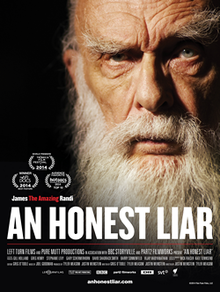
AN HONEST LIAR

Almost certainly my favorite documentary of the year, this clever biopic details the remarkable life of James Randi, both as one of the US’s premier illusionists (a job he describes with the title -- he’s being paid to trick his audiences) and subsequently as one of its premier skeptics and debunkers. Randi (now 87) is a spirited, funny figure, and his life has been chock full of landmark feats in both his careers, though the movie leans towards his later years -- most notably, perhaps, in his epic takedowns of charlatan faith healer Peter Popoff and self-proclaimed psychic Uri Geller. But the movie (perhaps even unexpectedly to the filmmakers) picks up a more interesting thread as it goes along. It explores the contradictions inherent in a man who devoted the first half of his life to great trickery and the second half to exposing frauds, and finds that truth might be a slightly more slippery concept than Randi’s dogmatic skepticism easily allows. Using Randi’s own surprising and sometimes tragic life, they gently imply that maybe people want to be tricked, even need to be tricked, and explore a surprising ambivalence about whether or not this is a tragic flaw or a survival mechanism. How honest do we dare be, about anything other than the fact that we prefer a comforting lie a lot of the time (and that, only when we’re not busy lying ourselves)? Though the film (rightly) has a lot of admiration and love for the lively septuagenarian, it perhaps finds its most interesting insights in interrogating his worldview a little. Like 2012’s Ricky Jay doc DECEPTIVE PRACTICES, it is this lightly philosophical turn which subtly transmogrifies what was already a riotously entertaining journey through a colorful life into something a bit more substantial. AN HONEST LIAR is just as funny and delightful as its central character, but it’s also an unexpectedly moving, thoughtful film, especially for what is essentially a talking-heads clipshow until near the end. Worthwhile even for those who would not consider themselves fans of Randi, but especially essential for anyone who already loves him.


Drama

TIMBUKTU
In Timbuktu, Mali, Jihadist invaders take control and impose a strict, fundamentalist Islamic law on the locals.* That sounds about as grim a scenario as one could imagine, but  Mali-born, Soviet-educated, and France-based director Abderrahmane Sissako (who, I would guess, is no stranger to cultural conflict) examines the scene with a more nuanced lens than one would expect. Rather than a misiberalist drama, it plays out as an darkly absurd parable, full of flawed but likeable characters and tragicomic slice-of-life sketches (boys play soccer with an imaginary ball after sports are banned, a young jihadist sneaks a cigarette when his boss is away). It has a few moments of gut-wrenching brutality (a couple deemed to be adulterous are buried up to their necks and stoned) but mostly avoids the obvious villainous jihadi cliches you are probably expecting to see, instead merely observing the dissonance between the complex, diverse local culture and the harsh new regime. Rich, closely-observed details provide much of the film’s power: sometimes, they’re mechanical (the newcomers don’t speak the local language, and translation can be a crucible of misperception) other times deeply human (a jihadi commander confesses to his translator how bad he feels about sentencing a man to death, but does it without changing his demeanor so the condemned man won’t realize it) and still others mysterious and surreal (a minor conflict between two characters inexplicably escalates into murder, silhouetted against a sunset-soaked river, in what might be the single most stunning image of the whole year). The film isn’t big on narrative or exposition, instead simply pointing a roving eye at the human side of the headlines. It’s not a film that feels like a righteous declamation, nor political rabble-rousing  --it cares far too much about these people to ever use them as props-- but nonetheless it makes for completely absorbing cinema. Even at a brisk 96 minutes, it feels expansive, unhurried, and completely confident in its unique blend of beauty, humanism, and bleakness, and frankly now that I’m writing this, it was a terrible mistake not to include this in my top 14. Only the somewhat truncated climax holds this one back from being a masterpiece of the highest order; and even at that, it’s an absolutely unmissable experience and a desperately needed perspective on the world that probably only Sissako could have provided.


*This happened in 2012, but I never heard about it. Looks like it’s over now. I always like it when I find out about a problem and then immediately learn it’s already been resolved. Feels like progress.


MAPS TO THE STARS
I would never have figured David Cronenberg for a “burn, Hollywood, burn!” type, but MAPS TO THE STARS is about as savage a condemnation of callow tinseltown vanity as, uh, tinseltown has yet been able to produce. Working with a fine cast and a nearly 20-year-old script (?!), Cronenberg trots out the usual assortment of delusional Hollywood phonies and pathological egomaniacs --most notably a 13-year-old Bieber-esque fame monster played by Evan Bird (CHAINED), his TV-shrink father (John Cusack), a desperate fading starlet (Julianne Moore), and her mysterious new assistant with the burn scars hidden beneath long gloves (Mia Wasikowska)-- and, at least initially, this seems like the conventional sort of vicious Hollywood satire, the kind they’ve been making since at least SUNSET BOULEVARD. Well, except for the satire part. That may have been how it was written (and certain parts are broad enough that I suspect it was), but it doesn’t play out like that at all. Instead of black comedy, the tone is one of icy, mysterious dread, perpetually circling but never quite becoming out-and-out horror. There’s a mystery at the heart of the plot, and as it unspools the characters get somewhat more complex --if no less broad-- sometimes with genuinely surprising results. Excellent performances abound (particularly Moore, who plays her deluded has-been character with a withering abandon) and combined with the tone and the strange asides to the 1942 French poem Liberté, the net result is that in spite of all the familiar digs at LA phoniness, the movie is more a rumination on ego and identity than yet another masturbatory Hollywood in-joke. It suffers from some structural problems, but like all of Cronenberg’s work, there’s something too perverse and compelling lurking here for you to dare lose interest. A strange, off-kilter, and subtly unnerving story, even by Cronenberg’s usual standards.


ABOUT ELLY
This Iranian film from Asghar Farhadi (A SEPERATION, THE PAST) actually came out in 2009, but it didn’t make it to America til 2015 (thanks, Obama!). But it’s just as well, because in 2009 I wouldn’t have known to take a chance on it, but after the masterful THE PAST in 2014, Farhadi has a much-coveted free pass with me, where I’ll see anything he does. And that’s working out great so far, because ABOUT ELLY is another terrific work. Just like THE PAST, it’s fundamentally a tense drama about the personal dynamics of a small group in an isolated place, but with an unassuming gilding of mystery thriller. A bunch of pretty, wealthy young people sharing a beach house are thrown into chaos when the titular Elly -- who none of them know very well -- mysteriously vanishes. In her absence, the group tries to figure out what to do, and what happened, and, for that matter, who Elly really was. What follows is a sharp examination of group dynamics in a stress situation, coupled with an intriguing and subtle examination of how we imagine identities for others. Tense and existential without losing its sense of intimate realism.


CAROL
A Sumptuously filmed, vividly acted drama about a burgeoning lesbian affair in the spirit-crushing 1950’s. Just as weepy as you’d want it, but fortunately the movie offers characters a little more complex and interesting than your standard tearjerker melodrama, and Cate Blanchett and Rooney Mara are more than up for the challenge. Unfortunately Mara’s repressed, mousey character has the more interesting arc (Blanchett’s story gradually devolves into a standard custody battle with her frustrated, vindictive husband) but the movie never quite comes around to letting it play out. It seems to want to push a true-love fairy tale which doesn’t seem to really make sense in the complicated, messy world it depicts. But whatever, the story’s as lugubrious as it needs to be, and the experience of watching it is sensuous and captivating.

THEEB
This Jordanian film finds a young Bedouin boy unexpectedly plunged into the chaos of WWI when a British officer enlists the help of his family. What starts off a sweeping adventure tale (capturing the unassuming magnificence of the Jordanian desert with an unsentimental realism) quickly turns into violence and danger, but the movie resists easy genre classification. It has moments of blistering intensity, but mostly focuses on capturing the quiet moments in-between the action. It’s slow, contemplative, and doesn’t go at all where you expect, all while portraying both a time and place we almost never get to see on the big screen with precision and nuance. Maybe a little too shy about cheap thrills for its own good, but even so, it’s a fascinating, deeply engrossing little movie.


BRIDGE OF SPIES
Ho-hum, another perfectly tailored, effortlessly gripping, and meticulously crafted crowdpleaser from Steven Spielberg. I’m really getting sick of him making such consistently technically masterful, irresistibly engaging movies. And it’s getting easy to take them for granted, especially when he tends towards such middlebrow, mainsream-prestige subjects so much nowadays. But if anyone but Spielberg had made BRIDGE OF SPIES, I feel like people would have been blown away by how pitch-perfect it is; it’s absolutely wall-to-wall packed with wonderfully endearing performances, witty, literate conversations, and gripping suspense sequences. But even more than that, it’s a movie which is surprisingly unafraid --in its middlebrow, mainstream-prestige sort of way-- to genuinely tackle some big issues about the Cold War mindset in specific and the legitimacy of American exceptionalism in general, without getting overtly sanctimonious about it, or ever letting up, even for a second, on its relentless desire to keep you entertained. The one sour note is Thomas Newman’s pushy score, which lays it on way thicker than is needed when the acting and filmmaking are this strong. If Spielberg has any weakness at this point in his career, it’s probably that his mastery of the artform is so complete that it probably benefits from restraint more than excess, and he doesn’t always quite have it in him to dial it back when he can overwhelm with sheer force. Even so, BRIDGE OF SPIES represents the very best in respectable, mature mainstream filmmaking and we’d be fools to take it for granted.

LOVE AND MERCY
Ugh, Musician biopics. Here’s a good idea: let’s depict an artist who is recognized specifically for their unique voice and inimitable performance style, and then have someone else do it. I’m sure some actor can do just as good a job with that. And also, if we could get a side dish of one traumatic event from their childhood which totally explains everything else that happened in their life, that would be great, too. Oh, and if you could just string together a long series of recreations of times when they did stuff and dramatize every major event of their whole life, I also think that would really help us understand them so much better. So LOVE AND MERCY was a tough sell for me, but it turns out it avoids most of the usual biopic cliches by a) using the original music, not trying to recreate it, and b) focusing exclusively on two points in troubled Beach Boys singer/composer Brian Wilson’s life: first, the creatively rich but psychologically destructive experience of creating Pet Sounds in 1966, and second, his efforts to escape the control of tyrannical, exploitive “therapist” Eugene Landy in 1986. The two stories are loosely interwoven, but as much as I like John Cusack and Elizabeth Banks in the ‘86 segments, Paul Dano as the younger Wilson in his Pet Sounds days is absolutely marvelous, funny and frustrating and eccentric and loveable, making Wilson’s essential strangeness into a fully realized character, not just a symptom or suite of actorly tics. Director Bill Pohlad (mostly a producer up til now) instill the experience with just enough sun-soaked stylization to allow a little subjectivity to peek through, but really it’s Dano’s show here, everyone else is just along for the ride. What emerges is not so much a biopic as two snapshots of a tortured genius at two very distinct moments in his life, and they’re both so rich with Wilson’s strange, tragicomic charm that you could completely forget that all this is supposed to be some silly prestige picture at all.


BLACK MASS
Johnny Depp is every bit as good as you’ve heard here, playing the ice-cold gangster James “Whitey” Bulger with a truly devilish intensity unlike anything you’ve seen him do before. But you know Depp is good; he’s always gonna be good, it’s just that sometimes he’s good in the wrong way for a movie, or just in the wrong movie, period. What makes BLACK MASS work isn’t just that Depp is great, it’s that director Scott Cooper (CRAZY HEART) and writers Jez Butterworth (EDGE OF TOMORROW, GET ON UP) and Mark Mallouk (nothing) actually craft a movie around him which is good enough to deserve it. Depp gets the showiest role, but the filmmakers do a fine job of crafting a long and multi-year crime story into an actual workable narrative, putting the conflicted FBI agent John Connelly (Joel Edgerton) at its center as a means of examining the worrying overlapping worlds of law enforcement and organized crime. Edgerton is great too, though in a less flashy sort of way, and a strong cast of seasoned character actors make sure the somewhat tired crime epic procedural side has plenty of vitality. The script’s ability to hew a functional narrative film out of so much sprawling historical material is quite impressive, and with Depp’s menacing presence dominating the film even when he’s not on-screen (which is surprisingly often) it zips along through 122 minutes with a commendable urgency. The only thing which holds it back from true genre greatness is it’s somewhat disappointing lack of style; Cooper and cinematographer Masanobu Takayanagi cultivate a very naturalistic look for the film, which worked nicely for the other Takayanagi-shot, Boston-set multi-year crime ensemble this year (SPOTLIGHT) but feels a bit flat here, considering the somewhat more intense, exaggerated characters and the greek tragedy Connelly’s character arc eventually takes him through. Still, I fucking love gangster epics, and this is one of the best in years, maybe since the MEREINE films.  

PHOENIX
In postwar Berlin, a Holocaust survivor with a new face must pretend to be a stranger in order to get close enough to her grifter ex-husband to find out if he was the one who betrayed her to the Nazis. That’s a classic noir plot if I ever heard one, but in the hands of German director Christian Petzold (2012’s BARBARA) it doesn’t quite play out that way -- it’s more repressed drama than white-knuckled thriller, perhaps not entirely to its benefit. But then again, I can’t argue that it doesn’t work; Petzold is comfortable enough with the inherent and inescapable tension of the premise that he doesn’t need to push the point and can just linger on the complex emotions at play here. And complex they are -- Nina Hoss (A MOST WANTED MAN) gets a role about as nuanced as any actor could ever hope for, playing many layers of hidden meaning with each subtle change of expression, and it is through her that we try to interpret her husband’s ambiguous motives and character. I’d probably have preferred a more stylized, classic noir take on this somewhat outrageous premise, but there’s not denying the power of the film as it is. And the ending, when it comes, is a thing of such absolute perfection that I cannot find it in my heart to offer any equivocating criticism of the film as a whole. Petzold obviously knew where he was going, and while I may have had my doubts here and there about his methods, I can’t argue with his results. That last scene is as spellbinding a bit of cinema as you could ever hope to see.


Also mildly worth watching, but not good enough to warrant a whole review, except for the ones I already reviewed:
The Hallow (actually this is pretty good, I don't know why I didn't put it in my Horror Best Of. But too late now. Just read the full review, I liked it).
Straight Outta Compton
I dunno, I guess Trainwreck? I like Basketball cameos.

AND THAT'S IT! That's all she wrote, folks! Back to your regularly scheduled horror programming next, and thanks for playing The Subtlety Guide to Shit You Should Have Seen in the Year of Our Lord, 2015!

Wednesday, November 28, 2012

Blood and Donuts

Blood and Donuts (1995)
Dir. Holly Dale
Written by Andrew Rai Berzens
Starring Gordon Currie, Justin Louis, Helene Clarkson, David Cronenberg


    BLOOD AND DONUTS is a well-meaning little Indie horror/comedy out of the 90s, which is pretty much shorthand for saying it’s ambitious but full of stilted, forced wannabe-Tarantino dialogue and filmmaking which ranges from adorably inept to unwatchable. As discussed previously, the 90’s were indie filmmaking’s awkward teenage years, as wannabe auteurs took inspiration from Tarantino and Kevin Smith, got together some local actors and a few hundred bucks, and made their ambitious dream projects that the studios would have laughed out of the room. They could be the next Tarantino or Smith! Of course, they wouldn't be, oh God, not at all, not even close. But no one had the heart to tell them that. So stuff like this got made.

    It’s not all bad in this case, though. It has a kind of nifty setup, even if it doesn’t do much with it. Seems a vampire named Boya (Gordon Currie), depressed with life, crawled into a burlap sack in 1969 and stayed there until awakened by an errant golf ball in 1995. The opening credits, where a golfer (Cronenberg? Looks like it might be) slices a bunch of (CG) balls at the screen makes it seem like it’s going to be A) a wacky comedy and B) in some way about golf, but neither is really true. Instead, the newly reanimated Boya wanders around, stays out of the sun, and gets involved in the lives of a idiot taxi driver named Earl (Justin Louis) and an I-guess-considered-hot-in-1995 24 hour donut retailer (Helene Clarkson). It’s mostly an indie drama with a few chuckles here and there, a bunch of self-conscious monologues (you know, like Tarantino would do!) and a vampire who doesn’t drink blood. No horror here whatsoever, except that it’s a vampire. So actually, it’s kind of a proto-TWILIGHT but with moderately attractive Canadians and some minor traces of a human soul. 


Jennifer Connolly called from 1987, she wants her eyebrows back.

    Currie is actually pretty good as Boya, coming across as endearing, sad, and appropriately idiosyncratic (the guy has spent 40 years in a bag, after all) but Louis, as cab driver Earl, is disastrously unfunny. There’s a running discussion on IMDB about what kind of accent he’s attempting: Bad Christopher Walken? Bad Robert De Niro from TAXI DRIVER? Bad Eastern European? Bad Quebecois? Hard to tell, but you’ll notice they all have something in common*. Earl is in a bad way with the local Toronto mob (wha?), and it’s up to Boya to save him, but Earl is such an annoying moron that you never feel very inclined to support Boya’s misguided quest to save this jackass. Especially since David Cronenberg, at his most monologue-indulgent, is the mob boss Earl owes money to. And unfortunately, that’s the crux of the drama, since even though Boya mildly romances the donut girl, there’s not really any conflict there. A more interesting subplot involves Boya’s ex, who’s been waiting for him for decades and, faced with the prospects of getting old, is not taking "no" for an answer. It seems like that one is going someplace interesting that might explore the basic sadness of it’s premise, but no, it just peters out so we can learn if Earl is OK.

The movie tries for some genuine drama, and Boya is good enough to almost sell it, but frankly the whole thing is narratively nonexistent and consequently any attempt at drama is mostly unearned and unsuccessful. Cronenberg (in one of his rare acting roles) has some fun with his kooky speeches about boots, but he’s only in a few scenes and turns out to be pretty unimportant to whatever plot ends up sneaking past all the hip monologues. Most damningly, the film is mostly set in a 24-hour coffee and donut shop which frankly is the single most unconvincing set I’ve ever seen in a movie. Maybe in Canada your donut shops look like enormous empty warehouse** soundstages with a tiny counter at one end, but here in America it would be ridiculous to pay that rent on a donuts-and-coffee budget. Especially if you’re gonna do it 24 hours. Where the fuck are they even baking these donuts, since there’s no kitchen or bakery to be seen? I was OK with tormented hundred-year old vampire and was even willing to tolerate the terrible Christopher Walken accent, but this crosses the line.  

*Fittingly, it seems like Justin Louis, so terrible in this, would go on to be the most successful actor in the cast, going on to appear (briefly) in THE DAWN OF THE DEAD REMAKE, Breaking Bad, and even SAW IV (Whoever “Art Blank” was, I can’t remember if he was important). Director Holly Dale wouldn’t do any more movies, but would go on to become a prolific TV director.

**I initially misspelled this as "werehouse", which suddenly gives me a great idea for a better horror movie.


CHAINSAWNUKAH 2012 CHECKLIST!

LOVECRAFT ADAPTATION: No, unless he wrote a vampire romantic comedy I'm unaware of.
BOOBIES: None. Although Boya is pretty ripped and spends quite a bit of time in the bathtub. Into melancholy hardbodied Canadian vampires? Christmas just came early.
> or = HERSCHELL GORDON LEWIS LEVEL GORE: Massive slaughter of rats, pigeons, bats. Not so much for humans.
SEQUEL: No.
OBSCURITY LEVEL: Mid-High, Indie Canadian 90's fare.
MONSTERS: No.
SATANISTS: No.
ZOMBIES: No.
VAMPIRES: Yes!
SLASHERS: No.
CURSES: No.
ALEX MADE IT THROUGH AWAKE: Hmm... I think so.