Showing posts with label 2019. Show all posts

Wednesday, April 27, 2022

Jacob's Ladder (2019 remake)


Jacob’s Ladder (remake) (2019)

Dir. David M. Rosenthal

Written by Jeff Buhler, Sarah Thorpe, “story by” Jake Wade Wall, Jeff Buhler, based on a screenplay by Bruce Joel Rubin

Starring Michael Ealy, Jesse Williams, Nicole Beharie


Since the original JACOB'S LADDER is one of my very favorite horror movies of all time, I can't say I approached this (loose) remake with a lot of optimism; more like morbid curiosity. Unfortunately it doesn't even offer much to be morbidly curious about. It's not bad so much as it fails to ever be even a little good, and the ways in which it fails to be good are mostly pretty boring. It's rarely outright incompetent, but at the same time there's just no evidence whatsoever that anybody involved wanted to be here or had any clear idea why it would be worth telling this story other than to ride the coattails of a more famous movie which still isn't even that famous.


That is, anyway, the only reason I can think of that this would be called JACOB’s LADDER. It vaguely echoes some plot elements of the original –the titular Jacob (Michael Ealy, MIRACLE AT ST. ANNA) is an American soldier back home after a foreign war (Afghanistan rather than Vietnam) and gets mixed up with an experimental drug that leads him into a paranoid, hallucinatory journey. Similar enough that you’d probably notice, but not specific enough that they’d have to worry about lawsuits if they just ripped it off. But let’s be honest here, it’s not like someone came up with a brilliant story and just later realized it kind of superficially resembled the scenario for a cult flick from 1990. Obviously somebody picked up the rights to the remake, grabbed some gigging writer (Jeff Buhler, already responsible for THE GRUDGE REMAKE [2020] and PET SEMETARY REMAKE and the screenplay for MIDNIGHT MEAT TRAIN and THE PRODIGY and recently STUDIO 666) and said “write a story we can title JACOB’S LADDER so that a small percentage of people will watch it thinking it’s the good version, and a handful of horror die-hards will check it out due to a sense of morbid curiosity.” And then when they needed re-writes and the original guy didn’t want to bother, they handed it to a personal trainer or niece or somebody that the producer knew (Sarah Thorpe, no other credits) and just said “try and cut out the stuff that sounds expensive.”


This is not the type of scenario that one could reasonably expect to produce great art. But it could still probably be better than this. Mostly the movie as a whole is just sort of drab and pointless, but I guess the script is maybe weak enough to qualify as outright bad, although in a bland way rather than an exotic one. The story itself is built around a pretty tepid mindfuck (and pretty nonsensical should you be inclined to try and ask pissy questions like "wait, if that's what was happening, what have I been watching up til now?") though at least it's a different mindfuck than the original. (I said "different," not "better" although I'll readily admit that the twist in the original is the worst thing about it). The fact that it's very stupid is a problem for a movie this relentlessly dour, but the bigger problem is more fundamental: it fails to ever establish a convincing baseline reality --starting with Jacob and his wife’s (Nicole Beharie, SHAME) pristine, antiseptic home with its demure, compliant newborn (!) who cries exactly once and never while anyone is sleeping-- which renders its later attempts at surrealism a dismal nonstarter. Can't disrupt reality if I never for one second believe in these characters even at their status quo.


And it doesn't get more convincing as the situation escalates. Early on, Jacob watches as his brother Isaac (Jesse Williams, CABIN IN THE WOODS --yes, their names are Jacob and Isaac) dies in front of him. Years later, Isaac turns up alive, apparently within walking distance of Jacob's house! And Jacob's response is... mild surprise and annoyance? He basically just drops him off at his house and goes about his business. At no point does he or his wife freak out or seem to find this shocking and inexplicable and demanding of answers. He mumbles something that the paperwork must have gotten mixed up and that's that. And Ealy (who I consider to be a terrific actor, but obviously needed a little more direction here) doesn't help matters with his disappointingly tepid performance. Very quickly, this guy is experiencing totally insane shit, and his reaction never seems to rise above "mildly perturbed." I'm sorry, but putting a five-o'clock shadow on Michael Ealy does not make him look tormented, it just makes him look hotter. And he's already borderline too hot to take seriously in the first place.


So yeah, it's a bad script, but it's at least committed to its dumb twist, and could, maybe, have been salvaged by some real directorial flair. But if any director was going to be able to pull that off, David M. Rosenthal --who must be a real charming guy, considering how often in his career he's been able to pull amazingly overqualified casts for completely anonymous DTV genre fare-- ain't the one to do it. The original JACOB'S LADDER is a masterclass in gritty, nightmare-fueled paranoia; this has a perfunctory sort of visual slickness that makes it feel like a gloomy car commercial, and the best it can manage in the nightmare department is that lame thing where someone's face will suddenly distort into a SCREAM mask and they’ll shout "boo!" (a trick I was already mocking as shamelessly unimaginative back when DEAD BIRDS did it like a thousand years ago). Creating a paranoid thriller is all about using the tools of cinema to create a heightened, anxious mental state, and this is just utterly, woefully unable to do it, instead drifting between hacky jump-scare scenes and languid, clunky backstory which is so rigidly built to service the goofy twist that the movie can barely even pretend to be a straight horror movie. Its problem isn't really that it's a lunkheaded cash-in trading on the good name of a classic; it's that it's just kind of boring.


Props for the scene near the end where he has sex with the Angel of Death, though. If the whole thing were that eccentric and melodramatic, we might actually have something here.


Friday, June 19, 2020

Dumbo (2019)


Dumbo (2019)
Dir. Tim Burton
Screenplay by Ehren Kruger, Based on Disney's DUMBO by Otto Englander, Joe Grant and Dick Huemer, which in itself was based on Dumbo, the Flying Elephant by Helen Aberson and Harold Pearl
Starring Colin Farrell, Nico Parker, Michael Keaton, Danny DeVito, Eva Green, Alan Arkin

I was going to begin by saying that 2019’s DUMBO takes Disney's recent "why does this exist?" energy to bold new heights, but I guess that's not really true; nothing could have less reason to exist than a scene-by-scene photorealistic LION KING remake, and that’s still too traumatically fresh a memory to ignore. We’ve already reached rock bottom, no need to indulge in any more hyperbole than necessary. But just because kicking you in the balls is clearly preferable to shooting you in the face, that doesn’t make the former commendable behavior. DUMBO may not be a harrowing, soul-churning pinnacle of anti-art the way LION KING 2019 –good God, they came out the same year—was, but it has a different kind of "why does this exist" cloud hanging over it, avoiding Disney's recent fetish for grotesquely tarted-up slavish recreations of their beloved animated classics… by instead throwing out virtually every single part of the original movie which bears the same name and replacing it with --well, not quite a new movie, exactly, because despite adding a second, comfortably feature-length scenario to the runtime, the new material isn't anywhere near cohesive enough to call a "movie" in its own right-- but certainly a whole lot of new stuff.

The "new stuff" consists of basically everything apart from the concept of a flying baby elephant named Dumbo who resides in a circus and is separated from his mother. Anything else from the original DUMBO –for example, original surrogate protagonist Timothy the mouse-- is included here only in the form of stultifying throwaway references, often hitting exactly that sweet spot of being far too emphasized to ignore, but having no meaning whatsoever outside their reference to the original film. Which mean that if you haven't seen 1941's DUMBO, this movie will be a baffling puzzle of inexplicable and meaningless visual cues.* But if you did see 1941's DUMBO and enjoyed it, you are now stuck with a movie that has functionally almost nothing in common with it, but insists on constantly reminding you of it. Cool.


The setting for the 2019 version remains the same as its predecessor, albeit with some odd added specificity. As before, we are introduced first to a rag-tag circus embarking on a tour of the American South at the end of World War I. This particular interwar American South, you will quickly notice, is very pointedly a land of harmonious integration and racial diversity, where an interracial family traveling by rails might receive a hearty handwave from the simple white farmers working the fields they’re passing by on their way to perform in front of a merrily heterogeneous audience which has apparently never known division along lines of gender, race, nationality, religion, or economic status. This is a little jarring, needless to say, but after some reflection, I’ve decided that it was ultimately the right approach, at least if we assume that this all absolutely had to be set in 1919 for some reason. You’d be entirely justified, were you so inclined, to slam it for whitewashing the brutality of segregation and Jim Crow, but hey, this was always fantasy – might as well be everyone’s fantasy. Once you’ve committed to “flying elephant” as a premise, I think it’s safe to say you’ve bought yourself sufficient distance from reality to be absolved of responsibility for hard-hitting journalistic accuracy, especially in service of broadened approachability. Or at least, I thought so until the movie arrived at its final act and decided it had some very serious thoughts on the morality of keeping animals in the circus. So, no problem brushing aside a century of brutal racial oppression in the name of fantasy, but cruelty to performing animals is just too pressing an issue to stay silent about. Got it.

At any rate, after a very leisurely scene-setting, our story starts to get going with the birth of the title character, a little elephant with gigantic ears which for some reason everyone considers a hideous, unspeakable deformity which brands him forever a freak and an outcast. Maybe because they never invented racism in this alternate reality, people are just real assholes about ears instead, I dunno.

Of course, he is a freak and should be cast out, but not for his ears. I mean, look at this fucking abomination:


This goddam thing looks like a baby C’Thulu cosplaying as Robert Blake’s character from LOST HIGHWAY. It reminds me of those grotesque “realistic” renderings of The Simpsons or Spongebob or what have you. This character design was all well and good in the squishy abstraction of cartooning, but you rip it, against God’s will, off the page and into the photorealistic real world, and you’ve got an unholy nightmare on your hands. Maybe COOL WORLD had a good point about keeping the ‘doodles where they belong.

Fortunately for the little freak, children can’t recognize the face of a Lovecraftian blasphemy when it’s staring right at them with its hateful squid eyes, and “Dumbo” finds allies in two hardscrabble circus urchins, siblings Milly (Nico Parker, giving a performance which cannot be described without the words “affectless automaton”) and Joe (Finley Hobbins, who the movie is so actively disinterested in that I frequently forgot this character existed while he was on-screen). The children discover Dumbo’s amazing power of flight (a feat of fanciful delight in the original cartoon, and a source of profoundly disturbing wrongness when translated to weighty, high-definition photorealism) which drags the young pachyderm from despised outcast to celebrated circus star.

So far, so good; sounds basically like the story of the original DUMBO with kids subbed for mice, right? And yet, while all of that happens on-screen, the above description doesn’t really accurately describe the movie, because it makes it sound as though this is Dumbo’s story. That would be a perfectly reasonable assumption to make, considering the title and the source material, but that is not the movie we have as a subject here today. You see, in a baffling feint towards gritty realism for a movie which --I feel I must stress this point-- features a flying elephant, Dumbo and his fellow circus animals do not talk or appear to experience any emotional state beyond what would be expected for an average trained circus animal.** Despite the disturbingly expressive face, Dumbo’s enormous, unnatural eyes stare impassively out from an empty, soulless void utterly alien to any human sensibility, and hence, despite various human characters frequently announcing aloud what his desires and wishes may be, he is really more of a MacGuffin than a character. He’s central to the plot, but more of an object to be acted upon by his human co-stars than a protagonist in any proper sense.

Horrible. Just horrible.


What we need, then, are human characters, and obviously the more the better. What’s that you say, we already have two human children to act as surrogate protagonists, and even one of those two is flagrantly unnecessary? No no, I mean celebrity human characters. We’re trying to spend 170 million bucks here. What’s that you say, there’s no possible artistic purpose in adding extraneous adults to this already entirely self-contained little fairy tale? What is this “artistic purpose” you speak of?

Therefore to fill the absolutely unavoidable storytelling necessity of having at least three A-list names printed on the movie poster, the simple story of talking circus animals trying to reunite an outcast baby elephant with its mother has been larded up with about 90 new humans (we do not, if I recall, see a single human face in the original DUMBO), all of whom must be given something to do (because they have no obvious purpose in the story as originally conceived) and yet not quite enough to do to  constitute an "arc" for any of them. Therefore recoil in horror as Colin Farrell, Danny DeVito, and Michael Keaton are dutifully trotted out for no clear reason, all giving career-worst performances while at the same time giving the distinct and worrying impression that they're trying very hard.*** They’re eventually joined by Eva Green, who manages to maintain her dignity rather better, and considering she must endure the mortifying indignity of being CGI'd onto the back of a flying baby elephant, this may be evidence that she is the greatest thespian who ever lived. Alan Arkin also appears in three scenes and so openly doesn't give a shit that you've kind of got to respect him for it. Sometimes being a pro means making a sincere effort regardless of the circumstances… but sometimes it just means recognizing a hopeless cause and giving up gracefully. Look, he set his margarita down for the take, what more do you want?   

The movie, alas, is too brain-dead to be able to follow Arkin’s example. Consequently, an absolutely exhausting amount of time is taken to establish each of these characters, even though only one has any narrative purpose whatsoever. Or, rather, only one is so completely extraneous to the original plot that establishing him essentially drags the movie in entirely new direction, thus creating a new narrative purpose for the character to fulfill. You see, once the movie has dutifully plodded through every single plot point from the original DUMBO, minus any part where animals talk or racism is happening, we’re still barely even sitting at the 40-minute mark. Now, the original DUMBO is only 62 minutes, but remember, we’re trying to spend $170 million here, and are therefore contractually obliged to pile as many convoluted plot points as money will allow into an appalling snake’s nest of wriggling chaos. That’s the law. And so, out of the blue appears Keaton, as a flamboyant, rapacious capitalist who buys the circus and immediately sets to work exploiting his star attraction, sadistically endangering his human employees, and eventually just straight up announcing that he’s going to murder Dumbo’s mom for absolutely no reason whatsoever. To accomplish these goals, he essentially kidnaps the entire cast and forces them into servitude in his garish, art-deco dystopian theme park known as “Dreamland.”


Savvy viewers will quickly notice that not a single detail of this has any relationship whatsoever to the 1941 movie DUMBO, which doesn’t even have a central villain character and is more about the generalized cruelty and randomness of the world. This is, then, basically a movie and its demented sequel uncomfortably shackled together roughly halfway though, as if somebody had edited BABE and PIG IN THE CITY to bare-bones shells, chopped the credits off the former, and then run them back to back as one movie. It’s deeply weird storytelling, but at least once Keaton appears the movie finds some focus; absent any kind of identifiable protagonist, it locates in its antagonist at least some measure of organization which utterly eludes it during the opening 45 minutes of wheezily recycled non-story. That doesn’t make it good, because it’s nothing of the sort, but at least it’s not quite so shapeless and inexplicable.

Speaking of the villain, what are we to make of the fact that, with his flashy showmanship, single-minded reckless ambition, and ostentatious theme park (complete with Epcot-center-esque “City of Tomorrow!”) this despicable sociopath is an unavoidable analog for Walt Disney himself? The comparisons are far too specific to even entertain the idea that this is not where the movie wants us to go, but why does it want us to go there? Is this some kind of sniveling JURASSIC WORLD-style apology for the tortured needlessness of the thing we’re watching, couched in ironic self-awareness? Is writer Ehren Kruger (damned forever for his part in writing three of five TRANSFORMERS films, and also producing the spectacularly moronic DREAM HOUSE, which is maybe even more embarrassing than having written it, though at least he can hold his head up with pride as the scribe of RENDEER GAMES) possibly deluded enough to believe this is somehow subversive? Or should we just consider this a tortured cry for help from the subconscious of Tim Burton, who Disney kidnapped and replaced with a TWIN PEAKS evil doppelgänger sometime in the mid-2000s? I’d dearly like to believe in the latter to be the case, but frankly by this point in his career Burton seems to have less in common with the misunderstood weirdos of the circus than he does with Keaton’s mercenary hired goons who happily trot off to murder Dumbo’s mom when their Disney-like boss tells them to, no questions asked.


Indeed, I’ve put off saying so as long as possible, but now there’s no escaping it, so let’s just face facts: Tim Burton is credited as the director here. He’s been in bored corporate lackey mode long enough now that I guess I can’t claim it’s a surprise, but even so, DUMBO 2019 conveys an alarming sense not just that the director’s a bored hack, but that there’s nobody at the wheel at all. Maybe twice in the movie he seems to perk up a little around some of the garish sets of “Dreamland,” but even the circus itself, which seems like the kind of thing Burton should have been able to work magic with in his sleep, is a disappointing nothing, lacking even the flop-sweating overdesign of 2005’s CHARLIE AND THE CHOCOLATE FACTORY and 2010’s ALICE IN WONDERLAND. It’s a dreary, lazily shot-on-soundstages huddle of low, perfunctory structures populated by limply defanged stereotypes whom the movie is far too fretfully woke to allow to lean into their inherent cartoonishness, but also dismissively disinterested in imbuing with any other traits (at least DeObia Oparei, as the circus’ strongman/bookkeeper, gets to make some archly funny faces). The whole thing is then color-corrected into an unsettling alien landscape of not-quite-right chromatic mismatches, where the grass is an odd pine green verging on blue, and the sky is perpetually tinged with an anxiety-inducing orange-red, as if the sun was always right about to set, even when that’s manifestly not the case.

According to the film’s press kit, the production design drew inspiration from the paintings of Edward Hopper, an odd choice any way you want to look at it -- Hopper’s best known work came from decades after the movie’s 1919 setting, and is marked by a spare, quiet sense of modern alienation, making it a baffling aesthetic touchstone for a childrens' fantasy—but made even weirder by the fact that the movie’s nettled plottiness and overabundance of unnecessary characters all but ensures that Hopper’s serene minimalism is entirely out of the question.**** The only way this makes any sense is as an explanation for why Burton’s recent penchant for seizure-inducing overproduction is ratcheted down to simply garish overproduction. It’s depressing possible that this is what Burton believes qualifies as “minimalism” by this point in his career -- although it’s probably a lot more likely that this is just a simple case of barely giving a shit at all, and having his production crew try to run cover by throwing out an aesthetic which wouldn’t be immediately familiar enough for most people to call their bluff.

Let's compare this 1957 Hopper painting entitled Western Hotel...

...to this frame, from 2019's DUMBO. Anybody else not seeing much similarity? 


Which is, ultimately, the real problem here: despite the effortful ponderousness inherent in any movie pushing a 200 million dollar budget, there’s not a single aspect of this that doesn’t seem to be operating on autopilot. At no point throughout the momentum-free 112 minutes***** does the movie ever make even the flimsiest argument as to why anyone thought it would be worth making; there’s nary a character, setpiece, storyline, or sequence that feel inspired by recognizable human interest. The sole artistic inspiration in this entire sorry affair was the marketing departments’ dead-eyed certainty that people will pay to see an insanely expensive iteration of a recognizable brand name. That’s the movie they tasked Burton and co with making, and that’s what they got: a huge pile of busy but meaningless narrative clutter indifferently trying to obscure the fact that this exists exclusively to remind you of that famous thing you’ve already seen. Despite all the added narrative detritus, there is literally no other purpose here, and the movie never even pretends to aspire to any. It is more reference than film.

This tendency reaches its zenith during a little vignette –too insubstantial to call a “scene”—where Dumbo sits in a tent while some clowns blow large, elaborate bubbles in the air while a wordless snippet of the tune “Pink Elephants On Parade” --the big showpiece hallucinatory number from the original (brought to the pinnacle of its form by Sun-Ra and the Solar Arkestra in 1988)-- wheezes over the soundtrack. This all plays out in an entirely literal, straightforward way; there’s nothing subjective of surreal about it, we’re just watching a CG elephant baby watch a mildly impressive circus act set to inexplicably ominous orchestration for a minute or two, while he kills some time. There’s no reason for this to happen; Disney in 2020 isn’t going anywhere near “drunk baby elephant” territory, and it has no baring whatsoever on the plot and is never referenced again.

Now, there isn’t exactly an overwhelming narrative necessity for this sequence in the original film, either, but the reason for including it is immediately obvious: just in the fun of it. It exists entirely for a bunch of hungry, energized artists to indulge in the sheer joy of going hogwild animating a bunch of surreal nonsense. Their delight in it is palpable, and its ability to inspire similar delight has not diminished in 80 years, not due to any quantifiable utility, but entirely because it is a curious bauble, a creation entirely of whimsy.

Again, let's compare.... this still from the original sequence...

... to this one from 2019. Which one of these looks like a human being actually cared about it? 


That is categorically not so in 2020; here, the same basic elements exist entirely to fulfill a rote function… and that function is simply to mirror something else that already exists. There is no whimsy here, no sense of artistic exhilaration; hell, there’s barely even any cynical, pandering calculation. Nobody ever even bothered to ask why. The sequence, like the movie itself, takes for granted the idea that creation and simulacrum are indistinguishable, that the act of evoking is functionally identical to the act of creating. It is, in that sense, very nearly some kind of experimental postmodern gamble that content is completely meaningless in the face of context, challenging us to ask if meaning itself is purely a construct, a function of the viewer’s applied cultural baggage projected not onto the screen, but into our own internal landscape, where it can be given whatever meaning we find useful.

But I cannot concur. A pipe is an exceedingly useful tool, should I fancy a smoke. A painting of a pipe merely reminds me that I want to smoke. One is the inevitable outcome of human ingenuity and desire; the other is an advertisement. It’s why Magritte titled his famous painting The Treachery of Images. The evocation of “Pink Elephants,” and of 1941’s DUMBO more broadly, is equally treacherous here. The images of 2020’s DUMBO might conjure some vague nostalgia for the real thing, but they have no meaning of their own, and they were never meant to. Ceci n'est pas une DUMBO. Ceci n'est pas une film, even. It’s just a very long, very expensive callback. And not even a very entertaining one, at that.

That said, just looking at Dumbo’s awful CGI face for two hours conjured the most raw, primal horror I’ve felt for a movie in quite some time. This isn’t an uncanny valley, it’s the fucking uncanny Mariana Trench. DUMBO 2019 inspires very few emotions other than despairing tedium, but profound spiritual disquiet is a feeling, and if, as is sometimes postulated, the purpose of art is to draw a reaction from the viewer, I guess you could still say that ol’ Tim Burton managed to make some extremely potent art afterall, despite himself. Recommended for fans of ANGST and A SERBIAN FILM and anyone who wants to see just how much implacable, disturbing wrongness they can withstand. Otherwise, you’re better off forgetting this ever existed as quickly as possible. And fortunately, other than some lingering elephant-related nightmares, that shouldn’t be too hard at all.


* Good luck to the new-to-DUMBO kiddies trying to figure out why the plot stops dead for a few minutes to watch an elaborate bit of bubble-art while a snatch of unaccountably creepy music plays in the background. Viewers of the 1941 version will recognize this as a dismal, watered-down tribute to the "Pink Elephants" showstopper in the original, but without that bit of knowledge it must surely seem utterly inexplicable. In fact, it bears such an uncanny visual resemblance to the "Opera scene" in STAR WARS III: REVENGE OF THE SITH (elaborately dressed dignitaries in box seats having a fraught conversation while they half-watch an elaborate 3D bubble show in a darkened, circular amphitheater, with a similar color scheme) that I would not be surprised to learn that this is the more common interpretation of the scene being referenced (there is no way to interpret it as anything but a reference to something, because the movie focuses on it so insistently and yet it has no bearing on the plot or any other context of any kind) so it's simply a matter of whether most audiences will have any reference for it at all.

** I’m aware that Dumbo doesn’t speak in the original either, but having all the other animals speak gives us a clearer sense that these are, to some degree, anthropomorphized surrogates for humans with the kind of fully articulated, complex emotional lives you’d need in order to be, you know, the protagonist of a movie. Here, no such luck; sometimes the humans speculate on what Dumbo must want, but it’s genuinely up for debate if he has any fucking clue what’s happening to him, or any clear opinion about it. This is basically a slightly less sexy THE SHAPE OF WATER.

*** This is a particular shame on the part of Farrell, who actually has a shockingly passable track record of appearing in pointless remakes and giving excellent performances (see FRIGHT NIGHT, TOTAL RECALL, THE BEGUILED). Alas, his morose one-note (or less) blob of a character, combined with a somewhat labored Southern accent, defeats any effort he might be making .

**** It goes without saying that Hopper never painted anything remotely like the art deco futurism which comprises the latter half of the movie, but even the warmer earlier scenes don’t seem to fit at all with his style, except maybe in the sense of the movie’s unusual palette.

***** Psychotically long for an adaptation of DUMBO, but at least it manages to come in under two hours, which was not at all a sure thing given that some of these live-action remakes’ aggressive runtimes are now edging dangerous close to the 130 minute mark


Wednesday, February 12, 2020

Color Out Of Space


Color Out Of Space (2019)
Dr. Richard Stanley
Written by Richard Stanley, Scarlett Amaris, based on "The Colour Out of Space" by H. P. Lovecraft
Starring Nicolas Cage, Joely Richardson, Madeleine Arthur, Brendan Meyer


I was dreading this one just as much as I was looking forward to it, which is always the way I approach a career resurgence by an artist like director Richard Stanley, i.e. an ambitious wunderkind who produced two good-bordering-on-great early works and then dramatically vanished from the scene. That’s about as surefire a recipe to end up over rated as has yet been conceived by man. Nothing drives up an artist’s stock like unavailability; it’s how Jeff Buckley went from being a guy who made a decent folk album to a legendary romantic genius, or how LONDON AFTER MIDNIGHT went from a critically panned matinee flick to the holy grail of lost cinema. Rarely does such a sudden and lengthy departure from the artistic scene reverse itself,* but that is precisely what Stanley has managed, by seizing on his unexpected reemergence in the cultural zeitgeist (brought about by the 2014 release of the documentary LOST SOUL, which depicts Stanley’s disastrous attempt to make THE ISLAND OF DR. MOREAU back in 1996) to mount a comeback. And so it is that Richard Stanley returns from the elite ranks of artists whose legendary status was largely built on unrealized potential, to the more Earthy realm of artists who have to justify their hype by, you know, actually making art.

That’s a dangerous thing for an artist who has quietly built a rather enviable reputation largely around the promise of unrealized projects, which will always remain perfect and pristine, safely locked away in our imaginations. There are any number of ways this can disappoint you. You can discover that, after all this time, the promising young artist was just that – promising, not fully formed, all hype and no delivery. You can discover that the promising young artist really did have something once, but lost it somewhere along the way – lost the fire of youth, lost the touch, just lost interest. Or, even worse, you can discover that the promise was legitimate and the talent is still there, but the time has passed, and something that would have seemed boundary-pushing and exciting in the artist’s heyday now feels dated and played-out. I must admit that I absolutely assumed Stanley’s return to directing** was more likely to fall into one of those many pitfalls than it was to represent a triumphant return to a long-denied cinematic wunderkind.


 Actually neither turns out to be the case, but I'm surprised and happy to report that it's closer to the latter than the former. COLOR OUT OF SPACE*** is not a great movie, but it is quite a good one, demonstrating some real moxie and craftsmanship which mark it as the undeniable work of someone with some real talent, even if a few missteps are made along the way. And frankly that shocked the hell out of me. I was all but certain that three decades in the cold would have left Stanley diminished and rusty if not out-and-out broken, and that’s even that takes for granted his two early-90s successes weren’t a fluke to begin with. I was expecting a latter-day Argento-style disappointment, but COLOR OUT OF SPACE reveals a director as ambitious and gifted as he's ever been. Which is not to say it's a work of untouchable genius or anything, but his two 90's movies were the work of a genre director with real promise. Thirty years later, he's still promising. That's better than I thought I could reasonably hope for.

As the 500 word of preamble make obvious, then, this movie comes with some baggage by virtue of its director, and that's before we even add the extra weight of its star (one-time Oscar winner and beloved internet meme Nic Cage, deep in his direct-to-video rampage) and its source material (H.P. “The Sauce” Lovecraft's genre-defining classic short story of the same title). It buckles under all that weight, of course –it’s hard to imagine any movie that wouldn’t-- but manages to keep from ever completely collapsing, and that in itself is kind of an accomplishment. As a Stanley comeback, it proves he was worthy of our interest, if not our hyperbole. As a Lovecraft adaptation, it's astonishingly good, although in a large part by virtue of the miserable company that descriptor places it in. As a Nic Cage movie... well, that's a little more up for debate, but at least he’s always gonna give you your money’s worth.


Before we get to that, though, we might as well talk about the actual plot. Amazingly, though the story is updated to the present day, this turns out to be a broadly faithful riff on the original Lovecraft story, which recounts the tale of the rural Gardner family, whose lives are thrown into escalating madness by the arrival of a meteor which brings with it an “unknown color” that gradually subverts and distorts the environment, and the bodies and minds of the people in it. You know Stanley really gets Lovecraft because he mimics the author’s characteristic style of writing a story-within-a-story (the original is actually a story-within-a-story-within-a-story, the gripping saga of a guy who interviews another guy about a third guy, but Stanley is content with merely one framing device). The details vary, especially as the movie progresses and gradually pivots towards Cronenbergian body horror, but the essence of the original story is clearly still here, along with most of the major incidents. It is, I would hesitate to say, one of the most faithful Lovecraft adaptations I’ve ever seen, not that it has a great deal of competition in that regard.

Of course, Lovecraft adaptations, even generally faithful ones, are practically preordained to be garbage. But COLOR OUT OF SPACE draws its unusual strength from its atmosphere, cultivated with great care by Stanley, DOP Steve Annis (a music video guy til 2019's I AM MOTHER), production designer Katie Byron (BOOKSMART, FINAL GIRLS) and composer Colin Stetson (HEREDITARY). It adds up to a look and feel which neatly captures Lovecraft's sense of creeping, insinuating wrongness. This is absolutely essential to any prayer of meaningful adapting Lovecraft, and it’s the one thing that virtually every other film version of his work fumbles miserably (including the previous adaptations of this very short story, a 1965 Boris-Karloff-starring AIP production under the dubious title DIE MONSTER DIE and the 1987 Wil Wheaton movie THE CURSE). Even RE-ANIMATOR, arguably the only legitimately good Lovecraft movie ever made, can’t claim that; it doubles down on goopy effects and campy humor instead. Capturing the classic Lovecraftian sense of cosmic, incomprehensible unease is a tough thing to do, but Stanley and company manage it beautifully here, and without even a trace of the pretentious self-consciousness that has defined a lot of modern "post-horror" movies with similar ambitions. In a world of THE VVITCHes and HEREDITARYs, I’d almost forgotten that “heavy on atmospheric dread” does not have to mean “gloomy” and “glacial,” but Stanley keeps things colorful and spritely while managing to work up quite a head of anxiety. It’s Lovecraft distilled through the mind of a distinctly oddball auteur**** (I doubt ol’ H.P. would have thought to introduce our protagonist in the middle of a white magic ceremony as a cute little character detail, or clarify that the hippie holy fool who squats on their property as a cat named “G-Spot”) but it is still very recognizably Lovecraft, a virtue which, despite the virtual cottage industry his work has inspired, almost nothing else can boast.

The movie is also helped quite a bit by a surprisingly fine cast, who vividly portray the family’s gradual slide into dreamy madness while still crafting sharply-defined, likeable --and often quite funny!-- characters. In the Q & A that followed the screening, Stanley mentions that he worked with the actors on their characters’ backstories, which makes sense; even though we get only tiny glimpses into what their lives were like before the events of the film, they feel unusually fully-formed. Even as things get weird, the family dynamic feels complex and lived-in; they seem unusually genuine for a genre movie, convincingly reading as an existing family unit rather than a bunch of body count whose existence is entirely defined by the circumstances of the plot. Madeline Arthur (BIG EYES) as the Gardner family’s teenage daughter and our protagonist, is especially great, managing a character who feels very lively and specific in a way which the movie absolutely does not require, but definitely benefits from. Brendan Meyer (THE GUEST) and Joely Richardson (EVENT HORIZON) do equally nuanced, likeable character work with the older brother and anxiety-fraught mother, respectively.


And of course, you’ve also got the father, one Nicolas Cage. He’s, um, a real character, possibly a little unhinged, given to doing a verbal impersonation of his own father, who all visual and audio evidence suggests was born in, like 1885, despite the movie taking place in modern times. IMDB trivia claims that “Richard Stanley's favorite Cage Movie is Vampire's Kiss (1988), [and] he asked Nicolas to use the same style of performance,” a claim I was initially rather dubious of, until I discovered that Stanely mentions VAMPIRE’S KISS by name in at least two distinct interviews. The finished film mostly doesn’t pitch Cage at quite that level, but it’s definitely a weird performance. And not entirely to the movie’s benefit, in my estimation; he matches, in some ways, the charming eccentricities of the rest of the family, but Cage's now-expected eagerness for full-on mega-acting turns out to be sort of an unhelpful distraction here. It's not a bad performance (it was made worse by my audience, a bunch of hipster douchebags who appear to consider any line that Cage speaks in any movie, regardless of context, inherently hilarious) but it's noticeably a bit broader and more cartoony than the rest of the cast, who are not exactly going for underplayed minimalism either, but who keep their escalating madness a little more grounded and wind up equally impactful but more emotionally effective.

Don’t get me wrong, I like Cage, and you hire him for his mega-acting superpower, obviously. But I think Stanley should have kept a tighter leash on him in this case. It feels like Cage is trying to go over the top, rather than just responding naturally to the insane situation the movie puts him in. It’s an entertaining performance, and Cage is terrific with the script’s dark --but slightly goofy-- humor, but I worry he’s turning into a bit of a parody by this point in his career. Those dipshits laughing at every single thing he said are definitely morons, but I feel like he’s been encouraging them. Of course, this is also his first film in a long time which is actually good enough on its own merits that it becomes a problem when he tries to hijack it with his manic weirdness, rather than a saving grace. So I get where he’s coming from. Still, given how well Stanley does pushing the other actors to equally extreme but less excessive and silly psychological states, he might have been better off finding a normal actor and pushing them out of their comfort zone to go a little mega, as opposed to Cage, who by this point seems like he’s barely able to hold his craziness in check even before the plot starts to take a turn towards the weird.


Anyway, Cage’s performance is an illustrative example of where the movie starts to go a little wrong. Stanely, like Cage, seems maybe a little bit too eager to please for his own good, and towards the back half starts to overplay things a bit. It’s nothing derailing, just a few miscalculations: an eerie scene where the “color” affects a family member is diminished by adding an aggressive lightning strike where a subtle implication would have had more impact, for example. Or a surreal, otherworldly tableau is blown into a gaudy light show, pushing the movie’s special effects a little past their budget for no real advantage. It wouldn’t really be that big a deal –in fact, I’d usually commend a low-budget film like this overextending itself a little in the name of whammy—but the frustrating thing is that, for once, the movie doesn’t need it. It does such a fine job with its eerie insinuations and little glimpses that the more standard effects movie razzle-dazzle actually lessens the impact. The more concrete things get, the smaller the movie feels.

Still, all things considered it's kind of a miracle the movie works as well as it does. The hardest part –the inevitable visualization of Lovecraft's famously unseeable color-- is handled with a nifty effect, a kind of shifting, shimmering pink that looks suitably unnatural. The short story described the titular color as “shining bands unlike any known colours of the normal spectrum,” a pretty tall order for any primarily visual medium (even one with Yog-Sothoth rooting for it), but the flickering, ever-shifting character of the effect suggests, if not a never-before seen color, at least some kind of inexplicable visual phenomenon which is only partially perceptible to the human senses. What we see crucially suggests that there is much more we don’t see, which is a legitimately clever way to tackle this difficult problem with the adaptation, and is, overall, the guiding philosophy behind the whole movie’s strengths, and indeed, of the original story’s strengths, too. Of the dozens of Lovecraft adaptations I’ve seen, this is perhaps the only one that seems to really understand that, and that’s reason enough to be pleasantly surprised.


 It takes ambition to commit to capturing that kind of tone, and that ambition permeates the whole film. Stanley, who is surely more aware than almost any living director that whatever film he’s currently making might easily be his last, isn’t playing safe for a single second here. Not everything pays off (as I’ve said, at times the film might actually benefit from more restraint), but it’s kind of incredible how many dangerously unexpected choices --the stunt-casting of Tommy Chong, the weird pivot to body horror, the flirtation with psychedelia, filming in sunny, semi-tropical Portugal rather than the expected austere New England-- all somehow manage not just to keep from derailing the movie, but to actually strengthen it. All these disparate strengths don’t necessarily cohere into a unified, architecturally strong framework, though many of them do (the film’s pervasive oddball humor, for example, makes for an unexpectedly effective compliment to its lurking anxiety, rather than setting up the tonal clash one might expect), but strengths are strengths, and COLOR OUT OF SPACE has plenty of unexpected ones. Ol’ Richard Stanley might or might not be the great lost genre auteur his legendary rep has made him out to be, but on the strength of this movie, I’d say the possibility is still on the table. And that alone seemed about as impossible as non-Euclidian geometry and unknown colors a few weeks ago. Sometimes raising the elder gods turns out to be a better idea than you might think.


 *One obvious example would be that of Terrance Mallik, who was hailed as one of cinema’s untouchable geniuses during the 20-30 year hiatus between DAYS OF HEAVEN and his resumption of regular releases in the mid-2000s, only to find an increasingly skeptical critical establishment as his body of work grew.
** To be fair, he did do a short segment in the 2011 anthology film THE THEATRE BIZARRE, but it’s so brief (one of six segments in only 114 minutes) that it was hard to tell much from it. He’d also done two well-regarded documentaries –THE SECRET GLORY and THE WHITE DARKNESS in 2001 and and 2002—and gotten a couple screenplay credits in the intervening years. But still.
***

****IMDB trivia: “Director Richard Stanley and Swedish filmmaker Henrik Möller apparently performed a ritual to the Lovecraftian god Yog-Sothoth while in the Pyrénées to get the film made.” Probably not gonna find that one on Spielberg’s page.

Tuesday, November 26, 2019

She Never Died (yes, SHE!)


She Never Died (2019)
Dir. Audrey Cummings
Written by Jason Krawczyk
Starring Olunike Adeliyi, Peter MacNeill, Kiana Madeira, Noah Dalton Danby, Michelle Nolden


I was genuinely surprised when I saw they made a sequel to HE NEVER DIED, the Henry-Rollins-starring cannibal/action/horror/drama/comedy that so unexpectedly delighted me back when I randomly caught it in 2015 during the AFI Spooky Movie Festival. Not that I wouldn’t be up for spending more time with Jack, the immortal, perpetually put-upon bingo enthusiast played by Rollins, but it just seemed like the first film wrapped up so neatly that it didn’t demand any further exploration. It was the first film I’d seen in ages to premise itself upon a J.J. Abrams-style mystery box and then actually have the goods to pay off that mystery with an interesting, satisfying solution – but in doing so, it didn’t seem to leave a sequel with much room for a similar mystery hook. Still, the possibility of kicking around for a sequel adventure with Rollins’ hilariously deadpan weirdo seemed appealing enough – which makes it doubly surprising that he isn’t in it! The fact that this “sequel” even takes place in the same universe as HE NEVER DIED is attested to only obliquely. If it didn’t have that title, I’m genuinely not sure even people who had seen HE NEVER DIED would have put together that this was a sequel, and, in fact, a sequel with some pretty serious and ballsy implications for a franchise.

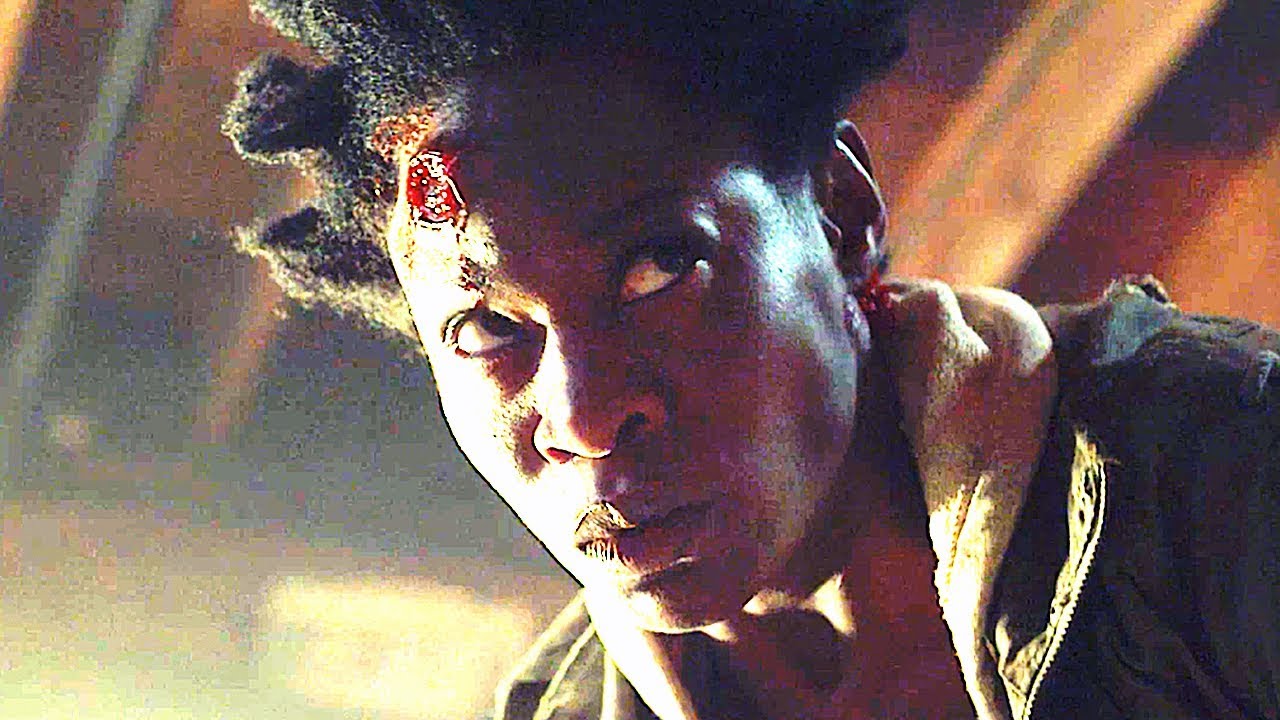
First things first, though: although it will eventually expand the mythology somewhat, SHE NEVER DIED is primarily one of those genre sequels which is essentially a remake and remix of the first one, like EVIL DEAD 2 or FROM DUSK TIL DAWN 3, or SECOND TO LAST TEMPTATION OF CHRIST or FRIDAY THE 13th Parts 2, 3, 4, 6, and 7, and to a lesser but still obvious extent also 5 and 8. Just like HE NEVER DIED, SHE NEVER DIED introduces us to an isolated, socially awkward weirdo who, uh, never died. But, as the title might suggest, it is not the same isolated, socially awkward weirdo, but instead a woman named Lacey (Olunike Adelivi, a surprisingly lengthy filmography including SAW: THE FINAL CHAPTER, THE PRODIGY, and UNDERCOVER BROTHER [uncredited]) who is living as a homeless derelict and moonlighting as a brutal vigilante who stalks the members of a human trafficking ring led by an absolutely magnificent douche named Terrance (a superbly entertaining Noah Dalton Danby, another surprisingly lengthy filmography including DETROIT ROCK CITY, RIDDICK, and EXIT WOUNDS [!]).


If her actions seem very slightly more proactive than Jack’s did, however, her personality is even more reserved. If Jack was utterly disinterested in the world, Lacey seems downright disengaged from it. She has a flat affect and glazed eyes, seems to be completely lost in her own mind, barely even aware of anything around her. When someone talks to her, it seems to take a conscious effort for her to drag herself out of her own thoughts and focus on the speaker. She comes off, in fact, as mildly autistic, not just annoyed by the unwanted intrusion of other humans’ problems --like Jack was-- but genuinely uncomprehending of them. If Jack has isolated himself in a hermetic routine, she has isolated herself within her own mind. Which makes it all the more startling when something finally jars her out of her stupor, and she suddenly roars into a focused, predatory frenzy that is likely to be fatal for anyone around her.

This makes her a harder character to relate to than her irascible, eccentric counterpart in the prequel. Consequently, the movie adopts a slightly different structure from its predecessor, framing the film mostly from the perspective of the other characters who are reacting to Lacey, keeping her at a mysterious distance. Thus, we are introduced to Detective Godfrey (Peter MacNeill, yet another startlingly lengthy filmography, including CRASH [the David Cronenberg one], A HISTORY OF VIOLENCE, REGRESSION) an old police veteran who is worrisomely close to retirement but would really love to finally nail the shadowy syndicate which has been kidnapping people and forcing them into brutal snuff films for a live internet audience. When Lacey crashes one of these films and provides an appropriately gory end for the filmmakers, she winds up on the radar of both the Godfrey and the gang, and things get even more complicated after she's joined by an unlikely sidekick, bubbly chatterbox Suzzie (Kiana Madeira, still another busy filmography, most notably an episode of The Flash) who she unintentionally rescued from a gristly death.


The details may be different, but when you get down to it this sounds like little more than a few cosmetic alterations to HE NEVER DIED; again, you have two acolytes, one chipper and persistent, the other disbelieving but curious, who gravitate to our Never Dyer du jour, while meanwhile an obtuse crime plot plays out in the background and provides some antagonists. But it turns out that even gently adjusting the levels of these elements produces a rather startlingly different effect. Despite a functionally identical plot, SHE feels much more like an ensemble piece than HE did, adopting the point-of-view of multiple different characters as they gradually figure out what Lacey is and consider what they want from her. Refocusing the movie this way is kind of a risky move, given the extent to which HE hung together entirely on Rollins’ great character work and inimitable personality. Fortunately, everybody here turns out to be more than up to the task; I didn’t recognize a single face, but, as you have seen, it turns out the cast is absolutely stacked with venerable Canadian character actors, and all those dozens of cheapie American genre flicks and TV shows that shot there to save money have provided this demographic with enough experience that they’re uniformly ready for their big showcase roles here.

 That they have good material to work with certainly helps; writer Jason Krawczyk brings the same offbeat wit he brought last time around. The characters are broad, but distinct and fun, quippy in that most rare of ways which doesn’t seem derivative of Tarantino or tediously labored. Director Audrey Cummings (DARKEN, TORMENTED), stepping in for Krawczyk while he supposedly develops this as a mini-series(?), manages the tone very nicely, giving the actors plenty of room to play up their colorful characters without allowing things to drift into frivolous, low-stakes comedy. Instead, it has the loose, scrappy energy of a 90's indie caper, chatty and maybe a little more self-consciously offbeat than is entirely good for it, but blessedly free of the relentless high-concept plottiness of the current cinematic era. You could definitely show this along with SUICIDE KINGS and THE BIG HIT and, aside from a few inconspicuous bits of technology, never guess it was made twenty years later. Not that it's in any way a pastiche; it's just a good vibe for this material. Not plotless, but less focused on plot than on hanging around with a bunch of colorful weirdos.

That was true of HE NEVER DIED too, of course, but the emphasis on the ensemble here highlights it even more. In particular, it’s worth pointing out what a tremendous improvement the villains are this time, with Danby creating a sleazeball character who is both utterly loathsome and terrifically entertaining. It turns out his boss is his yuppie sister (Michelle Nolden, CHRISTMAS HORROR STORY, HAUNTER, RED, THE TIME TRAVELER’S WIFE) who moonlights as a sadistic gang leader in-between yoga classes, and who is, if perhaps just a little more cartoonish than the other characters, at least a delightfully hissable villain, and a great foil for our homeless African-American Canadian protagonist. Their flippant, vain villainy got big laughs from my audience (and hopefully gets these actors some bigger parts down the line) but without sacrificing genuine menace or tempting us to identify with them, a subtly tough tone to get right.


 It’s also worth noting the mercifully understated portent of having a homeless black woman fight smug, bourgeois human traffickers; race is never explicitly an issue, but it's hard to ignore the the implications here, especially when they capture Lacey and put her in chains. That uncomfortable image smartly and quietly prompts us to consider a little bit about Lacey’s experience as an immortal. Being an ageless supernatural entity is hard enough on its own (or so I've learned from the endless parade of sad Draculas), but imagine trying it as a female minority! One of the funniest scenes in HE NEVER DIED found Jack offering a comically long list of jobs he’s had over the centuries. He does not describe a life of luxury (it’s a mostly blue-collar resume), but one can’t help but notice there’s no parallel scene for Lacey. It makes me think of Louis CK’s routine* “Time Travel is a White Privilege." Jack may have been miserable, but at least he had options. Black people have had a pretty bad run for a few centuries, especially in the Americas. And being a woman has made things harder pretty much everywhere, since forever. No wonder she seems obliquely unwilling to pay much attention to the world.

This is all left unsaid (to the movie’s enormous benefit); there's only a light suggestion of how enormously alone and beleaguered Lacey must feel, and the movie's focus is squarely on being a feisty, colorful horror/crime flick. Still, there's a unmistakable shadow of philosophical pathos in here, which makes the more familiar joys of supernatural violence hit a little harder. HE NEVER DIED did a magnificent job with this, and Cummings manages that tone at least as well as Krawczyk did, although she doesn’t do much to improve on his cheap-looking, rather style-less aesthetic. No matter; the content is entertaining enough that a simple, unflashy point-and-shoot style gets the job done, making the most of the gritty urban decay of the Canadian locations. In fact, I kind of love that these movies about ageless supernatural beings both take place in bland, run-down Canadian suburbs. I can’t find out specifically where SHE NEVER DIED was shot, but while its predecessor was supposedly shot in Toronto, it’s obviously not the part of Toronto that usually plays New York City. Both movies have a small-time, suburban outskirts feel to them, full of rotting industrial buildings and decaying, dirty strip malls. Nothing towering and gothic, just a drably dismal landscape of slow, dispirited neglect. Even the despicable villains are hardly plotting global domination from the penthouse of Trump Tower; their viciousness and greed looks like it just barely puts them in the upper middle class. They still spend most of their time working in grungy, unfurnished concrete buildings and hustling for new prospects. They can afford to buy off the local cops, but one gets the feeling a federal investigation would have no trouble locking these small-timers up and throwing away the key, if they ever bothered. The small scale keeps things personal, lets the movie focus on its characters rather than getting caught up in a bunch of complex, overwrought plotting about the fate of humanity.


 This all adds up to a charming little genre hybrid peppered with great moments,  though admittedly one which is functionally similar enough to its predecessor that it could hardly be called essential (despite a little extra action and gore, much appreciated). It would be hard to follow HE NEVER DIED in any case, but there's no denying that this feels a little less impactful, lacking its predecessor's element of surprise and failing to find a similarly potent substitute for the utter perfection of Rollins' take on a very similar character. It's a lot of fun, but even by the worthy standards of horror sequels which are essentially remakes, it feels a little bit safe and familiar, unable or unwilling to escalate things or expand the world.

Or, so I thought, until the movie ended, and then I realized it hadn’t quite ended yet. There's a little teaser of a coda at the end, and one so brazenly provocative that it retroactively forgives a lot of the film's general reluctance to break new ground. I wondered how Krawczyk though he was going to turn his simple little story about an eccentric immortal into a series; well, now I guess I have an idea. Whatever comes next seems like it's gonna be pretty wild. Still, SHE NEVER DIED is perfectly convincing proof that this series' ongoing existence needn't be contingent on ambitious narrative conceits. If the pleasures of watching a brusque, indestructible cannibal disinterestedly massacring small-time Canadian gangsters are simple ones, they at least remain reliable. If GENDER-NONBINARY-PRONOUN NEVER DIED does nothing but swap in another weirdo character actor and let them go to town on some local hoods, I'll still probably enjoy the hell out of that too, as long as it can maintain this level of shaggy, offbeat fun. Still, the ending here makes me excited about the possibility that there are still some pretty wild places for this concept to go.


* The fact that this reference has some baggage of its own now is telling in its own right.


CHAINSAWNUKAH 2019 CHECKLIST!
For Richer or Horror

TAGLINE
Everyone Has Their Demons. Pretty generic, and doesn't even seem to make sense with the movie because there are, I notice, no demons in it.
TITLE ACCURACY
Confirmed, the titular "she" does not die at any point.
LITERARY ADAPTATION?
No
SEQUEL?
Yes, to 2015's HE NEVER DIED
REMAKE?
None.
COUNTRY OF ORIGIN
USA/ Canada
HORROR SUB-GENRE
Sort of vaguely vampire/cannibal, but it kinda defies genre.  
SLUMMING A-LISTER?
None.
BELOVED HORROR ICON?
None
NUDITY? 
None, which is probably just as well given its grim subject matter. As it is, the movie is able to stay agreeably light even in the face of villains who run a snuff-film ring; getting sleazy about it might have pushed things into more unpleasant territory.
SEXUAL ASSAULT?
None
WHEN ANIMALS ATTACK!
None
GHOST/ ZOMBIE / HAUNTED BUILDING?
None
POSSESSION?
None
CREEPY DOLLS?
None.
EVIL CULT?
No
MADNESS?
No
TRANSMOGRIFICATION?
None
VOYEURISM?
Yes, via the live-stream murder viewers
MORAL OF THE STORY
Canada's way more intense than you think.