
Mark of the Vampire (1935)
Dir. Tod Browning
Written by Guy Endore, Bernard Schubert
Starring Lionel Barrymore, Lionel Atwell, Elizabeth Allen, Bela Lugosi

When a Czechoslovakian nobleman (Jean Hersholt, HEIDI. Yeah, fucking HEIDI.) dies under mysterious circumstances (his blood is missing, and he has two holes in his neck), the superstitious ninnies in town believe it to be to be the work of a Dracula or possibly Draculas. Police inspector Lionel Atwill (DOCTOR X, THE VAMPIRE BAT) thinks that’s hogwash, but he can’t deny that something sinister is afoot, especially since there are obviously at least a couple of Draculas (Bela Lugosi, DRACULA, Carroll Borland, Dracula: the play, also author of the Dracula sequel novel Countess Dracula) lurking around and menacing the nobleman’s virginal daughter (Elizabeth Allen, 1935’s A TALE OF TWO CITIES, THE MYSTERY OF MR. X). Who will answer the call to adventure? Why, Lionel Barrymore (best known for being consistently confused with Lionel Richie by me, but also star of MADAME X* and I dunno, IT’S A WONDERFUL LIFE and stuff) as Professor Van Helsing Zelen, of course, a helpful fella who’s going to show up and have a lot of curiously familiar-seeming but impossible-to-place advice on what to do about this little Dracula problem.
OK, so yeah, this is a pretty laughably transparent attempt by director Tod Browning to recapture the enormous success he’d had with 1931’s DRACULA by… basically remaking DRACULA with different names and structuring it as some kind of weird murder mystery. He even got Bela Lugosi back, pretty much in the same exact costume, albeit with three new touches. First, he has some kind of weird smudge or birthmark or something on his right temple. Didn’t have that in DRACULA, so totally different character here, guys. Second, he has an accomplice, in the form of Carroll Borland, who might be a Bride of Dracula or a daughter or just a younger female co-worker or something, it’s never made clear I don’t think, although online sources seem to unanimously describe her as a daughter (more on that later). Third and finally, these particular Draculas are in the witness protection program under the pen names “Count Mora” and “Luna,” so that’s one thing which makes them totally different from DRACULA, right off the bat.
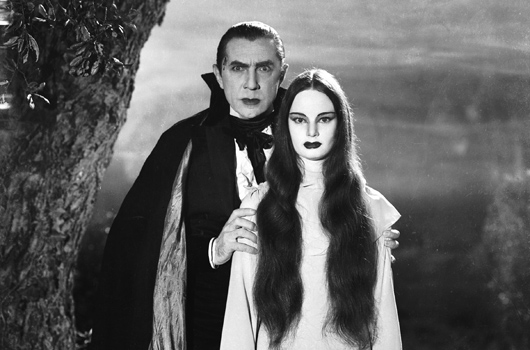
Other than that, this is pretty much exactly the same fucking thing, and only a scant four years later, so it’s not like the technology or staging or the culture has taken some radical leap forward and now the story can be told like you’ve never seen it before!! or something. It’s just DRACULA with two Draculas but less of either of them (they have, combined, a single line of dialogue, and it’s the last line in the film) and a lot more extraneous plot and sitting around, plus a bunch of “comedy,” if by comedy you mean people shouting and mugging and running around without any actual jokes, per se (otherwise known as Hong Kong comedy).
In fact, I think there’s a case to be made (and genre critics Kim Newman and Steve Jones make it on the DVD commentary) that MARK OF THE VAMPIRE may actually be some kind of low-key satire of the horror genre. Barrymore, anyway, is giving a campy enough performance to, at the very least, amble riiiiight up to the edge of parody. And if the broader comedy stuff is supposed to be “relief,” it probably gets about as much screen time as the horror it’s supposed to be be relieving. And then there’s that ending. That ending. But we’ll come to that in time.

First, though, the good news. Even though MARK OF THE VAMPIRE is in every way a shameless rehash of DRACULA with a worse story and a messy jumble of tones most of which work feebly if at all, and even with the extremely questionable ending which we’ll discuss in due course, I’m pleased to report that at least one thing does work: it has, if anything, an even more extravagantly lugubrious gothic horror atmosphere than its predecessor. And that counts for a lot. Shot by 10-times-nominated twice-awarded best cinematography Oscar winner James Wong Howe** (BELL BOOK AND CANDLE, HUD), gothic castles and rolling fog have never looked so sumptuously otherwordly, and Lugosi and Borland are both instantly iconic in their silent, predatory menace. A whole, whole lot of their role is just to stand around being eerily lit from below or slowly advancing towards the camera, but Howe and Browning are just the team to make that plenty sufficient to wrench a shiver out of an audience. And hey, there’s even a few bits of fun production value, particularly Borland taking flight in an impressively convincing bit of stage magic. This is strong work, and there’s no question about it. Unnecessary, derivative strong work, perhaps, but unmistakably masterful in its own right. It’s the very quintessence of this era of Hollywood horror filmmaking, replete with all the looming castles, roiling fog, and lazily flapping bat puppets you could possibly want -- a cliche, to be sure, but one of the absolute finest iterations of this particular paradigm ever to grace the silver screen. In fact, I’d be willing to argue that only THE WOLFMAN cinematographer Joseph Valentine comes close to giving Howe and Browning a run for their money when it comes to conjuring the perfect dreamworld of early Gothic Horror shadows and mist. And if that was what MARK OF THE VAMPIRE was peddling, I think it would probably be much beloved and much better remembered today.

But then there’s that ending to come along and turn everything on its head.
Which means that now is the time to reveal a major spoiler which I actually knew, but had forgotten going into this movie. See, MARK OF THE VAMPIRE is often called (though it is not credited as) a remake of Browning’s 1927 Lon Chaney-starring silent film LONDON AFTER MIDNIGHT, and it employs the same twist. And if you’ve seen LONDON AFTER MIDNIGHT, you know what that means. It means you’re either a filthy liar or you’re filthy rich and don’t know it yet, because LONDON AFTER MIDNIGHT is very possibly the most sought-after lost film of all time. It’s increasingly unlikely that we will ever see it (there’s a rumor that Stanley Kubrick was buried with the last existing copy… that’s your cue, makers of NATIONAL TREASURE III), but fortunately we have enough archival material to have a pretty good idea of how the plot played out -- in fact, TCM put out a full length recreation a few years back using stills and intertitles taken from the original shooting script.
 |
| Yep, this one. I'm sure the movie is shit, but man oh man, is that an amazing image. |
So, if you know anything about that film, you know that this one shares an ending which is both an infuriating letdown and, in retrospect, a brazen, nearly giallo-level act of narrative insanity. I don’t know if they somehow pulled it off the first time around in 1927, but here it’s handled so awkwardly that it’s frankly stunning anyone thought this was a releasable, completed motion picture, even in 1935. It’s a ridiculous idea by itself, but the damage is compounded disastrously by a seriously fumbled reveal which makes the ridiculous downright confounding. Or rather, a total lack of a reveal. The “twist” arrives so suddenly and with so little fanfare that I genuinely got confused and had to rewind to make sure I didn’t miss something. It’s so abrupt that it almost seems like the reels must be spliced out of order or something, but nope.
Essentially, (SPOILERS for an 85-year-old move) after being menaced by supernatural bloodsuckers one too many times, Professor Zelen and a few other characters head down into the abandoned castle to root them out (I’m actually not clear if this is the same castle where our victims live and they just have an unfinished vampire-infested basement, or if the haunted castle is next door or something). The poor virginal noblewoman, meanwhile, wanders into her living room to find her worst fear realized: her father is in there, returned from the grave as a vampire! Then all the sudden Zelen grabs a minor character who’s wandering around the basement with him and forcibly hypnotizes him, and you’re like, “Huh? Did I miss something?” To which the movie answers, “No, you didn’t miss anything, it’s totally normal and understandable that there would be a secret conspiracy to hire actors, including an actor who is the exact double of the recently deceased nobleman, to play vampires in order to trick a murderer into ????, and everyone pretends to be scared and we go through this whole elaborate charade where the vampires stay in character even when they’re alone and no one’s watching and the guy being gaslit isn’t around, and then when that somehow doesn’t produce the desired results (and how could it not!) we drop the whole idea and just easily hypnotize the suspect at the last minute and he confesses to everything.” And you’re all like, “Wait, what the fuck did I just watch?” and the movie’s all like “nothing! Absolutely nothing! Literally every bit of actual content that you just watched was gaslighting bullshit and it didn’t even work or factor into the solution.” And then it has the gall to end on a cheap meta-joke about how Lugosi famously played Dracula, proving that lazy meta jokes about the horror genre are basically as old as the genre itself (I think we just forgot all that in the 1950s when we correctly identified meta-humor as the province of debauched communists).

I mean, that is some straight up craziness (made all the more brazen by the fact that it’s a remake of a twist that audiences reportedly hated the first time!). There’s no world in which that twist makes any sense, not just as a logical narrative but just as basic storytelling. What kind of unhinged madman just gives up on the plot of the movie with five minutes left and abandons everything and introduces an entirely new plot?*** I mean, Michael Bay, I guess, but even he wouldn’t have the balls to actually stick to one plot all the way through and then change course at the last minute. He’s happy to just change plots every twenty minutes or so and count on such a maliciously punishing ten day runtime that by the time you get to the end you can’t even vaguely remember how you began. MARK OF THE VAMPIRE, at a slim not-quite-full-movie-length 60 minutes, does not have that luxury.
In fact, even back in 1935 when you could expect a work of fiction to comfortably make it through a plot in less than six seasons of one-hour episodes, 60 minutes was still unusually brisk, and the film seems oddly truncated, moving along at a odd, halting pace and filled with characters and plot points which seem to appear and vanish haphazardly (Barrymore, arguably the film’s protagonist, shows up for the first time with his back to the audience and no introduction of any kind). When scholars noted that the early reviews listed the runtime at 80+ minutes, they naturally got to wondering if the excised 10 minutes maybe contained some, uh, important plot points that might have made this one a little better. Maybe it had a more consistent tone? Maybe Lugosi actually had dialogue?
One song-simmering rumor has it that in the original cut, “Count Mora” and “Luna” had a lurid backstory in which they enjoyed an incestuous relationship, which led the Count to strangle her and shoot himself in the head, resulting in their respective vampiric states. That has the advantage of explaining their otherwise vague relationship and explaining what the deal is with that weird smudge of Lugosi’s forehead, but unfortunately the more I look into it the more unlikely I think it is that MGM would ever have let a script like that come anywhere near being filmed. I’ve read a few reasonably convincing claims that perhaps the original story treatment did include this detail, but scholars who had access to the shooting script were unable to find any trace of it. Sadly I think Newman and Jones are likely correct that the excised material was mostly exposition and comedy. Probably the right choice, given how dire both those things are in the finished film, though a little of either more of either might at least have helped the finished product come out a little more defined. As it is, there’s a distinct whiff of a film which doesn’t really have a clear idea of what it’s trying to do, except ride on DRACULA’s coattails with LONDON AFTER MIDNIGHT’s plot twist.
 |
| To be honest, it really looks like a bird shat on him. |
We tend to think of remakes as a syndrome of modern creative miasma, the purview of cynical corporate hacks who consider it their life’s work to sell brand names, and consider any actual art generated in the endeavor to be an unpleasantly lamentable but grudgingly tolerated byproduct of that noble goal. But of course, every generation thinks they invented greed. Remakes and shameless cash grabs have been around since the very beginning of cinema, and probably art itself. The earliest I can comfortably identify is the 1904 GREAT TRAIN ROBBERY, which features a gang of bandits robbing a train very much in the same vein as the film you’re thinking of, which is 1903’s THE GREAT TRAIN ROBBERY, one of the most lucrative and influential films of the entire silent era. There’s also a unauthorized, 1908 shot-by-shot remake titled EXCURSION TO THE MOON (I’ll let you guess what it’s a remake of). In fact, it seems that early cinema was rife with unauthorized remakes and flat-out film pirating (entrepreneur and filmmaker Siegmund Lubin was said to have sold more copies of Melies films than Melies himself did), and in fact it seems that it was not until a 1914 amendment to the Copyright Act of 1909 that motion pictures became a specifically protected work. Before that, they were essentially copyrighted as a series of still photographs, making it very difficult to enforce any kind of intellectual property claim. By 1922 Bram Stoker’s heirs successfully sued Murnau for his brazen daylight robbery of Dracula, but Browning seemed to have no such problem here (possibly because he was the director of the original), despite the widely acknowledged fact that the two films are, at the very least, exceedingly and specifically similar.
Indeed, it is almost certainly only the inaccessibility of LONDON AFTER MIDNIGHT which has made it the more intriguing of the two; film scholar William K. Everson viewed both films in the 1950’s (prior to a the 1967 vault fire which destroyed the last remaining copy the presumed destruction of the film in the MGM vaults sometimes in the 1960s****) and actually preferred MARK OF THE VAMPIRE. I’m sure if the situation was reversed and we just had a few tantalizing shots of Lugosi lurking in the mist to pique our imaginations, we’d all be rushing out to dig up Kubrick’s grave and wrench that last copy of MARK OF THE VAMPIRE from his greedy mitts. But that’s not the world we live in. We live in one where we get to see MARK OF THE VAMPIRE, and can agree that it’s pretty deeply flawed but also has some damn cool things about it, and the one thing it gets really right (an appropriately spooky black and white gothic vibe) is the most important thing anyway. Is it better to know the full truth and be a little disappointed, or to never know and preserve that sense of wonderful possibility? Reader, I cannot know. I do know this, though: whatever its flaws, MARK OF THE VAMPIRE does make a powerful argument against the common wisdom that catching mystery killers is as easy as hiring actors to dress up like vampires and live the part full time offstage***** to occasionally gaslight your chief suspect into confessing. I know, I know, it seems so obvious, but the world is a complicated place. Next time just hypnotize ‘em instead, that always does the trick.
FIN.

*DOCTOR X, THE MYSTERY OF MR. X, and MADAME X are, to the best of my knowledge, in no way related, and it’s a complete coincidence that three actors here all appear in movies with similar names. I only bring it up because I’m now fairly certain we can say with total confidence these were Malcolm X’s three favorite movies and he gave himself that stylish sobriquet in reference to his beloved “X” films from the late 20’s and early 30’s. I really feel like his encyclopedic knowledge of pre-code British crime cinema is too rarely discussed.
** Howe was born in Taishan, Canton Province, China, in 1899(!) and immigrated to the US at the age of five, overcoming grueling racism (his marriage to his white wife was illegal and unrecognized by the US government for a full decade) to become one of the most celebrated and influential cinematographers of all time. Somebody oughtta make that movie.
*** One possible answer would be FRANKENSTEIN CONQUERS THE WORLD, in which a giant pissed-off octopus shows up out of the blue in the last five minutes. But it’s Japanese so that probably doesn’t count.
**** Or Not? Although there is a wikipedia page about this supposed fire in 1967, after literally hours of exhaustive searches and a half-dozen emails to various film journalists and historians, I can find not one bit of independent data which backs up any specific claims about a vault fire in the 1960s which destroyed the film. Multiple sites make this claim, but no primary documentation appears to be available about specifically when, and if, such a fire occurred. But the movie definitely does seem to be gone, and a fire around this period seems a likely explanation. UPDATE: Or double not? I asked film historian David Pierce about this baffling lack of evidence, and he voiced what I was beginning to suspect, telling me: “I've never been able to find additional detail on the MGM fire in Culver City. I think it unlikely that a huge number of films were lost, as most of those films were lost many years earlier. I reviewed the correspondence between James Card and MGM starting in the 1950s and the studio no longer had many of those films even then. I believe that there was no single catastrophic event with MGM; most of the films simply decomposed before they could be copied.“ On the other hand, he interviewed several people in the 1990s who remembered a fire, including Roger Mayer, so it’s still likely, on the balance of the evidence, that at least some films perished this way. Was LONDON AFTER MIDNIGHT among them? I think at this point it's probably impossible to know. But optimists, take heart: according to Lon Chaney scholar Jon Mirsalis, the copyright expires in 2022, and it's just barely possible that someone out there is holding out til then before they publicly reveal they still have the original nitrate film (which, under proper storage conditions, could theoretically still survive), in order to cash in on their valuable property without MGM demanding a cut.
**** Or Not? Although there is a wikipedia page about this supposed fire in 1967, after literally hours of exhaustive searches and a half-dozen emails to various film journalists and historians, I can find not one bit of independent data which backs up any specific claims about a vault fire in the 1960s which destroyed the film. Multiple sites make this claim, but no primary documentation appears to be available about specifically when, and if, such a fire occurred. But the movie definitely does seem to be gone, and a fire around this period seems a likely explanation. UPDATE: Or double not? I asked film historian David Pierce about this baffling lack of evidence, and he voiced what I was beginning to suspect, telling me: “I've never been able to find additional detail on the MGM fire in Culver City. I think it unlikely that a huge number of films were lost, as most of those films were lost many years earlier. I reviewed the correspondence between James Card and MGM starting in the 1950s and the studio no longer had many of those films even then. I believe that there was no single catastrophic event with MGM; most of the films simply decomposed before they could be copied.“ On the other hand, he interviewed several people in the 1990s who remembered a fire, including Roger Mayer, so it’s still likely, on the balance of the evidence, that at least some films perished this way. Was LONDON AFTER MIDNIGHT among them? I think at this point it's probably impossible to know. But optimists, take heart: according to Lon Chaney scholar Jon Mirsalis, the copyright expires in 2022, and it's just barely possible that someone out there is holding out til then before they publicly reveal they still have the original nitrate film (which, under proper storage conditions, could theoretically still survive), in order to cash in on their valuable property without MGM demanding a cut.
***** Borland, who seems to be a bountiful if not always reliable source of information on the film, claims there was a proposed alternate ending where Barrymore gets a telegram from the actors apologizing that they were delayed and would not arrive for some time, suggesting that the silent creeps were the real deal. That would also be supremely idiotic, but at least more satisfying that retroactively removing any actual supernatural elements (except hypnotism) from the whole plot.

CHAINSAWNUKAH 2017 CHECKLIST!
The Discreet Charm of the Killing Spree
TAGLINE
| Not yet invented |
TITLE ACCURACY
|
Hard to know what that means; the alternate title is THE VAMPIRES OF PRAGUE, which is a little more accurate. Is the MARK OF THE VAMPIRE that smudge on Lugosi’s forehead?
|
LITERARY ADAPTATION?
|
None
|
SEQUEL?
|
None
|
REMAKE?
|
Almost certainly a remake of LONDON AFTER MIDNIGHT
|
COUNTRY OF ORIGIN
|
USA
|
HORROR SUB-GENRE
|
Vampires, Gaslighting
|
SLUMMING A-LISTER?
|
Lionel Barrymore, and possibly even Lionel Atwill. Two Lionels for the price of one!
|
BELOVED HORROR ICON?
|
Bela Lugosi, Tod Browning
|
NUDITY?
|
No
|
SEXUAL ASSAULT?
|
No
|
WHEN ANIMALS ATTACK!
|
Bat spooks everyone by emerging out of the darkness!
|
GHOST/ ZOMBIE / HAUNTED BUILDING?
|
The Vampirism seems to be based out of a castle, but it doesn’t seem to be the building’s fault.
|
POSSESSION?
|
Yes, people seem to get hypnotized by the vampires
|
CREEPY DOLLS?
|
None
|
EVIL CULT?
|
None
|
MADNESS?
|
None
|
TRANSMOGRIFICATION?
|
Vamp into bat!
|
VOYEURISM?
|
The vamps seem to be perpetually lurking outside, keeping an eye on their victims
|
MORAL OF THE STORY
|
Sometimes we’re better off with the legend than the facts.
|


