Showing posts with label 2021. Show all posts

Monday, May 1, 2023

Attraction and Repulsion: Last Night In Soho and the Ambivalence of "Problematic" Art


LAST NIGHT IN SOHO (2021)

Dir. Edgar Wright

Written by Edgar Wright and Krysty Wilson-Cairns

Starring Thomasin McKenzie, Anya Taylor-Joy, Matt Smith, Terence Stamp, Diana Rigg


I like Roman Polanski's REPULSION. At the same time, I very much don't like drugging and raping 13-year-olds. The same Roman Polanski who made REPULSION also drugged and raped a 13-year old. And the same 60's and 70's counterculture which produced so much provocative, challenging art I love also produced a culture of hedonistic, celebrity-centered boundary-pushing that made him think he could get away with it. And there's very little space to "separate art from artist" when it's so obvious that the art in question is the direct result of both the specific person and the the specific culture from which it sprang -- and not always even from the more admirable qualities of that person and culture. So what to do with the fact that these things I love are also inextricably interwoven with things I find repugnant -- and not just repugnant, but things that I think need to be actively, forcefully repudiated, not just for abstract moral reasons but because they remain active and dangerous forces in the modern world? 


LAST NIGHT IN SOHO is Edgar Wright's attempt to grapple with those questions, essentially by making a vague REPULSION riff* that very self-consciously brings to the foreground the less savory aspects of the director and the time period, forcing the confrontation between our fetishization of the nostalgic past and the grim reality of that past that we sometimes conveniently overlook. The movie does this in the most literal possible way: by sending a somewhat brittle Zoomer 1960's fangirl (Thomasin McKenzie, JOJO RABBIT) back in time, where she discovers in no uncertain terms that beneath the alleged glamour and liberating social loosening of the era, there was some rampant misogyny** that somehow she never gleaned from a lifetime of consuming an apparently unadulterated diet of nothing but 60's media. (Not to be an asshole, but, like, the first thing she sees in 1965 is a huge marquee for THUNDERBALL, a not-particularly-obscure film which, uh, has some pretty strong hints that gender equity in 1965 was not exactly up to the standards of today. It kind of makes her seem like an idiot for being surprised, but as we will see, being an idiot is at least a pretty consistent character trait for her). So it's basically MIDNIGHT IN PARIS if it was in any way self-aware. 


This is all reasonably successful, as far as it goes, but it's also a little disappointing it doesn't go further. For a movie taking aim at such a fraught topic, its insights are ultimately pretty shallow and prosaic. At the end of an extremely unrushed 116 minutes (including an entire opening act that is almost wholly useless deadwood), the only thing the movie has been able to articulate with any clarity is "boy, there sure was a lot of misogyny in the 60's, huh? But those clothes and pop songs sure do rock!" an observation which is not only a little underwhelming as a central thesis, but one which has already been fully explored by the 50-minute mark (which sounds like it's late in the movie but, in fact, marks the first glimmering of any actual conflict -- I told you it takes a long time to get going!) and will not be expanded upon a single iota during the film's remaining 66 minutes. 


This disappointingly banal answer to the movie's rather more complicated questions is not just reflective of a lack of intellectual rigor, though it is that too, but is also the inevitable result of Wright's stylistic choices, which have the effect of limiting any possibility that the film might expose something genuinely revealing. The problem is that in trying to explore our perception of the past, the movie never creates a real, tangible place. It's all as blunt and exaggerated as possible, presenting the 60's alternately as a giddy fairy-tale fantasy or a cartoonish nightmare, and consequently never really interrogating its central dilemma with any nuance. In theory, the movie probably thinks it's trying to balance our cozy nostalgia with harsh reality, but since both "good" and "bad" versions of the past are ultra-stylized caricatures, it never really feels like a search for truth, more like a battle between two opposing and equally phony reductive fantasies. 


In reality, the 60's wasn't just one thing; it was a complex, sprawling era that looked very different depending on where you were, who you were, and what you wanted, and the movie can't really explore it meaningfully when it presents the past in such starkly black-and-white terms. And because both visions of the 60's are so patently disconnected from any kind of real lived reality, the movie really struggles to link the dark side of the the 60's to the continued issues of the real-world present (in fact, I'm not even sure it's trying to, which is a serious issue for a movie that so strongly wants to posit itself as a moral arbiter). Bizarrely, the script places its only blatant modern-day misogyny at the very start of the movie (there's a very effective early sequence where our protagonist gets stuck in a cab with a sexually threatening driver), and then, content that it has established the present day as thoroughly unpleasant, sends its heroine back in time to her idealized 1960's, only to gradually disillusion her of the idea that they were such a great time for women. But wait, did she (or anyone) really think the 1960's were the halcyon days of sexual equality? This ordering of events has the strange effect of sequestering the problem in the distant past, and centering the movie's conflict on re-framing our images of history rather than seeing misogyny as a long-running continuity that stretches through the past into the present. Indeed, it almost makes the issue of misogyny itself independently unimportant, a mere stand-in for the ways in which we unwisely idealize the past, rather than an important topic in its own right (which would be fine if the movie had a lighter touch, but I seriously doubt that's what it thinks its doing, given how hard it pushes its themes of female persecution).  


And if its vision of the past more generally is more baroque fantasy than honest reckoning, its portrayal of actual misogynists is even worse. There are only two type of men in the movie: venal, despicable monsters or endlessly sympathetic saints (ok, there's only one of the latter), which is a thoroughly unhelpful way of looking at things. If it were that simple, it would be no problem, would it? One would think that a movie with Polanski so thoroughly on its mind would be more aware that misogyny is much more complex than the one-dimensional mustache-twirlers depicted here. After all, REPULSION, ROSEMARY'S BABY, and CHINATOWN, just to name a few Polanksi movies, are all acutely aware of women facing various kinds of misogynist violence and dismissal, and indeed are all rather more sensitive and closely-observed in their implied critique of the patriarchy than LAST NIGHT IN SOHO ever is. These movies suggest Polanksi enjoyed a more-than-superficial perceptiveness of women's exploitation at the hands of men... and yet, in the end, he was more than willing to perpetuate that exploitation himself, and to this day seems stubbornly insistent on rationalizing his actions rather than introspecting about them. That's the kind of misogyny that's truly insidious; LAST NIGHT IN SOHO, in its search of signifiers more than genuine provocation, has eyes only for the easy, obvious villains, who would have been roundly condemned by most of society even in the 1960s. What good does that do?


So as a reckoning with our relationship with history, and as a reckoning with real-world misogyny, the movie is well-meaning but depressingly superficial considering how effortful it is. But its more interesting angle is a more complicated one. By being both a tribute to and a tacit criticism of Polanski in particular and exploitation horror in general, the film isn't just reminding us of the dangers of blind nostalgia, it's openly asking the question what does it mean that we are drawn to art built around some extremely dubious morality, often made by some extremely dubiously moral artists?


Between this film, INCIDENT ON AND OFF A MOUNTAIN ROAD, and HOTEL FEAR, I seem to have stumbled onto an unexpected run of quasi-horror films which are very self-consciously dedicated to the subject of women's' suffering at the hands of men who view them as objects upon which to act out their own desires and insecurities. Given the horror genre's --let's say uneven-- track record on misogyny, there's a level of auto-critique inherent in threading this theme into a genre movie at all, and consequently, when you're watching them there's the implicit understanding that these films are intentionally trying to right a wrong, to address the genre itself by reframing the conventional narratives in a way that challenges our assumptions. That they attempt to do this through essentially the same tools as a more traditional horror movie is at least theoretically provocative, particularly given that all three were directed by men (and with only one female writer between them, in this case co-writer Krysty Wilson-Cairns [1917, THE GOOD NURSE]). 


This in turn requires a certain level of meta self-awareness on the part of the film and the audience; we need to understand that the point here is to undermine our expectations about the way the genre will treat its female protagonists, and to do that we need an implicit understanding of the way female suffering has traditionally been used in the genre. After all, depicting female suffering is hardly novel in itself; even the most horrifically misogynist genre works traffic in images of violence against women that are at least nominally sympathetic (since that sympathy is necessary to drive narrative tension). The difference between standard horror and these more introspective efforts is supposed to be in empathy, in the humanity the film grants to its suffering women, and the degree to which it is able to contextualize their fictional suffering in a way that implicates, or at least interrogates, the complicity of the viewer, making for a premise that is necessarily involved in a conversation about the genre more broadly, and the characteristic assumptions it makes about how we will interpret screen violence against women. 


That kind of self-awareness is not necessarily a shortcoming; there is, at least, something kind of perversely interesting in HOTEL FEAR's profound awareness of how threatened the protagonist feels to have men constantly lusting after her, while at the same time the camera constantly lusts after her too -- and of course this tension can only come from a director who feels both concerned about the implicit ethics of exploitation cinema and drawn to its earthy thrills. Although obviously it would be valuable to have more female voices expressing their gendered experiences with male violence articulated vis-a-vis the conventions of genre expectations, men just as obviously need to be part of this conversation too, especially considering their oversized role in both perpetuating real-life violence and creating and supporting violent art which frequently dehumanizes women (if not outright fetishizing violence against them). The question becomes, then: what does it say about us that we gravitate to art which often presents suffering --and primarily female suffering-- as entertainment? 


As a quick look at my viewing history should make clear, I don't believe violence in art is equivalent to real-life violence, and I don't believe depiction is inherently endorsement. And in fact, believe isn't even the right word; I think there is overwhelming evidence that, at the very least, antisocial media does not directly produce antisocial viewers (if it did, I would surely be a serial killer by now). But I don't think it's responsible to simply brush off antisocial film as harmless fantasy, either. Screen violence and real-world violence are not directly linked, but they are intertwined in slippery, nebulous ways that deserve hard scrutiny, at the very minimum simply because violent art makes it very clear how vulnerable our brains are to uncritically interpreting stories through the framework a careful storyteller lays out. That, at least, should have profound real-world implications, because it's not only movies that seek to carefully frame stories to subtly delineate who does and does not deserve our empathy. If a movie can get you to laugh at a woman who gets horribly butchered, a news story can too. 


Still, I think that asking how stories affect people's behavior is not the most productive direction from which to approach this topic. Rather than asking "what does art do to people," the question should be "what do people take from art?" A subtle distinction, maybe, but a vital one. Fantasy, and even (and maybe especially) antisocial fantasy, is not inherently dangerous; indeed, I think it is foundational to the experience of being human. But we start to run into more trouble when we let particularly compelling stories begin to dictate the terms of reality for us, and begin to forget that stories --all stories, fictional or not-- are always fantasies, and we're most vulnerable to uncritically embracing the fantasies that are sold to us in the most insidiously seductive style, with the most flattering framing. This has more to do with the inherent psychological landscape within the viewer than within the art itself; the movie is an inert object, but the interpretation we apply to it is an obscure and abstract process of internal storytelling, whereby we synthesize all our understanding of the world into a prism that refracts the sounds and images into something with meaning. Consequently, the content itself isn't something which acts upon the psyche so much as something to be acted upon by the brain's endlessly complex pattern-seeking machinery. A healthy brain has the tools to establish context, letting us interpret potentially horrific content through the conventions of fantasy, and not as something which needs to be literally reflective of reality, idealized or otherwise. An unhealthy brain, of course, may struggle to do this, with potentially disastrous real-world consequences. But then, discerning how constructively your brain is processing things is not always an easy task.


Self-awareness, then, is the key here; an honest accounting of what we're drawn to about antisocial art, and a vigilance about the ways it may be very subtly strengthening our unquestioned assumptions in way which make us less empathetic and less humble about life's infinite nuance. In that sense, I think antisocial art actually becomes incredibly valuable: the fact that we're drawn to it is a good reminder that we are, in fact, vulnerable to exactly the kind of nastiness it depicts. Nevermind REPULSION or PIECES or whatever, the very powerful personal attraction I feel from the odious charismatic chauvinism of THUNDERBALL's Sean Connery is a pretty powerful reminder that I have it within me to at least tolerate, if not outright enact, some ugly macho bullshit. And I don't even know that it's such a terrible thing that I do. I don't know that I'd want to root it out even if I could -- that little bit of nascent macho asshole helps me understand the world a little better, helps me glean some insight into men who more overtly embrace that ethos, who I may not like or respect, but with whom I have to share a planet and a culture. I don't think being a good person means stamping out every last vestige of temptation in one's soul, it just means acknowledging that those things are there, and they're part of you... but mostly not a useful part, and certainly not a part that should be handed the reigns in any unchecked way. But to guard against that, you need to clarify what ugly impulses inside you need to be guarded against in the first place, and that means an honest accounting of why we're drawn to create and consume art that reflects the darker aspects of human nature in the first place.


That, in my view, is Polanski's chief fault, and the one that LAST NIGHT IN SOHO misses, much to its detriment. He understood --and better than Wright does, I think, or anyway was better at depicting it in his movies-- just how oppressive and dehumanizing the patriarchy could be to women. He just refused to see it in himself, refused to see that even in his movies, despite --and in parallel to-- their obvious (and I believe genuine) empathy, there's also a subtle sort of sadistic pleasure they take in tormenting their female characters. In ROSEMARY'S BABY (spoilers for that movie) the Devil drugs and rapes the protagonist in one of the most horrifying violations in all cinema. Nine years later, Polanski himself did the same thing, yet he never saw himself as a Devil. Maybe if he'd been able to introspect just a little deeper about what that scene stirred in him, why he made it the way he did, why he was drawn to it at all... well, we'll never know. At any rate, I don't think Polanski was possessed of a uniquely deviant psyche (the fact that Wright and I enjoy his movies so much suggests we have more than a little in common with him), and after all, he spent much of his life as a victim himself (of the holocaust, and later the Mason family, just to name two egregious examples). But when it really mattered, he couldn't, or wouldn't, recognize that he had become the victimizer.


Still, although it didn't seem to help Polanski, I think there is value, and perhaps great value, in making and enjoying antisocial art. Far from seeding innocents with evil ideas, I think it helps people --most people, anyway, myself included-- connect with their darker sides, acknowledge them, maybe even indulge them a little, and consequently become more self-aware than they would be if they had to encounter these darker urges for the first time in the real world, in the heat of the moment. Of course that's not always the case for everyone, and we would be negligent to dismiss the people --a minority, I think, but who knows?-- who lack the tools or interest for self-reflection, and instead simply absorb the fantasy, use it to structure and validate their own antisocial internal narratives. This is not a problem lightly ignored, but at the same time I think our response has to start with the people in question, not with the art they misuse. People who lack the sophistication to introspect and distinguish fiction from reality are going to be a problem no matter what, even if we were somehow able to so studiously censor their media experience that they received only the most utterly anodyne, pro-social narratives. Fostering introspection and media savvy is simply a good idea all around, for everyone -- after all, it's not like deranged psychos are the only ones vulnerable to letting a manipulative fantasy subtly strengthen their biases and assumptions about the world. And indeed, I think films like the ones I'm talking about here, that encourage (or even require) a kind of meta-intercourse with our perceptions about genre and the assumptions it rests on, may be helpful, perhaps even necessary, to shape new generations to be more mindful of the ways in which they interact with media.   


...But probably not LAST NIGHT IN SOHO specifically, though, because I'm sorry to say that I think the commentary here just isn't really any good. I appreciate that Wright and co-writer Wilson-Cairns are trying to grapple with these issues, but unfortunately the movie simply never manages to satisfying address (let alone answer) its own questions, either about the dangers of nostalgia or its ambivalence about enjoying morally suspect art by morally suspect artists. To wit: though this is all ostensibly some sort of mystery-horror thing, the moral arc of the movie (or lack thereof) is best summed up by a dress. The protagonist, a fashion student, creates this dress after being inspired by the aesthetics of the 60's, but then freaks out and tears it up after learning that the 60's were actually not so great in some ways. But then at the end... she just happily goes back to it. Why? It's not like she experiences some great character growth which helps her find a healthy perspective on the past. She just flailingly vacillates between complete rejection and blithe acceptance, never meaningfully taking stock of what is so attractive to her about this resurrected signifier of the past in the first place, and consequently unable to grapple with the reasons for either her rejection or reconciliation with the style. Once again, the movie seems utterly unable to actually engage with the the worthwhile issues it raises.


And that's a big, big problem, because it's even worse at doing the other stuff it's ostensibly trying to do, namely be a compelling mystery and horror movie. It's barely a horror movie at all; its sole horror image, of a group of faceless ghostly men, is not utterly without merit, but any potency it ever possessed is quickly dashed through merciless repetition (I'm not joking when I say there's only one horror image in the movie) and by being presented with confounding literalism, despite how stylized most of the rest of the movie is. And as a mystery, it's even more of a dire failure, hanging its entire whodunnit premise on shamelessly withholding key information and in several egregious cases outright lying to the viewer, and beyond that utterly crippled by a protagonist who's as frustratingly incompetent an investigator as I have ever seen in a movie. 


How incompetent? Her entire campaign to "solve" a murder she saw in a vision consists of what looks like an hour or two of fruitless library research, after which she runs away and never again makes the slightest attempt to turn up any clues (the only other proactive step of any kind that she takes is to go to the police and angrily demand they go solve the murder for her, oh, except she doesn't know the names of anyone involved or when it happened or have any relevant details because she saw it in a dream, and the movie acts like the cops are being some real macho assholes for not taking her seriously). If this were any other movie, I would have no choice to but interpret a female character this inept and hysterical as a shamelessly regressive stereotype of helpless feminine fragility. Obviously that's not what is intended here, but the mystery plotting is so lazy and haphazard that it's just kind of where we end up anyway. At one point, she accuses someone of being the murderer, for all intents and purposes, entirely on the strength of his being the one apparently pointless male character who is suspiciously played by a famous actor. There's literally no other reason to suspect him of anything, she has no evidence and doesn't even know his name or anything else about him except that he lived in Soho during the 60's. This should be roundly embarrassing, but the movie is so self-congratulatory about its feminist bona fides that it tries to play the fallout of this incident as a big shocking twist rather than evidence that its protagonist is a spasmodic twit. Yet another modern movie content to simply tell us it believes in strong women without actually making the effort to create one. 


And for a very performatively feminist movie, a movie which, indeed, sets itself very explicitly to the task of condemning the history of misogyny in genre movies, it's a huge problem that the female lead is such an incompetent, helpless baby. She knows, for example, that she gets psychic visions from time to time. These can obviously be quite disruptive and upsetting, but at the same time she knows this happens, she's lived with it apparently all her life and knows they're just visions and can't hurt her, and yet she just simply cannot restrain herself from screaming and freaking out as though this were really happening, at one point almost accidentally murdering an innocent bystander in her panic (!) and at another almost getting her one Black friend arrested, and at no point seeming to realize it's possible, and lo!, even desirable, to just grit your teeth and maintain some composure so that you don't look like an utter psychopath. Haley Joel Osment in THE SIXTH SENSE --a literal child-- does such a vastly better job keeping his cool, while seeing objectively more upsetting things, that you can't help but feel like LAST NIGHT IN SOHO actually has very little real respect for its female characters after all. It does not speak well of this writing, to put it lightly, that I can think of a dozen tougher and more complex female roles from actual 60's movies --and not even super-progressive 60's movies-- right off the top of my head. If you need to make your heroine this wimpy in order to make the patriarchy seem mean, maybe misogyny just isn't really much of a problem. 


And if empathy is the missing ingredient in so much of horror cinema, what does it mean to have not one, but two female protagonists here who are basically empty nothing characters defined only by their naiveté and their helpless suffering at the hands of men? Without interiority or autonomy, their suffering is really distinguished from standard genre-movie female victimhood only by the movie's hesitance to make any of it entertaining, which isn't really an improvement in my opinion. And ultimately even if they were compelling female characters lucidly decrying the patriarchy, it would all be undone by the excruciating final act, which makes utter hash out of even the bland, boilerplate anti-misogyny themes the movie has been loudly declaiming up to that point (the twist about the killer's identity should, in itself, be disqualifying for any movie that wants to claim it's feminist, and the movie's completely off-the-rails final moment is so psychotically misjudged that I can only interpret it as a tacit approval of serial murder). If one were to be charitable to the point of active ignorance, I suppose you might be able to make a case that the climactic twist is attempting to complicate the movie's otherwise fairly boilerplate themes, but considering how badly it already fumbles the boilerplate, you can imagine how deftly it handles "complicating" it. It's almost audacious in how stunningly misjudged it is, but unfortunately also too dull and hectoring to quite manage to to feel exciting in its fearless willingness to jump completely off the rails. 


So does that mean LAST NIGHT IN SOHO is completely worthless? Surprisingly, no! It's just worthless at being a meta-commentary about genre and nostalgia or being an entertaining or effective mystery or horror movie. Fortunately, although it expends a whole lot of very trying runtime on those things, they're not really what it's about. No, what LAST NIGHT IN SOHO really is, for whatever reason, is a ravishing throwback musical-fantasy, minus the actual "musical numbers" per se. Wright may like REPULSION well enough, but self-evidently what really gets him excited is gaudy, gimmicky music videos, and he indulges this fetish every single moment he gets the chance to, in the process turning out some genuinely ravishing sequences. The film's big signature setpiece, tellingly, has nothing to do with murder mysteries or faceless specters; it is a giddy one-take dance sequence where, using mirrors and slick choreography, McKenzie and Anya Taylor-Joy seamlessly double each other in-camera in a breathless whirlwind of joyful movie magic. This has not much at all to do with anything thematically; indeed, the whole complicated doubling thing is purely literal, simply reminding us that the two characters are experiencing this simultaneously. But it's also what the film is really about, as opposed to what the tedious script is about. If turning the 1960's into a gorgeous, rhapsodic fairy-tale fantasy is resolutely at odds with the movie's stated intent of an honest accounting of the past, the film is so slick and enrapturing about it that I'd happily give up every scintilla of tedious pedantic theme to keep it. If only the movie felt the same way.
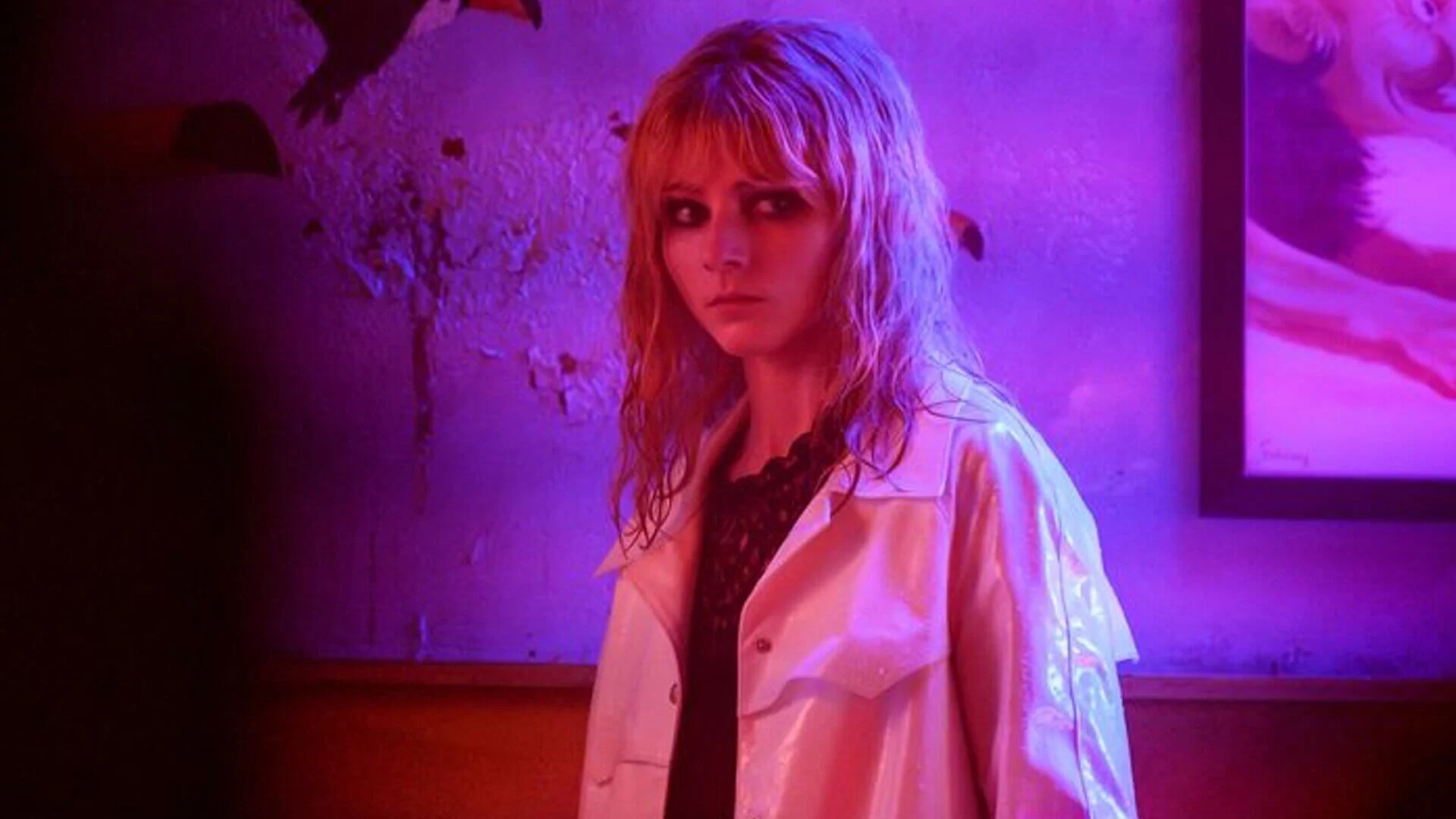

I could never wholly condemn a movie with even one scene as blissfully transporting as that one, and LAST NIGHT IN SOHO has several, which is more than enough for me to ultimately feel glad it exists. And I genuinely appreciate the questions it raises, even if it does an objectively bad job actually grappling with them. But still, it can't help but feel like a real missed opportunity -- a film with style and technique and curiosity to spare, in desperate search of a script that allows those things to flourish. Which is, I think it needs to be said, a pretty apt description of every movie Wright had made that wasn't co-written with Simon Pegg, the one man alive who seems able to channel Wright's obvious strengths as a filmmaker into films that are as structurally sturdy as they are energetic and visually imaginative. I wish LAST NIGHT IN SOHO worked on all the levels its ambition is aiming for, but in the absence of anything else really like it, I'll take what I can get. Ironically, then, this film that wants so badly to try to address the legacy of REPULSION elicits a similar reaction in me (though for very different reasons): I like it... with some key reservations.


* Wright also claimed it was his attempt at a giallo, about which many of the same things could be said. But other than his use of vivid, monochromatic color and maybe some vague gestures towards excessive style, there's less of that in here than I was expecting -- so little that I don't know that I would have noticed it if I hadn't been told to look for it. 


** But nothing else; weirdly, despite having a Black character, the movie has not a single hint that there was any other kind of injustice in 1965 London (or today). Not that every movie needs to or can address every issue, but it does seem odd since the movie is so explicitly posited as a direct cultural criticism.  

Wednesday, July 6, 2022

No Time To Die


No Time To Die (2021)
Dir. Cary Joji Fukunaga
Written by Neal Purvis, Robert Wade, Cary Joji Fukunaga, Phoebe Waller-Bridge (!)
Starring Daniel Craig, Léa Seydoux, Rami Malek
 
Frankly, I'm not at all sorry to see this misbegotten Daniel Craig era of Bond film come to a close. That's no slight against Craig, who has been game enough, and plenty able to cast himself as the suavely misanthropic super-spy with the right blend of macho traditionalism and actorly specificity. But the very idea --pushed hard throughout this pentalogy-- of a grittier, darker tone with a bent towards probing Bond's broken psychology always felt absolutely asinine, the kind of dumbass 90’s defensively self-serious posturing that was already passé by 2006. Why would we want a dour, realistic version of something so inherently unrealistic? Who cares that Bond's life of traveling to fancy places, bedding every beautiful woman he sees, and killing thousands of villainous goons with no consequences scars his soul and leaves him sad and emotionally damaged, when no one has or will ever do any of that?  It’s so ridiculously far removed from anything remotely resembling reality that moralizing about it is a completely meaningless exercise in utter abstraction. What's next, a depressing, realistic origin story for The Joker? That would be stupid, obviously. This is a fun, empty-headed anachronistic antisocial fantasy with absolutely nothing to teach us about the real world. Just let it be its itself.*

This has been my feeling from the very start, and Craig's subsequent run of movies has done little to disabuse me of that initial reaction. CASINO ROYALE has a few fun beats and a magnificent villain in Mads Mikkelsen, but it's also a structural mess which, predictably, has no idea what to do with its self-conscious "darker" tone other than scowl more. And when it became clear that QUANTUMN OF SOLACE would do the same thing and would be larded up with a bunch of tedious continuity porn, I almost stormed out of the theater (and I wouldn't have missed much if I had). SKYFALL was something of a welcome course correction, with much more shameless huge-scale silliness, a worthy theme song and Roger Deakins making everything look lush and purty, but it takes a weird turn into mawkish melodrama in its last act and makes the horrible mistake of centering the story around Bond personally. And finally even though SPECTRE is the most recent one, I remembered almost nothing about it except that it has a good opening, a hot Monica Bellucci, and it turns out Blofeld is Bond's brother like in (spoilers for AUSTIN POWERS IN GOLDMEMBER) AUSTIN POWERS IN GOLDMEMBER. Also it has not just the worst Bond theme song ever, but a real serious contender for the title of worst theme songs in any movie in the history of cinema. And the blandest title in the entire Bond canon, which is particularly galling.** I hope it's obvious to everyone here that Bond movies, like gialli, need baroque, decadent titles. NEVER DIE AGAIN TOMORROW, NOTHING NEW UNDER THE GUN, ON GOLDEN POND, THE STRANGE COLOR OF YOUR BODY'S TEARS. Stuff like that. This might seem like unduly sour nitpicking, but Bond films, even more than other rigidly formulaic franchises, are defined by such a particular and iconic set of distinct signifiers that yes, it's a big problem if you bungle your tile and theme song game. And the fact that the Craig era seems to have been defined by a creative team slightly embarrassed about those signifiers and eager to marginalize them or at least furtively recontextualize them strikes me as folly of the highest order.  
So in fact, I would argue with the title of this movie and insist that it is in fact very much time to die. And the fact that the movie begins with Bond and Léa Seydoux (CRIMES OF THE FUTURE) together, as though I have any idea who she is or any memory of her being in the last movie, put me in a sour mood right off the bat. And then from there we immediately dive back into continuity porn with Blofeld and Eva Green and shit. Goddamit, this is why I swore off the MISSION IMPOSSIBLE movies, and this isn't even going to have that level of stuntwork.


But I warmed to it a bit. The movie bustled along, doing its standard James Bond thing, and doing it pretty well, pretty honestly. Noticeably less anxious, self-conscious fretting about gritty realism, not a lot of drab overthinking but not entirely braindead, either. Still too much annoying continuity clutter and moony melodrama about Bond himself, but at least enough of the desired formula, executed handsomely, that I was willing to provisionally get on board with the film. 
But then something unexpected happened. Like Saul Tenser in CRIMES OF THE FUTURE,*** something alien and unexpected but maybe kind of beautiful started to grow inside it. Something, in fact, that feels almost like a whole different film, a parallel work of art, not wholly disconnected from the standard globetrotting Bond fare but also not particularly dependent on it: an odd, melancholy drama about endings, about regret for the roads not taken, the things left undone, the future that we won't see.

Or maybe it’s not even a drama, since you can’t really call it a story, per se, and Craig is the only character (technically, much of it centers around Bond’s relationship with Seydoux, who the movie frames as his true love. But she’s nearly 20 years younger than him, their chemistry is middling at best, and she’s transparently more plot device than character, important to Bond only because the movie needs it to be so, and even then only by virtue of being the last Bond girl still sitting at the end of a 60-year-long game of musical chairs). So it’s not getting anywhere on the strength of its narrative. But it's more than a tone. It's like, you've got a normal Bond movie, where he wears a tuxedo and orders a Martini and drives a souped up sports car and what have you, but maybe every fourth scene or so just lingers a little longer than you expect, sometimes just holds a second longer on Craig's face than it needs to, lets him register this look he's perfected of aching, resigned regret immediately masked by a reflexive, protective retreat to macho cynicism. It may be just a look, it may not even be anything more than that -- it's not really in the screenplay, except in the sense that the screenplay is confident enough to place Bond in emotionally fraught situations and then mostly just shut up and just let Craig tell us what we need to know entirely through his eyes. 

But it's a powerful look, and not because I've finally come around to the drab idea that this is a penetrating insight into why being a suave, indestructible superspy-lothario is emotionally crippling. Rather, the thing that gives this surprising emotional heft is that it actually has nothing to do with being a superspy. It's about being an emotionally wounded old man, with too much accumulated hurt to be able to entirely trust anyone --to be open and vulnerable the way that love requires-- and experiencing that inevitable moment when you realize you've spent your youth pushing people away instead of letting them love you, and you find yourself alone and empty, with only your regrets and your haunting questions about how it might have all gone differently to occupy your time. And then the old excuses start to ring hollow -- was it really that I am an international superspy and couldn't risk a romantic partner who might betray me to the massive clandestine criminal network run by my estranged stepbrother that wants to kill me? Or was I just afraid of being happy? The specifics emerge naturally from what we understand about the essence of James Bond, but the feelings are richer and more universal. This could be the story of a super-spy, or a gangster, or a high-end chef, and though the specifics of the story would change, that haunted expression would mean the same thing. Combined with Linus Sandgren's (LA LA LAND, FIRST MAN) lush, painterly cinematography,**** and the unrushed editing of Elliot Graham (MILK, X2) and Tom Cross (WHIPLASH, LA LA LAND, HOSTILES), it feels weirdly, unexpectedly evocative, and gives the whole enterprise a curious vibe indeed, a mostly straight-faced silly action romp which is threaded with an implacable but genuine sadness. And the two impulses don't contradict each other, somehow; they balance each other, with the scuzzy fun of Bond fighting it out with a cyborg-eyed motorcycle henchman keeping the middle-aged ennui from sliding into gloomy mawkishness, and the gently insistent emotions giving the action a little insulation from the featureless, plastic churn of some of the more mercenary Bond films.


None of which is to say it's a good movie, exactly. The action is adequate, but mostly lacking in any real showstopper "oh shit!" moments, the design is nice-looking but a little bland, the acting is mostly a moot point outside of Craig himself (Rami Malek is going for something with his bizarre, affectless villain performance, but he's such an uninteresting character the result is pretty dull). The dialogue, scene by scene, is actually rather witty (I’m going to credit a final script-polish by Phoebe Waller-Bridge for that), but the story as a whole is a complete mess, an awkward thing which spends almost half its runtime lurching around trying to tie up unnecessary loose ends from the rest of the series in a way so tossed-off and arbitrary that it makes me angry all over again that this series leaned so hard into its manifestly useless continuity, before finally settling down and pivoting to whatever silly bullshit this movie is about, which it then doesn't seem to quite have time to develop, or even coherently explain (the villainous "Lyutsifer Safin" --yes, that's a real name-- has like three different motives and backstories which are all laboriously spelled out, but they don't seem to meaningfully fit together; as near as I can tell, it's a complete coincidence that he happens to kidnap Bond's girlfriend, --not because she's Bond's true love, but because he happens to already knows her from an unrelated series of events during her childhood and was already obsessed with her?-- on the same day Bond was already planning to fight him because of his evil plan to destroy the world, which was in fact originally SPECTRE's [the organization, not the movie] evil plan but then he stops them because he also hates SPECTRE***** for unrelated personal reasons, but then does the exact same thing they were planning to do? And to understand any of this, the movie relies on you remembering whatever the fuck the deal was with Seydoux's character's father in the previous movies, which seems like a pretty long shot. And it's all made weirder by the fact that everything in the scenario insistently points to "Safin" being an older Japanese man, while Rami Malek is very noticeably not that). Like the Billie-Eilish-sung title track, the plot gets the essential elements right, but can't seem to build like it needs to.

And yet, for all that, there really is something here. Between Craig, director Cary Joji Fukunaga (SIN NOMBRE), and the ace production team given a limitless budget to fuss around with, a genuine mood is evoked, one which is hard to quantify but impossible to ignore. James Bond will return, of course –even the credits tell us as much—but this is the first and only Bond film which really feels like a goodbye, a bittersweet farewell to maybe not just the Daniel Craig Bond, maybe not even the Daniel Craig era, but maybe to the whole baggage-laden 60-year 25-movie whirlwind itself. There’s something percolating here, not necessarily stated but certainly felt, which is very distinctly aware that Bond as a character has become unsupportably anachronistic. This is not necessarily a new revelation --GOLDENEYE begins with Bond getting dressed down as a "dinosaur," and that was nine movies ago-- but if Bond was an old-fashioned throwback in 1995, today's he's an outright relic of a dead civilization, and utterly alien artifact, functionally incomprehensible and incompatible with the modern world. There’s very little left in the basic concept which doesn’t read as something of an ugly holdover from a specifically mid-20th-century Imperialist fantasy that isn’t very relatable these days – the poisonous misogyny, the flippant violence against endless expendable hordes of foreigners, the inescapable, curdled nationalism of spies violently reshaping the world to fit their own political ends. Even the character's personal idiosyncrasies have aged into obsolescence -- do cool kids fantasize about donning a immaculately starched tuxedo to sip fussily prepared Martinis anymore? 


It's not so ancient as to be outside living memory; us old guys remember a world where it was easy enough to slip into the concept of Bond. The world that produced him was present enough, or at least a recent enough memory, that whether or not we could personally identify with it, we understood it, it read as a comprehensible worldview that you could immerse yourself in for the purposes of this particular brand of silly fiction. But it’s increasingly hard to do that today; indeed, the whole pivot towards moody introspection that the Craig era embodied seems obviously (though blunderingly) calculated towards re-orienting Bond to something vaguely closer to a recognizable modern outlook. But is there anything left of this concept after we’ve stripped away the dated anachronisms and problematic undertones? NO TIME TO DIE provocatively posits that Bond, having resigned from MI6, has been replaced as 007 by a young Black woman little inclined to respect her antediluvian predecessor (Lashana Lynch, CAPTAIN MARVEL). She seems like a cool character in her own right -- one can easily imagine further movies chronicling her adventures. But James Bond is an archetype, and she has her own separate archetype -- if any young British superspy with their own style and outlook can be called "James Bond," the designation means very little. 

And yet, the classic archetype, which has proved surprisingly durable over the course of six very eventful decades --malleable enough in its manifestation to successfully evolve even as the fundamental core remained remarkably rigid-- has finally and obviously ground to a halt, with no clear way forward. If Bond is to be resurrected, he’ll have to be born anew as something completely different, and I, for one, can’t imagine that being particularly practical or even desirable. But that’s OK; the old dies so the new can be born. I’m nearly 40. The world moves on, and I understand it less and less, spend more and more time looking back at the comforting past which may have been horrible, but was at least familiar. I don’t feel any inclination to defend that past, but I also can’t deny that it made me what I am, defined my outlook on life, even if it defined that outlook through revulsion as much as acceptance. And so with the passing of Bond, so too I acknowledge the passing into irrelevance of a part of myself which grew up in a world where he made sense. It wasn’t a world I would want to go back to, but it was home, with all the contradictory comforts that provides, and it feels oddly meaningful, in some way, for NO TIME TO DIE to offer us old folks an opportunity to acknowledge and eulogize the end of that particular, strange, corny, impish, appalling, extravagant, crass, bloated, misguided, ever-evolving and never-changing antisocial macho power fantasy.

Goodbye then, James. We hereby bid you farewell with the same lingering mix of melancholy and relief that we leave you with in your last moments on-screen here. With the bittersweetness we might associate with a high school romance or childhood celebrity crush, say. We wouldn’t want to go back there, wouldn't want to live through it all again, but as a nostalgia-tinged memory safely in the distant past, we’ll remember you fondly and allow ourselves a certain sense of grief at our parting. And a part of you will always be with us, even if it’s just as a reminder of the road we’re glad we didn’t take.

You know, I guess it actually was Time To Die, after all.


* In saying that, I make a strong distinction between the film series, which almost immediately degenerated into a sequence of increasingly absurd, gaudy, Saturday-morning-cartoon action extravaganzas, and the relatively more staid (but still not very realistic) series of novels by Ian Fleming, which seemed to provide some vague inspiration but little else for the film series. I have never read any of them, though, so I can't be more specific than that. But I have seen every single James Bond film, most multiple times, so when I say get me more of that, please you can be quite sure I know what it is I'm asking for.

**  I was once grousing about that title and someone said something like 'well, they were probably just excited to get the rights to the name "S.P.E.C.T.R.E" back, and wanted to celebrate.' I mean, who among us could be coldhearted enough to stand in the way of a huge corporation's overwhelming expression of joy at re-acquiring a trademarked brand name? It was around this point that I began to wonder if I was an amnesic alien abandoned on Earth as a social experiment. 

*** Hey, I guess he probably wouldn't do it, but how great would Viggo be as a Bond villain? Oh man. 

**** With its serene palette of moody pastels and curiously propensity for unusually wide shots that feel wistful and beautiful but also make Bond himself a curiously small figure in the frame, this is almost without any doubt the most visually lovely Bond movie, and the first to feel like it has a genuinely distinct visual style, give or take the hideous digital BOURNE-chasing of QUANTUM OF SOLACE or the luxurious Roger Deakins work in SKYFALL.

***** Also, --SPOILERS-- I can't even begin to describe how asinine it is that "Safin" is running the third multinational super-secret criminal syndicate to be grandiosely introduced and then unceremoniously disposed of in this five-movie cycle, each one lavished with oceans of tedious exposition despite being functionally identical. This is the curse of continuity; if you haven't planned ahead, you just leave the next guy the task of laboriously sweeping aside all the previous clutter in order to do their own thing, and it's powerfully tedious stuff by this point.

Wednesday, April 20, 2022

The Secret of Sinchanee

The Secret Of Sinchanee (2021)

Dir. and written by Steven Grayhm

Starring Steven Grayhm, Tamara Austin, Nate Boyer


I watched THE SECRET OF SINCHANEE as a Hail-Mary style random Tubi pick, based entirely on "hey, looks like there's some kind of monster or a giant bird or something on the poster." I knew nothing about it, had no reason to assume it was good, and much reason to assume it was probably garbage. Inadvisable, certainly; self-destructive, probably. But it is the kind of utter recklessness which is my legal right during Half-O-Ween, that magical time of the year when you can watch stuff you wouldn’t touch with a ten foot pole even in October.

And despite the consistent level of shocking doggerel that I post about here, there are movies even I wouldn’t bother with, and this would normally be one of them. It belongs to a broad category of about nine hundred million indie horror flicks which were seemingly released direct to the internet without a word starting in the late ‘naughts. They all look reasonably professional --mostly since cameras and sound equipment have evolved so much that it doesn't take a tremendous amount of skill to shoot a movie which looks basically competent-- they all have perfectly professional acting…* and not one of them has anything even the least bit interesting in it. Unlike the raucous, anything-goes zero-budget hokum of yesteryear, they feel respectable and responsible and crisply professional, movies that were made at the behest of career councilors, rather than fevered nightmares forced onto the screen by delusion madmen with delusions of grandeur. All of them, I assume, were cranked out by the self-reinforcing cycle whereby streaming services require content --a volume business wherein it doesn't particularly matter what content-- and consequently there's always money available for a first-time filmmaker looking to pad their resume to crank out a bland, mercenary horror flick about whatever, just to prove they can handle bringing a shoot in on time and under budget, and hopefully use it as a springboard to move on to more interesting things. You sell the result to Netflix or Tubi or somebody who buys 'em in bulk, sight-unseen, then they slap a generic title like THE UNDERNEATH or DEMON HOUSE or something on the cover along with a gloomy-looking picture of a scared lady cowering in an all-grey abandoned house, and presto, chango, content has been created. An algorithm has been fed. And there it is popping up when you search for "horror" on Tubi, adding quantity but no actual value to your lengthy selection process. Unless, of course, you take the plunge and just click anyway, at which point, well, you can't say they didn't warn you.


THE SECRET OF SINCHANEE doesn't exactly buck the stereotype, but it does feel at least a little more committed than I was expecting. Far from a mercenary effort to churn out content, it's almost a vanity project, a showpiece for producer-writer-director-star Steven Grayhm ("Russ -- Party Boy" in WHITE CHICKS), one of those longtime working actors who has had a perfectly successful 20-year career without ever quite hitting the big times. The surprise here is that his big Orson Welles moment reveals him to be a more-than-capable director, producing something with an unflashy but effective atmosphere, generally strong performances, and steady, intentional pace. It has an old-fashioned vibe, a serious-minded movie for adults without being pretentious or insisting it's about anything other than the pleasure of a good spooky story. With its snowy New England milieu (the lived-in, real-world locations help immensely to give it some weight and texture) and stately, slow-burning paranoid vibe, it kind of reminds me of a low-concept X-Files monster-of-the-week episode, which I consider a good thing. Or of the recent, grievously under-valued THE EMPTY MAN.


Unfortunately, the sturdy direction ends up being in service of a script that never takes off. The plot is one of those simultaneously undernourished and overbuilt things which can be summed up in a single sentence, or summed up in five paragraphs, and nothing in-between will quite work. Suffice to say, then, that it’s about this dude Will Stark (Grayhm, solid enough in a role which mostly just requires him to silently look uneasy) who is forced to move into his recently-deceased fathers’ house, and quickly begins to get mind whammy’d by the sinister forces which were also presumably behind a horrific tragedy from his youth. Grayhm approaches this bedrock-simple setup with a bizarre, almost lackadaisical indirectness, however. The movie maintains a holding pattern, circling becoming a possession movie without actually doing it, for a surprisingly long time, and in the process drawing in two detective characters (Tamara Austin [The Walking Dead] and Nate Boyer [former Seattle Seahawk and US Army Green Beret, DEN OF THEIVES]—both doing unusually fine work to make their characters feels worth investing in), who have a complicated, somewhat resentful relationship but still manage to work together while they gradually, um… It’s a little hard to explain from here. There’s like, this whole thing where someone Will used to know as a child has been murdered, and for some reason the detectives think Will is the killer and he acts sort of suspicious even though we know he’s innocent (unless he isn’t and it’s just not very clear?) and it all relates to this cult who worship an ancient American Indian spirit of death, except that actually they’re the descendants of colonial Satan-worshippers, and they want to kill the last members of a magical (and fictional**) Indian tribe called the Sinchanee, who are described as “a peaceful mixed-race tribe discovered to have a unique immunity to diseases brought to the new world” who were “liberated” when “at the turn of the 18th century, French and Native forces attacked an English Settlement at Deerfield, Massachusetts.” For some reason, this resulted in a situation where “for years, locals have reported unusual paranormal phenomena that to this day…. remain unexplained.” And that scans because everyone keeps getting haunted by this evil little ballerina girl, except that I think she’s Will’s sister who was horribly murdered when he was a child? And also there’s an evil mirror? And a haunted piano?

I honestly have no idea what’s up with any of that, and it’s the main problem with the film: it’s well-directed and well-acted, but this story is a complete mess, cluttered up beyond belief with characters it doesn’t need (the two detective characters contribute literally nothing to the plot, are not even present at the climax, and everything in the movie would have worked out exactly the same if they had not been there) and a jumbled backstory it is completely incapable of making use of (despite the four impenetrable paragraphs of explanatory text at the start of the movie, which are then basically reiterated verbatim by another character in the final act, none of the stuff about the Sinchanee being invulnerable to smallpox or an 18th-century French-and-Indian raid or a secret pagan cult actually end up mattering all that much. There is definitely a cult hanging around, I guess, but I was never clear on exactly what their deal was or why they would want to possess this one dude instead of just killing him. And it never ends up meaningfully altering the basic possession narrative at work here anyway. It would pretty much be exactly the same story if he was just haunted by the ghost of his crazy dad or something. Although at least the masks are pretty boss. Might get back into organized religion if they started handing out badass skull-faced masks on major holidays.).


 And even if you can get past all the clutter, it kind of bungles the structure, puttering about, skirting the edges of a possession story and framing it as a mystery for so long you keep assuming there's gotta be some kind of twist -- but there isn't, it's all bedrock-standard possession stuff, it’s just bedrock-standard possession stuff buried in a haphazard pile of all sorts of mostly irrelevant bric-à-brac, none of which adds enough texture to be worth it. For a while it seems kind of interesting to have two parallel stories, one about this nice guy getting haunted, and the other about the detectives who wrongly think he's a killer, but you'd need them to eventually intersect for that to have any kind of payoff, and since that doesn't really happen, it's all for naught. Instead the whole thing just feels fatty and dawdling, floundering around and throwing out characters and worldbuilding without a clear idea of how any of it could be constructively woven together into a satisfying narrative. It sort of feels like it was originally meant to be a TV mini-series --complete with all the meandering subplots and side characters and time-wasting that format entails in this current cultural moment-- all edited down into one way over-burdened movie, but also not edited down quite enough, because the flippin' thing is damn near two hours long. And there's just not enough payoff here, in terms of whammy or in terms of simple imagination, to justify 115 extremely unhurried minutes.

Still, it’s trying, and for a good half of the movie --when it was still unclear that all this was going absolutely nowhere interesting-- I was pretty into it. If it’s a swing and a miss, at least there was a swing, and that's about the best case scenario for a Tubi blind watch, so I'm inclined to be generous.  

And speaking of generosity, the movie ends with text saying it's part of a project to employ veterans and their families? So even if doesn't land as a horror classic, at least it succeeds as a New Deal-esque WPA project. Homies gettin' paid and all that. Maybe that's the real Secret of Sinchanee?


*One of the great mysteries of our time is the utter vanishment from this earth of that great 80's and 90's style bad acting that was full of enthusiastically alien line readings and brisk energetic nonsense. What happened? Where did it go? Did the dour seriousness of the torture-porn years just kill off our capacity for frivolous artifice? Is this the next step in human evolution, that we're just all gloomy and sober all the time?

** Grayhm is descended from the Weskarini Algonquin on his father's side, according to IMDB, so I'll try not to get too weirded out about his making up a new tribe who are vaguely implied to be magic, I guess? Anyway, at least they're the good guys, and the colonialists are the bad guys, or so the dialogue says although none of that ever really plays out in the story itself.

Tuesday, February 8, 2022

The French Dispatch


The French Dispatch (2021)

Dir. Wes Anderson

Written by Wes Anderson, story by Anderson, Roman Coppola, Hugo Guinness, Jason Schwartzman

Starring everybody


You know, it took me a long time to get on the Anderson train. Back in 2012 (good lord, ten years ago!), when I reviewed MOONRISE KINGDOM, I summarized my feelings thusly:

"...despite his obviously enormous talent for cinematic language (everything from camera framing to narrative construction to music), he often cripples the experience with his obsessive desire to shoehorn in his particular fetishes for children’s plays, bathrobes, tents, pajamas, board games, irritating people, etc. Not that I fault the guy for having a recognizable --even iconic-- style; my problem is that once you get past the quirky trappings and arch performances, you often find that there’s not really much else there. Anderson is so busy swaddling his characters in quirks and quips that he forgets to fill in the inside. Consequently, watching his films can be a somewhat hollow experience."

At that time, THE LIFE AQUATIC was the only one of his films I really loved, and since that's the one film that most of Anderson's fans seem to really hate, I just figured I wasn't on this guy's wavelength. There’s something slightly oppressive in his early movies, burdened as they are by lethargic pseudointellectual ennui. THE LIFE AQUATIC leans into that somewhat with a Noah-Baumbach-assisted screenplay that flirts with outright miserabilism --which to my mind makes for a more potent contrast with the whimsical visuals-- but otherwise, I find his early run of films uncomfortably airless and gloomy, and without the psychological depth which would make that feeling productive.* Which is not to say bad, per se, just not really my jam. I could respect the specificity of Anderson’s auteurial vision, but it seemed clear that his work just wasn't for me. And especially after his tendency towards suffocatingly ornate sad boi manchild moping reached its zenith with the infuriatingly dégagé DARJEELING LIMITED and gratingly bijou FANTASIC MR. FOX,** I was ready to cut my losses and move on.

But things change, and to my increasing surprise I've liked and eventually loved pretty much everything he's done since. And it's not because he backed off on the style; if anything he doubled down. But crucially, after the insufferable DARJEELING, Anderson seemed to back away from his previously inescapable obsession with quirky, emotionally stunted bourgeois intellectuals, and the subsequent movies have all been a little less suffuse with mawkish navel-gazing. More important, they have increasingly introduced little flickers of actual conflict (THE GRAND BUDAPEST HOTEL, in fact, even sports the vague outline of a thriller plot), which the movies take just seriously enough to give them some much-needed stakes and dramatic punch. It makes them feel livelier and more playful, and consequently the heavy layer of style feels less embalmed. A good example of how a slight tonal shift 
can make for an enormous difference in the way we react to a film.


Interestingly, none of that does much at all to address my original complaint that Anderson's films are fussily stylized fetish filmmaking with a hollow emotional center. It just reframes that fussily stylized, fetishistic hollowness on a more appealing and entertaining subject, which turns out to be more than enough to get me back on board. I don't know if Ralph Fiennes' affronted comic melancholy in GRAND BUDAPEST is meaningfully deeper than the mopey ennui of the central trio in DARJEELING LIMITED, but I can definitely say it's a lot less annoying. And that puts me in a far more accommodating mood regarding the aforementioned style.

Cue FRENCH DISPATCH, which is probably about peak Anderson. I mean, I really don't know where he could go from here; if it's possible for a Wes Anderson film to be more Wes Anderson-y than this, it's certainly not possible for me to imagine it. Here we see his career-long aspiration to remake the world into a kitschy impeccably manicured diorama reach what surely must be full bloom; every shot, every performance, every set, every word of dialogue, every detail of mise-en-scène has been meticulously crafted until it has no direct connection to reality whatsoever, and instead feels like an artfully constructed living dollhouse meant to evoke the feeling of, though never the actual substance of, a kind of mid-century expat intellectual artistic ethos. Like Tarantino, Anderson has burrowed so deep into his own particular fetishized aesthetics that he has altogether abandoned even the pretense of reality; the movie exists in a fictional French city (“Ennui, France;” great name, no notes) during an extremely fuzzy time period which is expressed entirely through aesthetics rather than history (the film's style cues place the various segments between the interwar period and the early 70's, but their connection to any actual real-life event is so slippery that it’s not even worth trying to pin down). Likewise, some of its characters are vaguely based on real people, but not in any direct way: more like they were adapted from a half-remembered anecdote he heard once at a dinner party, and then thrown into fictional situations which themselves vaguely reflect the works of a mélange of other artists and art forms. We’re accustomed to art which utilizes an element of artifice to try and depict a familiar reality; THE FRENCH DISPATCH entirely reverses that sentiment, using a few disconnected elements of reality to try and conjure a familiar artifice.


And even that is perhaps too direct; it is, essentially, a simulacrum of an aesthetic, a warm nostalgia for something never actually experienced, the world recreated as a pastiche of a parody of a cliché of a rosily-remembered yesterday -- perhaps the inevitable destination of an artist who has always seemed most comfortable navigating his way back to human experience through dense layers of arch signifiers. At any rate, it deliberately puts the maximum possible distance between the viewer and anything remotely resembling lived reality, cheerfully breaking realism (as we see early on, when a waiter climbs a Rube Goldberg machine of stairs with impossible rapidity) or outright abandoning it altogether (as the film's final segment replaces an action sequence with an animated cartoon). And yet, somehow, it doesn't feel entirely like the fastidiously overbuilt novelty that it probably ought to; it feels like an ornate stained-glass window, something blatantly artificial which filters the light of genuine human emotion into its own fussy patterns, but still unmistakably lets it slip through.

And this is especially fitting given the film's loose but unmistakable focus on art itself. What better way to ruminate on the meaning and value of the human creative impulse than to place the artifice squarely in the foreground and let the humanity play out behind its unpredictable refracting surface? To whit, we are presented with three stores (yes, it’s Anderson’s first anthology film!) all connected through the writings of three journalists working for the New Yorker-esque French Dispatch, a highbrow periodical with an eccentric staff (vaguely inspired by real journalists; the film ends with a dedication to “Harold Ross, William Shawn, Rosamond Bernier, Mavis Gallant, James Baldwin, A. J. Liebling, S. N. Behrman, Lillian Ross, Janet Flanner, Lucy Sante, James Thurber, Joseph Mitchell, Wolcott Gibbs, St. Clair McKelway, Ved Mehta, Brendan Gill, E. B. White, and Katharine White.”) The first story finds a wealthy huckster (Adrian Brody, hey, nice to see you’re still alive!) trying to get rich by hyping the art of the incarcerated, criminally insane painter (Benicio del Toro); the second finds a reporter (Frances McDormand) getting a little too personally involved in a quixotic (and somewhat unfocused) student rebellion; the third finds yet another reporter (Jeffrey Wright), invited to sample the Ennui police department’s fine cuisine, instead becoming a witness to a diabolical kidnapping plot.


Amazingly, all three vignettes (and two much shorter ones which form something of a framing narrative) are pretty great. Man, what was the last anthology you could say that about? The student rebellion feels a little slighter than the other two to me, but maybe it’s just because I’ve never seen any of Godard’s “revolutionary period” films (LA CHINOISE, TOUT VA BIEN, etc) which it’s obviously riffing on. In the other two sections, though, Anderson seems unstoppable. In the first, Benicio de Toro proves an inspired addition to his stable of actors, bringing just a hint of live-wire danger to Anderson’s quaint little world***, and balanced to utter perfection by steely Lea Seydoux as his domineering model/muse. The episodic nature ensures things stay brisk, and the jokes are varied and sharp, ranging from egghead meta-humor (the actor who plays the young version of del Toro’s character [Toni Revolori, “Marvel’s Flash Thompson”****] physically enters the frame with del Toro to symbolically hand the role over) to out-and-out slapstick (there’s a wheelchair fight which is probably second only to BORN ON THE FOURTH OF JULY) all in the service of a sublimely delivered shaggy dog story about an inconveniently located fresco. Highly delightful, note-perfect stuff.

It is, however, the final segment that really lingers with me; not for the plot, necessarily, which is a silly, twee little lark and marks one of the few times the movie strays close to being a little too cute for its own good (the animated sequence, obviously riffing on Tintin comics, has the unfortunate effect, also felt in GRAND BUDAPEST, of defanging a potentially exciting sequence rather than complementing it), though it all looks too breathtakingly ravishing in high-contrast, ultra-manicured black and white to stick in the craw. No, the key here is its central performance, which finds Jeffrey Wright as a loquacious, openly gay reporter (with shades of James Baldwin[!]) reflecting back on an incident from his early days. The story is a silly thing, but Wright’s performance isn’t. He’s fucking phenomenal, taking one of Anderson’s characteristically chatty intellectuals with a melancholy side and going way beyond the material to turn it into something profoundly rich and rewarding.


There’s a moment where he’s been sitting in jail for a few days, having been busted in a raid on a gay club. Bill Murray’s editor character comes by to bail him out and offer him a job, and he’s so moved by this unexpected good turn that he sheds a tear, to which Murray returns with his monotone catchphrase, “no crying.” It’s a good scene in itself, but Wright is so spectacularly emotive that his performance fleshes the whole incident into something much deeper. Without him saying a word about it, we suddenly get an insight into the true plight of this fast-talking caricature. He’s black, American, intellectual, and gay, far from home without any real prospects, an outsider everywhere on Earth, maintaining a charming façade which no one even cares enough to probe beneath into the vast gulf of loneliness that underlies his confident pose. The tiny gesture of goodwill and kinship he gets from this eccentric old white man is maybe the first unsolicited bit of kindness and help he’s received in years, the first time he doesn’t have to just pretend to be happy, and all he can think to say is “thank you” – but that line is loaded with so much pain and relief and naked gratitude, and then the simultaneous realization of how pathetic it is that such a small things means this much to him, and the profound hurt that comes rushing back to him in even that microsecond of vulnerability where he’s let his protective persona down… it’s two words, but it contains all that and much more. It’s still a deeply affecting gut-punch even recalling it now, weeks later. Wright is an actor I’ve seen in plenty of things, and he’s always professional, but this is a whole other level: an astounding performance, funny, complex, and heartbreaking without giving even an inch on the silly, mannered quality which is essential to Anderson’s work. A masterful comedic performance, with an underlying of pathos that deepens the comedy, all within the bounds of a very specific and distinct character totally unlike any other I can think of. And all that, in one segment of an anthology film which isn’t even directly about him, and with a framing narrative on top of it!

It's Wright who really takes this thing to the next level, (he’s working with Anderson on his next film too, thank god!) but the fact that the movie is capable of receiving a performance like that without getting swamped by it says something about the surprising sturdiness of a work that might superficially seem like a whimsical little bauble. Anderson’s tetchy fetish for a particular visual style is imminently parodiable, and sometimes seems a little limiting (maybe even self-limiting; I think it’s telling that even with an exciting car chase sequence he seems unwilling or unable to engage with it on an unironic level*****) but his core fundamentals have only gotten stronger. There’s a sequence here where Wright wanders through a maze of different rooms in a sprawling, impossibly labyrinthian building in what appears to be one long take with the camera gliding seamlessly around him to frame each new location with casual eloquence. And I mean, in any other movie, we’d have spent 2,000 words just talking about that. Anderson may be a little rigid, may be a little formulaic, but you can’t argue with the pure mechanical precision required to pull something like that off and make it look easy. And the way that messy human emotion spills through the cracks of his ossified style is too precise to be accidental; this is clearly the work of a artist who is not simply hiding behind a defensive wall of protective aesthetics (like Wright’s character!) but one who is using those aesthetics to refract emotions. To focus them, distort them, filter them, perhaps, but nevertheless to use the miracle of artifice to clarify something very real. It’s kitschy, maybe; frivolous, perhaps, insufferably whimsical to some. But it’s not hollow.

And what else is art supposed to be for, anyway?


* All this, I should, mention, ignores his debut BOTTLE ROCKET which is so clearly an outlier within his filmography that it doesn't feel like a useful point of comparison.

** Particularly galling given how frisky and savage the beloved Roald Dahl book it's ostensibly adapted from is. I adore Dahl and freely concede that my hatred of the Anderson’s wussy adaptation possibly blinds me to the movie’s quality as a separate artistic object.

*** Really a first for Anderson; he’s worked with tough guy actors like Bruce Willis, Gene Hackman, and Harvey Keitel (!) in the past, but this is surely his first character who seems able to back up his bluster with actual menace. He’s not just a gruff teddy bear, he’s an actual unbalanced murderer. Also, while I have you down here, I just want to remind you how hilarious it is to imagine a deeply unimpressed Gene Hackman just spending every single day on ROYAL TENNENBAUMS relentlessly bullying fancy-pants little Wes Anderson until the guy was scared to even come into work. I mean, obviously, bad behavior, sure, but in this case objectively comedy gold. In fact, Wes Anderson should really make a movie about it. Get Hackman back out of retirement to come play himself and make Anderson suffer through the whole thing again to create the greatest movie ever made.

**** Whatever that means. I thought The Flash was a DC thing? Who knows anymore.

***** Though this is the first Anderson film which has some noticeable stirrings of actual horniness, to its immense benefit. But I guess you can’t really make a pastiche of French cinema without some horniness, so maybe he had no choice.