Showing posts with label DC COMICS. Show all posts

Friday, June 11, 2021

Batman Forever


Batman Forever (1995)

Dir. Joel Schumacher

Written by Lee Batchler, Janet Scott Batchlet, Akiva Goldsman

Starring Val Kilmer, Tommy Lee Jones, Jim Carrey, Nicole Kidman, Chris O’Donnell


In which America sanctions a surprising amount of buffoonery.


You’ll notice I did something unusual in watching these 20th-century Batman movies: I watched both pairs (the Burton duology and the related-but-distinct Schumacher duology) in reverse order, starting with the later film and then checking out the earlier one. This was somewhat happenstance, but it turned out to be an interesting way to view them: the rap on both duologies is that they each began with a somewhat staid first movie, while the second became a near-parodic catalog of the respective directors’ personal fetishes, to their detriment. Watching in reverse order, with the full expression of auteurial excess already on display, we can perceive more clearly what is absent from the first movie, rather than focus on the continuities between them.


All of which makes it kinda hilarious, in retrospect, that people loved BATMAN FOREVER when it came out and hated BATMAN & ROBIN two years later, because I can't help but notice that they're basically the exact same fucking thing. Same neon hellscapes, same duo of furiously over-acting villains, same incessant campy corniness, same nightmarish overproduction. Hell, even the Bat-nipples, so strenuously derided by the time BATMAN & ROBIN rolled around, were already clearly in evidence.* Everything people claimed to hate in the sequel was already omnipresent here.


There is one key difference, though: while BATMAN & ROBIN was obviously written as a comedy, FOREVER seems to have been written more or less earnestly... it's just played for comedy. Relentlessly so. As Ebert’s contemporary review remarked, “there was a feeling after ‘Batman Returns’… that the series had grown too dark and gloomy,” and one feels the movie self-consciously course-correcting in nearly every scene. Nothing is allowed to play out without being immediately undercut by some desperate mugging, even when there’s nothing even resembling a joke in the script… which is most of the time! BATMAN & ROBIN had terrible, corny jokes, but at least they were, unmistakably, jokes. FOREVER seems to have become a comedy more out of anxiety over being perceived as too serious than out of any apparent plan to be funny per se, but the result is that regardless of the actual story, nearly everything that happens is presented as if it was funny.


And this is a huge problem, because the only person who is ever even remotely funny is psychotic bat fetishist Nicole Kidman, who's playing her daffy character 100% straight, and seems to be the only person who isn’t aware of the buffoonery playing out around her. But this is at most a mild grace note, and is almost immediately drowned out by the maniacally overacting villains, in the form of the unlikely duo of Tommy Lee Jones and Jim Carrey. Of the two, Carrey sucks up the most of the film’s attention; he is pitched at a frequency that can only be described as "the brown note," and is absolutely inescapable here, constitutionally unable to resist screaming and doing a weird voice and doing a wacky dance and running through sixteen different facial expressions and striking a comic pose and throwing in some kind of dumb joke, all while wearing an outfit that would make Cher blush. It's screeching, fingernails-on-a-chalkboard anti-entertainment, and it sucks up every single molecule of oxygen in the film, stopping the film dead in its tracks every time he's on-screen, which is constantly. Meanwhile Jones is so monotonous in his over-the-topness that he basically vanishes into the background, which is a pretty fitting description of the entire movie. If everything is turned up to 11, nothing is.**


A Batman movie is gonna live or die on its villains, and so FOREVER was doomed before it even began. But there's one other major problem on top of all that: I feel weird saying this, but for a movie so histrionic, its main problem is that nothing very interesting happens. The movie has many elaborate sets (MVP Barbara Ling of BATMAN & ROBIN infamy is doing basically the same thing here, just on a slightly smaller scale) but it has amazingly few set pieces. I’m not convinced that Batman himself does even a little bit more superheroing than he does in the infamous low-action Burton duology. It’s an oddly inert story, yet pitched at a manic tone – a mismatch that makes the whole thing feel like huge engine which is constantly revving but never drives anywhere. BATMAN & ROBIN, for all its many flaws, at least uses its garish silliness to do fun stuff. FOREVER just kind of sits there, yelling at you. 


So how to explain, then, the general positive response this one got at the time? Looking back, it’s a real head trip to see apparently sane people like Ebert treating this more or less as a normal movie, pointing out themes and motifs and stuff as if any of that mattered even a little bit, commenting that “Schumacher makes a generally successful effort to lighten the material” and (incorrectly) that there are “lots of laughs for the Riddler.” Everybody seems to have just accepted on faith that this was basically a normal Batman movie with a slightly lighter tone, rather than a weird camp parody which makes the 60’s Adam West Batman look solemn and dignified by comparison. I can only conclude that the mainstream still didn’t have an entirely clear idea of what camp was, or a solid idea about what a comic book movie should be – and so they simply took the script and the marketing department’s word for it that this was basically a serious Batman film with a little bit of silliness to lighten the mood. Its sequel made the mistake of assuming the audience was in on the joke, which apparently they were not, and did not appreciate being enlightened (perhaps because of the unavoidable implication that if they missed it the first time, the joke was on them). It seems crazy, but I don't have another explanation. We forget, sometimes, to what a shocking extent an audience can simply be told what to think of art, even when there’s a mountain of contradictory evidence sitting right there in front of their eyes.


Still, the degree to which you can tell an audience what to think has a lot to do with time and place. If you're going to gaslight them, you need to keep gaslighting them, and the subsequent sequel kinda blew it by owning up to its own silliness. Which means that in retrospect, people taking this movie seriously seem outright insane, and people enjoying it seem misguided to the point of outright fraud. Needless to say, BATMAN & ROBIN is not a good movie either, but it at least has the benefit of being entirely one thing. FOREVER, trapped between a script with no jokes and a tone so bracingly shrill that it can only play as comedy, doesn’t even have that solid foundation to fall back on. It’s all but unwatchable, a bizarre pileup of contradictory corporate notes, frantic and flop-sweating without ever producing any actual energy or momentum.*** The only appropriate response to a such a monster is the response Jones apparently had to his insufferably mugging co-star: “I hate you. I really don’t like you… I cannot sanction your buffoonery.”


* Schumacher later grumbled, “The bodies of the suits come from Ancient Greek Statues, which display perfect bodies. They are anatomically correct.”

100% medically accurate
 

** The heroes vanish into the background so completely that they're not even worth mentioning, except that at one point Robin does his laundry using karate. And even that isn't quite able to reach the level of sublime dumbness that it should, thanks to its manic, disruptive editing.


*** Interestingly, there is a fabled SnyderCut-esque “Schumacher Cut” which is reported to be less campy and more serious, potentially actually delving a little into the script’s fleeting lip service about Batman’s psychology (which intrigued Ebert enough that he opened his review by addressing it!). It’d be interesting to see, and basically anything with less Carrey and O’Connell could only be an improvement, but the essential problem that the film simply lacks incident and momentum seems unsolvable to me. We’ll see #ReleaseTheSchumacherCutIGuess         


APPENDIX A: Various Batmans or Batmen
BATMAN (1989)
BATMAN FOREVER (1995)
BATMAN BEGINS (2005)
THE DARK KNIGHT (2008)
BATMAN VS SUPERMAN (2016)
JUSTICE LEAGUE (2017 / 2021)
THE BATMAN (2022)


Tuesday, June 1, 2021

Batman & Robin


Batman & Robin (1997)

Dir. Joel Schumacher

Written by Akiva Goldsman

Starring Arnold Schwarzenegger, Uma Thurman, George Clooney, Chris O’Donnell, Alicia Silverstone


[[Originally posted on letterboxd, where most of my shorter reviews now go. Included here for posterity]]
 

In which Joel Schumacher learns the meaning of the word "Toyetic"

It's customary to begin any contemporary review of BATMAN AND ROBIN by stressing how terrible the reviewer thought it was when it came out, back in 1997. Alas, I cannot contribute to this venerable tradition, because I never saw it until now. And I probably wouldn't have seen it, except that my buddy Dan Prestwich was apparently going through some kind of latent emotional crisis and decided to undertake a thorough survey of modern Batman cinema. As his friend, I knew it was irresponsible to let him attempt such a reckless folly on his own, and so I bravely braced myself for BATMAN & ROBIN, a movie with a reputation so dismal that simply adducing its name as a comparison point is basically invoking Godwin's law.

But amazingly, everyone was wrong! Far from the expected disaster, BATMAN & ROBIN turns out to be a thoughtful and provocative high-water mark of modern pop art, crafted with the refined care of an auteur versed in the Apparatus theories of Althusser and Metz and steeped in the semiotics of nah, I'm just yanking your chain. It does suck, obviously. 

Still, 22 years of emphatic and uncontested public consensus that this movie was absolute dogshit is about the maximum possible level of expectation-lowering, and those low expectations certainly made this a much more palatable experience that it would surely have been in 1997. Being warned ahead of time about the garish ridiculousness, uber-campy tone, relentless ice puns, and bat nipples doesn't quite prepare one, emotionally, to be confronted by such things, but at least it allows a viewer to approach it in the right state of mind. Back in 1997, people somehow seemed to interpret its screeching archness as a mistake, some sort of malignant perversion of its real intent. Watching today, that archness is obviously the point, and can at least live or die on its own merits instead suffering in comparison to some imaginary version of how a film titled "Batman & Robin" should be.


Not that it's exactly any great shakes even on its own merits. The jokes are intentional, but that doesn't mean they're especially funny, and 125 minutes is a very, very long time to stay amused by what is essentially one joke, that joke being "haha, look at how campy this insanely expensive movie is." 

Still, it's a joke that's at least a little funny, and executed on a scale of Caligulan extravagance such as the world may never see again. If the pleasures of the story are slight (and they are slight to the point of being ephemeral), the pleasures of the colossal, stylized sets, wild lighting, frantic mega-acting and elaborate costumes are rather more intoxicating, at least for a while. Watching Shumacher play around in the neon-poisoned, transmogrified ruins of Tim Burton's austere modernist cityscape can occasionally even be a heady joy; witness the sequence where Batman and Freeze enjoy a lengthy car chase across the twisted body of one of Burton's colossal statues (now Schumacher-fied into an aesthetic considerably more buff and nude). In moments like this, Schumacher's complete lack of taste and restraint collide nicely with a comic book sensibility of freewheeling, fanciful vigor, and the movie becomes genuinely fun.

But those moments are pretty fleeting. Though there's certainly more action here than in either of Burton's morose modern gothics, very little of it is any good at all; it's mostly upstaged by the overwhelming mis-e-scene or just lost in the choppy, frantic editing (a grim portent of what was to come in the next decade). That leaves the actors to carry most of the movie -- which is to say, that leaves the villains to carry the movie, since after four separate Batman movies we can't at this point reasonably expect the title characters to be the real focal point of the film (though of the "Gough/Hingle quadrilogy," this is the only film to meaningfully put Batman at the center of the narrative, not that it matters much at this point). 

Thankfully, if you're relying on over-the-top charisma to anchor your movie, you could hardly do better than Schwarzenegger and Thurman (plus guest star John Glover and the absurdly over-muscled arms of wrestler Jeep Swanson). Schwarzenegger is as dialed-up as everything else in the movie, but this was his natural element, and perhaps even natural state, in 1997, playing into his strength for cheerful, energetic caricatures. Thurman, doing some kind of wild Mid-Atlantic accent and vamping it up like a coked-up Mae West, is easily the best thing in the movie (she falls into a giant venus fly trap and yells "Curses!"), entertaining on exactly the level the movie is shooting for, but without pulling so heavily from the usual bag of tricks as Arnold is. Both are compulsively watchable in almost any circumstances, and their combined enthusiasm and sheer frenetic energy bolster the movie far past the point it ought, by all rights, to start flagging. That doesn't get you quite to the end of that ridiculous 125 minutes, but it gets you much deeper into the runtime than you'd have any real business expecting.


As for the heroes, Clooney does an impressive job of looking only a little embarrassed and comfortably exuding his usual cool. He does little to stand out, but it's a testament to the actor's easy charisma that he manages to avoid entirely fading into the background in the face of so many wildly dialed-up distractions. His co-stars fare less well; O'Donnell is playing such an actively intolerable character that no actor could have really expected to save the role, but he doesn't even try. And Silverstone is giving one of the most spectacularly terrible performances in the history of English-language cinema, delivering her lines as if she's reading them phonetically, syllable-by-syllable, off a cue card that she can barely focus her eyes on. She looks legitimately confused and disoriented, like a hopeless drunk at a party desperately nodding along to pretend they follow a confusing conversation that has gotten entirely away from them.

Not that good acting was ever going to save --or even have any place in-- the outrageously exaggerated, senselessly overstuffed hodge-podge of neon and blacklight kitsch that is certainly the movie's true star. Despite the presence of actors and a script which, while dumb*, is in every way more coherent and straightforward than either of Burton's films, there is room for only one marquee star here, and that is production designer Barbara Ling (most recently of ONCE UPON A TIME IN... HOLLYWOOD), who dominates everything else to the degree that it's barely even worth mentioning anything as minor as a "plot." And just as in Burton's films, this is simultaneously the film's raison d'etre, its greatest success, and its ultimate undoing. With everything --the acting, the dialogue, the costumes, even the fucking scenery-- turned to its loudest, broadest pitch at all times, exhaustion sets in around the final 30 minutes. All the yelling eventually just fades into white noise, and what was once at least charmingly colorful and outrageous becomes kind of a drag. Which is, honestly, hardly surprising; it's actually more surprising how long the movie is able to consistently generate some level of modest pleasure than it is that it eventually flames out. 


It's still a long way from actively good, of course, but as huge-budget debacles of this scale go, it's mostly an amusing and unique enough bit of pop-art fluff that it's hard to understand the vitriol it generated at the time. It's of interest purely as an exotic cultural artifact, but modern anthropologists interested in this evolutionary dead end of the Hollywood blockbusters are likely to find it a less painful thing to endure than its reputation might lead one to believe.

Only one last thing remains to be said, and it remains my hottest, most dangerous take in what is otherwise a fairly safe review. There is one scene, and only one scene, which managed to surprise me, in this movie which features not just dancers costumed like apes, but pink apes (and, of course, two of them, because BATMAN & ROBIN would certainly never stop at just one). It is perhaps the film's least characteristic scene, a scene which has no neon light whatsoever, no campy costumes, no ice puns, no ape suits of any kind. It is merely this: Batman's beloved butler Alfred (Michael Gough, Hammer's THE HORROR OF DRACULA) has taken ill, and Bruce Wayne stops by to check on him. And Bruce simply, directly, tells the old man he loves him. 

They both know this, of course, but the gentle pleasure of Alfred's reaction, combined with the straightforward, unselfconscious sincerity of Bruce's delivery had the completely unexpected effect of slipping directly past my shell of ironic detachment and somehow making me feel a tiny twinge of real emotion, in this movie of all fool places. It's nothing major, and it has exactly zero to do with anything else in the movie (Alfred's illness barely even registers as a subplot). But it's genuinely sweet. It speaks to a different kind of movie that could have been, something which needn't have been less silly, which needn't have been anything like the oppressively, laboriously serious Nolan movies which would follow, but could have been a little more sincere. Comic books are for kids, but that doesn't mean that their simple, primary-colored emotions are shallow and easily dismissed. Quite the contrary, in fact. As modern comic book movies have increasingly settled into either the flippant (Marvel) or the ponderous (DC), this one little scene is a nice reminder that sometimes a direct approach is the best approach. You don't have to pretend this isn't a ridiculous concept to treat its essential, primal emotions seriously. It's the very ridiculousness of our emotions that lends them so well to abstract, simplistic fiction like a Batman story.

Anyway, outside that one scene, BATMAN & ROBIN comes absolutely nowhere close to doing that, which ultimately leaves it a wholly shallow, superficial thing. But as far as shallow, superficial things go, there's a lot of goofy, neat stuff on the surface to gawk at, and you could do a whole hell of a lot worse.


* While pointing out plot holes in BATMAN & ROBIN is beneath the dignity of a serious commentator, I do have to point out one particularly batty (ha! take that, Schwarzenegger!) detail I found rather charming: our heroes are told by Freeze (and apparently believe without question) that once a person is frozen, they have 11 minutes to unfreeze them safely. So naturally, the climax involves the city being frozen, and then it's a race against time to save the citizens of Gotham. And of course, that race against time is embodied by a literal countdown (or, in an unusual twist on this sort of thing, in this case a semi-confusing count up) on a digital clock. But fortunately our heroes arrive at Freeze's lair and wreck his machine, stopping the clock with only seconds to spare. But here's the thing; they only stop the clock, they don't actually unfreeze anyone until after a lengthy action sequence. Are they aware that time doesn't stop just because the second hand on a clock stops ticking? Anyway, it turns out I guess Freeze undersold how long you could safely stay frozen, because like 30 minutes later everyone still seems OK. 

While I have you down here, I also want to point out that before she decides to destroy the city or whatever, Poison Ivy actually comes to Bruce with a plan to green up his enterprise --which I hasten to add, actually was funding the villainous mad scientist who tried to kill her and was cooking up 'roided out super-soldiers for the highest bidder-- and he just brushes her off by smugly saying that everyone on Earth will die if they give up diesel. What the fuck, Bruce? I feel like we can try a little harder than that. Seems awful convenient for the insanely rich guy with the billion-dollar industrial empire that there's literally nothing we can possibly do for the environment and it would be stupid to even try.


APPENDIX A: Various Batmans or Batmen
BATMAN (1989)
BATMAN & ROBIN (1998)
BATMAN BEGINS (2005)
THE DARK KNIGHT (2008)
BATMAN VS SUPERMAN (2016)
JUSTICE LEAGUE (2017 / 2021)

THE BATMAN (2022)

Wednesday, May 26, 2021

Batman (1989)


Batman (1989)

Dir. Tim Burton

Written by Sam Hamm and Warren Skaaren

Starring Jack Nicholson, Kim Basinger, Michael Keaton


 A lot of guys I know associate action movies with their dads, have fond memories of paternal male bonding through the storied medium of tough guy movies from the 1980s and early 90s. There are men who have a sentimental fondness for Steven Seagal or Bruce Willis to this very day, because they associate them so strongly with their own fathers, many of whom are now gone. Well, my old man was (and remains!) a great guy, but he wasn’t really into movies; the only thing I ever distinctly remember him showing me was RAIDERS OF THE LOST ARK, and that only because he tried it when I was way too young, completely traumatizing me pretty much from the get-go. I have only myself to blame for the cinephilia which has so thoroughly crippled me socially and emotionally during my adult life. Nobody pushed me. I just fell into it.

And yet, I do have one other youthful memory of an adult showing me a movie: Sometime around 1990 or 1991, my Uncle Richard showed me BATMAN.

I was, in fact, meeting Richard for the first time. He was a recent addition to my family, having married my Aunt Anne a few years earlier, and my immediate impression upon meeting him –the same impression he made on nearly everyone, I later learned—was one of tremendous energy and intense focus. He was a smallish man in statue, with a thick, dark beard and lively dark eyes that felt like they could melt steel when they alighted on something. The only child of Jewish parents, he was used to being the center of attention, and seemed to revel in holding court with a genial grace that sprang not from ego, but from a love of life so confident and overwhelming that it simply had to be shared. He juggled –what little kid could resist such a man?--, and vigorously attempted, without success, to teach me the skill; he waxed philosophic on politics. And he asked me if I had seen BATMAN.

            I had not. I had something of a solitary childhood, with few friends and even fewer sources of access to pop culture; the TV in our house only got a few channels, and was seldom on. The Batmania that had swept America upon the film’s theatrical released had entirely passed me by, unnoticed. I knew who Batman was, of course, but in the same way that I knew who Shakespeare or Robinson Crusoe was, as a mythic culture figure with whom I personally had almost no direct experience. So that stark gold-on-black logo on the VHS box (it was the first-ever Hollywood movie to premiere “priced-to-own” on VHS a mere six months after the film’s release!) was as mysterious and portentous to me as the Sphinx. Richard was incensed; “it’s really cool!” he said, casting a reproachful look at my parents for neglecting his nephew in this shockingly negligent manner, and I believed him utterly and without reservation. Richard was into technology; his television seemed huge and futuristic, and he approached setting it up properly for this showing the same way he approached everything in his life: with a direct, all-consuming gusto that said louder than any words ever could that if we’re going to do this, we’re going to do it right.

            Revisiting the movie now, many years later –my sister wasn’t born when I first saw it, and she’s a married adult with a doctorate today—I was impressed by how much I remembered, which is all the evidence I could ever require that there’s something special here. But it’s a much stranger artistic object to experience with several more decades of American culture under my belt, a curious time capsule from a distant history where it was by no means clear that audiences would accept, or perhaps even understand, a superhero film.


            It is a movie which more or less takes for granted that audiences recognize the character of Batman and know what his deal is –and if even I knew in 1990, I think that was a reasonably safe assumption—but doesn’t preoccupy itself by trying to anticipate what the audience is expecting from a Batman film. Because, after all, people weren’t really expecting anything specific. Other than the 1978 SUPERMAN a decade earlier, nobody had ever tried making a serious comic book film; even SUPERMAN’s sequels had quickly devolved into campy, kiddie matinees, ending with the ignominy of SUPERMAN IV: THE QUEST FOR PEACE just two years before a young, unusual filmmaker (boasting just two finished films on his resume, one a TV adaptation and the other a weird, grotesque comedy) showed up with a very different approach to comic-book cinema in mind. If there was any template to work from, it was only the even-campier 1966 Batman TV series starring Adam West (or, I guess, the Batman serials from the 1940s, if you want to get real technical about it) and everyone seemed to be in agreement up front that it should definitely be not-that.

This was to be a serious movie, then; not exactly a movie for adults, but certainly not a kid’s film. Something dignified, something crafted with a certain amount of ambition and maturity, though also not with so much dignity, ambition and maturity that there couldn’t be a Burger King merchandising tie-in. A movie for the masses, something with board demographic appeal, real bread and circuses stuff. Crucially, a movie for the people, not for the fans; nobody involved in the production seems to have fretted too much over appeasing diehard devotees of the character. Comic books nerds were still considered a fringe demographic of stunted adolescents, barely worthy of attention and certainly not in their wildest dreams worth pandering to. The inmates were not yet in charge of the asylum; the internet had not yet allowed them to organize and form a powerful economic block, although it must be said, they themselves were still as virulently invested in controlling the process as they have subsequently shown themselves – even without the internet to assist in organizing, over 50,000 letters from Batman fans poured into the studio to protest the casting of Michal Keaton (MR. MOM), who was generally considered too much of a comic actor for the role. The difference between then and now, however, was that the studio felt perfectly comfortable ignoring them and not pandering to their outraged fury, despite the fact that it was the shifting preferences of these very fans which in some ways made a Tim Burton BATMAN film possible.

After all, comic books had abandoned their campy origins for more self-conscious grown-up fare fairly recently; Frank Miller’s over-the-top THE DARK KNIGHT RETURNS had pushed Batman to edgier new places in 1986, and Alan Moore’s nihilistic THE KILLING JOKE had hit stands just a month before Burton’s film was officially greenlit. Combine that atmosphere with a then-edgy young director with a reputation for the macabre, and it’s tempting --particularly when viewed in retrospect through the lens of Nolan’s ultra-serious trilogy-- to consider BATMAN a film defined by its boundary-pushing darkness. And it would indeed be foolhardy to ignore it, because that’s definitely what struck people at the time (sensitive ol’ Roger Ebert, even while praising the movie’s design, called it a “hostile, mean-spirited movie about ugly, evil people”). Still, watching it today, the thing that stands out is not so much the gothic darkness (which is expected, and perhaps even a bit of a bore after almost 30 years of increasingly insipid “adult” posturing in comic books) but how little removed from the camp of 1966 it actually is. The “darkness” is primarily the effect of the portentously gloomy production design and the ominous, magnificent score by Danny Elfman (which, to be fair, are probably the two most impactful and defining factors of the whole film), but when you get down to the plot and structure, we find something not really so very different from its pulpy roots.


Indeed, if we look at the script in the abstract, it’s not like we find some kind of moody psychological exploration of Nietzschean modes of identity. We find quintessential comic book stuff: colorful villains, silly convoluted plots, stock characters, and childish fantasies about fast cars and caped crusaders. You could have used this script, almost completely unaltered, for an episode of the Batman serial from 1943 and nobody would have batted (ha!) an eye. There’s really very little “adult” material in here. Bruce Wayne is definitely DTF, but it’s not a horny movie (like virtually every Burton film, with the very notable exception of BATMAN’s immediate sequel, sex is something abstract, a genre trope more than a compulsion of flesh). Likewise, there’s certainly some deaths, but it’s not a violent movie; death, like sex, happens bloodlessly and safely off-screen, obliquely implied but tastefully glossed over. When Batman murders what must be dozens of henchmen by blowing up the building they’re in, the movie does not encourage us to consider the subject of their charred remains or, even worse, wonder about possible mutilated survivors dragging their mangled bodies from the wreckage. Batman vanquishes his opponents and they simply vanish from his mind and ours. The hero has prevailed, the villains have been routed, good has triumphed over evil, and the movie sees absolutely no reason to consider the matter even a little bit further. There is little evidence that Bruce Wayne is traumatized or mentally unwell, or that his behavior is aberrant or antisocial; there is little evidence he considers his dual identity to be a burden or a turn-on or anything else. Indeed, there is little Bruce Wayne of any kind. The movie is almost aggressively uninterested in who he is. He is simply Batman. Who would ever bother asking what that means? Batman is Batman is Batman. You know what his deal is. It’s being Batman. Batman is nothing so vulgar as a character. Batman is an icon.

Of course, narrative film tends to be about characters, not icons, and the result of Burton’s obvious disinterest in the former is something rather weird: a movie called BATMAN which is only intermittently and reluctantly about Batman, and then only to the extent it functionally has to be. Burton loves the image of Batman; loves to see him in contour, to have him drop down from above with his wings cutting a gorgeous geometric silhouette against the backlit street, loves to watch his eyes gleam out of the darkness of his exaggerated tombstone profile. But beyond that he has manifestly little interest in the macho, repressed power fantasy which is arguably at the heart of what Batman is. In his own words: “I was never a giant comic book fan, but I've always loved the image of Batman and the Joker. The reason I've never been a comic book fan … is because I could never tell which box I was supposed to read. I don't know if it was dyslexia or whatever, but that's why I loved The Killing Joke, because for the first time I could tell which one to read” (Tim Burton, Burton on Burton: Revised Edition (London: Faber and Faber, 2006) 71.) In other words, the first Batman comic Burton ever loved came out literally one month before he was greenlit to start shooting this movie… and the thing he liked about it was the intuitive layout. Not a word about the content, even with that books’ shocking, provocative storyline. He loved the “image of Batman and the Joker,” but their story is clearly not something that resonated with him. Burton was never a kid who fantasized about punching gangsters or driving fast cars; if he had any connection to the characters at all, it’s in their shared love of an eccentric black aesthetic and swishing around dramatically in capes. But that leaves the inevitability of Batman being an action hero something which openly bores the director, and something he engages with only when he’s given absolutely no choice (and even when he’s forced to, he does a pretty middling job of it… the big climax is mainly defined by Batman furtively running up a seemingly endless flight of stairs. Probably didn’t even need a stuntman).

Instead, he refocuses the movie by skirting around Batman, centering the narrative on two other characters. One is The Joker (Jack Nicholson, THE TERROR) whose theatrical style and delight in anarchic rule-breaking is clearly more fun and appealing to Burton, and who dominates the movie to a far greater extent than Batman. The other is Vicky Vale (--you know, from the Prince song!—Kim Basinger, COOL WORLD) a plucky photographer whose determination to photograph Batman allows Burton to frame the movie in a way that bests suits his interests: with its ostensible central character as a figure of mystery, compelling and unknowable. It puts us outside Batman, looking in, all the better to perceive him as a larger-than-life figure. An image, not a character.


Putting it in black and white like that, it sounds like an insane approach to a movie like this. A comic book movie with almost no action, that tries as hard as it can to keep its title character removed from the audience? Lunacy! And yet, watching it all those years ago as a little kid with his cool new uncle, that never occurred to me. Maybe it’s because, like Burton, I wasn’t a fan of the comics, didn’t have any attachment to the formula. Maybe it’s because unlike many comics fans, the basic premise of Batman as a fascist power fantasy doesn’t have a tremendous amount of appeal to me, and I don’t miss it when it’s shifted to the deep background. But I’m most inclined to think that Burton is just essentially correct: none of that stuff is really important. Comic books are only superficially an action genre, and their staying power and broad appeal suggest there’s something more powerful here than just macho wish-fulfillment. The content itself is barely even important; it’s the aesthetic that matters. The medium is the message. Batman is bigger than content. It’s about a vibe. As my reviewing hero Vern put it, “Tim Burton’s BATMAN is a movie about a feeling – a feeling called Batman.” Not about acting like Batman, not about being Batman, or watching him, or learning about him. About feeling Batman.

That feeling isn’t about a person, it’s not about a specific goal, it’s not about politics or even spirit-crushing, overcompensating male insecurity. It’s about the towering, tombstone art deco skyscrapers with their severe, unearthly statuary. It’s about the lurking, low rumble of the score, which feels like it scrambles up from some unfathomable depth and claws its way to the sky with just enough strength left to resolve into that lonesome, mournful theme. Like Burton’s evocation of Gotham city itself –with its ragged modernity squatting atop the sepulchral ruins of an alien vision of savagely inhuman modernist majesty—it feels not just ancient, but out of time, a half-remembered vision from a dream of the elder gods. That is the Batman feeling, that is the elusive core that has allowed a very stupid concept for children to somehow twist and evolve itself over the course of what is now 82 years. That is what could make someone’s cool uncle confidently assert that BATMAN is really cool, an appraisement that to this day I certainly couldn’t dispute. And it’s the thing that stuck with me all these years. It is not, truth be told, a movie with a tremendous amount of incident, especially by modern comic book standards. But that cool sticks with you.

Batman has stuck around too, of course; Burton would push even further into aestheticized dreamland with BATMAN RETURNS, and Joel Schumacher would exaggerate it into feverish camp with a soft underbelly of crass corporate commercialism with his two sequels, finally crushing the series under its own weight and allowing Christopher Nolan to start fresh with his gritty, self-serious trilogy in the ‘aughts. And then of course there was the steroid-sweaty, abortive Synderverse run, with Affleck playing the character, and now there’s a new reboot on the horizon as well. But while all of those have their merits, there’s something to be said for Burton’s ability to –or maybe just inability to do anything else but—strip the character down to the pure mythical core and let that Batman Feeling speak for itself. Other directors have had varying success doing other things with him, but in some ways, there’s a pureness of vision right here, at the very beginning of things, which has somehow been lost along the way. The Nolan films, for instance, are fun, but almost in spite of starring Batman; you get the sense that the director might have been just as happy making films about a rich playboy detective who didn’t have the embarrassingly pulpy habit of dressing like a bat. BATMAN (1989) could never be about anything but a caped crusader – it wouldn’t be anything, would have no reason to exist at all without that distinct silhouette with the bat ears, without the sleek lines of the rocket car, the grotesque Conrad-Veidt-inspired Joker’s visage. It’s not always a real exciting watch, but there’s always something magnetically compelling about it. I felt it back then as a kid, full of wonder and amazement at this strange thing unlike anything else I’d ever seen before. And I feel it even now, all these years later, though maybe with an adult’s sense of amused distance from it.

That’s no small feat, because those two viewings are separated by a lot of years. I’m an adult now – not even a young adult, but sinking ever closer to middle age. Uncle Richard is gone, died a year ago of complications from a stroke. When I was briefly in his house after the funeral, I made a point to look for a BATMAN Blu-Ray by the TV, but I didn’t see one. I never got to watch another Batman movie with him, never even got to ask him what he thought of RETURNS, or the Schumacher movies, or anything that came after. I wondered what he would have thought if I had told him what an impression that night made on me. Would he even remember? I wish I had asked, but it never came up, and now it’s too late. Here’s some advice, kid: when people mean something to you, tell them so. Don’t wait. If you miss your chance, you’ll never get another one.

Sometimes people are gone before you’re ready. Life can seem so static sometimes, as one day drifts into another and everything seems the same. But nothing is permanent, and suddenly your youth is gone, your loved ones are gone, and you find yourself grasping to try to hold onto something. Even memories fade, quietly rearrange themselves. I ask myself – wait, did Richard show us the juggling tricks the same night that we watched BATMAN? Or am I confusing two different visits? I can’t be sure. The past recedes like a heavy fog, shaping the world we imagine but retreating as we try to approach it. But life moves on. There’s always a new Batman on the horizon. Maybe that’s why we can’t bring ourselves to let him go – maybe by holding onto Batman, we’re trying to hold onto our cool uncle, or our older brother, or long-gone childhood friend, or just our childhood selves, back when we were earnest enough to simply bask in that Batman Feeling without all the emotional clutter of complicated adulthood dulling its potency. As always, we take the wrong message from things, end up thinking it’s Batman himself that we care about, let some goofball like Christopher Nolan try and tell us it’s a psychologically rich concept, let some stunted fascist like Frank Miller tell us it’s gritty and dangerous. But Burton knows –or at least, knew then—that’s it’s both simpler and deeper than that. Batman is about being a kid, swooshing around in a cape and feeling mysterious and elemental, about allowing yourself to be swept up in that feeling, and maybe even sharing it with someone else who really needs it. In that sense, although Burton would best capture the Batman Feeling on the screen, it would be Schumacher who had the final word: Batman is, indeed, forever.


For Uncle Richard and Uncle David, my cool uncles.

APPENDIX A: Various Batmans or Batmen
BATMAN (1989)
BATMAN BEGINS (2005)
THE DARK KNIGHT (2008)
BATMAN VS SUPERMAN (2016)
JUSTICE LEAGUE (2017 / 2021)
THE BATMAN (2022)


Thursday, April 8, 2021

Batman Returns


Batman Returns (1992)
Dir. Tim Burton
Written by Sam Hamm, Daniel Waters, Wesley Stick
Starring Michael Keaton, Michelle Pfeiffer, Danny DeVito, Christopher Walken, Michael Gough


Originally published on Letterboxd, where the majority of my reviews now go. Included here for posterity.


In a way, it's kind of comforting to see that the Achilles’ heel of modern huge-budget franchise IP movies --too many overbearing egos pulling them in too many directions and winding up with scripts rewritten into chaotic incoherence-- was vividly present even here, at the very inception of the concept of a big-budget comic book movie franchise.* BATMAN RETURNS (to cinemas, presumably, since there's no suggestion the character has been anything but a continuous presence in Gotham City) isn't just haphazardly plotted, it barely has anything which could even be called a plot, and its few absent-minded gestures in that direction (most of which materialize only well past the halfway point, and still peter out before the arbitrary "climax") certainly have nothing whatsoever to with each other --or any character named "Batman," for that matter. This makes for a movie which is fundamentally and unavoidably broken, a movie which we can parse for any meaning only in the manner of archaeology, by interpreting and extrapolating from tantalizing artifacts which survived the presumed dozens of re-writes, and offer hints at what actual intent might have once flourished before being buried in a mountain of arbitrary wheel-spinning. And of course, because it's me, that's exactly what we're going to do. What, you have better ways to spend your time?

In this case, we don't have to dig very deep before we find that others have pondered the film before us, and come to a pretty consistent conclusion. The consensus as to what was being attempted here --which emerged concurrently with the movie and has only solidified since-- is that director Tim Burton believed himself to be making a movie about the experience of social misfits, or at least decided that whatever the suits eventually decided about the script, he would make a movie about freaks and misfits and just sort of ignore anything --plot, for example-- which might get in the way of that goal.

There's some evidence for this interpretation which survives even in the script; the famous exchange where Penguin contemptuously tells Batman ”You're just jealous because I'm a genuine freak and you have to wear a mask!” to which Batman sadly assents; Alfred pointedly asking Bruce "Must you be the only lonely man-beast in town?”; Selina Kyle's lament that "It's the so-called 'normal' guys who always let you down. Sickos never scare me. Least they're committed." But that's honestly about it for textual evidence; most of the rest of the dialogue is devoted to weirdly sexual quipping or "plot" mechanics. It’s weird, in a way, that a movie could get a point across so strongly despite the fact that it occurs almost nowhere in the script or story. But the sentiment comes through loud and clear in the direction, particularly its almost fetishis --did I say "almost"?-- its blatantly fetishistic interest in its deviant, not-all-there protagonists, namely Penguin and Catwoman. And lest you wonder if I mistakenly left somebody out, I want to point out that in the original Daniel Waters script, the word "Penguin" appears 465 times, as opposed to a mere 342 for "Batman," including the title.**


So it is our villains, then, who will be the focus of the movie, to the point that it's dubious to even call them villains at all. Despite how overwhelmingly repellent he is, the movie is weirdly sympathetic towards Penguin, an outcast from his very birth --where the movie begins, as perhaps the only film in history to begin with the birth of its apparent antagonist-- who longs, it seems, in equal measure, for both acceptance by a society which shunned him and for violent revenge against them. And it's even more sympathetic to Catwoman, a put-upon wallflower*** who finally just snaps and starts lashing out at the world, which the movie clearly posits as an empowerment fantasy. Whether or not the movie validates their behavior, it at least understands, and is much more interested in understanding than judging. Whatever the script may say about them (and it’s too all-over-the-place to really say anything specific), Burton as director hones in on their pain and their feelings of persecution and rejection in a way that feels deeply personal. The 90's was the decade for wallowing in self-pity and feeling like an unfairly ignored misfit, and certainly no director seems to have more fully embraced that zeitgeist than Burton, who was at the time--and it's hard to remember this now that he’s spent the better part of the last two decades becoming a garish parody of himself—considered a genuinely subversive and eccentric auteur, the cinematic patron saint of macabre weirdos. EDWARD SCISSOR-HANDS is more concentrated in its fixation on outsider-dom at the hands of suffocating bourgeois normalcy, and ED WOOD is a better parable of a misunderstood artist, but BATMAN RETURNS is, without question, the pinnacle of Burton's fixation on --and, of course, fetishization of-- social deviance as empowerment.

Burton is even less interested in punching than he is in Batman, so that empowerment is not manifested in grandiose action, but in sexual capital. The movie is overtly, startlingly sexual; not just surprising for a PG-13 movie about a comic book character, but for a Burton movie in general. Burton is almost categorically an unsexy director. I don’t think I can even name another director anywhere near his level of success and ubiquity who has left behind such a thoroughly sexless body of work; even the fetish-y Ed Wood or the heaving bosoms in SLEEPY HOLLOW or PLANET OF THE APES**** play out with an almost naïve, childlike lack of kink. But here, the movie's erotic fixation on Catwoman is almost uncomfortable in its intensity. I'm not sure Penguin says a single thing to her that isn't overtly sexual, and while Batman/Bruce Wayne's interest in her is (a little) more refined, the entirety of their relationship is about their desire for each other. Curiously, the costumed thing comes between them, rather than bringing them together, and I think I know why: Catwoman is, like Penguin, a "genuine freak" (she may, in fact, be some kind of zombie?), uninhibited both in and out of costume. But Batman is still in the closet; he's not ready to give up on being respectable, dorky Bruce Wayne and admit that he's a full-fledged freak. For all his money and cool cars and stuff, his hesitation to commit to either lifestyle is isolating him; his relationship with last movie’s love interest, we are told, couldn't survive his being Batman, and now his relationship with kooky dominatrix Catwoman can't survive his being tethered to Bruce Wayne. He's not a normie, but he's not quite a fully committed freak, either. He lacks the courage to embrace who he really is, and consequently is never 100% present in his own story. No wonder Burton so openly doesn't care about him. 


Of course, this sort of defeats the purpose of making a movie ostensibly about, you know, Batman. Batman is fundamentally a juvenile macho power fantasy –just look at the fevered testosterone-driven nightmare by Frank Miller from which BATMAN RETURNS almost certainly derives its name--, and if you don’t find Batman’s butch fascism appealing, or find Bruce Wayne very interesting, there’s simply just not much for the character to do. I hear this has more action than the 1989 BATMAN, which is frankly kind of mind-boggling; there are maybe a handful of halfhearted action beats in here, but Batman barely has anything to do because there isn’t really much to do. Penguin is sort of the villain, but his evil plan is barely hinted at until the last 20 minutes of the movie, and Batman foils it with some weird abstract anti-cinematic computer program that mostly happens off-screen. Catwoman doesn’t have any kind of arc at all, and in fact her storyline barely even involves Batman and gets resolved without even a glancing intervention on his part. There’s barely any conflict here, and most of the movie finds its characters idling around (in one case, literally; it’s pretty funny to see the Batmobile just cruising around the city under the speed limit) without any clear long-term objective or any reason to get involved in each others’ lives. In fact, a huge chunk of the movie, probably pound for pound the most screentime of any of its six or seven plots, is spent on the political machinations of Penguin and greedy capitalist Max Shreck (Christopher Walken), a very, very weird and self-defeating decision for a movie which claims to be about an action hero, but an equally self-defeating one for a movie which stubbornly insists on itself as a fairy tale (more on that later). 

This weird diversion into politics, and really the character of Shreck himself, is the apotheosis of the film’s wildly divergent, contradictory impulses. Shreck’s role here is obvious; he’s the one character who’s not a freak, and consequently the one Burton feels most comfortable identifying as a clear villain. He is venal and debased in strictly normal, aggressively mundane ways (his evil plan, barely even mentioned, is, I guess, to secure city permission to build some kind of energy-stealing power plant?). He represents the oppressive, stagnant forces of straight society, comfortably asserting himself around mayors and rich, well-connected socialites in a way that Penguin and Catwoman could never dream of, and Bruce Wayne has little interest in. Unfortunately, this means that he must serve as antagonist for all three of our freaks, making him the only person in the movie who seems in any way active or meaningfully consequential to conflict of any kind. He’s the character who’s designed to be a dull foil for our colorful heroes, and yet he’s the one who motivates virtually every single bit of action. 

 And this is made even worse because he’s played by Christopher Walken, by far the most “genuine freak” anywhere around, who undermines the character’s bourgeois venality by playing him as a total fucking weirdo (kudos to Andrew Bryniarski, who plays his son Chip with a committed and pretty hilarious Walken impersonation). As with most of the movie, including its inexplicable political interlude, there are good ideas here; framing the movie as outcasts vs establishment is a solid idea, and putting Christopher Walken in there is always a good bet to make things more entertaining. Unfortunately, these are two ideas which not only don’t work together, they actively cancel each other out. Either Shreck is a despicable stuffed shirt or an entertaining weirdo; he cannot be both, and the movie posits that he must be for it to work. It does not work.


Much of the movie, then, cancels itself out; it's an action premise without almost any significant action, it’s a movie about fetishy outcasts which never actually gets around to examining what that might mean, it’s a Batman movie which is mostly uninterested in Batman, it’s unbearably plotty without ever actually establishing a plot. That leaves the content almost a complete wash.

Fortunately, in swoops the style to save the day! While Burton was neglecting the plot, it seems, he was not idle; instead, he was constructing gigantic art deco dreamscapes full of towering statuary, neon kitsch, and gothic menace, a world so potently evocative that, especially when draped in Danny Elfman’s iconic, career-defining score, it actually manages to conjure meaning and purpose to a movie which otherwise has none. It’s pure alchemy, but it’s there. The script may disagree, the title might disagree, but the style informs us decisively and with a focused confidence otherwise completely absent from the movie: this is a macabre fairy tale, a tragedy in the original sense of the word, about people The Fates have plucked from obscurity for an arbitrary, cruel odyssey through life. From the film’s mythic opening to its melancholy final shot, Burton tells us through pure cinema what he cannot through narrative cinema: it’s lonely out there for a freak. That is the pervading sense one gets from BATMAN RETURNS; one of timeless, lugubrious hopelessness, of disconnection and desperation and frustration, about sad people groping out –or lashing out—to find each other, and failing. Even if Batman foils the Penguin’s evil plot, this is a movie about failure, about not getting the girl, about not getting the job, about being too broken to transcend your pain, about searching for a place that doesn’t exist in a society that doesn’t want you, only to find yourself right back where you started after the dust settles.

It is a strange thing to find at the heart of a movie with BATMAN in its title, but it’s equally indisputable and unmissable; it is the movie; everything else is just window dressing. I cannot in good conscience call BATMAN RETURNS a good movie, but I also can’t deny that if all that window dressing is messy and incoherent, the movie’s heart and soul are as vivid and affecting as any movie ever made. It’s a masterpiece hidden inside a corporate junkheap, its greatness nearly always obscured, but always palpably near, a diffuse warm glow behind a frost-covered window pane. I’ve never been sure how much of a “genuine freak” Burton actually is, but there’s a howl of lonesome despair in BATMAN RETURNS which is as genuine as anything as you’ll find in mainstream cinema. It’s an inarticulate howl, but it echos back to us throughout the entire film, giving definition to the dark spaces in-between the silly plot where our eyes can’t quite reach. It allows us to plunge on into that darkness with this reverberating echo as a guide.

Like a bat.


Speaking of which, what’s up with casting Michael Keaton as Batman, it really doesn’t make any you know what, this review is running kinda long actually let’s just end it there.


*Strictly speaking, The 1978 SUPERMAN and its three sequels and one spinoff probably ought to be considered the genesis of the modern comic book franchise, but for reasons we could reasonably debate, the consensus seems to be against that reading.

** Including "Bruce Wayne" pushes the character to a narrow lead, but still.

*** Read: "That unbelievably gorgeous supermodel has glasses"

**** Estella Warren, not the Apes.


APPENDIX A: Various Batmans or Batmen
BATMAN (1989)
BATMAN BEGINS (2005)
THE DARK KNIGHT (2008)
BATMAN VS SUPERMAN (2016)
JUSTICE LEAGUE (2017 / 2021)
THE BATMAN (2022)

Wednesday, August 6, 2014

Man Of Steel

Man of 'Supes (2013)
Dir. Zack Snyder
Written by David S. Goyer
Starring Henry Cavill, Amy Adams, Michael Shannon, Kevin Costner, Diane Lane (holy shit, is she really in there? I have no specific memory of that), Russell Crowe

Oh yeah, that looks cheery.

Well, I didn’t want to have to do this. I saw this one ages ago, got all my bitching about it out of the way at that time. It seemed like by the time I’d gotten around to seeing MAN OF STEEL, people had pretty much universally turned against it, so I thought, why bother adding yet one more negative voice to the internet, surely I’ve got more constructive things to do with my time (I didn’t, but hey, a man can dream). But then the naysayers kinda went off a cliff, started complaining in advance about the sequel which hasn’t even come out, and that led MOS’s few supporters to rally behind a counterbacklash, which in turn led to talkbackers getting even more whiny, which led even the usually cool-headed Vern to review the movie an unprecedented three separate times to address the complaints and then the complaints about the complaints about the complaints. So I feel like I gotta step in and set the record straight. Actually now that I think about it having typed all that, this is starting to sound like a terrible idea, but fuck it, I’ve come this far. Let’s do this.


First of all, let’s get this out of the way: this is NOT a sequel to the classic 1997 Shaquille O'Neal vehicle STEEL. Do not go in thinking that, you will be disappointed. I know it sounds the same and it was also based on a beloved DC comic character, but I’m sorry to say that instead this one is based on the little-known 1938 “Action Comics #1 Man” created by Jerry Siegel and Joe Shuster and rarely seen since except in comic books, TV shows, video games, lunchboxes, action figures, fluffy fluffy beach towels, boxer shorts, posters, limited edition die-cast 1/6 scale replicas, condom wrappers, raunchy jokes, Seinfeld episodes, Quentin Tarantino screenplays, dense postmodern pop-culture academic screeds, lavish coffee table retrospectives, bedsheets, headphones, decorative china, magazine covers, the internet, and of course literally dozens of movies since 1951. So ok, a little baggage on this one.


Secondly, here’s how I feel about this particular movie: Never before has nothing happened as loudly for 143 minutes. While admittedly pretty, this thing was honestly the most ponderous bore that I saw all year. Not since PROMETHEUS have I seen a movie work this hard to do this little. It’s shockingly over-plotted, relentlessly morose, bloated, thematically overbearing, and just fucking joyless. There’s a couple moderately fun, nicely shot action scenes near the end, but by the time you get to them you’ve already had to suffer through nearly two hours of almost pure fat, a desolate non-story that would have been better told in 15 minutes, instead stretched to 2+ hours. I do think director Zack Snyder –a reliably great visualist– has a decent Supes movie in him somewhere, but writer David Goyer (BLADE III) and comic book enthusiast/producer Christopher Nolan are dragging him down by painfully overthinking something that should be simple and charming.

Hmmm... I wonder how I can ruin this.

All that is a matter of public record. But I thought it might be worth exploring that overthinking bit, because I believe the overthinking is at the heart of everything that bored me so direly in this lumbering ambien tablet posing as a movie. Here’s the thing: Superman is an utterly simplistic concept meant to be an empowerment fantasy for children, and there’s absolutely nothing wrong with that. Until you start to get embarrassed about it. I complained about that feeling a little with Nolan’s BATMAN films, but managed to enjoy those anyway. This one, though, is probably the worst offender I’ve seen yet; even more than the BATMANses, it feels like here Nolan et al are trying to tart up this cheerfully simplistic empowerment fantasy with a bunch of self-consciously gloomy grown-up claptrap because they don’t think we’ll take them seriously otherwise. Guys, you don’t have to apologize for the material being juvenile. It IS juvenile, that’s why it was made for kids to begin with. But it’s OK that it was, because it has the benefit of being simple and entertaining; it’s elegantly made for cinema already, bursting with iconic visuals and mythic conflict. Why try to cover that up with a bunch of clutter about Kevin Costner trying to save a dog and so on? I mean, what’s next, a 2 1/2 hour epic tale of CLIFFORD THE BIG RED DOG where they spend two hours establishing that he was tormented as a puppy and writing in dozens of pointless subplots about uninteresting minor characters before the big finale where he kills the guy who murdered his alien father (don’t worry, we’ll spend 40 minutes establishing the father first)*? Maybe make a 143 minute epic gloomfest MARMADUKE movie about the eternal schism between webs of perceptive consciousness?


I don’t know that Superman has any LESS right to be taken seriously than any other comic character, but that doesn’t mean that it’s a good idea to turn it into a solemn, joyless and convoluted 2 1/2 hour epic. In fact, I think with the marginal exception of Nolan’s good/sometimes great Batmanses, it’s generally a bad idea to do that to ANY superhero; they’re just inherently too conceptually absurd. There’s simply no way around the fact that Superman as a concept is ridiculous. He’s an alien who looks exactly like a human, is solar powered, shoots (lazer?) beams from his eyes, flies through the air wearing a cape, has super speed, super strength, invulnerability, and a secret identity based entirely on his wearing glasses. I mean, I defy you to try and argue that a hero with those characteristics isn’t outright laughable. But that doesn’t mean he’s not a worthwhile subject for film, it just means that the best superhero films embrace the fundamental silliness of their concept and don’t apologize for it.

Exactly the sort of situation where you really miss the red underpants.

That doesn’t mean the best comic adaptations don’t want or deserve to be taken seriously; quite the contrary. They just refrain from insisting that we’re too grown up to have any fun. I like comic book movies, but there’s a way to take the characters and stakes of the universe seriously without without turning it into an epic mope-fest which puts theme before pleasure. In fact, I think there’s a lot more dignity in that than in sweeping decades of goofball history under the rug and pretending this was always intended for philosophy majors. No one watches a Superman movie primarily hoping to learn something valuable in the human experience which explains why the man-god chooses benevolence over conquest. It’s all well and good if it’s in there, but contorting the whole structure solely to make that point is a dire error. And the biggest reason for that is that Superman already worked just fine. I mean, remember about the beach towels and lunchboxes and everything? This concept already worked on its own, this character has unambiguously come to define the very concept of what a superhero is, and in all that time no one seemed to mind that it wasn’t loaded with a bunch of pop pyschobabble and weighty thematic claptrap. Why the heck would you make a Superman movie if you’re so embarrassed about the character that you’ve gotta load all that bullshit onto him before you figure he’s ready for the big screen?


This to some degree is at the heart of the conversation I’ve been having with myself about the approaches DC and Marvel have respectively taken towards the cinematic remaking of their worlds. Whereas Marvel has tended to more or less directly adapt their colorful, cheerfully absurd universe directly to cinema, DC (perhaps still smarting from the BATMAN FOREVER N’ ROBIN public shaming they took in the 90’s) seems to think it needs to approach these topics with a grimness that would typically be reserved for a candlelight vigil honoring the victims in a recently discovered mass grave. And even then it would have to be a mass grave they were pretty sure was mostly wealthy white girls, no less than four of them at least B-list celebrities. Just like Supes, it’s not that I don’t think Batman deserves to be taken seriously; I just wish the movies would do it on the comic’s own terms. Why adapt such an absurd concept if you’re just going to weasel out of gimmicky villains and magical nonsense, especially if you’re just going to replace it with equally hackneyed bullshit (RISE’s supervillain holding the city hostage with a nuclear bomb) and still try and pretend this is some kind of gritty realism? I mean, the way I figure, you gotta either embrace the pulp or just admit that maybe you don’t want to make a comic book movie after all. This just isn’t the best subject matter through which to examine reality. You can’t just make a big ridiculous thriller full of absurd nonsense and then try and claim it’s an issues movie. No matter how rich your dissertation of modern alienation or whatever is, eventually I’m just gonna notice that there’s a handsome young man in a cape flying through the air in it, and, I’m sorry, that’s probably gonna bring me out of it.

I mean Jesus, is this a Superman movie or a Morrissey album?

By all means, if you’re feeling serious about the character, put some serious drama in there. This year’s CAPTAIN AMERICA 2, for example, does a magnificent job in gilding a fun, action-packed comic book story with some subtle commentary on modern American Imperialism. But let’s start by having fun, not by thinking how we need to turn Superman into SOPHIE’S CHOICE. It feels disingenuous, like they started by trying to think of something heavy and serious to say about the character, and then built the story around that. I think that’s why the PROMETHEUS parallel feels so right to me. Both feel like fundamentally silly movies trying desperately to seem mature and important, and contorting themselves unnaturally and counterintuitively to do it. And this is from a guy who fucking LOVES Bryan Singer’s SUPERMAN RETURNS, which is arguably even less action-oriented and more deliberately plotty. But that one, at least, felt like a natural part of Superman’s ridiculous but earnest universe, not an apology for it. MOS feels to me like an enormously insecure movie, a movie that doesn’t think you’ll care until it can convince you that it’s not just entertaining but important. Why? I enjoy Superman, guys, that’s why I paid for it. It’s OK to just tell a story and then let the themes naturally emerge. The Marvel movies, while not perfect, seem to have accepted that idea much more than the DC ones. They’re confident enough to put their actual characters front and center and just let the action play out, without having to circuitously reinvent everything so it seems dark and portentous. Now, obviously that’s not a sure thing either; I think we’d all prefer to avoid another GREEN LANTERN. But I would argue there’s a pretty wide middle ground there which gets the most out of the juvenile but enjoyable premises without collapsing into a frantic, charmless bore.


*************Intermission***************


But I don’t know, I’ve taken dumber concepts more seriously. I mean,  maybe most of the comic films I really love take themselves a little less seriously than this one does, but I guess it would be foolish to complain about a genre movie with some real ambition for thematic depth. It’s not like I’m demanding that comic films should be smirking, disposable trifles. Hell, even Nolan’s BATDANCE films pretty much worked for me, even though I still struggled with their inherent ridiculousness balanced against their self-conscious seriousness. At the end of the day, the real problem here is that we wouldn’t even be having this discussion in the first place if the movie worked. Maybe it’s possible to make a movie like this that does work, that manages to be weighty and epic and deeply felt while still being about a flying alien guy in a cape, and the day I see it I’ll be a happy man. But MAN OF STEEL isn’t just wrongheaded in its approach to the material, it’s simply turgid and convoluted, an overplotted mess of superficial themes and unearned pretensions. And that’s the real bottom line here. If you’re gonna shoot for important instead of fun, with a concept this silly, you better be prepared to back up your ambition with genuine content. And MOS is not.

Truck Talks. Son, there comes a time in every young man's life when his father sends him to another planet where he's basically invincible and then his adopted father who wants to make sure he never lives up to his potential suicidally walks into a tornado to save a dog, but then later the kid reads an Ayn Rand novel or something and figures Dad was wrong and has to save the human race from these asshole guys who were punished for overthrowing the government by being put into the last ship leaving a dying planet, and then mankind is scared of him but he has a secret identity where he wears glasses and acts like a dork except it seems like everyone knows who he is anyway, I dunno. Anyway, it's the oldest story in the book. The important thing is, we can all relate to that.

Oh, it’s got themes and stuff. Plenty of that. On paper it’s got narrative and story arcs and conflicts. Its not like the Prequels or TRANSFORMERS or something, where it just seems like a bunch of random exposition and action scenes jumbled together. This all feels deliberate and plotty, very planned out for maximum impact. At its core, it’s supposed to be about the ol’ Man of Supes finding his place in the world, an outsider who still stands up for the good aspects of mankind, even if maybe we don’t always give him a ton of reasons to.
But the problem is that I just don’t see that element meaningfully dramatized in this movie. In fact, Bill’s monologue on the subject in KILL BILL 2 probably better summarized the interesting dynamic between super and normal men than the whole 2+ hours of MOS. I get what Goyer/Nolan were going for, but although I see the CONFLICT spelled out, I don’t see a meaningful change for the character. Why does Cal L. Superman (Henry Cavill, HELLRAISER 8: HELLWORLD**) choose Earth over Krypton, even when a ridiculously transparent plot device gives him the option to choose? Pretty much just because he grew up here. I guess? There’s never really any genuine conflict about it, he never for a single minute appears to take seriously the idea that there’s a real debate about what he should do. WHY does he decide to save a bunch of assholes? I really don’t know, he never seems to be given a chance to genuinely think about the matter beyond a few simple platitudes. So even the central conflict feels like its rushed and unearned (not to mention a bit hard to relate to, unless you are someone who holds enormous personal power but have been instructed by Kevin Costner never to use it for fear that you’ll reveal yourself to be an alien). Not a single dramatic beat here feels intuitive and earned. Every bit feels conspicuously, self-consciously constructed, which might be tolerable if it was more fun, but at this level of serious it just ended up feeling labored and dull. I just can’t make myself ignore Goyer and Nolan running around stuffing overbearing themes into everything and preventing it from ever really taking off and feeling like a genuine adventure film unfolding naturally in service of telling a story.

Buried alive in skulls: admittedly a pretty badass way to go, but still inconvenient.

And alas, for all their fretting, all their labored plotting to set up these themes, the movie never really gets around to actually developing any of the characters much. Surely 143 minutes was enough time to at least introduce us to this character Superman, right? But somehow it never seems to get around to that. A lot of time is spent on tertiary characters, and a significant portion of the middle of the film is spent from an outsider’s perspective, painting Supes himself as a mysterious figure. And even when it finally does get to the man of the hour, his motivations have to be explicitly stated aloud for us to understand the conflict. When you’re reduced to that, you probably haven’t told a story very well.


For all the movie’s bluster, there’s a palpable sense of panicked desperation about conveying its most basic conflicts. How many times must we stop the action and flash back to Kevin Costner lecturing Clark before they’re convinced that the point has been made***? How many times do we have to drive home the fact that his power means he’ll forever be separated from us? We get it, guys. It’s just not all that interesting, please, fucking move on and tell an actual story that might be enjoyable. In fact, for all of MOS’s longwindedness, I’d argue that most of the best issues at the heart of the movie are completely underdeveloped. The mostly nonverbal finale is well-crafted, but by the time it arrived I had already completely checked out and just started to see a bunch of problematic elements there, too. How does Supes end up winning against Zod**** (Michael Shannon, DEAD BIRDS, GROUNDHOG DAY [seriously!]), who correctly points out that he’s been training for this moment his whole life? The fight goes one way and then another, and then just randomly Supes wins, (spoilers) kills Zod, and gets all sad about it. Why is he sad? I don’t honestly know, we don’t know enough about him to really know if he just doesn’t like killing, or he’s sad to kill off the last of his own species, or what. There’s definitely an interesting conflict there in theory, but despite all the bluster the script doesn’t really give us much meat.

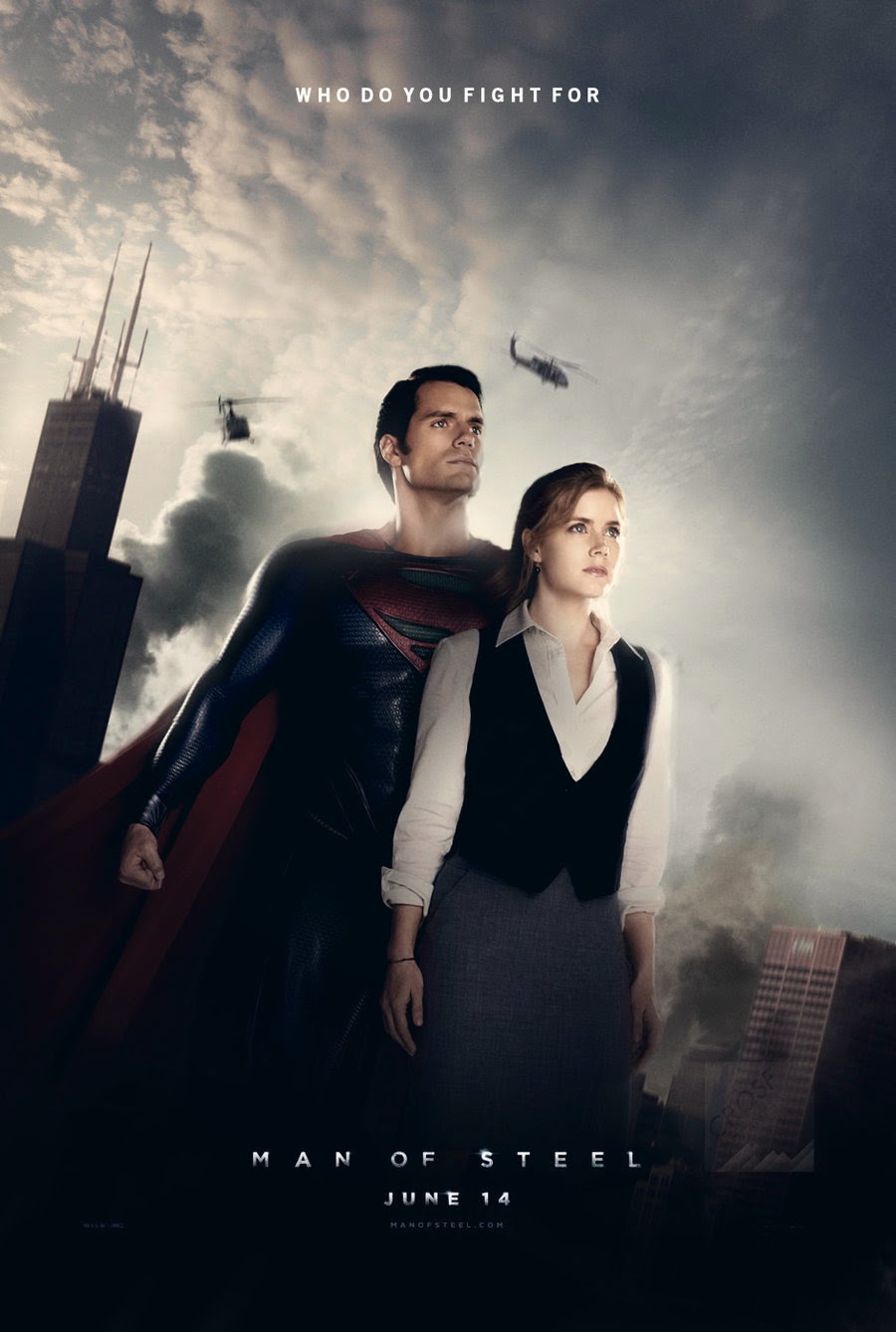
"Who do you Fight For?" is the tagline, but I'm kinda stumped. I guess if "the right to party" is taken, I suppose I'll take "self-actualization." Or at least, "to save the family dog so my dad doesn't die like a jackass." 

But even THAT might be forgivable if the movie had simply been more fun. I can take over-plotted nonsense, I can take ill-advised self-serious hokum, I can deal with gloopy melodrama, but you damn well better entertain me. And MOS spends surprisingly little time on that goal. As we all know, Snyder has a fabulous eye, and so several action sequences scattered throughout the film (mostly at the end) are at least striking, capturing some unmistakably potent images of this American icon. But despite his obvious visual prowess, Snyder doesn’t have a great grasp of rhythm or tone. His movies always look great, but they’re pitched at the same hysterical frequency all the way through; every scene is presented as the most intense scene ever, whether the content merits it or not. You’d think that would result in a more relentlessly gripping cinematic experience, but actually the opposite is the case: you simply burn out after awhile, everything looks expensive but nothing comes off as very thrilling. I’ll admit, by the time it gets to the world-wrecking chaos of the finale, the sheer scale of the spectacle does generate some mild interest, but honestly even that has a curiously unfocused mechanic (at one point, Supes has to defeat a giant robot octopus by flying at it really hard) and after 2 hours of tedium, it’s just not enough to turn the tide. Smash all the buildings you want, but until you can actually make me care about what’s happening, it’s just gonna be special effects.


I mean, it’s weird, there’s lots of stuff that sounds fun on paper. Russell Crowe commutes home on an alien dragon, then returns from beyond the grave as a computer face in pin art. Michael Shannon mega-acts till he gets a nosebleed. Supes breaks the sound barrier, shoots eye-beams at people, fights superpowered aliens in rockin’ robot spacesuits. There’s that giant robot octopus, a fortress of solitude, superman saving helicopters, fighter jets, and destroying virtually every kind of four-walled structure mankind has yet devised. But I dunno, it just never overcomes its sense of grim lugubriousness enough to have any of this stuff read as fun. I think that’s what the nerds complaining online that Superman doesn’t save enough people are ultimately mad about; everything here just seems so serious that you can’t just brush off the wholesale destruction of a major American city the way you’d be able to in a movie with a sillier, lighter tone like THE AVENGERS. Snyder wants us to see the tragedy of Superman’s life; he feels guilty if he uses his powers because Pa didn’t want him to, but also feels guilty about not using them when he has the power to save people. He feels alienated from humans because he’s so much better at everything than them, but also alienated from the Kryptonians because they’re such assholes. Sad, sad Superman. But he’s the star here, and if he’s sad, we’re gonna be, too. How can we enjoy all the destruction when Snyder’s busy stuffing down our throats how emotionally traumatic all of this is? Especially when the trauma is too rote and ill-defined to have much impact either?

Michael Shannon reacts to the MoS dailies.

So what we’re left with is a bloated, pretentious, somber slog, far too dismal to have fun with but far too ludicrous to take seriously as an epic tragedy. It’s stuffed with characters who mostly have nothing to do, but somehow seems to never get around to focusing on the characters who do have something to do. It’s clearly expensive and sumptuously filmed and jam-packed with aliens and spaceships and stuff, but somehow never seems to produce any images which inspire genuine awe. It has lots of action but virtually no genuine excitement, and in fact is so mopey that when the spectacle does get truly grand-scale, all you can think about is the immense human suffering it’s going to engender. What does that leave you with?


Nothing. I mean, really, just nothing. It leaves you with a 143 minute hole, which cost 225 million dollars to make. Why this was done, I do not know; all I can say is that it should not have been done. This is fucking SUPERMAN, for cryin’ out loud! How do you not turn that into a big, rousing, crowdpleasing empowerment fantasy? The overthinking that went into bungling this is the only legitimately epic thing about the whole sorry affair.


Anyway, I don’t really care, it’s just a loud, long, crappy movie, its not like it’s worth getting mad and writing 3600 words about or anything, though now that I have I feel confident that the matter is now settled and we'll never have to talk about it again. We’ve had plenty of Superman movies before this, and we’ll have plenty after, some good, some terrible, most kinda stilly and stupid but affable enough that we kind of remember them fondly later. And I don’t really give a fuck about Superman anyway, so what the heck do I care? But listen DC, you better learn from this experience. If you fuck up your inevitable STEEL remake, both Shaq and I are pulling out the pitchforks.


*I hope not, because that would be unfaithful to the beloved Clifford the Dog character at least as far as I am aware.


**Cavill is so terrible in that one that his bad acting is noteworthy even in the 8th Hellraiser sequel, four movies into their direct-to-video period. He’s fine in this one, though, as far as it goes; he looks the part and manages to not look ridiculous in flight.


***Dad’s noble sacrifice of his own life to save the family dog is the most hilarious dog-related melodrama since Christian Bale decides to bring down society instead of murder a puppy in EQUILIBRIUM, and I appreciate that. But I have some questions about Pa Kent’s logic here. “Son, you can’t go save that dog or everyone will think you’re an alien.” Makes perfect sense obviously, except then he goes and tries to do exactly that and yet no one seems to think he’s an alien, for whatever weird reason. Maybe he just means “Son, you can’t go save that dog and survive or everyone will think you’re an alien,” but if that’s the case, he’s basically intentionally planning to die for a dog too stupid to get out of the way of a tornado OR come when called.

***By the way, let’s take a moment to consider the Kryptonian justice system. “Zod! For you horrifying crimes, I sentence you to be placed on the last ship to leave our crumbling planet, to spend hundreds of years in cryo-sleep, resting comfortably and unaware of time passing, to awake refreshed some day in the future with a ship and all of your underlings immediately at your disposal. Meanwhile, we’ll all die.” Yeah, tough but fair. This is what you get putting Democrats in charge of a dying planet.