Monday, September 26, 2011

Album Review: Warren Zevon - "Transverse City"


 Warren Zevon
"Transverse City" (1989)


So recently when I reviewed FEAR NO EVIL I offhandedly called “Transverse City” Zevon's worst album. It's a backhanded insult, since all Zevon albums are worthwhile, but this one is generally acknowledged to be among his most ineffective (and it was a big expensive commercial flop which pretty much ended his career as a mainstream pop musician). In the comments, longtime friend of the show Dan Prestwich actually contacted me while on his honeymoon to tell me that, “... for what it's worth, I dig TRANSVERSE CITY and think it's seriously underrated.” Well, if he could take a break to defend the album while traveling the world with his lovely new wife, I figured I could sober up long enough to at least give the thing a chance to defend itself.

After an extended, painful hangover followed by a good, serious listen, I came to the conclusion that I do think Transverse City is underrated, but its still one of my least-favorite Zevon albums. I don't mind the big-studio bloat (the synths do sound a bit dated; still they're not as overbearing as some of his contemporaries) but I think the big production necessitated a little too much studio exactness from Zevon. His songs are so consummately constructed anyway that they tend to sound a little dry when he's so focused on studio-ready professionalism. But that can be ok when he's in a rollicking mood; his personality alone is big enough to propel most middling studio productions into a party, and his brilliant songwriting does the rest. Here, he's unusually dour and staid, which –combined with the overbearing production-- makes the album as a whole feel like a slog.

Worst album? I dunno. It's certainly his most dismal album, though. Zevon has always had a dark side virtually no other American songwriter could even approach, but his signature move has always been to camouflage the macabre and malevolent horror stories in his lyrics in mordant humor and a gleeful sense of wicked fun. "Excitable Boy" --off his record of the same name-- has to be about as disturbing a tale as has ever been told in American pop music, but it's also a wild party of rockabilly horns and sugary background singers. Zevon has frequently worn his heart on his sleeve as well, but when it come to the rough stuff his MO is usually to dress it up so it slips past our defenses a little easier.

Not here. While he stays away from murder and mayhem this time, "Run Straight Down" and "They Moved the Moon" are easily among the bleakest and darkest songs in his whole canon, and they're done without even a hint of gallows humor. "Run Straight Down" is as grim as they come, a ponderous, almost lethargic ode to despair featuring anxiously swirling synths and a David Gilmour guitar solo. "Went walking in the wasted city/ started thinking about entropy" Zevon sings over a maelstrom of keyboards and growling guitars. The song begins with a chanted chemical formula which manages to be utterly menacing and evocative even if you don't understand what it means, and gets creepier and more alien from there. "They Moved The Moon" is even more desolate, a glacial, disorienting haze of abstract paranoia and crushing loneliness (featuring --of all people-- Jerry Garcia on guitar, conjuring a pensive flurry of sharp, angular guitar picking.)

It's not all quite so grim, but the heavy stuff seems to be where Zevon's focus is this time. More fun (and more typically Zevon) fare, like the call-and-response "Long Arm of the Law" and the bouncy Cold-War shaggy dog tale "Turbulence" feel a little under-baked. Zevon has made his name telling intriguing tales with the vaguest suggestion in his minimal (but highly literate) lyrics, but most of the mid-tempo stuff feels slight even for him, coasting on endlessly repeated choruses and big-studio bloat (“Long Arm” could probably stand to lose a whole minute and a half of filler). The only one which really fires on all cylinders is the classic "Splendid Isolation," a erudite and hilarious ode to an agoraphobic misanthrope. Witty rants like "Networking" (co-written by FEAR NO EVIL star Stefan Arngrim as part of his generalized quest to be the pimpest motherfucker ever) "Gridlock" and "Down at the Mall" are pleasant enough but dispensable. "Nobody's in Love This Year" finds Zevon in the lone pocket of heart-on-his-sleeve warmth, but isn't quite a strong enough song to provide the needed balance to the rest of the album's despair and cynicism; instead, it feels like a jarring tonal change which doesn't hit hard enough to get the album moving in a different direction or linger long enough to draw us into its world.

A big part of the problem, of course, is the album's unfortunate 80's studio production. This was Zevon's attempt at a big-budget studio album and its meticulous production is at best ponderous and at worst painfully dated. The more you listen to the album the easier it is to roll with it, but the layers of synths and endless parade of unnecessary guest stars mostly serve to make the songs feel stilted and unwieldy. Occasionally it works out in the song's favor, as with the busy hubbub of overlapping effects on the title track (also co-written by Arngrim) which neatly mirror the song's densely layered description of frenzied modern life; more frequently, though, it just serves to make tracks like "Gridlock" feel turgid and to kill the spontaneity that might make them seem more fun.

It may not help that even though the album is certainly among Zevon's most expensive studio efforts, his backing band (though sturdily professional) feels a little bland. Little Feat drummer Richie Hayward brings little of that band's funkiness to this rhythm work here, instead opting for a more technical drum-machine approach while the appropriately named bassist Bob Glaub globs thick stabs of bass onto his tracks, weighing them down when they ought to be dancing.The reliable Waddy Wachel shows up on only a handful of tracks (alas, mostly the less memorable ones) and while he has the most innate understanding of how to play Zevon's material his usually strident style sounds a bit restrained here, as if he's trying not to show up his colleagues' lack of enthusiasm. The guest stars do fine, but can't do a lot to save tracks which are fundamentally weighed down. It's interesting to hear the likes of David Gilmour and Jerry Garcia try their hand at Zevon songs, but only Neil Young really heightens the material. His belligerently rough guitar lead brings the otherwise unexceptional "Gridlock" briefly to life, and seems to goad Zevon into letting himself loose a little on the vocals as he drops the studio magic and gives in to the sweet embrace of the unhinged yelp.

The album could have used a little more like that. It's probably his darkest album so he rarely sounds like he's having much fun or feeling much spontaneity -- fine for the material, but then the weight of the production also kind of blunts the desolate despair in his vocals. Zevon's voice is such a rich and powerful tool that dressing it up in effects and mammoth production merely encumbers the deft way he can mine a single syllable and caustic phrase for pathos. There's plenty of possible quibbles with the album's production, but the biggest problem is that there just isn't quite enough Warren in there. The clamor of the studio musicians squeezes him out on one side, while he's under asserting himself vocally and lyrically on the other. A bonus track of Zevon performing “Networking” solo --with a simple acoustic guitar and harmonica-- reveal that even a Benmont Tench organ solo can't rival the complex alchemy of pathos and hilarity of the man himself.

But the real issue may be that it's not entirely Zevon's own instinct guiding things. The whole album is his take on the works of cyberpunk author William Gibson, whose grim futurism (while admittedly prescient) doesn't really seem to bring out the best in the interpreting artist. Zevon is caustic, cynical, macabre... but I don't buy that he's as fatalistic as the lyrics here would have you believe. While the gloom is faithful to Gibson's work, I doubt Zevon is quite as horrified by the idea of a world of globally interconnected robot zombies as Gibson is; in fact, I imagine he'd find that pretty cool in a mordantly funny kind of way. Hence, the songs can feel like a respectful interpretation of the sci-fi author's concerns rather than a full-on assault of Zevon's own indelible personality. It's true that the lyrics are neigh-on prophetic (who else was singing about uploading and downloading in 1989? But its so spot-on for today's world that it seems almost laughably obvious). Gibson's work is fascinating and holds up remarkably well, which is undoubtedly what caught Zevon's interest – but despite his obvious respect, Zevon just isn't the artist best suited to approach Gibson's work and it dilutes a lot of the things which make his own work so potent and original.

                                        Soon to be a film by Joseph "TORQUE" Khan. Seriously.

The album's not a wash by any means; actually, its just good enough to frustrate you that it's not better. But despite its flaws, Zevon's dependably brilliant songwriting and eccentricities are fully evident, and the album delivers plenty of pleasure. It's just as well he didn't do any more albums like this, but there's enough of interest here to make anyone with any sense glad he did this one. We're pretty much already living in the dystopian future hinted at by “Transverse City,” but as long as we have Zevon's discography there's always the possibility of a pretty wild post-apocalypse afterparty.

And Stefan Arngrim, if you're listening, keep on rockin.

Sunday, September 11, 2011

Fear No Evil

Fear No Evil (1986)
Dir. Frank LaLoggia
Starring Stefan Arngrim, Elizabeth Hoffman, Kathleen Rowe McAllen


     Frank LaLoggia is one of those odd directors who directed one movie interesting enough to take seriously, but never built up a big enough filmography to make a name for himself. His 1988 film LADY IN WHITE is somewhat flawed (its melodrama a tad overwrought, its performances uneven, its score overbearing) but also manages to be a unique and somewhat classy affair, unique to its time for its deliberate pace, classic storytelling, and emphasis on atmosphere over shock. I was curious to see if his debut film, 1986’s FEAR NO EVIL, would confirm that he was a worthwhile director who never got the chance to blow people away or if LADY was a fluke success.

      The answer --as is often the case with this movie-- is unclear. FEAR NO EVIL is a worse film than LADY, and lacks most of the things I liked about the later film (slow pace, classic style, atmosphere). This one is closer to a teen horror film than a classy ghost story, but its still packed with unusual touches and interesting ideas which give it a distinct personality.

      The story is this: Many years ago, the Devil was reincarnated and, at adolescence, prepared to bring about the apocalypse. He was stopped (via impalement) by this old Irish priest, who himself was apparently an arch angel in human form (didn’t get that from the movie, but I’ll trust the IMDB description, I guess. I was pretty drunk.) Now, it’s the 80s and Satan is back in human form again and under the guise of a 20something high school kid, he's moving closer to his dark purpose. Opposing him are the sister of that priest from before and also one of his high school classmates, a young lady tragically born without any personality whatsoever.

      This has all the clichés you’d expect from an 80s high school horror film, including the feathered-hair hot ride-stealing bully, the obligatory boiler room teen sexcapades, the inevitable locker room humiliations, the conspicuously hip punk soundtrack. But it also has a lot of stuff which is pretty much unique to this one, including a series of surprisingly overt escalating homoerotic scenes, a bunch of religious hand-wringing, an enormous crumbling castle location on a lake in New York, a death via dodgeball, a high school jock suddenly sprouting boobs, a severe case of man-bites dog, a crucifixion. So that much sets it apart from “Welcome Back Kotter” in my opinion (though to be fair I haven't seen every episode, its possible they got a crucifixion one in there).

      What makes this one kind of interesting is that despite all the worn 80s high school tropes on display, the film is surprisingly ambiguous. Everything is so familiar that you feel like you know where this is going, but the film craftily (or perhaps obtusely) confounds your expectations and does something weird instead. By the halfway point, you realize you have no idea where all this is headed, or even what kind of movie this is. Is it a campy gore-fest, as the film's memorable death-by dodgeball scene would have you believe? Is it a religious anxiety film soaked with atmospheric dread, as its OMEN-esque opening suggests? Is it a weird high school drama with some supernatural elements, as its long middle sequence seems to believe? The answer --as is often the case with this movie-- is unclear. It seems to be kind of its own thing, but then again its all sown together from the parts of more familiar things. It's a Frankenstein's monster kind of movie and I genuinely cannot say with any confidence if that reflects ambition or incompetence on the part of the filmmaker. It doesn't seem like anyone on set is aware of what a weird film they're making, but then there is is, boldly letting it all hang out (like a good portion of the male cast ends up doing by the film's end).

        Say what you want about the antichrist, but he knows how to rock some fab sideburns.

      The female lead is so milquetoast that I didn't even realize she was the protagonist until finally there just wasn't anyone else. But Stefan Arngrim*, who plays young Satan (now going by the name Andy Williams**) does a great job, and plays a key role in keeping the proceedings off-kilter and interesting. He plays Andy as an intelligent, somewhat effete (if not outright gay) loner, but manages to make him seem more sympathetic than menacing. We hear from his alcoholic, abusive, murderous father that he's “a manipulator” and “the devil's spawn,” but the father seems like a way worse guy himself and so we're not inclined to take him seriously. Are we being manipulated by him, or is just a poor misunderstood kid who doesn't know what he's doing any more than any other high schooler does?

      It gets even more confusing as we begin to see him manifest his powers. In one scene, a bunch of bullies (all fully naked) start abusing him (also totally naked) in the gym shower, and one, to demonstrate just how gay this weird kid is, grabs him and kisses him full-on the mouth (you know, like high school bullies always do?). Things get weird fast though and they end up getting kind of stuck together at the mouth as Andrew pulls some kind of supernatural soul-sucking business on him. When it ends, the bullies run for it, but the interesting thing is that Andrew looks even more traumatized than they do, slumping down in the shower and looking drained and upset. But the next thing you know, he's killing a dog with an ax and drinking its blood. So, what, is he starting to get all Antichrist-y and doesn't know what's happening to him, or is he just a weirdo sensitive Satan who gets tired after some strictly platonic male-on-male nude shower open-mouth kissing? The answer --as is often the case with this move-- is unclear. But the ambiguity makes it more interesting.

      Overall, the film is a little too uneven to really recommend, but it has a few sequences which genuinely work up some grotesque dread, and even more that are memorably crazy if not entirely successful. Like its central antagonist, it can be hard to tell what it's really trying to do, and even when it seems to know it's not always great at pulling it off. But its still pretty interesting to watch something this weird develop, even if you can't quite figure out what its going for. The mystery of whether or not LaLoggia is a director worth serious study remains unsolved, but I'd say this movie is a net gain for the world. 


*according to IMDB, Arngrim is a musician who co-wrote many of the songs on Warren Zevon's arguable worst album, “Transverse City” (wikipedia credits him with only two, the title track and “Networking,” but those are both pretty decent songs so we'll give him a pass). 

**Yes, Andy Williams. His father is John Williams. I have a hard time believing that they didn't realize the hilariousness of those names, but if it means anything I sure as hell have no idea what it might be.

Friday, September 2, 2011

Kick-Ass

Kick-Ass (2010)
Dir. Matthew Vaughn
Written by Jane Golman, Matthew Vaughn
Starring Aaron Johnson, Christopher Mintz-Plasse, Chloe Mortez, Nicholas Cage


So I took another look at this one, wondering if having seen it in the midst of its initial run I was being reactionary in finding it an unpleasant experience. Nerds at large fell hard for this one, finally getting their long-coveted “hard R” superhero movie and feeling very grown up about themselves. The critics, too, mostly praised its kinetic pace and lightly postmodern take on the subject (this was back in the days before postmodern “What if a real person became a superhero?” films actually outnumbered legit superhero films [2018 edit: well, that was fun while it lasted]). But I thought it was a kind of nasty, stupid, ugly little thing just barely concealed in a sugary coat of glossy Hollywood professionalism. Most of the people who seemed to share my point of view were the typical family values censorial puritans [2018 edit: yes, there was a time when evangelicals actually purported to care about values]. But both Roger Ebert and Outlaw Vern agreed with me, which is pretty good company to be in if you’re going to be defending an unpopular opinion. Still, I wondered if I would learn to love this one like all my peers did if I took a little time away from it and returned knowing what was in store.

Nope. Turns out I was right the first time, this thing is a craftily concealed little pill of pure hate dressed up in fun action tropes. I guess I might have known that considering it came from the comic by Mark Millar, who wrote the indefensibly vile WANTED. I consider him to be perhaps the reigning auteurial voice of impotent white beta-male rage, and WANTED is a very nearly impeccable manifesto of school-shooter logic, the kind of movie where the moral of the story can be almost any kind of loony abstraction ("you should never disobey the orders of a magic loom that tells you to kill") as long as the disempowered young white men at its center are given the basic license to achieve erection self-actualization through murderous violence. But the weird thing is, I’m not sure Millar is at fault here, at least not entirely. I’ve never read his comic, but the film seems to me to be shockingly unaware –willfully, even—of what the story it's telling is actually about. If it's an even moderately faithful adaptation, I have to assume that the point its author was trying to make is the exact opposite point the movie seems to posit. Or, I guess the two could both be equally deluded, but for that to be so would require such a titanic failure of self-awareness as to cause the mind to balk.

Here’s the thing: KICK-ASS is about a bunch of bitter, deluded, pathetic, hate-fueled losers who feel better about themselves only when they successfully commit acts of violence against other people. No one here even pretends to have humanitarian motives – they do what they do because it’s a nice confidence booster, to be able to beat people up or murder them and get away with it makes them feel special. And because they’re fighting crime, it’s all nice and morally justified and they can spout some platitudes about justice or whatever and not have to ask uncomfortable questions about why they're so angry and empty inside. That's the entire plot of the movie, more or less.

This would be a reasonably interesting take on the Superhero trope, had they chosen to actually develop this subtext (which admittedly was already better explored in the WATCHMEN movie, and already much, much better explored in the Watchmen comics waaaay back in the 80s). Not exactly a hot take, but certainly a valid point; the entire concept of the Superhero, for all its posing about responsibility and justice and Law and Order, is nothing but a juvenile power fantasy, barely dressed up in the rags of Campbellian hero's journey mythos. Obvious, perhaps, but always worth a reminder, especially for the kind of nerds who would take this movie seriously. The terrifying thing about KICK-ASS THE MOVIE, though, is that instead of exploring what seems like the most obvious thing to draw out of the story --these people are toxic, egomaniacal monsters fueling their boundless sense of worthlessness with comically sophomoric violent posturing-- it’s totally on these guys’ side. It really thinks they’re fucking awesome, and the more violent they get the more awesome it thinks they are.

Which is, I think, what makes it such an unsettling experience to me. It's the kind of film which plays into all the worst tendencies of nerd culture – validating their misogyny, their secret feelings of superiority, their bitter, simmering rage. This is the movie where the geeks are right, girls really do only like jerks. Nice guys might as well be gay to them (and I don't mean that figuratively -- that is literally a subplot here). But if you become a successful enough bully, the girl who previously ignored you can hardly wait to fuck you in an ally (again, no exaggeration. Literally depicted). The subtext is about empowerment, validation, and popularity through violence, and there's no other way to see it. The movie even makes explicit this point. Kick-Ass is a selfish, whiny little prick who's ready to retire after committing one “heroic” act and feeling better about himself. But he has one thing to do first: go tell his crush that he's a hero so she'll fuck him. “What's the difference between Peter Parker and Spider Man?” Kick-Ass sneers, “Spider Man gets the girl.”

Is that really the difference, though? Since you brought it up, KICK-ASS, let's actually talk about Spider-Man a little bit. Peter Parker isn't like Batman, he's not living a faux life as cover for his superheroing. He's actually living a real life, trying to balance his superhero moonlighting with his responsibilities to his family and loved ones, all while grinding by in a low-paying, unflashy working-class job. He's got plenty to complain about, but instead he's sweet and upbeat, heroically taking abuse from people who think he's irresponsible and unreliable due to his anonymous webslinging. He could easily tell everyone that he's Spider-Man and probably do a lot better for himself, but he doesn't.* That's not what it's about. Besides, it's not like Spidey is thorax-deep in women, either. Sure, Black Cat is a babe, but it's Peter Parker, not Spidey, who ends up finding long-term happiness with the likes Mary Jane and (briefly) Gwen Stacy. Not because he's a hero, but because he's a good guy and an unselfish friend. He doesn't get the girl because she thinks it's hot that he beats up baddies -- he gets her in spite of feeling obligated to put his own life second in order to make the world safer. Spider-Man is Peter's burden, not his fantasy. He lives a double-life as Spider-Man because he's cursed with abilities which make him uniquely suited to helping the world.

At the end of KICK-ASS, the title character mocks the classic Spider-Man ethos by musing (in his incessant, self-satisfied narration), that, “With no power comes no responsibility,” and it's supposed to count as character growth that he goes ahead and kills a few people even though he didn't technically have to and probably won't even be substantially rewarded for it. That line should tell you everything you need to know about KICK-ASS's horrifyingly self-serving philosophy, but it also demonstrates perfectly just how little he actually took from the comic books he's constantly prattling on about and using as a smug cover for being a vicious little sociopath. I mean, do you really think Peter Parker would have just led a life of selfish instant gratification had he not been bitten by that radioactive/genetically altered spider? If Uncle Ben had been killed and Peter didn't have superpowers, would he just have shrugged it off and gone into middle management at an investment bank because, "with no power comes no responsibility?" Fuck no. He's in the game to help people, to make the world better. 

And that's something Kick-Ass --both the character and the movie-- just fundamentally misunderstand. For all its nonstop self-congratulatory meta-commentary, the film and its title character get the whole concept of the hero (super or otherwise!) fundamentally backwards, and, to all appearances, don't have the slightest awareness of that fact. KICK-ASS's idea of a hero is simply someone whose self-gratification generally lines up with brutalizing criminals. That's it. The idea that they're pursuing any kind of philosophy of justice, let alone making the world a better place, is paid only the most transparent and fleeting lip service, and mostly ignored entirely. Every so-called hero in the movie is in it for entirely (and explicitly!) selfish reasons, and the movie never for an instant seems to find this fact curious or noteworthy. In many cases, they make life considerably worse for other people. When Kick-Ass learns that an impersonator has been savagely murdered in his stead, it doesn't even occur to him to feel a twinge of remorse or regret for what he's started. He's just glad someone else got killed first so he has a heads-up to save his own ass.

Only one person in the film seems aware that they’re playing a sociopath, and that’s the reliably eccentric Nicholas Cage (PAY THE GHOST, THE FROZEN GROUND, DOG EAT DOG, MOM AND DAD, and also I believe he won an Academy Award at some point?) in one of his court-mandated five great performances per decade. He plays "Big Daddy," an emotionally stunted single father who forces his 11-year old daughter to become a vicious, remorseless assassin, a premise which the movie thinks is just so edgy it can barely contain itself about how daring and brave it is, and it doesn't like to use the word "hero," but you know, what else do you call someone --an artist, say-- with the balls to stand up to those Hillary Clinton PC thugs of the world who wanna tell you how to live your life man, fuck you Tipper Gore I don't conform to your delicate sensibilities, I'm an outlaw, I'm dangerous, baby, look at that, I put an 11-year old killing people with a sword in my movie and you're like, so outraged, GOD MOM WHY DO YOU ALWAYS RUIN MY STUFF? STAY OUT OF MY ROOM OK?! GOD.

As much as the movie wants you to think this guy’s awesome, though, Cage lets you know what a spaced-out psycho he is with his Ned Flanders mustache (he actually adds a fake handlebar to his real mustache 
when he dawns his crime-fighting persona, a touch of genius I must assume came from Cage), hilariously nutty gay southern drawl (he should have a talk show with Gary Oldman from THE FIFTH ELEMENT) and magnificent vacant-eyed uncomfortable earnestness. He immediately reads as someone who stands outside a bus terminal all day with a terrifyingly artificial smile, softly telling people they'll burn in hell for their mini-dresses and Beatle boots. He's good at killing, but he's a total, abject failure as a father and as a human being. The movie is totally on his side, and falls all over itself trying to convince you how badass he is, but Cage brilliantly undermines the effort by putting just a hint of overblown theatrical flair into his superhero persona. Cage knows how to look cool as a superhero type, but here he (intentionally, I truly believe) makes the character look like a kid playing in a Batman costume, subtly reminding you that this guy isn't so much a serious gritty hero as a big self-absorbed child who happens to own a lot of guns.

                  Nic Cage auditioning for BLACK SWAN 2: UGLY DUCKLING

Other than that, though, the movie is dead set on convincing you how awesome these guys are, and the scary thing is that it’s devilishly good at making the whole thing fun, funny, and kinetic. It’s a pretty good time, objectively, and I have to imagine Matthew Vaughn has a genuinely fun action comedy in him somewhere.** But this ain’t it. This is a serial killer film where we’re supposed to cheer for the killers and think they’re cool. It idolizes violence, makes a tacit (and occasionally even explicit) argument for violence as a necessary tool for self-actualization. Which gives the screen violence an unpleasant, pushy feel, like an aggressive drunk getting in your face about something you basically already agree about. Shit, man, I love movie violence! I didn’t watch every FRIDAY THE 13th just for the sex scenes. But this thing worships the violence so feverishly, and so steadfastly refuses to introspect about the obvious horror story playing out in its narrative that it's actually a turn-off. It manages to make a guy flying a jetpack shooting chain guns feel like a bummer. My god, there's a special place in hell for that.

If it had anything to say about anything at all, that might even be OK. With a film this short on ideas, though, it just feels uncomfortably close to trying to win friends by feeding into people's worst traits and validating their most selfish fantasies. If you let yourself get sucked into its nasty little fable about discovering how special you are by beating people up, I imagine it can be a kind of powerful, seductive fantasy. But watching from the outside is pretty horrifying. And as we've watched exactly the demographic this movie is courting metastasize from angry unfulfilled basement-lurkers into nihilistic, rape-threat-spewing crypto-fascists, it's gotten harder and harder to see it as harmless, irresponsible mayhem. Movies may not cause people to turn bad, but sometimes they reveal a lot about the kind of person who does. And sitting through KICK-ASS is an uncomfortably slick tour through the mind of a very unpleasant person indeed. Not my idea of a fun trip.

*2018 edit: Actually I guess he does go public about being Spider-Man sometime in the mid-2000s in a book written -- ha, of course it was-- by Mark Millar. Anyone know how that turned out?

** 2018 edit: turns out I liked X-MEN: FIRST CLASS, but was pretty mixed on KINGSMEN, which has a lot of the same problems as this one but watered down. I hear STARDUST is fun, though!

Tuesday, August 23, 2011

Raw Meat (C.H.U.L. double feature with 2005's "Creep"!)

Raw Meat aka Death Line(1972)
Dir. Gary Sherman
Starring Donald Pleasance, David Ladd, also Christopher Lee has one scene

                           This poster is entirely accurate except for all the things on it.

RAW MEAT is the second part of my C.H.U.L. (Cannibalistic Humanoid Underground Lads) double feature about Mutant Cannibals in the London Underground tunnel system. The first one, 2005’s CREEP, was competent but not particularly interesting and I can’t say I had particularly high hopes for this one other than the reliable pleasure of watching Donald Pleasance solve things.

Turns out I was wrong, though, this is a pretty good –if decidedly strange—entry into this subgenre. It’s a unique and surprisingly assured horror/thriller thing which takes an interesting idea and goes nowhere you’d expect with it.

Here’s the skinny: some sleazy rich prick with a bowler is carousing the strip clubs of the region and heads down into the subway to pick up/sexually assault a prostitute. Something goes wrong, though, and two college kids leaving the station find his unconscious body on the subway stairs. The boyfriend, a sardonic New York native played by noted Alan Ladd son David Ladd, thinks this is no big deal (“We step over these guys in New York!” He says, exasperated by his bleeding-heart girlfriend’s desire to get involved) but his cute British gal talks him into returning with the authorities. Thing is, though, when they get back the body’s gone.

When the sleazeball doesn’t show up the next day, it gets reported to Inspector Calhoun, a marvelous asshole gleefully portrayed by Pleasance. English is a second language to Calhoun; his native tongue is sarcasm, which in his mouth blooms into a breathless dance of impishly cutting poetry. He’s a working class schlub who gets no respect and affords none to anyone else, dragging the kids into his office and rather indelicately badgering them (for a crime we know they’re completely innocent of). Turns out old bowler was a big-shot wealthy MI5 guy, and suddenly people at the station start remembering, oh yeah, haven’t a bunch of people gone missing down there? Calhoun suspects it’s a government cover-up for some sort of shady secret agent business, but of course we know better. When a minor character offhandedly tells a story about a bunch of workers trapped in a closed station in the 1800s, and speculates that perhaps some of them could have survived by eating the flesh of their departed colleagues… well, we know where this is going.

The odd thing is, it doesn’t go anywhere for a long time. We follow the two college kids as they go about their life and wonder what the fuck that was all about (the gal inexplicably expresses her interest in purchasing a book on Poltergeists, which is an odd enough detail in itself but particularly odd since director Gary Sherman would one day go on to helm the pretty-good POLTERGEIST III), and meanwhile Calhoun is trying to investigate bowler-guy’s murder by following his connections to the seedier side of British High Society (which of course we know will be a dead end). At the dead man’s house, he encounters Christopher Lee as a fellow MI5er who may be the only man who can give Calhoun a run for his money in the withering caustic assholery department. Lee warns Calhoun off the case, tells him to drop it and not get involved where he doesn’t belong. In any other movie, this and the poltergeist thing would be red herrings, intended to throw you off the trail. But here, we’ve already seen the killer, we know where he lives and why he’s doing what he’s doing. Why is this stuff in here?

                                         He has no idea why he's here either.


So for the whole middle of the movie, we get three parallel threads: the college kids being a couple, Calhoun struggling to investigate something we know is wrong, and then the killer himself, whom we get to know rather intimately.

Seems that Mr. Raw Meat is the last survivor of generations of workers trapped in the abandoned underground station, where they have gradually succumbed to a lifestyle of nonverbal cannibalism. His wife, the last of his companions, has just died of a deforming disease which also afflicts him. Turns out he grabbed that bowler asshole in a futile effort to try and cure his wife with a little fresh blood. This whole scenario is revealed in the film’s masterstroke, a stunning, confidently patient long tracking shot which gradually explores the cannibal’s gristly meat storage room, and then the whole environment inside the abandoned station, past literal catacombs of previous generations of CHUCs, a collapsed tunnel with human skeletons buried in the rubble, down the long, creepy tunnels, and up to the crack in the sky where our killer has learned to venture into the outside world for fresh meat.

The shot easily lasts for an uninterrupted five minutes, and is completely silent save for the echoing drips of water which cast a fiendish anxiety over the proceedings. It’s a masterful bit of cinema which eloquently visually communicates to us everything we need to know about the scenario. The film doesn’t gets that good again, but most films never get that good, so who are we to complain?

The odd thing about this whole setup is that the murderous cannibal comes across quite sympathetically. We first meet him in his inarticulate emotional agony over the loss of his wife, and it’s hard not to empathize with him as the last lonely survivor of a tragedy which somehow dragged on nearly 200 years. It’s pretty easy to understand what he’s doing and why he doesn’t know any better.

Anyway, eventually all three story strands meet up in a predictable but rather classily constructed way. It builds some nice tension but also makes good use of the pathos its build for its antagonist. Nothing too stunning, admittedly, but a nicely orchestrated conclusion which gets a lot of mileage from the long setup (and especially the audience’s intimate knowledge of the layout of the cannibal’s lair).

And that's about all I would have thought about it, had I not happened to linger for a brief moment over the Netflix plot description (frequently my nemesis, as you may recall) which concludes with this sentence:

"a cult classic notable for its allegorical depth, atmospheric intensity -- and stomach-turning gore."

Allegorical depth? What the fuck are they.... oooohhhhh . . . dear god, they're right. I would never have thought about it, but the concept of these forgotten laborers trapped underground eating their own to eke by and drawing any attention from the authorities only when they affect some rich guy with connections has a lot to do with the class politics which are lurking just below the surface of the film.

If you remember your history or have watched the excellent Sex Pistols Doc THE FILTH AND THE FURY, you'll recall that England was an economic basket case during the 70s, a wasteland of prospectless malaise and cultural tensions. There's a reason Calhoun is such an asshole to everyone -- he, like most of his working class ilk, is just looking out for himself and trying to maintain a little dignity in the face of life's constant barrage of demeaning reminders of how bad off he is. Seen in this light, the otherwise inexplicable Christopher Lee scene is actually key to understanding what's going on here. The rich are part of a separate world, as distinct from Pleasance and the college kids as their own world is from our CHUC antagonist. No matter what he does, he'll never be part of that world (Lee smugly even refuses to let him investigate, happier to have it go unsolved than to have this cretin explore the separate life of the upper class). He can imitate them, even imagine himself to be a powerful man in his own little kingdom, but they're living in a world beyond his understanding and experience which he can only parrot -- the same way Mr. CHUC meaninglessly parrots a distorted version of the station platform instructions (his creepy phonetic rendering of “Mind the Doors!”).

There may be something, too, to the fact that Ladd’s character is an American not as sensitive to class distinctions as his British counterparts. He hardly even notices the fallen man at the beginning, but his girlfriend does. Not because they don’t have drunks in England, but –and this is my read of the subtext, mind you -- because this guy is obviously a social better who seems so horribly out of place passed out in a subway that it upsets her enormously. So while Calhoun is chasing his tail following all the wrong leads, only the American can actually cut through the bullshit, figure out what the fuck is going on and save the day. The detective, the cannibal, and the American are all figures who are venturing out of their usual environment and entering areas they can’t possibly fully understand – but the American lacks the baggage of hundreds of years of British class history (nicely symbolized by the cannibal’s 200-year exile from the surface) and as such is the only one who knows better than to get involved.

I should note that I was surprised by the quality of this picture, but I wouldn’t have been had I recognized the name of director Gary Sherman. RAW MEAT was apparently called the “Most Significant Debut of the Year” by the British Film Institute. His next film, nearly a decade later (1981), was the superb and equally unusual DEAD & BURIED. Looks like I’ll have to take a look at the rest of his filmography.

Creep (C.H.U.C. double feature with 1972's Raw Meat!)

Creep (2005)
Dir. Christopher Smith
Starring Franka Portente, Sean Harris, Vas Blackwood


This is the first in my two-film series about London Underground Mutant Cannibals, which I have affectionately dubbed C.H.U.C.s (Cannibalistic Humanoid Underground Chaps). This is a modern take on the classic subject of mutated cannibals who live in the London subway (“Underground”) tunnels, and was directed by Christopher Smith, who’s BLACK DEATH you may remember I recently enjoyed due to its interesting structure and concepts, despite its somewhat uneven execution.

CREEP is, I think, a better made film, but not well made enough to really justify the fact that it’s pretty generic in every regard. It’s your standard trapped-with-a-serial-killer scenario, this time set in the London Undergound which doesn’t seem nearly as creepy as the filmmakers seem to think it is. They have to fall all over themselves to think of reasons someone can’t simply get out (cell phones don’t work, door is locked, security guard refuses to help, pay phone doesn’t work, other guy only helps once it’s too late to do anything) but it still seems like an imminently survivable situation.

Here’s the story: Franka Portente (RUN LOLA RUN) is a German-accented Londoner who falls asleep inside a subway station and wakes up to find the place has closed (nobody checks the platform before they lock the door and leave for the night, apparently). But she’s far from alone; her rapey would-be paramour is down there too, as are two drug-addled homeless kids, a security guard, a stray sewer worker, and of course our titular creep. So it’s a regular after-hours party down there of potential victims, most of whom are dispatched in short order in fairly mundane ways (the Creep, despite appearing to just be a kind of skinny humanoid imbred, possesses super strength and --before we first lay eyes on him-- likes to do things like climb along the ceiling or underneath the subway cars and grab people, which I call bullshit on because once we see him it becomes unclear how he accomplished this feat).  

Portente does a nice job of seeming like an unusually resourceful, logical victim for this kind of scenario, but doesn’t add much to the proceedings aside from being basically competent. Which could be said for the whole film: pretty competent, but doesn’t add much. I just couldn’t get past the fact that every single scare in this film has been done somewhere else much better and frequently more imaginatively. It’s standard in almost every way, never really embarrassing itself but never giving itself much reason to stand out either. The film is more interested in jump scares and gore than it is in building atmosphere or paranoia, so it’s a bit more damning than you might assume that it doesn’t have much to add to the basic genre structure.   

There is one thing which is pretty cool, though, and that’s the implied backstory to our Creep (Sean Harris, looking like Gollum crossed with Mer-Man). As our heroes penetrate the abandoned catacombs beneath the city, they come across a secret, abandoned abortion clinic which houses evidence that seems to suggest that the Creep (who we find out is named Craig) was born there along with many other creepy deformed cannibal children. That raises a number of disturbing possibilities; was Craig’s deformity a result of an abortion gone wrong? Was the doctor secretly keeping babies he was supposed to be aborting for some kind of twisted experiments, or, even creepier, to sort of half-raise as his own family?

Things get even creepier when Craig drags a victim down there and straps her into the ol’ abortion chair. He proceeds to clumsily mimic the actions of a doctor, strapping on filthy bloodstained scrubs, mimicking washing his hands (with no running water), sighing theatrically. He’s watched this being done many, many times, but it’s a perverse parody of actual medicine, just as Craig is a perverse parody of a human. Creepy. Then he grabs a rusty saw and the film gets back to trying to shock you with gore. Meh.

Overall, not a bad effort but not really a good enough one to recommend it very strongly either. If subways creep you out, this might be your thing, otherwise there’s just not a whole lot of interest here.

Thursday, August 18, 2011

The Passion of the Christ

The Passion of the Christ (2004)
Dir. Mel Gibson
Starring Jim Caviezel, Maia Morgenstern, Monica Bellucci, Rosalinda Celentano


So OK, I’m a little late on jumping into the controversy about this one. Like a good liberal, when this first came out I acted all offended about the perceived ant-Semitism, but of course the truth was that this film is sort of scary to me. The very idea of this film is scary to us secular humanists; it’s bizarre and alien and hostile to our most basic sensibilities. We don’t like it admit it, but the hordes of true believers who buried this film in cash and wept and spoke in tongues and reaffirmed their faith to this little motion picture scare the bejeesus out of us. We don’t understand them and they can’t be reasoned with, and when they get fired up they can drastically alter the course of this country. Hollywood has no shortage of films filled with paranoia about Christian fanaticism, and that probably reflects my demographic pretty well. These unironically stone-serious religious films for a specifically religious audience are widely regarded by my people as weird outliers for a somewhat disturbed fringe demographic, probably the same way normal people look at stuff like CANNIBAL HOLOCAUST. So yeah, when the film came out I was intrigued but – I’m man enough to admit it— sort of scared of it, sort of disturbed by the way it was received and not quite interested enough in the content to overcome those hurdles and go out and watch it.

But then in 2006, APOCALYPTO came out and became one of my absolute favorite films of that year and reminded me that whatever else Mel Gibson is, he’s one of the best working directors out there. And guess what, everyone acted like that film was a Klan rally too, a ludicrous charge by any stretch of the imagination. If you think APOCALYPTO is racist enough to write strongly-worded scolding essays about, you better be burning every copy of BREAKFAST WITH TIFFANY you can lay your hands on, man.

Basically, the critics were reviewing the man, not the movie. I suppose I can understand that logic; I think its ultimately very difficult to create a work of real art without a particular vision, more or less necessitating we involve the artist in our consideration of the art. And it seems pretty well beyond debate that Gibson is a fairly intolerant fanatical nutter, which sort of makes you look at his work with that framework in mind. But come on, people, you gotta actually look at the work, too. Just because a racist made a movie doesn’t automatically make that movie racist. Yeah, it seems like Gibson is none too fond of the Jews, but portraying the high priests who pretty well form a lynch mob to kill Jesus a bit negatively seems fairly reasonable in the context of the story. Accusing the film of anti-Semitism or racism is an easy way to get out of really examining why it makes you uncomfortable. And besides, a great film is a great film. Insidious as BIRTH OF A NATION is, I don’t hear anyone dismissing its artistic merits simply because it’s a blatantly toxic, hateful sickening display of racist paranoia. OK, so Gibson isn’t exactly reinventing cinema the way Griffith did with that one, but he’s indisputably a master of the art form and his consummately crafted classic style is rare enough to seem almost experimental these days.

As the 581 preceding words indicate, then, this movie comes with a lot of baggage. But I was in it to watch one of my favorite directors do his thing, and was genuinely ready to be won over by it. Unfortunately it turns out that lost in the culture war rhetoric is the fact that the movie itself is easily Gibson’s weakest. Amusingly enough, though, I’m not sure its Gibson’s fault. For the greatest story ever told, I think this is about as well as you can tell it and it’s just not that great a story.  

Here’s the problem: this film has a lot of similar issues to another movie which I only liked when I wanted to love it recently: PIRANAH 3-D. It’s well-made, but the parts don’t add up to much. It’s well-acted, but none of the characters really does anything. It gets the tone right but never builds to anything. It has interesting events but not any real narrative. And it’s really fucking violent, with some great imaginative touches, but eventually fails to get much emotional mileage from that violence. Which is a problem in both cases, because violence is really the star of the show.

Seriously, I doubt I’m the only critic to notice this, but THE PASSION is basically a horror movie. It’s sort of a parade of the grotesque, in a dirty and dangerous world packed with demons and brutal sadistic senseless violence. And at the center of it is the guy you’re supposed to know is the best person who ever lived, intentionally taking the worst of what the world can throw at him. He’s doing it out of love, trying to absolve his fellow man of their suffering.

Or at least, that’s what Gibson says about it. Problem is, the film doesn’t really tell you much about Jesus, who he is, or what he’s doing. You gotta bring all that with you for the film to have any context at all. For a film from a guy who supposedly loves Jesus, we don’t really get to know him much in this thing. He’s on-screen a lot, but mostly all-but comatose-- first because he’s petulantly refusing to answer his captors, and later because he’s basically incapacitated by torture. We get tiny, tiny flashbacks of him before this point in his life, but most last less than a minute and don’t really tell us much about him, his philosophy, his personality, or his character arc. Caviezel does a fine job in the presumably easy role of making Jesus seem like a nice guy; in better times, his warm smile and open expressiveness do a lot to endear him to us (despite his inexplicable dark Jedi yellow eyes, like that evil kid in A CHRISTMAS STORY). But ultimately he’s kind of a cipher.

The biggest problem, really, is that Jesus is basically the main character, but he doesn’t really do anything. He’s an incredibly passive character. Now, I think the point is that Jesus is not actually passive, that he’s basically actively accepting his fate even though it’s hard, like Gandhi’s nonviolent resistance deal. Gandhi hated the term passive resistance because of course there’s nothing passive about it, it’s actively engaging in a nonviolent way. But Gibson doesn’t quite make Jesus active enough to pull that possibility off. The film breaks him down so much he’s pretty much helpless by minute 20, and spends the rest of the film simply enduring. The film opens with him having doubts, struggling to believe in himself enough to do what he knows he has to do. He makes the decision there to go for it, but that’s the last decision he seems to make throughout the film. His wordless refusal to save himself, even given a few chances to do so, don’t read as advancement in his character arc so much as glum resignation that he’s finished no matter what he does. So it just feels like stuff is happening to him.

Likewise, the few side characters don’t really develop in any interesting way. Peter starts off with a badass slow-mo action scene (?!) but quickly disappears after he gets his one scene of triple-denial. How does this affect this guy who was so certain of his faith that he lops off a guy’s ear and still tries to get into Jesus’ trial? We’ll never know, I guess it wasn’t important, and it doesn’t seem to mean much to Jesus, either. John (heavily hinted to be Jesus’ brother) is in almost every scene but I don’t think says a single word. Mary Jesus’ mother watches and cries, but the most she ever does is walk up to him one time and give him a hug. Mary Magdalene is basically a sidekick to the already inert older Mary, although she’s much more interesting to watch since she’s played by Monica Bellucci. Judas is clearly torn up about what he’s done but the film isn’t at all interested in what his motivations were, and seems only interested in giving him a suitably horrible death (it succeeds – the shot with his feet dangling in front of the desiccated donkey carcass is truly disturbing and admirably poetic). Even the film’s most interesting and charismatic character, Satan, does a pretty piss poor job of causing Jesus any trouble –(s)he (ooh, scary androgyny! Too bad David Bowie was too old to play this one) spends the whole movie watching impassively from the sidelines. The only character who really has any meaningful narrative conflict is poor Pontius Pilate (inexplicably the subject of great sympathy and compassion in the film) -- and his conflict is resolved by him deciding to do nothing! The only two characters that are really given anything to do are the two stations-of-the-cross cameos from Simon de Cyrene and Seraphia as two completely uninvolved bystanders who take a moment out of their apparently busy days to give Jesus a little assistance on his way to his death. Jesus is so out of it that Simon’s gradual turn from not wanting to get involved to basically carrying Jesus and his cross himself is arguably the most character development that happens in the whole movie. So of course as soon as they arrive Simon just walks away and is never referenced again.

I guess my point is that Gibson fairly faithfully follows the story told in the gospel, beat for beat. But it’s not all that interesting a story. Gibson leaves out most of the things which would give it emotional weight and instead focuses on the brutality, which in point of fact the actual bible doesn’t really emphasize. I fear that Gibson is probably so invested in the character and his mission already that he doesn’t understand that he needs to communicate those points in his actual film. The film is just a checklist of events which happen to Jesus at that particular point, and he’s counting on you to fill in the gaps with the lovey compassion stuff while he supplies the cruelty.

Jesus fucking CHRIST! How many red pens did they go through drawing this?
                      
And as a committed atheist, it just doesn’t work. Like most atheists, I’m extremely familiar with the Bible and hence knew every beat pretty thoroughly already. Gibson crafts compelling, sometimes beautiful scenes but offers very little in terms of enriching these events with details which might give them weight and meaning beyond a literal rendition of the text. If you know the text, you know the film already and it adds only a few colorful details to make it worth experiencing visually. The film is at its best when it throws in weird creepy details like the WTF Satan-and-scary-baby or the dead donkey at Judas’s death scene – that’s a take only someone as crazy as Gibson would see in the Bible and I like it because it gives the film a little more unique vision and reason to exist than most of its paint-by-numbers runtime. Gibson also taunts us with a few nicely done human moments in flashback (the scene where Jesus builds [invents?] the modern table is probably the best, as it capitalizes on Caviezel’s gentle, charming good humor) but these scenes are frustratingly brief and too few to amount to much more than the slightest of suggestions. Weirdly, Gibson actually seems to impose too little of himself into the thing and it ends up feeling surprisingly timid about offering its own vision, with the exception of its overwhelming focus on suffering. The brutality of the thing does make it Gibson’s own, but just isn’t all that interesting when it so blatantly upstages any kind of context. Jesus is getting beat up from almost minute one, and its ability to shock kind of plateaus at the excellent scourging scene and fades to a sort of dull monotonous drone by the end (which doesn’t help itself by being almost entirely slow motion). Ok dude we get it, sucks to be Jesus, is that really why you dragged us here and made all this fuss?  

This would have all worked much better had Gibson realized that Jesus’s sacrifice doesn’t mean much if we don’t get what’s at stake. Christians know already and they’re thinking about it all the time --and I know what they think-- but you gotta have it in the film for the thing to work. I love a good story, I don’t have to actually believe it to get hooked, but you gotta give me a narrative. I mean, I don’t believe that if the baby dies in WILLOW we’re really fucked in real life, so I’m not turned off by the Christian mythology either. But Gibson never really offers you his take on why Jesus’s death is important. What would it mean for mankind if Jesus punked out and escaped? What exactly does Satan fear if Jesus succeeds? Can we at least see Jesus doing his prophet thing a little bit, so even if we don’t have a good sense of the big picture we can at least feel bad that the world is losing this one nice dude? Instead of doing this, Gibson treats Jesus the same way Tarantino treats Hitler – as cinematic shorthand. Of course you’re against whatever Hitler’s doing, he’s fucking Hitler. Of course you’re on Jesus’s side, he’s fucking Jesus. Sadly, for people who aren’t really into Jesus the way Gibson is, this failure to establish him as a character with a clear goal kind of undermines the story’s potential power.

And ultimately, Jesus was more interesting than the bullied victim Gibson makes him here. One of my absolute favorite films of all time is JESUS CHIRST SUPERSTAR, which covers roughly the same time period as Gibson’s film (it starts just a few days earlier) but manages to find great richness and complexity in its characters, deftly examine the political and cultural landscape, find a clear and satisfying narrative, and mine more pathos from less violence. And it’s a gorddam musical which still finds time for a pink fringe jumpsuit. For all its earnestness and claims to historical accuracy* THE PASSION is simply a much shallower, less involving film. And also less funky, which of course hurts any film. Might have saved itself if they’d kept in the pink fringe.

Anyway, the thing banked some serious loaf and fish money for Gibson, which maybe it didn’t exactly deserve, but that’s OK. Even though this one is hobbled a bit by Gibson’s reverence for the source material and inability to see beyond his own perspective, it’s still a gorgeous and bold and crazy production that no one else on Earth right now would have made or even imagined. He may not be a great human being, but he’s a great director with an absolutely unique kind of insanity that consistently translates into fascinating films. He’s been working a little more steadily than usual lately as an actor-- which is fine because he’s a great actor too-- but I would rather he spend his autumnal years pulling a Coppola and making passion projects that only he really understands, like his long gestating PROTOCOLS OF THE ELDERS OF ZION big budget conspiracy thriller (just kidding. I hope.) Judging from this one, the guy has a truly great horror movie in him somewhere. Whatever he chooses to do, there’s more personality and class and transfixing bugnuts crazy in a single scene of his than in most of the studio films that came out this summer. Come on Mel, spend some of that PASSION money and let’s find out what else you’ve got on your mind!


*Priest: Well you should definitely see the Passion. It's a very important movie.
Huey: Couldn't see it, white Jesus.
Priest: Excuse me?
Huey: Come on man, it’s supposed to be all historically accurate, and they STILL have a white man playing Jesus? That's some old bullshit.

Tuesday, August 16, 2011

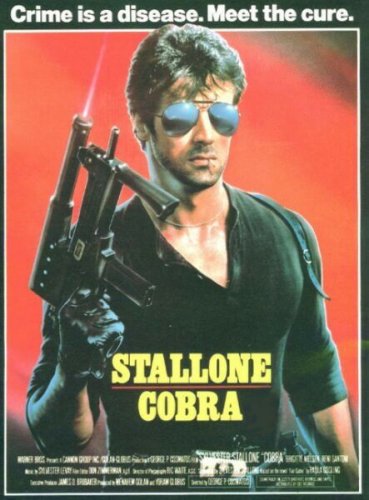
Cobra

Cobra (1986)
Dir. George P Cosmatos
Starring Sylvester Stallone, Brigitte Nielsen, Brian Thompson


A cute little ante up on the already ludicrous DIRTY HARRY films, this one takes the lone wolf action cop things to levels which could generously be described as parody. Stallone plays officer Marion “Cobra” Cobretti, the kind of guy who wears aviators inside. He’s the kind of guy who’s gonna find a way to have an explosion involved while stopping some punks from robbing a grocery store. Everyone on the force already knows not to even call him in on anything unless they’re prepared for a special effects show. He drives a muscle car. He owns his own machine guns. It’s pretty righteous.

Most things about this movie do not work very well, and it goes without saying that anything remotely interesting in the script or concept is laughably underdeveloped. The villain is Brian Thompson (the more cultured out there will remember his cartoonishly chiseled face as the Alien Bounty Hunter from The X-Files) who everyone knows is the nefarious serial killer the Night Stalker. What only Cobra suspects for no reason is that there isn’t just a single Night Stalker, he’s actually the head of a secret society of serial killers, who target poor defenseless model Bridgitte Nielsen as their next victim and will stop at nothing to kill her. Cobra’s superiors correctly point out that his theory makes no sense and has no evidence at all to support it, but they recognize that he’s pretty much the awesomest guy ever and agree that the poor defenseless model needs some security. Obviously that means Cobra is gonna get assigned to protect her, take her out to the countryside and have ten kinds of sex with her, possibly have to fight off hordes of armed maniacs on motorcycles, who knows, could be anything, you gotta be prepared for whatever in this line of work. This is all a modestly interesting idea but the script does absolutely nothing with it, barely even bothering to address why in God’s name these Night Stalker people are doing this, much less explaining it in any kind of satisfactory or intriguing way. Likewise, plot strands about Cobra’s difficulties with Internal Affairs and his romance with Nielsen are so perfunctory that they might as well just have had an intern hold the cue cards up right to the camera.

But the one thing that really matters in a movie like this ends up working just fine, and that’s Stallone’s enjoyable deadpan hyper-macho killing/sex machine. Believe it or not, apparently Stallone wrote this one as BEVERLY HILLS COP but left that project because he wanted to make a more serious action movie. Looking back, this is probably funnier. But the movie is so self-assured about how badass it is that you end up buying into it and ultimately it’s the most ludicrous parts which work the best. The script may waste its concept, characters, and themes, but at least it wastes no opportunities for big action set pieces. The finale finds Cobra combating dozens upon dozens of gun-toting generic thugs in a hotel, then a lemon grove, and finally in a steel plant. It’s pretty fun, and suitably oversized if a little generic. But weirdly, the one thing not oversized is the runtime -- the thing ends up feeling too short. At 87 minutes, there’s only time for three big action sequences and no time for anything to feel like its escalating. Still, if you’re a youngster trying to figure out what the deal is with all these larger-than-life lone-wolf cops which only appear in comedies now, this is a pretty good example of how close to parody the genre already was by 1986.

There are better George P. Cosmatos Golan/Globus productions (if you have to ask, you’re not ready to know the answer) but this is a fine mid-level one which at least won’t waste much of your time doing anything other than exploding. I think Officer Cobretti would appreciate that.